The 30-Second Exam Hall Shortcut: ⚡ Frog Respiratory Medium Switch
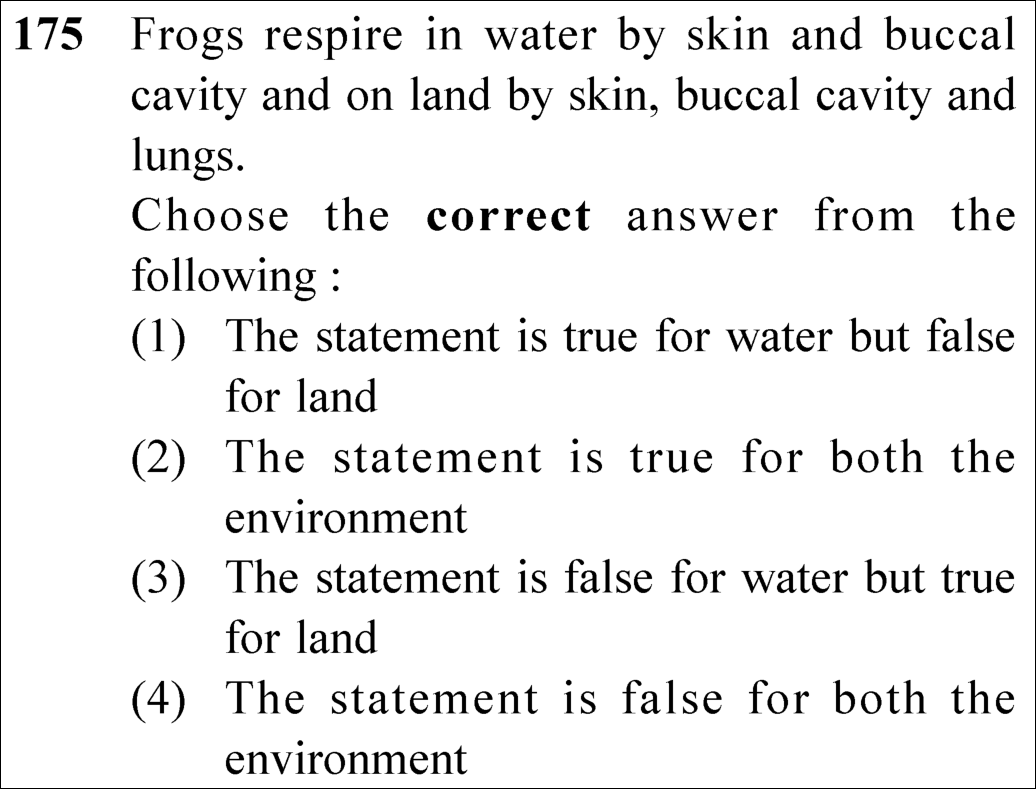
In water: SKIN only (cutaneous)! On land: Skin, Buccal cavity, and Lungs (pulmonary)!
Step-by-Step Rigorous Workflow & Mathematical Proof
Mechanisms of Respiration in Adult Frogs
Frogs exhibit three distinct modes of respiration depending on their environmental state: 1. Cutaneous Respiration: Gas exchange across the thin, moist, highly vascularized skin. This is the SOLE mode of respiration when the frog is submerged in water, as well as during winter sleep (hibernation) and summer sleep (aestivation). 2. Buccopharyngeal Respiration: Occurs on land when the mouth remains closed while the buccal floor moves up and down. 3. Pulmonary Respiration: Occurs on land using a pair of sac-like lungs.
- • Mucus glands keep the skin moist to facilitate diffusion of dissolved oxygen.
Evaluate Incorrect Options
1. Buccal cavity: Used only on land; cannot draw dissolved oxygen underwater. 2. Lungs: Frogs cannot breathe water into their lungs; lungs function exclusively in atmospheric air. 3. Trachea: Frogs lack a true trachea (they have a laryngotracheal chamber leading directly to lungs).
- • Option (1) is the only scientifically correct medium-specific organ.
Conclusion
In water, frogs respire using skin.
- • Matches Option (1).
360° Option Elimination Engine Key Feature
Diagnose every choice: Know exactly why the right option works and why distractors fail.
Exact match with NCERT Frog morphology: Cutaneous respiration via skin is the exclusive aquatic respiratory mechanism.
Incorrect. Buccal respiration occurs only on land in atmospheric air.
Incorrect. Lungs are used for pulmonary respiration on land, never underwater.
Incorrect. Frogs do not possess a trachea (tracheae are insect respiratory organs).
NTA Trap Alert: Confusing Land Respiration with Aquatic Respiration
On land, frogs use Skin + Buccal Cavity + Lungs. In water, frogs use ONLY their skin (Cutaneous respiration).
Core NEET Syllabus Standard
"In water, dissolved oxygen is exchanged across the moist skin by simple diffusion."