MyCompetitiveExams Logo MyCompetitiveExams
Search 1,140+ Questions
Chapters, formulas, speed tricks
→
⚡ Brahmastra NEET 2027
720 MARKS

Dynamic 180-question full-length simulator mixed dynamically from all 6 years for 2027 & 2026 aspirants.

Launch Brahmastra 2027 Test →
Start Practice →
100% Free · No Login Required
Q.176 Zoology ⭐ 360° Option Elimination Active
Vault ↗

NEET 2023 Zoology Question 176 Solution

Topic: Structural Organisation in Animals · Official NTA Booklet Code G5
NEET 2023 Zoology Question 176: Classification of Connective Tissues: Dense Regular vs. Specialized Tissues

Question

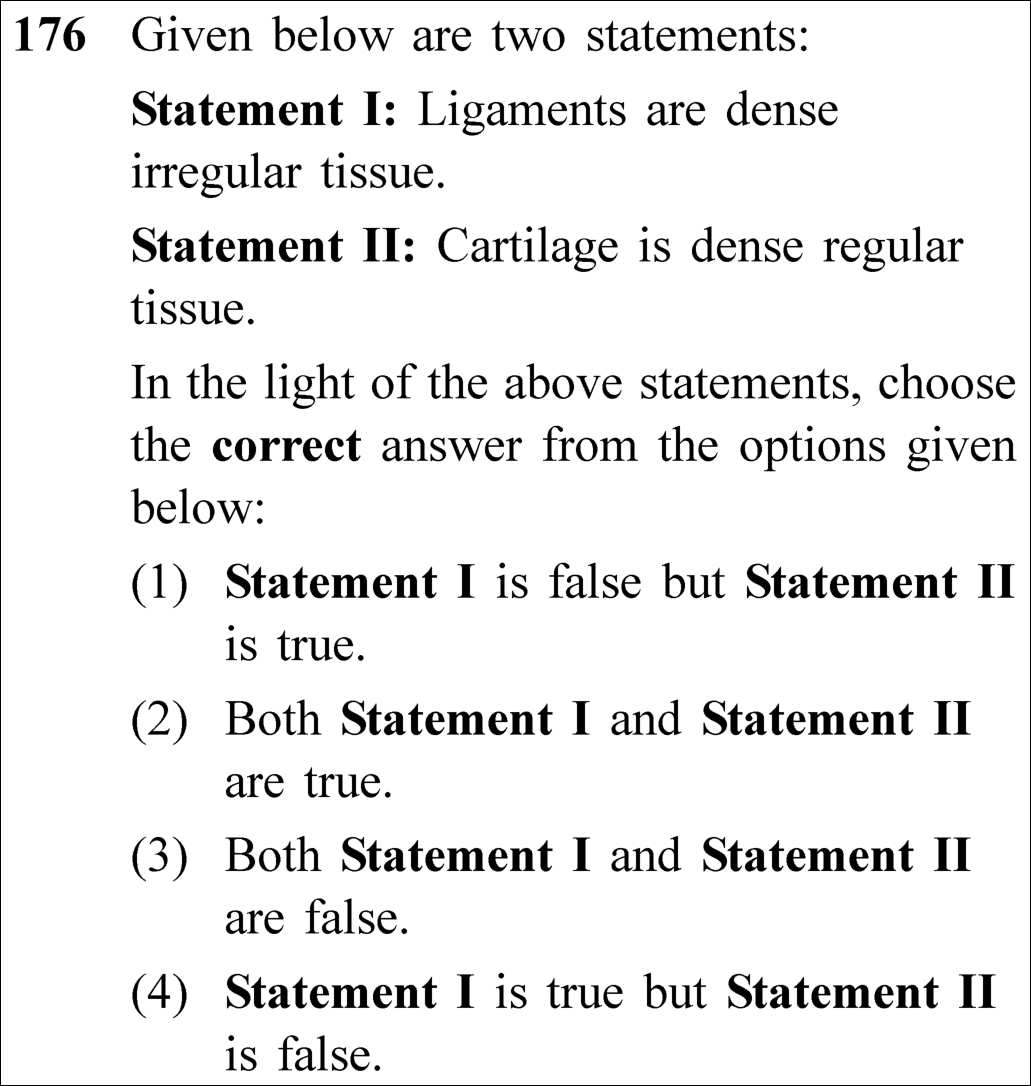
Given below are two statements: Statement I: Ligaments are dense irregular tissue. Statement II: Cartilage is dense regular tissue. In the light of the above statements, choose the correct answer from the options given below:

  1. (1)Statement I is false but Statement II is true.
  2. (2)Both Statement I and Statement II are true.
  3. (3)Both Statement I and Statement II are false.
  4. (4)Statement I is true but Statement II is false.
✓
Verified Against NTA Final Answer Key
Option (3) : Both Statement I and Statement II are false.
📚 Structural Organisation in Animals Medium
📋 Given Parameters & Problem Setup
Statement I Ligaments are dense irregular tissue.
Statement II Cartilage is dense regular tissue.
⚡

The 30-Second Exam Hall Shortcut: ⚡ Connective Tissue Cross-Error: Both are FALSE!

⏱️ Save ~25 seconds

Ligaments and tendons are DENSE REGULAR connective tissue (parallel collagen rows, not irregular!). Cartilage, bone, and blood are SPECIALIZED connective tissues (not dense regular!). Both statements are completely false! Select Option (3)!

1 Dense regular connective tissue: Tendons (muscle to bone) and Ligaments (bone to bone). Statement I calls ligaments dense irregular -> False.
2 Dense irregular connective tissue: Present in skin dermis.
3 Specialized connective tissue: Cartilage, bone, and blood. Statement II calls cartilage dense regular -> False.
4 Both Statement I and Statement II are false.
5 Match Option (3).
🛡️
Why You Can 100% Trust This Shortcut: Canonical NCERT Animal Tissues connective tissue classification matrix.
📐

Step-by-Step Rigorous Workflow & Mathematical Proof

Step 1

Taxonomy of Connective Tissues in NCERT

Connective tissues are divided into three major categories based on ground matrix and fiber density:

Connective Tissue={1. Loose:Areolar, Adipose2. Dense:{Regular:Tendons, LigamentsIrregular:Skin (Dermis)3. Specialised:Cartilage, Bone, Blood\text{Connective Tissue} = \begin{cases} \mathbf{\text{1. Loose:}} & \text{Areolar, Adipose} \\[3pt] \mathbf{\text{2. Dense:}} & \begin{cases} \mathbf{\text{Regular:}} & \mathbf{\text{Tendons, Ligaments}} \\[2pt] \text{Irregular:} & \text{Skin (Dermis)} \end{cases} \\[3pt] \mathbf{\text{3. Specialised:}} & \mathbf{\text{Cartilage, Bone, Blood}} \end{cases}
Step 2

Evaluation of Statement I

Ligaments attach bone to bone and consist of parallel bundles of collagen and elastic fibers arranged in orderly regular rows. Hence, ligaments are dense regular connective tissue. Statement I calls them "dense irregular", which is FALSE.

Ligaments≡Dense Regular Tissue(≠Dense Irregular)  ⟹  Statement I is FALSE\text{Ligaments} \equiv \mathbf{\text{Dense Regular Tissue}} \quad (\neq \text{Dense Irregular}) \implies \text{Statement I is } \mathbf{\text{FALSE}}
Step 3

Evaluation of Statement II

Cartilage has a solid, pliable, chondroitin-rich intercellular material with chondrocytes enclosed in lacunae. NCERT explicitly categorizes cartilage as a specialised connective tissue, alongside bones and blood. Statement II calls it "dense regular", which is FALSE.

Cartilage≡Specialised Connective Tissue(≠Dense Regular)  ⟹  Statement II is FALSE\text{Cartilage} \equiv \mathbf{\text{Specialised Connective Tissue}} \quad (\neq \text{Dense Regular}) \implies \text{Statement II is } \mathbf{\text{FALSE}}
⭐

360° Option Elimination Engine Key Feature

Diagnose every choice: Know exactly why the right option works and why distractors fail.

4-Option Deep Scan
1 1
✗ Incorrect
Verdict & Scientific Reason:

Statement II is false because cartilage is specialized connective tissue, not dense regular.

⚠️
Student Fallacy (Why candidates pick this trap): Thinking cartilage is dense regular connective tissue.
2 2
✗ Incorrect
Verdict & Scientific Reason:

Both statements misclassify their respective connective tissue types.

⚠️
Student Fallacy (Why candidates pick this trap): Assuming both tissue labels are loosely acceptable.
3 3
✓ 100% Correct
Verdict & Scientific Reason:

Both statements are factually false according to canonical NCERT histology classification.

💡
Why this is airtight: None; precise histological taxonomy.
4 4
✗ Incorrect
Verdict & Scientific Reason:

Statement I is false: ligaments are dense regular, not dense irregular.

⚠️
Student Fallacy (Why candidates pick this trap): Believing ligaments possess irregular fiber orientation.
⚠️

NTA Trap Alert: Dense Regular vs. Dense Irregular vs. Specialized Trap

Students frequently remember that tendons and ligaments are dense, but mix up "regular" (parallel bundles) and "irregular" (random criss-cross in skin dermis). Similarly, they forget that cartilage and bone are classified as "specialized".

🛡️ How to avoid the -1 mark: Tendons & Ligaments = Dense Regular. Skin dermis = Dense Irregular. Cartilage, Bone, Blood = Specialized.
📖

Core NEET Syllabus Standard

NCERT Biology · Structural Organisation in Animals Standard Benchmark
Core Scientific Principle Tested:

"Tendons and ligaments are dense regular connective tissue. Cartilage, bones and blood are specialized connective tissues."

Syllabus Focus: Connective Tissue
✓ Core NEET UG Syllabus Anchor Syllabus & Academic Standards ↗

Ready to attempt under real exam pressure?

Test your speed and accuracy in the authentic 200-minute timed NTA simulator.

Launch NEET 2023 CBT Test →

Spotted a mistake in this solution? Report an error ([email protected])

⚖️ Legal & Fair Dealing Notice: Sourced from publicly released NEET 2023 question papers and NEET answer keys for private study, research, and non-commercial educational practice under Fair Dealing (Section 52(1)(a) of the Indian Copyright Act, 1957). Not affiliated with or endorsed by NTA or NMC.

Solve 4 NEET Questions a Day — One per Subject

Cover all 1,140 official NEET questions in 285 days at your own pace. Progress is saved on your device. No login needed.