MyCompetitiveExams Logo MyCompetitiveExams
Search 1,140+ Questions
Chapters, formulas, speed tricks
→
⚡ Brahmastra NEET 2027
720 MARKS

Dynamic 180-question full-length simulator mixed dynamically from all 6 years for 2027 & 2026 aspirants.

Launch Brahmastra 2027 Test →
Start Practice →
100% Free · No Login Required
Q.175 Zoology ⭐ 360° Option Elimination Active
Vault ↗

NEET 2023 Zoology Question 175 Solution

Topic: Neural Control and Coordination · Official NTA Booklet Code G5
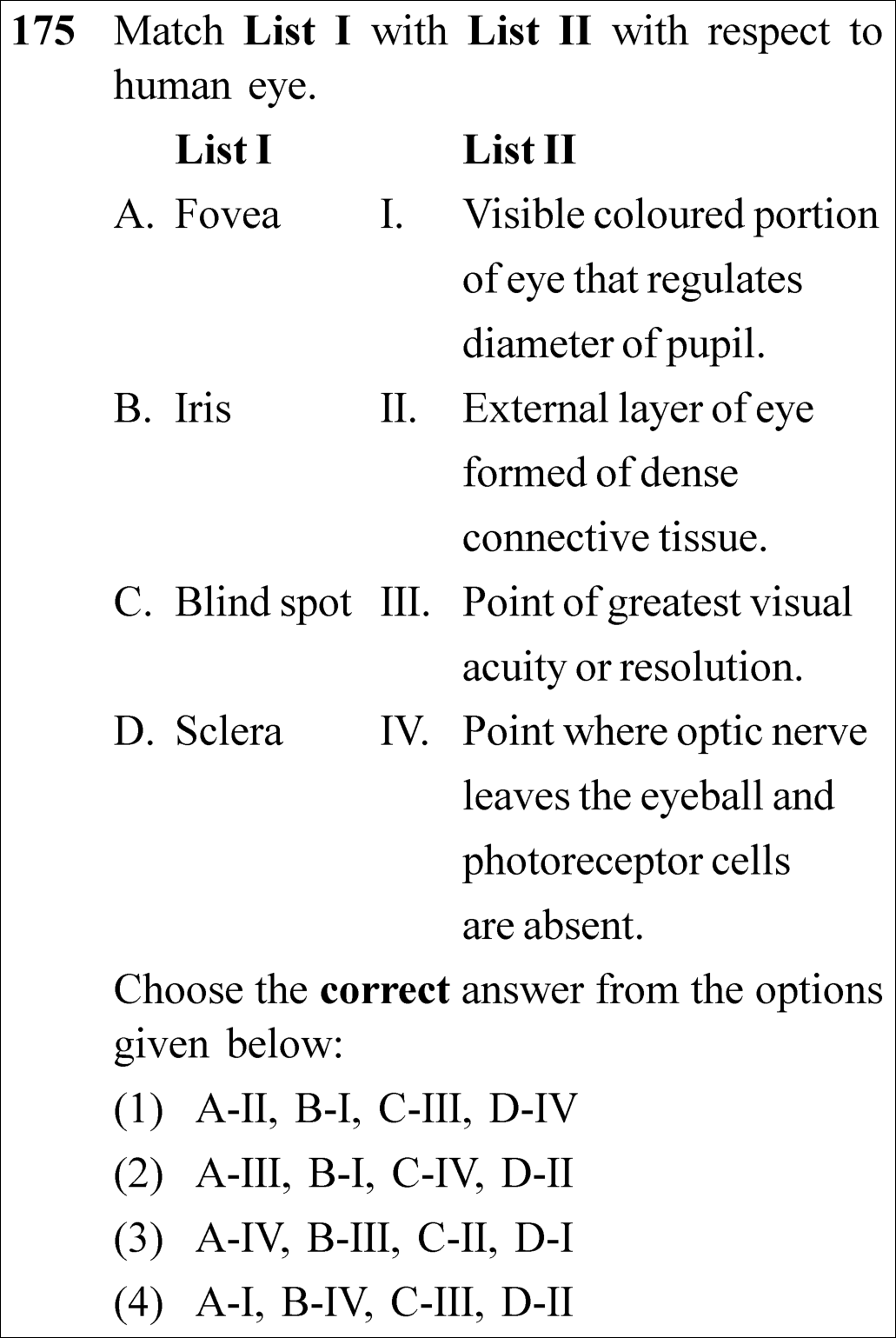
NEET 2023 Zoology Question 175: Anatomy and Optics of the Human Eye

Question

Match List I with List II with respect to human eye. List I: A. Fovea; B. Iris; C. Blind spot; D. Sclera. List II: I. Visible coloured portion of eye that regulates diameter of pupil; II. External layer of eye formed of dense connective tissue; III. Point of greatest visual acuity or resolution; IV. Point where optic nerve leaves the eyeball and photoreceptor cells are absent. Choose the correct answer from the options given below:

✓
Verified Against NTA Final Answer Key
Option (2) : A-III, B-I, C-IV, D-II
📚 Neural Control and Coordination Easy
📋 Given Parameters & Problem Setup
Ocular Structures Fovea, Iris, Blind spot, Sclera
⚡

The 30-Second Exam Hall Shortcut: ⚡ Human Eye Diagnostic Matcher

⏱️ Save ~25 seconds

Match diagnostic definitions: Fovea = Greatest visual acuity / densely packed cones (III). Iris = Visible coloured portion regulating pupil (I). Blind spot = Optic nerve exit, no photoreceptors (IV). Sclera = External dense connective tissue coat (II)! Match Option (2)!

1 Fovea: Central pit of macula lutea with highest density of cones; point of greatest visual acuity -> A-III.
2 Iris: Visible coloured portion of eye controlling pupil diameter -> B-I.
3 Blind spot: Optic nerve exits, retinal vessels enter, rods and cones absent -> C-IV.
4 Sclera: External protective fibrous coat of dense connective tissue -> D-II.
5 Match combination: A-III, B-I, C-IV, D-II -> Option (2).
🛡️
Why You Can 100% Trust This Shortcut: Canonical NCERT Neural Control and Coordination ocular anatomy profiles.
📐

Step-by-Step Rigorous Workflow & Mathematical Proof

Step 1

Anatomy and Optics of the Human Eye

Analyzing the structural layers and optical features of the eyeball:

A. Fovea:Central pit of macula lutea; point of greatest visual acuity (resolution)  ⟹  IIIB. Iris:Visible coloured portion of eye that regulates diameter of pupil  ⟹  IC. Blind spot:Point where optic nerve leaves eyeball; photoreceptors absent  ⟹  IVD. Sclera:External layer of eye formed of dense connective tissue  ⟹  II\begin{aligned} \text{\textbf{A. Fovea:}} & \quad \text{Central pit of macula lutea; } \mathbf{\text{point of greatest visual acuity (resolution)}} \implies \mathbf{\text{III}} \\[4pt] \text{\textbf{B. Iris:}} & \quad \mathbf{\text{Visible coloured portion of eye that regulates diameter of pupil}} \implies \mathbf{\text{I}} \\[4pt] \text{\textbf{C. Blind spot:}} & \quad \mathbf{\text{Point where optic nerve leaves eyeball; photoreceptors absent}} \implies \mathbf{\text{IV}} \\[4pt] \text{\textbf{D. Sclera:}} & \quad \mathbf{\text{External layer of eye formed of dense connective tissue}} \implies \mathbf{\text{II}} \end{aligned}
Step 2

Verbatim NCERT References

NCERT states under Parts of an Eye: - "The external layer is composed of a dense connective tissue and is called the sclera." - "The iris is the visible coloured portion of the eye." - "Photoreceptor cells are not present in that region and hence it is called the blind spot." - "The fovea is a thinned-out portion of the retina where only the cones are densely packed. It is the point where the visual acuity (resolution) is the greatest."

Step 3

Option Elimination

Matching A-III immediately isolates Option (2) uniquely, confirming the answer within seconds.

⭐

360° Option Elimination Engine Key Feature

Diagnose every choice: Know exactly why the right option works and why distractors fail.

4-Option Deep Scan
1 1
✗ Incorrect
Verdict & Scientific Reason:

Mismatches Fovea with sclera description and Blind spot with visual acuity.

⚠️
Student Fallacy (Why candidates pick this trap): Confusing fovea with the outer fibrous coat.
2 2
✓ 100% Correct
Verdict & Scientific Reason:

Exact 1-to-1 match with all four verbatim NCERT definitions of eye anatomy.

💡
Why this is airtight: None; textbook verbatim match.
3 3
✗ Incorrect
Verdict & Scientific Reason:

Mismatches Fovea with blind spot.

⚠️
Student Fallacy (Why candidates pick this trap): Inverting fovea and blind spot.
4 4
✗ Incorrect
Verdict & Scientific Reason:

Mismatches Fovea with iris.

⚠️
Student Fallacy (Why candidates pick this trap): Scrambling internal retinal spots with anterior uvea.
⚠️

NTA Trap Alert: Fovea vs. Macula Lutea vs. Blind Spot Trap

The blind spot has zero photoreceptors; Macula lutea is a yellowish pigment spot; Fovea centralis is the specific central pit inside the macula where ONLY cones are present with maximal resolution.

🛡️ How to avoid the -1 mark: Remember: Greatest visual acuity = Fovea. Zero photoreceptors = Blind spot.
📖

Core NEET Syllabus Standard

NCERT Biology · Neural Control and Coordination Standard Benchmark
Core Scientific Principle Tested:

"Fovea is point of greatest visual acuity; Iris is visible colored pupil regulator; Blind spot lacks photoreceptors where optic nerve exits; Sclera is dense connective tissue outer coat."

Syllabus Focus: Sense Organs (The Eye)
✓ Core NEET UG Syllabus Anchor Syllabus & Academic Standards ↗

Ready to attempt under real exam pressure?

Test your speed and accuracy in the authentic 200-minute timed NTA simulator.

Launch NEET 2023 CBT Test →

Spotted a mistake in this solution? Report an error ([email protected])

⚖️ Legal & Fair Dealing Notice: Sourced from publicly released NEET 2023 question papers and NEET answer keys for private study, research, and non-commercial educational practice under Fair Dealing (Section 52(1)(a) of the Indian Copyright Act, 1957). Not affiliated with or endorsed by NTA or NMC.

Solve 4 NEET Questions a Day — One per Subject

Cover all 1,140 official NEET questions in 285 days at your own pace. Progress is saved on your device. No login needed.