MyCompetitiveExams Logo MyCompetitiveExams
Search 1,140+ Questions
Chapters, formulas, speed tricks
→
⚡ Brahmastra NEET 2027
720 MARKS

Dynamic 180-question full-length simulator mixed dynamically from all 6 years for 2027 & 2026 aspirants.

Launch Brahmastra 2027 Test →
Start Practice →
100% Free · No Login Required
🧬 Zoology 📌 Standard Frequency (~1–2 Qs/Year)

NEET Neural Control and Coordination Previous Year Questions with Solutions

Complete repository of official NTA NEET questions for Neural Control and Coordination from 2020 to 2026. Every question includes 30-second elimination tricks, step-by-step NCERT solutions, option-by-option traps, and official answer keys.

6 Questions 4 Exam Years (2026, 2024, 2023, 2020) 6 Easy · 0 Medium · 0 Challenging
NEET 2026 · Q95 Easy
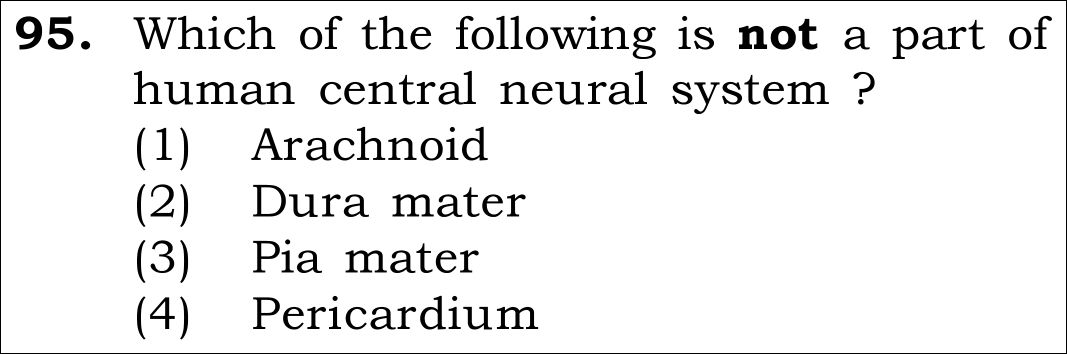
Official NEET 2026 Question 95 - Neural Control and Coordination
1 Arachnoid
2 Dura mater
3 Pia mater
4 Pericardium ✓ Key
💡 Verified Solution & 30-Second Hack
✓
Verified Against NTA Final Answer Key
Option (4) : Pericardium
📚 Neural Control and Coordination Easy
📋 Given Parameters & Problem Setup
Target System Human Central Neural System (CNS - Brain & Spinal Cord)
Query Which of the following is NOT a part of human CNS?
⚡

The 30-Second Exam Hall Shortcut: ⚡ Dura, Arachnoid, Pia = Meninges; Pericardium = Heart!

⏱️ Save ~40 seconds

The brain is wrapped in DAP (Dura, Arachnoid, Pia)! Pericardium wraps the HEART!

1 Scan options: Arachnoid (middle meninx), Dura mater (outer meninx), Pia mater (inner meninx).
2 These three layers form the cranial meninges protecting the human brain (CNS).
3 Pericardium is the double-walled fibroserous sac enclosing the HEART (Circulatory system)!
4 Option (4) is Pericardium -> Selected in 5 seconds flat!
🛡️
Why You Can 100% Trust This Shortcut: NCERT Neural Control verbatim: The brain is covered by cranial meninges consisting of an outer layer called dura mater, a very thin middle layer called arachnoid and an inner layer called pia mater.
📐

Step-by-Step Rigorous Workflow & Mathematical Proof

Step 1

Review the Protective Coverings of the Central Nervous System

The human central nervous system consists of the brain enclosed inside the cranium and the spinal cord inside the vertebral column. Inside the bony skull, the brain is covered and cushioned by three cranial meninges: 1. Dura mater: Tough, fibrous outermost layer. 2. Arachnoid: Thin, web-like intermediate layer. 3. Pia mater: Delicate, vascular innermost layer in intimate contact with brain tissue.

Cranial Meninges (CNS)=Dura mater+Arachnoid+Pia mater\text{Cranial Meninges (CNS)} = \text{Dura mater} + \text{Arachnoid} + \text{Pia mater}
  • • Subarachnoid space between arachnoid and pia mater contains cerebrospinal fluid (CSF).
Step 2

Identify the Nature and Function of Pericardium

The pericardium is the double-walled fluid-filled sac that surrounds and protects the heart in the thoracic cavity. It consists of an outer fibrous layer and an inner serous pericardium, reducing friction during cardiac contraction.

Pericardium≡Protective membrane of the Heart (Circulatory System)\text{Pericardium} \equiv \text{Protective membrane of the Heart (Circulatory System)}
  • • Pericardium has zero association with the central nervous system.
Step 3

Conclusion

Pericardium is not a part of the human central neural system.

Matches Option (4)\text{Matches Option (4)}
  • • Matches Option (4).
⭐

360° Option Elimination Engine Key Feature

Diagnose every choice: Know exactly why the right option works and why distractors fail.

4-Option Deep Scan
1 A
✗ Incorrect
Verdict & Scientific Reason:

Incorrect. Arachnoid is the middle cranial meninx of the central nervous system.

⚠️
Student Fallacy (Why candidates pick this trap): Thinking arachnoid is unrelated to neural anatomy.
2 B
✗ Incorrect
Verdict & Scientific Reason:

Incorrect. Dura mater is the tough outermost meninx protecting the brain and spinal cord.

⚠️
Student Fallacy (Why candidates pick this trap): Failing to recognize dura mater as a brain membrane.
3 C
✗ Incorrect
Verdict & Scientific Reason:

Incorrect. Pia mater is the innermost meninx adhering directly to the brain surface.

⚠️
Student Fallacy (Why candidates pick this trap): Confusing pia mater with non-neural structures.
4 D
✓ 100% Correct
Verdict & Scientific Reason:

Exact: Pericardium is the membrane surrounding the heart (cardiovascular system), not part of the central nervous system.

💡
Why this is airtight: None; straightforward anatomical classification.
⚠️

NTA Trap Alert: Misreading "Not a Part of CNS"

Students moving too fast overlook the negative qualifier "NOT" and select Dura mater (Option 2) or Arachnoid (Option 1) as valid neural structures.

🛡️ How to avoid the -1 mark: Circle negative words like NOT, EXCEPT, INCORRECT in exam stems.
📖

Core NEET Syllabus Standard

NEET Biology Core Syllabus · Neural Control and Coordination Standard Benchmark
Core Scientific Principle Tested:

"The cranial meninges protecting the brain are Dura mater, Arachnoid, and Pia mater."
Syllabus Focus: Central nervous system - Human brain and cranial meninges
✓ Core NEET UG Syllabus Anchor Syllabus & Academic Standards ↗
DAP covers the Brain: Dura, Arachnoid, Pia; Pericardium beats with Heart cardia!
NEET 2024 · Q173 Easy
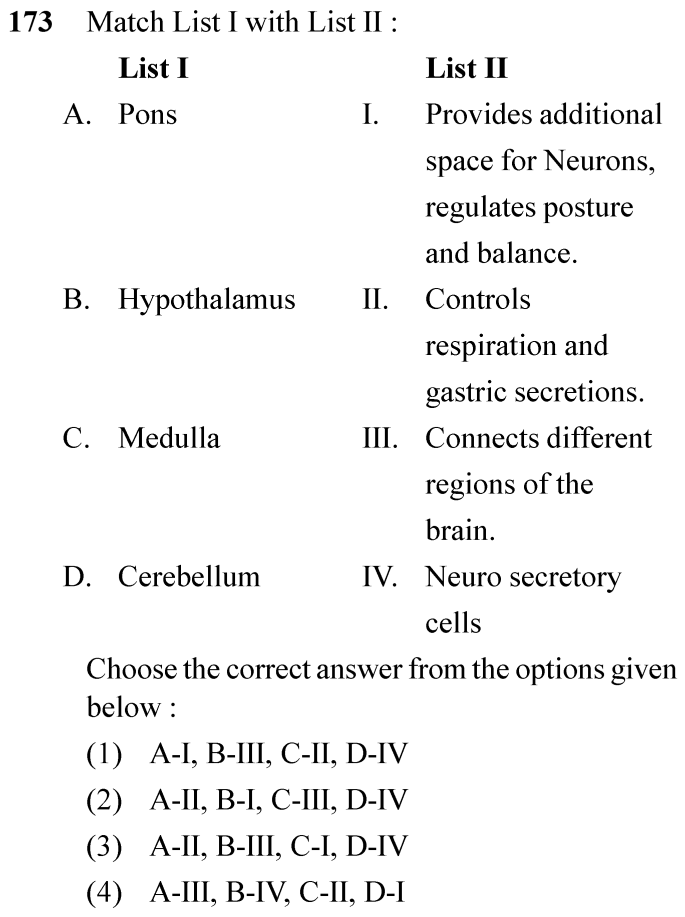
Official NEET 2024 Question 173 - Neural Control and Coordination
1
2
3
4 ✓ Key
💡 Verified Solution & 30-Second Hack
✓
Verified Against NTA Final Answer Key
Option (4) : A-III, B-IV, C-II, D-I
📚 Neural Control and Coordination Easy
📋 Given Parameters & Problem Setup
List I (Brain Regions) A: Pons; B: Hypothalamus; C: Medulla; D: Cerebellum
List II (Functional Specializations) I: Provides additional space for Neurons, regulates posture and balance; II: Controls respiration and gastric secretions; III: Connects different regions of the brain; IV: Neurosecretory cells
⚡

The 30-Second Exam Hall Shortcut: ⚡ Brain Region Functional Lock

⏱️ Save ~25 seconds

Pons = Fiber tracts connecting brain regions (III); Hypothalamus = Neurosecretory hormone cells (IV); Medulla = Respiration & gastric secretions (II); Cerebellum = Convoluted surface for balance/posture (I)! Match: A-III, B-IV, C-II, D-I!

1 A. Pons: Consists of fiber tracts that interconnect different regions of the brain (III).
2 B. Hypothalamus: Contains neurosecretory cells (nuclei) that secrete hormones (IV).
3 C. Medulla oblongata: Centers for respiration, cardiovascular reflexes, and gastric secretions (II).
4 D. Cerebellum: Highly convoluted surface providing space for neurons, coordinates posture and balance (I).
5 Matching order: A-III, B-IV, C-II, D-I -> Option (4) / D.
🛡️
Why You Can 100% Trust This Shortcut: NCERT Biology · Neural Control and Coordination (Central Nervous System)
📐

Step-by-Step Rigorous Workflow & Mathematical Proof

Step 1

Match Pons and Hypothalamus

Pons consists of fibre tracts that interconnect different regions of the brain (A -> III). The hypothalamus contains a number of centres which control body temperature, urge for eating and drinking. It also contains several groups of neurosecretory cells, which secrete hormones called hypothalamic hormones (B -> IV).

Step 2

Match Medulla and Cerebellum

The medulla of the brain contains centres which control respiration, cardiovascular reflexes and gastric secretions (C -> II). Cerebellum has very convoluted surface in order to provide the additional space for many more neurons, regulating motor coordination, posture, and balance (D -> I).

Step 3

Assemble Combination

The unique valid combination is A-III, B-IV, C-II, D-I, matching Option (4).

⭐

360° Option Elimination Engine Key Feature

Diagnose every choice: Know exactly why the right option works and why distractors fail.

4-Option Deep Scan
1 (1)
✗ Incorrect
Verdict & Scientific Reason:

Mismatches Pons with posture/balance and Hypothalamus with fiber tracts.

⚠️
Student Fallacy (Why candidates pick this trap): Mismatches Pons with posture/balance and Hypothalamus with fiber tracts.
2 (2)
✗ Incorrect
Verdict & Scientific Reason:

Mismatches Pons with gastric secretions.

⚠️
Student Fallacy (Why candidates pick this trap): Mismatches Pons with gastric secretions.
3 (3)
✗ Incorrect
Verdict & Scientific Reason:

Mismatches Cerebellum with neurosecretory cells.

⚠️
Student Fallacy (Why candidates pick this trap): Mismatches Cerebellum with neurosecretory cells.
4 (4)
✓ 100% Correct
Verdict & Scientific Reason:

Accurately pairs all four brain structures with their respective neuroanatomical functions.

💡
Why this is airtight: None.
⚠️

NTA Trap Alert: Pons vs Medulla Respiration Centers

Confusing pneumotaxic center in pons with primary respiratory rhythm center and gastric secretions in medulla.

🛡️ How to avoid the -1 mark: Medulla controls basic respiratory rhythm and gastric secretions; Pons connects fiber tracts and contains pneumotaxic center.
📖

Core NEET Syllabus Standard

Biology Core Zoology · Neural Control and Coordination Standard Benchmark
Core Scientific Principle Tested:

"Pons consists of fibre tracts that interconnect different regions of the brain. The hypothalamus contains neurosecretory cells which secrete hormones. The medulla contains centres which control respiration, cardiovascular reflexes and gastric secretions. Cerebellum has very convoluted surface to provide additional space for neurons."

Syllabus Focus: Brain Regions: Functions of Pons, Hypothalamus, Medulla, and Cerebellum
✓ Core NEET UG Syllabus Anchor Syllabus & Academic Standards ↗
NEET 2024 · Q193 Easy
Official NEET 2024 Question 193 - Neural Control and Coordination
1 ✓ Key
2
3
4
💡 Verified Solution & 30-Second Hack
✓
Verified Against NTA Final Answer Key
Option (1) : Statement I is correct but Statement II is incorrect.
📚 Neural Control and Coordination Easy
📋 Given Parameters & Problem Setup
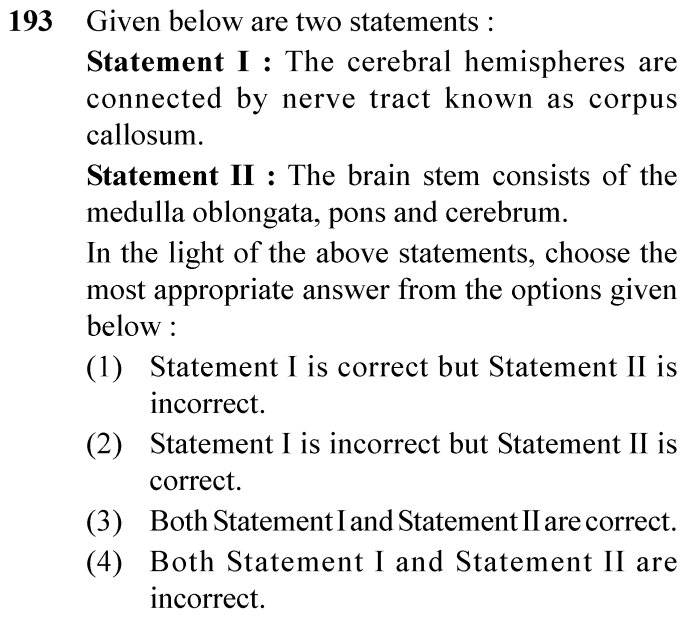
Statement I The cerebral hemispheres are connected by nerve tract known as corpus callosum.
Statement II The brain stem consists of the medulla oblongata, pons and cerebrum.
⚡

The 30-Second Exam Hall Shortcut: ⚡ Brain Stem Components Rule

⏱️ Save ~20 seconds

Brain stem consists of: Midbrain, Pons, and Medulla oblongata! Cerebrum is part of the FOREBRAIN, not brain stem! Statement II is incorrect; Statement I is correct!

1 Statement I: Left and right cerebral hemispheres are connected by a large transverse tract of nerve fibers called corpus callosum -> TRUE.
2 Statement II: Brain stem comprises midbrain, pons, and medulla oblongata. Statement II includes cerebrum instead of midbrain -> INCORRECT!
3 Conclusion: Statement I is correct but Statement II is incorrect -> Option (1) / A.
🛡️
Why You Can 100% Trust This Shortcut: NCERT Biology · Neural Control and Coordination (Forebrain, Midbrain, and Brainstem)
📐

Step-by-Step Rigorous Workflow & Mathematical Proof

Step 1

Evaluate Statement I (Corpus Callosum Tract)

A deep cleft divides the cerebrum longitudinally into two halves, which are termed as the left and right cerebral hemispheres. The hemispheres are connected by a tract of nerve fibres called corpus callosum. Thus, Statement I is correct.

Step 2

Evaluate Statement II (Brain Stem Anatomy)

NCERT states explicitly: "Three major regions make up the brain stem; mid brain, pons and medulla oblongata. Brain stem forms the connections between the brain and spinal cord." Statement II falsely includes the cerebrum (forebrain) while omitting the midbrain. Thus, Statement II is incorrect.

Step 3

Select Matching Choice

Statement I is correct but Statement II is incorrect, matching Option (1).

⭐

360° Option Elimination Engine Key Feature

Diagnose every choice: Know exactly why the right option works and why distractors fail.

4-Option Deep Scan
1 (1)
✓ 100% Correct
Verdict & Scientific Reason:

Statement I correctly defines corpus callosum; Statement II incorrectly includes the cerebrum in the brainstem.

💡
Why this is airtight: None.
2 (2)
✗ Incorrect
Verdict & Scientific Reason:

Statement I is correct and Statement II is incorrect.

⚠️
Student Fallacy (Why candidates pick this trap): Statement I is correct and Statement II is incorrect.
3 (3)
✗ Incorrect
Verdict & Scientific Reason:

Statement II is incorrect because cerebrum is not a brainstem component.

⚠️
Student Fallacy (Why candidates pick this trap): Statement II is incorrect because cerebrum is not a brainstem component.
4 (4)
✗ Incorrect
Verdict & Scientific Reason:

Statement I is factually correct.

⚠️
Student Fallacy (Why candidates pick this trap): Statement I is factually correct.
⚠️

NTA Trap Alert: Brain Stem Triad Confusion

Confusing the midbrain with the cerebrum when reciting brain stem components.

🛡️ How to avoid the -1 mark: Brain stem = Midbrain + Pons + Medulla oblongata. Cerebrum and cerebellum are distinct higher brain structures.
📖

Core NEET Syllabus Standard

Biology Core Zoology · Neural Control and Coordination Standard Benchmark
Core Scientific Principle Tested:

"The hemispheres are connected by a tract of nerve fibres called corpus callosum... Three major regions make up the brain stem; mid brain, pons and medulla oblongata. Brain stem forms the connections between the brain and spinal cord."

Syllabus Focus: Corpus Callosum Function and Anatomical Composition of the Brain Stem
✓ Core NEET UG Syllabus Anchor Syllabus & Academic Standards ↗
NEET 2023 · Q175 Easy
Official NEET 2023 Question 175 - Neural Control and Coordination
1
2 ✓ Key
3
4
💡 Verified Solution & 30-Second Hack
✓
Verified Against NTA Final Answer Key
Option (2) : A-III, B-I, C-IV, D-II
📚 Neural Control and Coordination Easy
📋 Given Parameters & Problem Setup
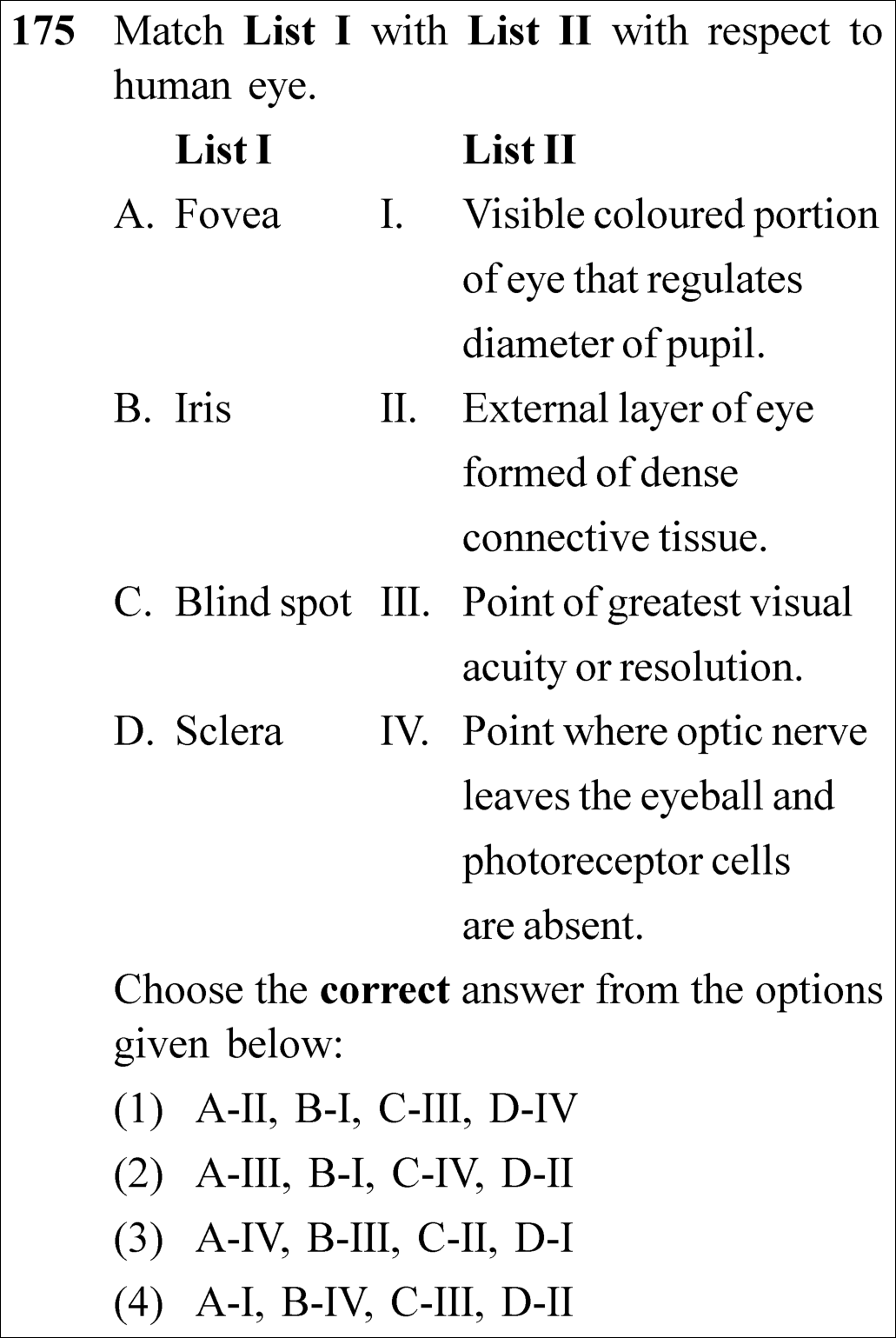
Ocular Structures Fovea, Iris, Blind spot, Sclera
⚡

The 30-Second Exam Hall Shortcut: ⚡ Human Eye Diagnostic Matcher

⏱️ Save ~25 seconds

Match diagnostic definitions: Fovea = Greatest visual acuity / densely packed cones (III). Iris = Visible coloured portion regulating pupil (I). Blind spot = Optic nerve exit, no photoreceptors (IV). Sclera = External dense connective tissue coat (II)! Match Option (2)!

1 Fovea: Central pit of macula lutea with highest density of cones; point of greatest visual acuity -> A-III.
2 Iris: Visible coloured portion of eye controlling pupil diameter -> B-I.
3 Blind spot: Optic nerve exits, retinal vessels enter, rods and cones absent -> C-IV.
4 Sclera: External protective fibrous coat of dense connective tissue -> D-II.
5 Match combination: A-III, B-I, C-IV, D-II -> Option (2).
🛡️
Why You Can 100% Trust This Shortcut: Canonical NCERT Neural Control and Coordination ocular anatomy profiles.
📐

Step-by-Step Rigorous Workflow & Mathematical Proof

Step 1

Anatomy and Optics of the Human Eye

Analyzing the structural layers and optical features of the eyeball:

A. Fovea:Central pit of macula lutea; point of greatest visual acuity (resolution)  ⟹  IIIB. Iris:Visible coloured portion of eye that regulates diameter of pupil  ⟹  IC. Blind spot:Point where optic nerve leaves eyeball; photoreceptors absent  ⟹  IVD. Sclera:External layer of eye formed of dense connective tissue  ⟹  II\begin{aligned} \text{\textbf{A. Fovea:}} & \quad \text{Central pit of macula lutea; } \mathbf{\text{point of greatest visual acuity (resolution)}} \implies \mathbf{\text{III}} \\[4pt] \text{\textbf{B. Iris:}} & \quad \mathbf{\text{Visible coloured portion of eye that regulates diameter of pupil}} \implies \mathbf{\text{I}} \\[4pt] \text{\textbf{C. Blind spot:}} & \quad \mathbf{\text{Point where optic nerve leaves eyeball; photoreceptors absent}} \implies \mathbf{\text{IV}} \\[4pt] \text{\textbf{D. Sclera:}} & \quad \mathbf{\text{External layer of eye formed of dense connective tissue}} \implies \mathbf{\text{II}} \end{aligned}
Step 2

Verbatim NCERT References

NCERT states under Parts of an Eye: - "The external layer is composed of a dense connective tissue and is called the sclera." - "The iris is the visible coloured portion of the eye." - "Photoreceptor cells are not present in that region and hence it is called the blind spot." - "The fovea is a thinned-out portion of the retina where only the cones are densely packed. It is the point where the visual acuity (resolution) is the greatest."

Step 3

Option Elimination

Matching A-III immediately isolates Option (2) uniquely, confirming the answer within seconds.

⭐

360° Option Elimination Engine Key Feature

Diagnose every choice: Know exactly why the right option works and why distractors fail.

4-Option Deep Scan
1 1
✗ Incorrect
Verdict & Scientific Reason:

Mismatches Fovea with sclera description and Blind spot with visual acuity.

⚠️
Student Fallacy (Why candidates pick this trap): Confusing fovea with the outer fibrous coat.
2 2
✓ 100% Correct
Verdict & Scientific Reason:

Exact 1-to-1 match with all four verbatim NCERT definitions of eye anatomy.

💡
Why this is airtight: None; textbook verbatim match.
3 3
✗ Incorrect
Verdict & Scientific Reason:

Mismatches Fovea with blind spot.

⚠️
Student Fallacy (Why candidates pick this trap): Inverting fovea and blind spot.
4 4
✗ Incorrect
Verdict & Scientific Reason:

Mismatches Fovea with iris.

⚠️
Student Fallacy (Why candidates pick this trap): Scrambling internal retinal spots with anterior uvea.
⚠️

NTA Trap Alert: Fovea vs. Macula Lutea vs. Blind Spot Trap

The blind spot has zero photoreceptors; Macula lutea is a yellowish pigment spot; Fovea centralis is the specific central pit inside the macula where ONLY cones are present with maximal resolution.

🛡️ How to avoid the -1 mark: Remember: Greatest visual acuity = Fovea. Zero photoreceptors = Blind spot.
📖

Core NEET Syllabus Standard

NCERT Biology · Neural Control and Coordination Standard Benchmark
Core Scientific Principle Tested:

"Fovea is point of greatest visual acuity; Iris is visible colored pupil regulator; Blind spot lacks photoreceptors where optic nerve exits; Sclera is dense connective tissue outer coat."

Syllabus Focus: Sense Organs (The Eye)
✓ Core NEET UG Syllabus Anchor Syllabus & Academic Standards ↗
NEET 2023 · Q196 Easy
Official NEET 2023 Question 196 - Neural Control and Coordination
1
2 ✓ Key
3
4
💡 Verified Solution & 30-Second Hack
✓
Verified Against NTA Final Answer Key
Option (2) : Limbic system & hypothalamus
📚 Neural Control and Coordination Easy
📋 Given Parameters & Problem Setup
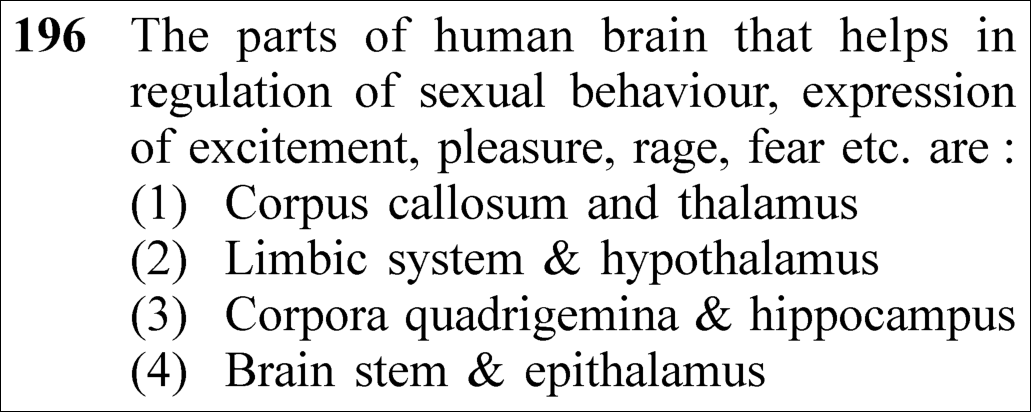
Behaviors Controlled Sexual behaviour, expression of excitement, pleasure, rage, fear, motivation
⚡

The 30-Second Exam Hall Shortcut: ⚡ Emotional Brain = Limbic System + Hypothalamus

⏱️ Save ~20 seconds

Verbatim NCERT sentence under Limbic Lobe: "Along with the hypothalamus, it is involved in the regulation of sexual behaviour, expression of emotional reactions (e.g., excitement, pleasure, rage and fear), and motivation!" Instant 3-second recall!

1 Corpus callosum: Tract of nerve fibres connecting left and right cerebral hemispheres.
2 Corpora quadrigemina: Four round optic/auditory lobes on dorsal midbrain.
3 Brain stem: Pons, medulla, midbrain (controls autonomic visceral vegetative centers).
4 Limbic system & Hypothalamus: Emotional brain controlling sexual behavior, rage, fear, pleasure, and motivation.
5 Match Option (2) Limbic system & hypothalamus.
🛡️
Why You Can 100% Trust This Shortcut: Canonical NCERT Neural Control and Coordination forebrain neuroanatomy.
📐

Step-by-Step Rigorous Workflow & Mathematical Proof

Step 1

Anatomy of the Limbic System (Emotional Brain)

The limbic system (limbic lobe) is a complex ring of interconnected forebrain structures located on the inner margin of the cerebral cortex, comprising the amygdala, hippocampus, and cingulate gyrus:

Limbic System=Amygdala+Hippocampus+Associated Deep Cortical Structures\text{\textbf{Limbic System}} = \text{Amygdala} + \text{Hippocampus} + \text{Associated Deep Cortical Structures}
Step 2

Functional Synergy with the Hypothalamus

The hypothalamus coordinates endocrine and autonomic outputs, while the limbic system processes affective emotional valence. Operating together, they form the central circuit regulating primal emotions and drives:

Limbic System + Hypothalamus⟶{Sexual behaviourEmotional expressions (excitement, pleasure, rage, fear)Motivation and drive\mathbf{\text{Limbic System + Hypothalamus}} \longrightarrow \begin{cases} \text{Sexual behaviour} \\[2pt] \text{Emotional expressions (excitement, pleasure, rage, fear)} \\[2pt] \text{Motivation and drive} \end{cases}
Step 3

Verbatim NCERT Reference

NCERT states under Forebrain: "The inner parts of cerebral hemispheres and a group of associated deep structures like amygdala, hippocampus, etc., form a complex structure called the limbic lobe or limbic system. Along with the hypothalamus, it is involved in the regulation of sexual behaviour, expression of emotional reactions (e.g., excitement, pleasure, rage and fear), and motivation."

⭐

360° Option Elimination Engine Key Feature

Diagnose every choice: Know exactly why the right option works and why distractors fail.

4-Option Deep Scan
1 1
✗ Incorrect
Verdict & Scientific Reason:

Corpus callosum is a commissural tract; thalamus is a sensory relay station.

⚠️
Student Fallacy (Why candidates pick this trap): Confusing commissural fibers with emotional centers.
2 2
✓ 100% Correct
Verdict & Scientific Reason:

Verbatim NCERT match: Limbic system together with the hypothalamus regulates sexual behavior and emotions.

💡
Why this is airtight: None; textbook verbatim recall.
3 3
✗ Incorrect
Verdict & Scientific Reason:

Corpora quadrigemina are midbrain visual/auditory reflex lobes, not primary emotional regulators.

⚠️
Student Fallacy (Why candidates pick this trap): Confusing midbrain colliculi with hypothalamic emotional integration.
4 4
✗ Incorrect
Verdict & Scientific Reason:

Brain stem controls vital vegetative functions (respiration, cardiovascular reflexes, gastric secretions).

⚠️
Student Fallacy (Why candidates pick this trap): Confusing autonomic brainstem centers with higher emotional regulation.
⚠️

NTA Trap Alert: Hypothalamus Alone vs. Limbic System Synergy Trap

Students frequently remember only the hypothalamus for temperature/hunger/sexual drive and miss the essential contribution of the limbic system (amygdala and hippocampus) for emotional expression.

🛡️ How to avoid the -1 mark: Emotions, rage, fear, pleasure, sexual behavior = Limbic system + Hypothalamus.
📖

Core NEET Syllabus Standard

NCERT Biology · Neural Control and Coordination Standard Benchmark
Core Scientific Principle Tested:

"Along with the hypothalamus, the limbic system is involved in the regulation of sexual behaviour, expression of emotional reactions (excitement, pleasure, rage, fear), and motivation."

Syllabus Focus: Human Neural System (Forebrain)
✓ Core NEET UG Syllabus Anchor Syllabus & Academic Standards ↗
NEET 2020 · Q62 Easy
Official NEET 2020 Question 62 - Neural Control and Coordination
1 (ii) (iii) (i) (iv)
2 (iii) (i) (iv) (ii)
3 (iv) (ii) (i) (iii) ✓ Key
4 (i) (ii) (iv) (iii)
💡 Verified Solution & 30-Second Hack
✓
Verified Against NTA Final Answer Key
Option (3) : (a)-(iv), (b)-(ii), (c)-(i), (d)-(iii)
📚 Neural Control and Coordination Easy
📋 Given Parameters & Problem Setup
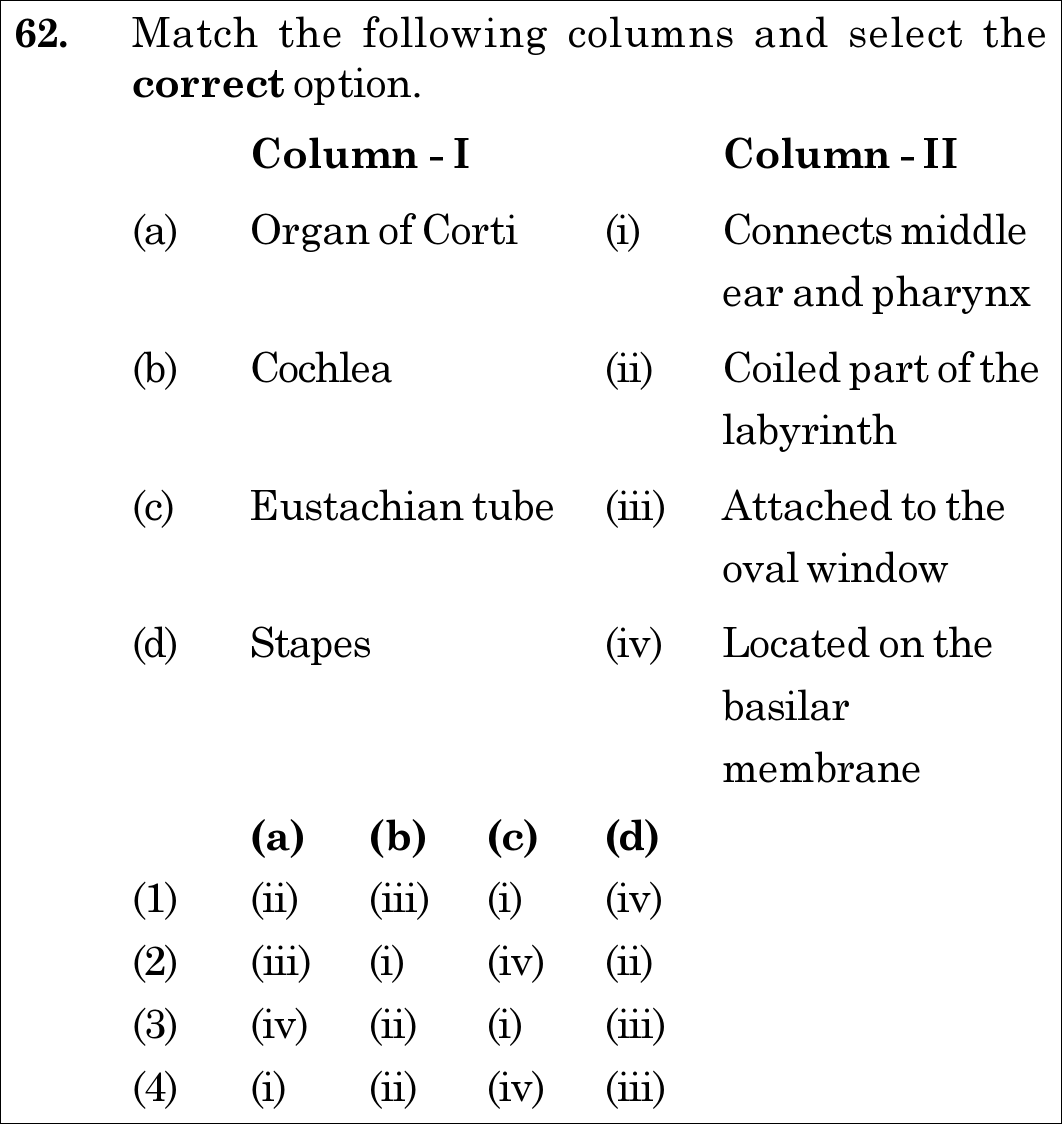
Column I (Ear Structures) (a) Organ of Corti, (b) Cochlea, (c) Eustachian tube, (d) Stapes
Column II (Descriptions) (i) Connects middle ear and pharynx, (ii) Coiled part of the labyrinth, (iii) Attached to the oval window, (iv) Located on the basilar membrane
⚡

The 30-Second Exam Hall Shortcut: ⚡ "Corti = Basilar; Cochlea = Coiled; Eustachian = Pharynx; Stapes = Oval Window!"

⏱️ 25 seconds

Organ of Corti rests on the basilar membrane (a->iv). Cochlea is the coiled portion of the labyrinth (b->ii). Eustachian tube connects middle ear to pharynx (c->i). Stapes attaches to the oval window (d->iii). Match gives Option (3) in 10 seconds!

1 Organ of Corti -> (iv) Located on the basilar membrane.
2 Cochlea -> (ii) Coiled part of the labyrinth.
3 Eustachian tube -> (i) Connects middle ear and pharynx.
4 Stapes -> (iii) Attached to the oval window (fenestra ovalis).
5 Mapping: (a)-(iv), (b)-(ii), (c)-(i), (d)-(iii) -> Option 3.
🛡️
Why You Can 100% Trust This Shortcut: NCERT Biology · Human Physiology: Neural Control and Coordination (The Ear)
📐

Step-by-Step Rigorous Workflow & Mathematical Proof

Step 1

Match Organ of Corti

The Organ of Corti is a structure located on the basilar membrane of the cochlea which contains hair cells that act as auditory receptors. Thus, (a) matches (iv).

Step 2

Match Cochlea

The inner ear consists of fluid-filled labyrinth; the coiled, snail shell-like portion of the labyrinth is called the cochlea. Thus, (b) matches (ii).

Step 3

Match Eustachian Tube

The Eustachian tube connects the middle ear cavity with the pharynx and helps in equalizing the pressures on either side of the ear drum. Thus, (c) matches (i).

Step 4

Match Stapes

The middle ear contains three ossicles (Malleus, Incus, Stapes). The stapes is attached to the oval window (fenestra ovalis) of the cochlea. Thus, (d) matches (iii).

⭐

360° Option Elimination Engine Key Feature

Diagnose every choice: Know exactly why the right option works and why distractors fail.

4-Option Deep Scan
1 A
✗ Incorrect
Verdict & Scientific Reason:

Incorrect; places Organ of Corti as coiled part and stapes on basilar membrane.

⚠️
Student Fallacy (Why candidates pick this trap): Swapping ear structures and locations.
2 B
✗ Incorrect
Verdict & Scientific Reason:

Incorrect; misassigns Eustachian tube to basilar membrane.

⚠️
Student Fallacy (Why candidates pick this trap): Random mispairing.
3 C
✓ 100% Correct
Verdict & Scientific Reason:

Accurate pairing across all four anatomical features of the ear.

💡
Why this is airtight: None; textbook auditory anatomy.
4 D
✗ Incorrect
Verdict & Scientific Reason:

Incorrect; mispairs Organ of Corti with middle ear-pharynx connection.

⚠️
Student Fallacy (Why candidates pick this trap): Confusing sensory organ of hearing with pressure equalization tube.
⚠️

NTA Trap Alert: Malleus vs Stapes Attachments

Malleus is attached to the TYMPANIC MEMBRANE (ear drum). Stapes is attached to the OVAL WINDOW (fenestra ovalis).

🛡️ How to avoid the -1 mark: Mnemonic: "M-T, S-O" -> Malleus to Tympanum, Stapes to Oval window!
📖

Core NEET Syllabus Standard

Zoology · Neural Control and Coordination Standard Benchmark
Core Scientific Principle Tested:

""

Syllabus Focus: Anatomy of the Human Ear: Organ of Corti, Cochlea, Eustachian Tube & Stapes
✓ Core NEET UG Syllabus Anchor Syllabus & Academic Standards ↗

Solve 4 NEET Questions a Day — One per Subject

Cover all 1,140 official NEET questions in 285 days at your own pace. Progress is saved on your device. No login needed.