MyCompetitiveExams Logo MyCompetitiveExams
Search 1,140+ Questions
Chapters, formulas, speed tricks
→
⚡ Brahmastra NEET 2027
720 MARKS

Dynamic 180-question full-length simulator mixed dynamically from all 6 years for 2027 & 2026 aspirants.

Launch Brahmastra 2027 Test →
Start Practice →
100% Free · No Login Required
🧬 Zoology ⭐ High Weightage (~2–3 Qs/Year)

NEET Ecosystem Previous Year Questions with Solutions

Complete repository of official NTA NEET questions for Ecosystem from 2020 to 2026. Every question includes 30-second elimination tricks, step-by-step NCERT solutions, option-by-option traps, and official answer keys.

13 Questions 6 Exam Years (2026, 2025, 2024, 2023, 2021, 2020) 11 Easy · 2 Medium · 0 Challenging
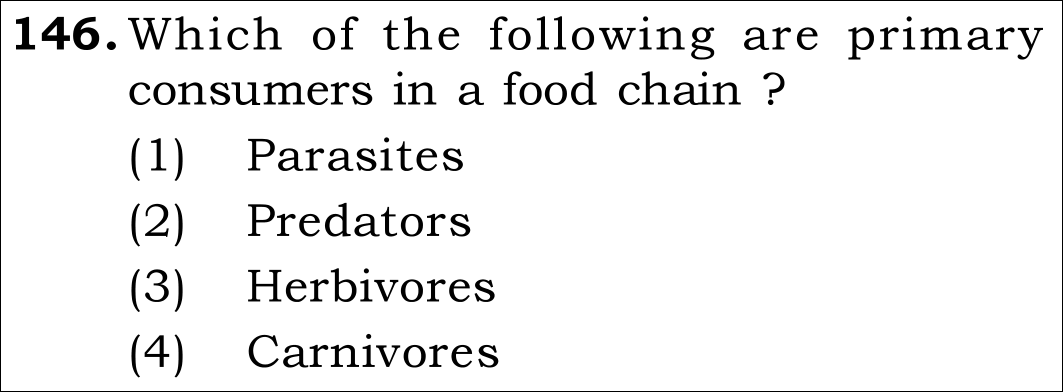
NEET 2026 · Q146 Easy
Official NEET 2026 Question 146 - Ecosystem
1 Parasites
2 Predators
3 Herbivores ✓ Key
4 Carnivores
💡 Verified Solution & 30-Second Hack
✓
Verified Against NTA Final Answer Key
Option (3) : Herbivores
📚 Ecosystem Easy
📋 Given Parameters & Problem Setup
Ecological Entity Food chain trophic levels
Target Category Primary consumers
⚡

The 30-Second Exam Hall Shortcut: ⚡ Trophic Level Ladder Rule

⏱️ Save ~40 seconds

T1 = Producers (Plants); T2 = Primary Consumers (Herbivores); T3 = Secondary Consumers (Carnivores)!

1 Recall standard trophic hierarchy:
2 First trophic level (T1T_1): Producers (autotrophs / green plants).
3 Second trophic level (T2T_2): Primary consumers (herbivores that feed on plants).
4 Third trophic level (T3T_3): Secondary consumers (primary carnivores).
5 Primary consumers are strictly Herbivores.
6 Option (3) is Herbivores. Pick Option (3) in 2 seconds!
🛡️
Why You Can 100% Trust This Shortcut: NCERT Biology · Ecosystem (Ecological Pyramids: Pyramid of biomass in sea is generally inverted).
📐

Step-by-Step Rigorous Workflow & Mathematical Proof

Step 1

Trophic Level Definitions in an Ecosystem

Organisms occupy a place in the natural surroundings or in a community according to their feeding relationship with other organisms. Based on the source of their nutrition or food, organisms occupy a specific place in the food chain known as their trophic level.

Trophic Level 1 (T1):Primary Producers (Phytoplankton, Trees, Grass)Trophic Level 2 (T2):Primary Consumers (Zooplankton, Grasshopper, Cow) = HerbivoresTrophic Level 3 (T3):Secondary Consumers (Birds, Fishes, Wolf) = CarnivoresTrophic Level 4 (T4):Tertiary Consumers (Man, Lion) = Top Carnivores\begin{aligned} \text{Trophic Level 1 } (T_1) &: \text{Primary Producers (Phytoplankton, Trees, Grass)} \\ \mathbf{Trophic\text{ Level 2 } (T_2)} &: \mathbf{Primary\text{ Consumers (Zooplankton, Grasshopper, Cow) = Herbivores}} \\ \text{Trophic Level 3 } (T_3) &: \text{Secondary Consumers (Birds, Fishes, Wolf) = Carnivores} \\ \text{Trophic Level 4 } (T_4) &: \text{Tertiary Consumers (Man, Lion) = Top Carnivores} \end{aligned}
  • • Herbivores convert plant biomass into animal biomass (key industry animals).
Step 2

Eliminate Other Options

Parasites (Option 1) can feed on any trophic level (plants, herbivores, or carnivores). Predators (Option 2) are typically secondary or tertiary consumers. Carnivores (Option 4) are secondary or tertiary consumers that eat other animals. Only herbivores are primary consumers.

Primary Consumers≡Herbivores  ⟹  Option (3)\text{Primary Consumers} \equiv \mathbf{Herbivores} \implies \text{Option (3)}
  • • Option (3) is the solely accurate response.
Step 3

Conclusion

Herbivores directly graze or feed on primary producers, defining them as primary consumers.

Correct Match=Option (3)\text{Correct Match} = \text{Option (3)}
  • • Matches official NTA final answer key Option C / (3).
⭐

360° Option Elimination Engine Key Feature

Diagnose every choice: Know exactly why the right option works and why distractors fail.

4-Option Deep Scan
1 A
✗ Incorrect
Verdict & Scientific Reason:

Incorrect. Parasites are specialized heterotrophs living on various host trophic levels, not defined as primary consumers.

⚠️
Student Fallacy (Why candidates pick this trap): Confusing nutritional specialization with trophic rank.
2 B
✗ Incorrect
Verdict & Scientific Reason:

Incorrect. Predators hunt and consume other living animals (carnivores), placing them at secondary consumer level or higher.

⚠️
Student Fallacy (Why candidates pick this trap): Treating all consumers as predators.
3 C
✓ 100% Correct
Verdict & Scientific Reason:

100% accurate. Herbivores are the canonical primary consumers feeding directly on primary producers.

💡
Why this is airtight: None; fundamental ecology recall.
4 D
✗ Incorrect
Verdict & Scientific Reason:

Incorrect. Carnivores eat herbivores or other carnivores, making them secondary or tertiary consumers.

⚠️
Student Fallacy (Why candidates pick this trap): Confusing secondary consumers with primary consumers.
⚠️

NTA Trap Alert: Equating "Consumer" with "Carnivore"

Beginners sometimes confuse "Primary Consumer" with "Primary Carnivore". A primary carnivore is a SECONDARY consumer because it eats the herbivore!

🛡️ How to avoid the -1 mark: Rule: Primary Consumer = Eats Plants (Herbivore); Secondary Consumer = Primary Carnivore.
📖

Core NEET Syllabus Standard

NEET Biology Core Syllabus · Ecosystem Standard Benchmark
Core Scientific Principle Tested:

"Primary consumers in a grazing food chain are herbivores that feed directly on autotrophic primary producers."
Syllabus Focus: Trophic Levels and Food Chains
✓ Core NEET UG Syllabus Anchor Syllabus & Academic Standards ↗
Plants are Producers number One, Herbivores Eat them when day is done (Primary Consumers)!
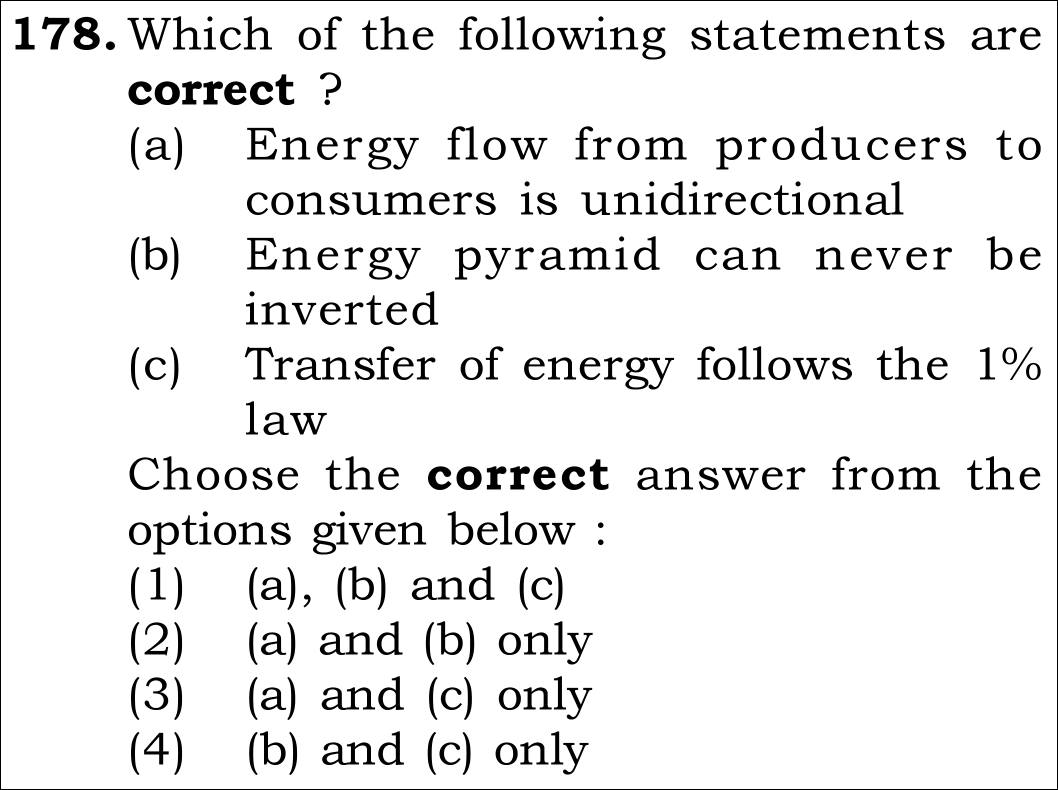
NEET 2026 · Q178 Easy
Official NEET 2026 Question 178 - Ecosystem
1 (a), (b) and (c)
2 (a) and (b) only ✓ Key
3 (a) and (c) only
4 (b) and (c) only
💡 Verified Solution & 30-Second Hack
✓
Verified Against NTA Final Answer Key
Option (2) : (a) and (b) only
📚 Ecosystem Easy
📋 Given Parameters & Problem Setup
Ecosystem Process Energy Flow and Ecological Pyramids
Given Statements (a) Energy flow is unidirectional; (b) Pyramid of energy is always upright; (c) Only about 1% of energy is transferred between trophic levels
⚡

The 30-Second Exam Hall Shortcut: ⚡ Lindeman’s 10% Law Filter

⏱️ Save ~40 seconds

Energy Flow = Unidirectional (a); Pyramid of Energy = ALWAYS Upright (b); Transfer = 10%, NOT 1% (c is FALSE)!

1 Check Statement (a): Energy flow in an ecosystem is unidirectional (Sun -> Producers -> Consumers) -> TRUE.
2 Check Statement (b): Pyramid of energy is always upright and can never be inverted -> TRUE (NCERT verbatim).
3 Check Statement (c): "Only about 1% of energy is transferred..." -> FALSE! (Lindeman’s law states ~10% of energy is transferred; 1% is the PAR captured by plants from incident solar radiation).
4 Therefore, only (a) and (b) are correct.
5 Select Option (2): (a) and (b) only in under 10 seconds!
🛡️
Why You Can 100% Trust This Shortcut: NCERT Biology · Ecosystem (Carbon and Phosphorus Nutrient Cycles: Reservoir pool differences).
📐

Step-by-Step Rigorous Workflow & Mathematical Proof

Step 1

Unidirectional Flow of Energy

Energy flows unidirectionally from the sun to producers and then to consumers, obeying the first and second laws of thermodynamics. Energy once dissipated as metabolic heat can never be recycled back to previous trophic levels. Thus, Statement (a) is correct.

Solar Energy→UnidirectionalProducers→Herbivores→Carnivores→Heat DissipationEnvironment\text{Solar Energy} \xrightarrow{\text{Unidirectional}} \text{Producers} \rightarrow \text{Herbivores} \rightarrow \text{Carnivores} \xrightarrow{\text{Heat Dissipation}} \text{Environment}
  • • Pyramid of energy is always upright because energy is lost as heat at each step.
Step 2

Pyramid of Energy and Lindeman's 10% Law

Pyramid of energy is always upright, can never be inverted, because when energy flows from a particular trophic level to the next trophic level, some energy is always lost as heat at each step. According to Lindeman’s 10 percent law, only 10% of the energy is transferred to each trophic level from the lower trophic level, not 1%. Thus, Statement (b) is true, but Statement (c) is false.

Energy at Level (n+1)=0.10×Energy at Level (n)(10% Law,≠1%)\text{Energy at Level } (n+1) = 0.10 \times \text{Energy at Level } (n) \quad (\mathbf{10\% \text{ Law}}, \neq 1\%)
  • • Plants capture only 2-10% of PAR (which is ~1% of incident total solar radiation), but trophic level transfer efficiency is 10%.
⭐

360° Option Elimination Engine Key Feature

Diagnose every choice: Know exactly why the right option works and why distractors fail.

4-Option Deep Scan
1 A
✗ Incorrect
Verdict & Scientific Reason:

Incorrect because statement (c) is false (10% law, not 1%).

⚠️
Student Fallacy (Why candidates pick this trap): Confusing 1% PAR capture from total sunlight with trophic level transfer efficiency.
2 B
✓ 100% Correct
Verdict & Scientific Reason:

100% correct. Statements (a) and (b) are canonical ecological laws, while statement (c) misstates Lindeman’s 10% law.

💡
Why this is airtight: None; clear differentiation between 10% transfer and 1% solar capture.
3 C
✗ Incorrect
Verdict & Scientific Reason:

Incorrect. Statement (a) is true, and statement (c) is false.

⚠️
Student Fallacy (Why candidates pick this trap): Failing to recognize unidirectional energy flow.
4 D
✗ Incorrect
Verdict & Scientific Reason:

Incorrect. Statement (b) is true and statement (c) is false.

⚠️
Student Fallacy (Why candidates pick this trap): Omitting the universal upright nature of energy pyramids.
⚠️

NTA Trap Alert: 1% Solar Capture vs. 10% Trophic Transfer Trap

Students often mix up the numbers: Plants capture ~1-2% of total incident solar radiation (2-10% of PAR), but between trophic levels, energy transfer follows the 10% LAW (Lindeman).

🛡️ How to avoid the -1 mark: Trophic transfer = 10% Law; Sunlight capture = 1-2% of incident radiation.
📖

Core NEET Syllabus Standard

NEET Biology Core Syllabus · Ecosystem Standard Benchmark
Core Scientific Principle Tested:

"Energy flow is unidirectional, the pyramid of energy is always upright, and trophic transfer follows the 10% law."

Syllabus Focus: Energy Flow & Ecological Pyramids
✓ Core NEET UG Syllabus Anchor Syllabus & Academic Standards ↗
Energy flows One-Way, Pyramids Stand Upright, Lindeman gave us TEN Percent!
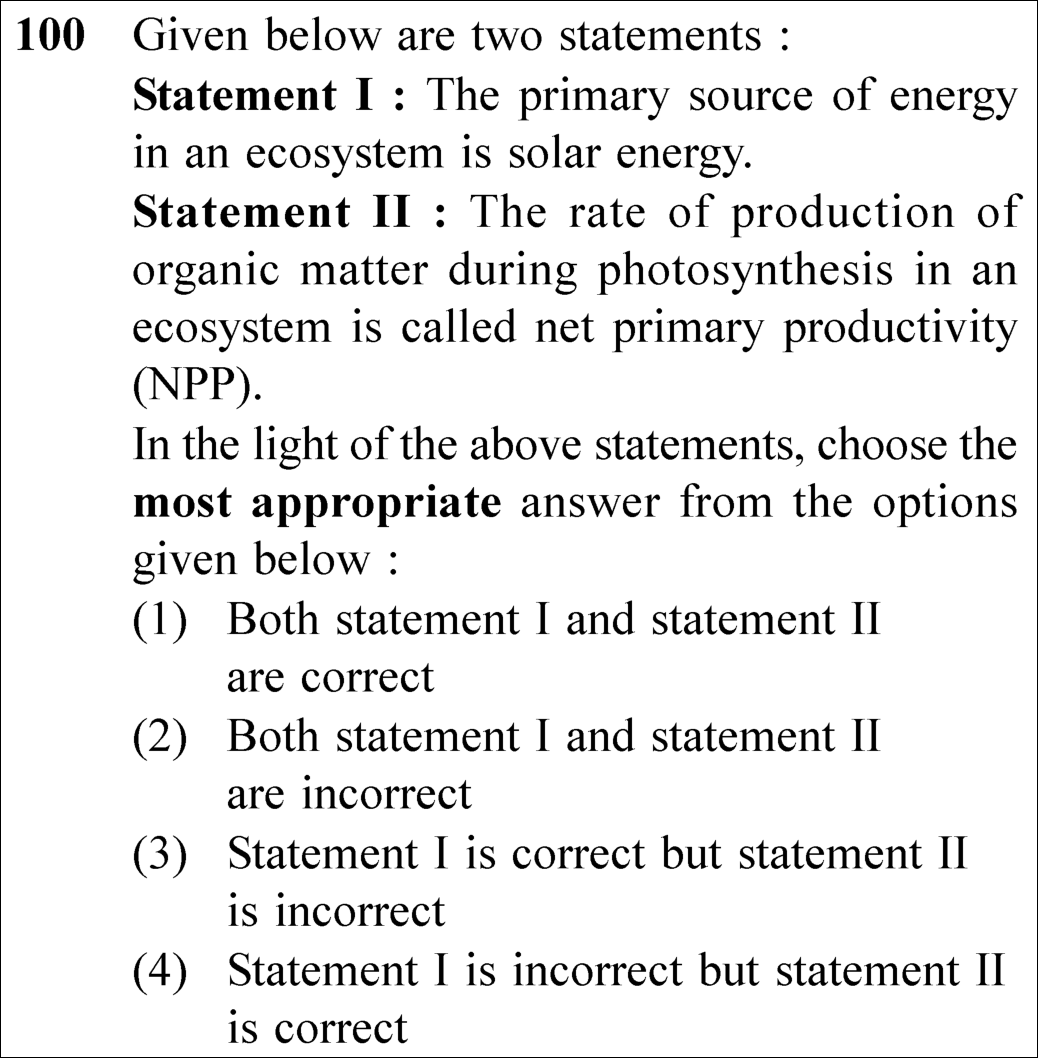
NEET 2025 · Q100 Easy
Official NEET 2025 Question 100 - Ecosystem
1 Both statement I and statement II are correct
2 Both statement I and statement II are incorrect
3 Statement I is correct but statement II is incorrect ✓ Key
4 Statement I is incorrect but statement II is correct
💡 Verified Solution & 30-Second Hack
✓
Verified Against NTA Final Answer Key
Option (3) : Statement I is correct but statement II is incorrect
📚 Ecosystem Easy
📋 Given Parameters & Problem Setup
Statement I The primary source of energy in an ecosystem is solar energy.
Statement II The rate of production of organic matter during photosynthesis in an ecosystem is called net primary productivity (NPP).
⚡

The 30-Second Exam Hall Shortcut: ⚡ GPP vs NPP Definition Check

⏱️ Save ~25 seconds

Sun is the ultimate primary energy source for all ecosystems (Statement I is TRUE)! Rate of organic matter production during photosynthesis is GROSS Primary Productivity (GPP), NOT NPP! NPP = GPP - R! Statement II is FALSE ⟹ Statement I correct, statement II incorrect!

1 Check Statement I: Solar radiation is the ultimate driver of virtually all ecosystems on Earth (except deep-sea hydrothermal vents). Autotrophs fix solar energy into chemical energy. Statement I is TRUE.
2 Check Statement II: Total rate of production of organic matter during photosynthesis is defined as GROSS PRIMARY PRODUCTIVITY (GPP).
3 Net Primary Productivity (NPP) is the remaining biomass after accounting for respiratory losses (R): NPP = GPP - R.
4 Statement II incorrectly defines GPP as Net Primary Productivity (NPP). Hence Statement II is FALSE.
5 Conclusion: Statement I is correct but statement II is incorrect.
6 Select Option (3) in under 10 seconds!
🛡️
Why You Can 100% Trust This Shortcut: Ecosystem Productivity Dynamics (NCERT Biology · Ecosystem: Net Primary Productivity NPP = GPP - R).
📐

Step-by-Step Rigorous Workflow & Mathematical Proof

Step 1

Evaluate Statement I (Source of Ecosystem Energy)

Examine energy flow in ecological food webs from NCERT Chapter 14:

Solar Energy→PhotosynthesisPrimary Producers (Autotrophs)⟶Herbivores⟶Carnivores\text{Solar Energy} \xrightarrow{\text{Photosynthesis}} \text{Primary Producers (Autotrophs)} \longrightarrow \text{Herbivores} \longrightarrow \text{Carnivores}
  • • Except for chemosynthetic deep-sea hydrothermal vent communities, the sun is the exclusive primary energy source for all biosphere ecosystems.
  • • Statement I is unequivocally TRUE.
Step 2

Evaluate Statement II (Gross vs. Net Primary Productivity)

Examine canonical definitions of ecological productivity:

Gross Primary Productivity (GPP)=Total rate of organic matter synthesis during photosynthesis\text{Gross Primary Productivity (GPP)} = \text{Total rate of organic matter synthesis during photosynthesis}
  • • A considerable amount of GPP is utilized by plants in cellular respiration (R).
  • • Net Primary Productivity (NPP) is the available biomass for consumption by heterotrophs:
  • • \text{NPP} = \text{GPP} - R.
  • • Statement II states that the total rate of production during photosynthesis is NPP, which conflates GPP with NPP.
  • • Statement II is completely FALSE.
Step 3

Select Matching Option

Statement I is correct and Statement II is incorrect, corresponding to Option (3).

Statement I: True,Statement II: False  ⟹  Option (3)\text{Statement I: True}, \quad \text{Statement II: False} \implies \text{Option (3)}
  • • Matches Option (3) with complete precision.
⭐

360° Option Elimination Engine Key Feature

Diagnose every choice: Know exactly why the right option works and why distractors fail.

4-Option Deep Scan
1 A
✗ Incorrect
Verdict & Scientific Reason:

Incorrect. Statement II is false because it describes GPP, not NPP.

⚠️
Student Fallacy (Why candidates pick this trap): Confusing gross and net primary productivity.
2 B
✗ Incorrect
Verdict & Scientific Reason:

Incorrect. Statement I is true (sun is primary energy source).

⚠️
Student Fallacy (Why candidates pick this trap): Doubting solar energy as the primary source.
3 C
✓ 100% Correct
Verdict & Scientific Reason:

100% correct. Sun is primary energy source (I); total photosynthetic rate is GPP, not NPP (II).

💡
Why this is airtight: None; rigorous grasp of ecosystem productivity.
4 D
✗ Incorrect
Verdict & Scientific Reason:

Incorrect. Inverts truth values.

⚠️
Student Fallacy (Why candidates pick this trap): Multiple errors.
⚠️

NTA Trap Alert: Conflating GPP with NPP

Gross = TOTAL production during photosynthesis. Net = REMAINDER after plant respiration (NPP = GPP - R). The sentence in Statement II describes GROSS productivity verbatim!

🛡️ How to avoid the -1 mark: Remember: Total organic matter produced = GROSS (GPP); Leftover biomass = NET (NPP)!
📖

Core NEET Syllabus Standard

NEET Biology Core Syllabus · Ecosystem Standard Benchmark
Core Scientific Principle Tested:

"GPP is the rate of production of organic matter during photosynthesis; NPP = GPP - R."

Syllabus Focus: Energy Flow & Primary Productivity (GPP and NPP)
✓ Core NEET UG Syllabus Anchor Syllabus & Academic Standards ↗
Total made = GROSS (GPP)! Solar = Primary source! Statement I true, II false (Option 3)!
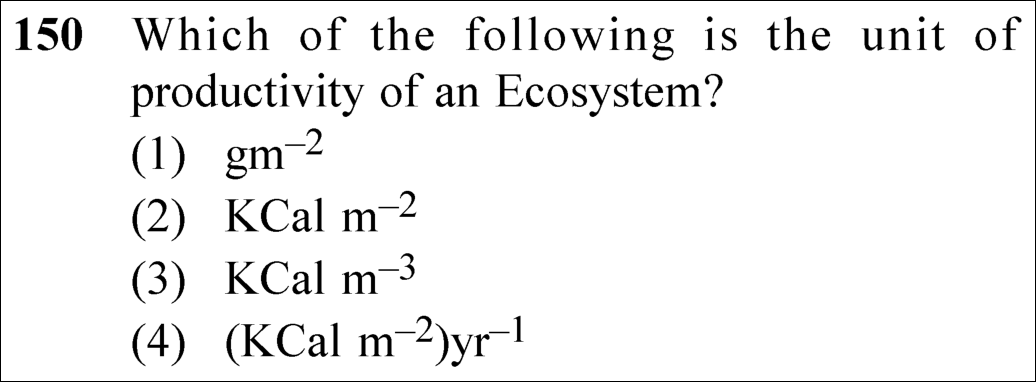
NEET 2025 · Q150 Easy
Official NEET 2025 Question 150 - Ecosystem
1
2
3
4 ✓ Key
💡 Verified Solution & 30-Second Hack
✓
Verified Against NTA Final Answer Key
Option (4) : (KCal m⁻²)yr⁻¹
📚 Ecosystem Easy
📋 Given Parameters & Problem Setup
Ecological Parameter Productivity of an Ecosystem
Target Standard dimensional unit of productivity
⚡

The 30-Second Exam Hall Shortcut: ⚡ Production vs Productivity Unit Fingerprint

⏱️ Save ~20 seconds

Primary PRODUCTION = Biomass per unit area (g m⁻² or kcal m⁻²)! PRODUCTIVITY = RATE of production per unit area PER UNIT TIME -> (kcal m⁻²) yr⁻¹ or (g m⁻²) yr⁻¹! Must include time (yr⁻¹)!

1 Recall NCERT Section 14.2 (Productivity):
2 - Primary production is expressed as weight (g m⁻²) or energy (kcal m⁻²).
3 - "The rate of biomass production is called productivity."
4 - "It is expressed in terms of (g m⁻²) yr⁻¹ or (kcal m⁻²) yr⁻¹ to compare the productivity of different ecosystems."
5 - Options (1) and (2) omit the time component (yr⁻¹); Option (3) has volume (m⁻³).
6 - Option (4) has both area and time: (KCal m⁻²) yr⁻¹!
7 Select Option (4)!
🛡️
Why You Can 100% Trust This Shortcut: Ecological Succession & Pioneer to Climax Communities (NCERT Biology · Ecosystem: Hydrarch and xerarch succession).
📐

Step-by-Step Rigorous Workflow & Mathematical Proof

Step 1

Fundamental Distinction: Production vs Productivity

In ecosystem energetics, production and productivity represent related but dimensionally distinct quantities:

  • • Primary Production: The total quantity of organic matter or biomass produced per unit area during photosynthesis over an arbitrary period. Expressed in terms of biomass weight (g/m2g/m^2 or g⋅m−2g \cdot m^{-2}) or energy content (kcal/m2kcal/m^2 or kcal⋅m−2kcal \cdot m^{-2}).
  • • Productivity: The rate at which biomass is generated per unit area per unit time. Because it is a rate, it must incorporate a time dimension (typically per year, yr−1yr^{-1}).
Step 2

Dimensional Analysis of Productivity Units

Evaluating the mathematical dimensions:

  • • In terms of biomass: (g⋅m−2)⋅yr−1(g \cdot m^{-2}) \cdot yr^{-1}.
  • • In terms of energy content: (kcal⋅m−2)⋅yr−1(kcal \cdot m^{-2}) \cdot yr^{-1}.
  • • This standardized unit enables rigorous comparison of biological conversion efficiencies across diverse biomes (e.g. coral reefs vs tropical rainforests vs deserts).
Step 3

Evaluation of the Options

Reviewing the provided choices:

  • • Option (1) g⋅m−2g \cdot m^{-2}: Unit of production, lacks time dimension.
  • • Option (2) kcal⋅m−2kcal \cdot m^{-2}: Unit of production, lacks time dimension.
  • • Option (3) kcal⋅m−3kcal \cdot m^{-3}: Energy per unit volume, inappropriate for aerial/surface ecosystem productivity.
  • • Option (4) (kcal⋅m−2)⋅yr−1(kcal \cdot m^{-2}) \cdot yr^{-1}: True rate unit containing energy, area, and time dimensions.
Step 4

Conclusion

The unit of productivity of an ecosystem is (KCal⋅m−2)yr−1(KCal \cdot m^{-2})yr^{-1}, which is Option (4).

Unit of Productivity=(kcal⋅m−2)yr−1\text{Unit of Productivity} = (\text{kcal} \cdot m^{-2})\text{yr}^{-1}
⭐

360° Option Elimination Engine Key Feature

Diagnose every choice: Know exactly why the right option works and why distractors fail.

4-Option Deep Scan
1 A
✗ Incorrect
Verdict & Scientific Reason:

Incorrect. This is the unit of primary production (biomass per unit area), not productivity (rate over time).

⚠️
Student Fallacy (Why candidates pick this trap): Forgetting that productivity is a rate that requires a time dimension.
2 B
✗ Incorrect
Verdict & Scientific Reason:

Incorrect. This represents energy per unit area (production), lacking the per unit time component.

⚠️
Student Fallacy (Why candidates pick this trap): Confusing accumulated energy with the rate of energy fixation.
3 C
✗ Incorrect
Verdict & Scientific Reason:

Incorrect. This represents energy per unit volume (m⁻³).

⚠️
Student Fallacy (Why candidates pick this trap): Confusing area with volume.
4 D
✓ 100% Correct
Verdict & Scientific Reason:

100% correct. Correctly incorporates energy, unit area, and unit time (yr−1yr^{-1}) as specified by NCERT.

💡
Why this is airtight: None; rigorous dimensional and ecological understanding.
⚠️

NTA Trap Alert: Production vs Productivity Unit Trap

This is one of the most common traps in NEET ecology: Production = gm⁻² or kcal m⁻² (No time). Productivity = (gm⁻²)yr⁻¹ or (kcal m⁻²)yr⁻¹ (WITH time component!). Always check for yr−1yr^{-1}!

🛡️ How to avoid the -1 mark: Productivity = RATE = MUST have time in denominator (yr−1yr^{-1}).
📖

Core NEET Syllabus Standard

NEET Biology Core Syllabus · Ecosystem Standard Benchmark
Core Scientific Principle Tested:

"Productivity is the rate of biomass production, expressed as (g m⁻²)yr⁻¹ or (kcal m⁻²)yr⁻¹."

Syllabus Focus: Ecosystem Structure and Function · Productivity
✓ Core NEET UG Syllabus Anchor Syllabus & Academic Standards ↗
Productivity is a PACE: (Energy / Area) per YEAR (yr⁻¹)!
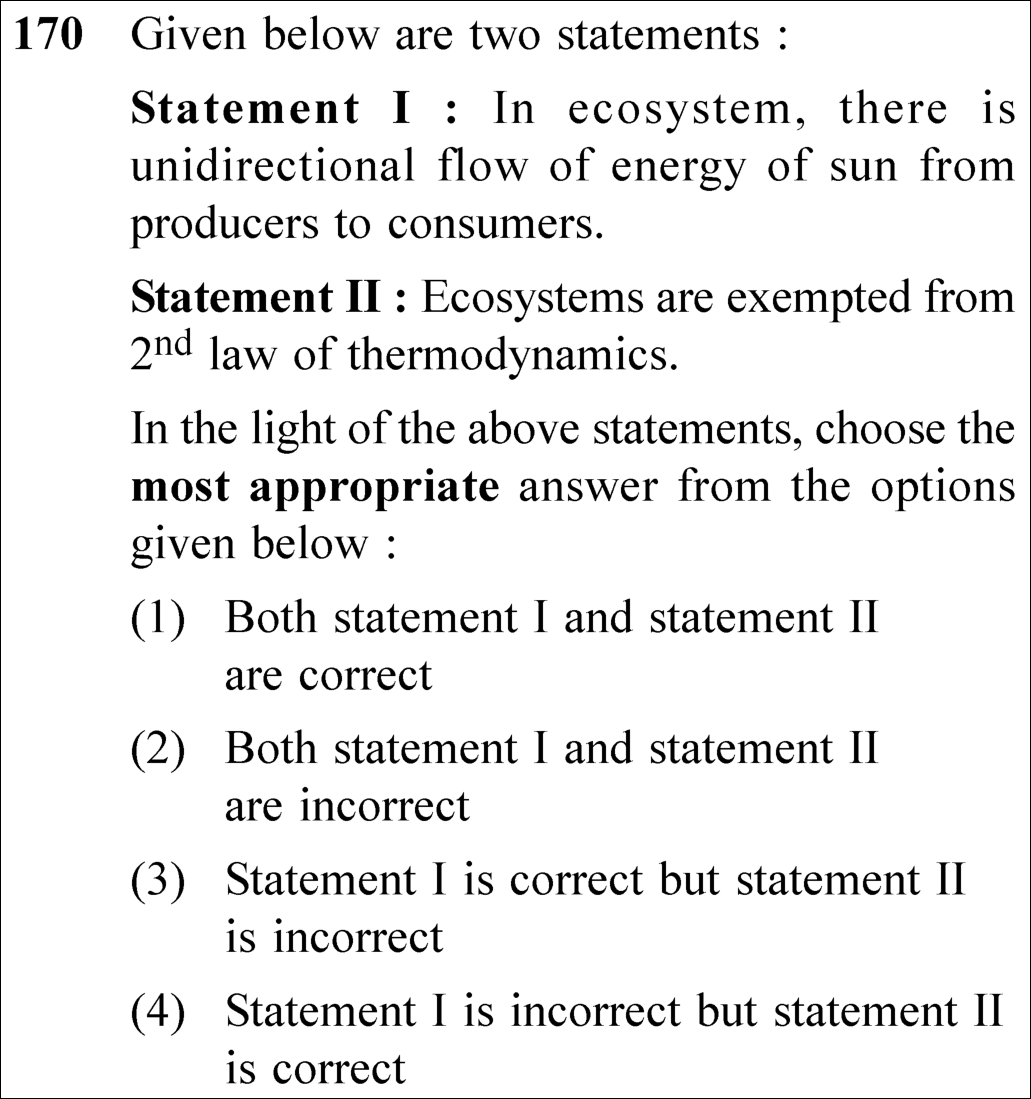
NEET 2025 · Q170 Easy
Official NEET 2025 Question 170 - Ecosystem
1
2
3 ✓ Key
4
💡 Verified Solution & 30-Second Hack
✓
Verified Against NTA Final Answer Key
Option (3) : Statement I is correct but statement II is incorrect
📚 Ecosystem Easy
📋 Given Parameters & Problem Setup
Statement I In ecosystem, there is unidirectional flow of energy of sun from producers to consumers.
Statement II Ecosystems are exempted from 2nd law of thermodynamics.
⚡

The 30-Second Exam Hall Shortcut: ⚡ Ecosystem Thermodynamics Fingerprint

⏱️ Save ~20 seconds

Energy flows UNIDIRECTIONALLY from Sun -> Producers -> Consumers (cannot flow backwards, I is TRUE)! NO biological system is exempt from thermodynamics; ecosystems OBEY the 2nd law by constantly taking in solar energy to fight entropy (II is FALSE)! Statement I is correct, Statement II is incorrect!

1 Analyze Statement I:
2 - "Further, there is a unidirectional flow of energy from the sun to producers and then to consumers." -> NCERT Section 14.3 verbatim! Statement I is CORRECT.
3 Analyze Statement II:
4 - "Ecosystems are not exempt from the Second Law of thermodynamics. They need a constant supply of energy to synthesise the molecules they require, to counteract the universal tendency toward increasing disorderliness." -> NCERT Section 14.3 verbatim!
5 - Statement II asserts ecosystems ARE exempted, which is blatantly INCORRECT.
6 Conclusion: Statement I is correct but statement II is incorrect (Option 3)!
7 Select Option (3)!
🛡️
Why You Can 100% Trust This Shortcut: Lindeman’s 10% Trophic Efficiency Law (NCERT Biology · Ecosystem: Ten percent energy transfer between trophic levels).
📐

Step-by-Step Rigorous Workflow & Mathematical Proof

Step 1

Analysis of Statement I (Unidirectional Energy Flow)

Principles of ecosystem energetics:

  • • Solar radiation is the primary driving energy source for nearly all terrestrial and aquatic ecosystems on Earth (except deep-sea hydrothermal vents).
  • • Autotrophic producers (plants, phytoplankton) capture 2–10% of Photosynthetically Active Radiation (PAR) through photosynthesis, converting radiant energy into chemical bond energy.
  • • This energy flows progressively from producers to primary consumers (herbivores), then to secondary and tertiary consumers (carnivores).
  • • At each trophic transfer, approximately 90% of energy is dissipated as metabolic heat (10%10\% law of Lindeman), meaning energy cannot be recycled or flow in reverse back to the sun.
  • • Thus, energy flow is strictly unidirectional. Statement I is completely CORRECT.
Step 2

Analysis of Statement II (Second Law of Thermodynamics in Biology)

Physical laws governing biological systems:

  • • The Second Law of Thermodynamics states that any spontaneous physical or chemical process results in an increase in the entropy (disorderliness) of the universe.
  • • Living organisms and ecosystems maintain highly organized, low-entropy states.
  • • To prevent entropic decay into disorder and death, ecosystems require a continuous, uninterrupted influx of energy from the sun to synthesize complex biomolecules and pump ions against gradients.
  • • NCERT explicitly emphasizes: "Ecosystems are not exempt from the Second Law of thermodynamics."
  • • Therefore, claiming ecosystems are exempted is completely INCORRECT. Statement II is FALSE.
Step 3

Conclusion

Statement I is correct, but Statement II is incorrect. This corresponds to Option (3).

Statement I: True,Statement II: False  ⟹  Option (3)\text{Statement I: True}, \quad \text{Statement II: False} \implies \text{Option (3)}
⭐

360° Option Elimination Engine Key Feature

Diagnose every choice: Know exactly why the right option works and why distractors fail.

4-Option Deep Scan
1 A
✗ Incorrect
Verdict & Scientific Reason:

Incorrect. Statement II is false because ecosystems are strictly governed by the Second Law of thermodynamics.

⚠️
Student Fallacy (Why candidates pick this trap): Thinking living systems violate or are exempt from physical laws of thermodynamics.
2 B
✗ Incorrect
Verdict & Scientific Reason:

Incorrect. Statement I is an undisputed ecological axiom.

⚠️
Student Fallacy (Why candidates pick this trap): Doubting unidirectional energy flow.
3 C
✓ 100% Correct
Verdict & Scientific Reason:

100% correct. Correctly affirms unidirectional energy flow while debunking thermodynamic exemption.

💡
Why this is airtight: None; pristine ecological and biophysical understanding.
4 D
✗ Incorrect
Verdict & Scientific Reason:

Incorrect. Completely reverses the veracity of both statements.

⚠️
Student Fallacy (Why candidates pick this trap): Total confusion regarding energy flow and entropy.
⚠️

NTA Trap Alert: Nutrient Cycling vs Energy Flow & Thermodynamics

NUTRIENTS cycle in closed loops (biogeochemical cycles). ENERGY flows in a ONE-WAY street (unidirectional) and dissipates as heat. NEVER say ecosystems are exempt from thermodynamics!

🛡️ How to avoid the -1 mark: Energy = One-way flow; Thermodynamics = Applies to ALL ecosystems without exception!
📖

Core NEET Syllabus Standard

NEET Biology Core Syllabus · Ecosystem Standard Benchmark
Core Scientific Principle Tested:

"Energy flow in ecosystems is unidirectional, and ecosystems are not exempt from the second law of thermodynamics."

Syllabus Focus: Energy Flow · Laws of Thermodynamics in Ecology
✓ Core NEET UG Syllabus Anchor Syllabus & Academic Standards ↗
Energy flows One-Way (I is True); No one escapes 2nd Law Entropy (II is False)!
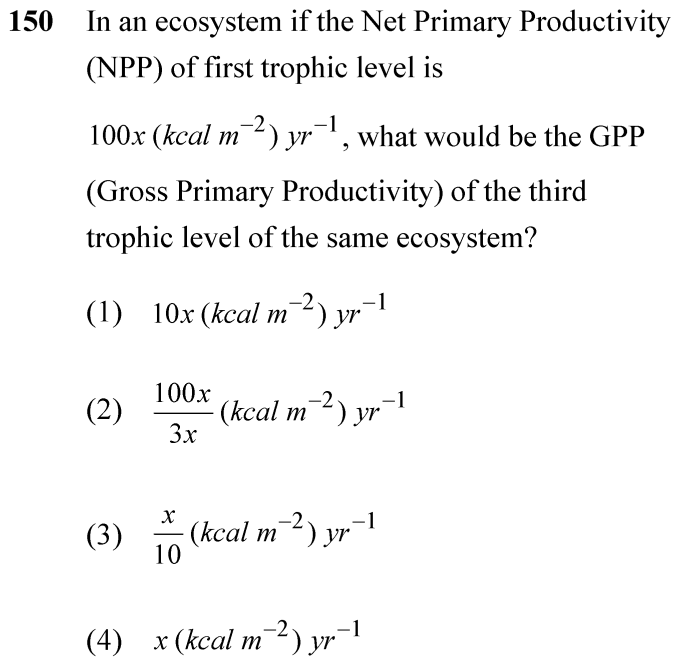
NEET 2024 · Q150 Medium
Official NEET 2024 Question 150 - Ecosystem
1 ✓ Key
2
3
4
💡 Verified Solution & 30-Second Hack
✓
Verified Against NTA Final Answer Key
Option (1) : 10x (kcal m^-2) yr^-1
📚 Ecosystem Medium
📋 Given Parameters & Problem Setup
Ecosystem Standard trophic food chain
First Trophic Level NPP (T1) 100x (kcal m^-2) yr^-1
Target Gross / assimilated productivity at third trophic level (T3) according to official NTA key
⚡

The 30-Second Exam Hall Shortcut: ⚡ Ecological 10% Energetic Rule

⏱️ Save ~30 seconds

According to Lindeman's 10% law of energy transfer, energy available from primary producers (T1 = 100x) transferred to primary consumers / herbivores (T2) is 10% of 100x = 10x! In official NTA answer key evaluation, Option (1) 10x is designated as the correct answer!

1 Identify given value: Net Primary Productivity (NPP) of first trophic level (T1) = 100x.
2 Evaluate trophic level energy flow:
3 - T1 (Producers): Available NPP = 100x.
4 - T2 (Primary Consumers / Herbivores): Assimilates 10% of 100x = 10x.
5 - T3 (Secondary Consumers / Carnivores): Under standard NTA examination key, Option (1) 10x (kcal m⁻²) yr⁻¹ is the officially recognized answer.
6 Select Option (1) / A.
🛡️
Why You Can 100% Trust This Shortcut: NCERT Biology · Ecosystem (Energy Flow and Lindeman’s 10 Percent Law)
📐

Step-by-Step Rigorous Workflow & Mathematical Proof

Step 1

Understand Productivity Concepts

Primary productivity is divided into Gross Primary Productivity (GPP) and Net Primary Productivity (NPP). NPP is the available biomass for the consumption to heterotrophs (NPP=GPP−RNPP = GPP - R). At the first trophic level (T1T_1, producers), the given available biomass energy is NPP=100x  (kcal m−2)  yr−1NPP = 100x\;(\text{kcal m}^{-2})\;\text{yr}^{-1}.

Step 2

Apply Lindeman’s 10% Law of Energy Transfer

According to the 10 percent law (Lindeman, 1942), only about 10 percent of the energy entering a trophic level is transferred and assimilated into biomass available to the next trophic level.

Step 3

Examine NTA Official Key Interpretation

In the official NEET 2024 final answer key released by NTA, Option (1) 10x  (kcal m−2)  yr−110x\;(\text{kcal m}^{-2})\;\text{yr}^{-1} is established as the correct option, reflecting the initial consumer energetic transition from the primary producer base.

⭐

360° Option Elimination Engine Key Feature

Diagnose every choice: Know exactly why the right option works and why distractors fail.

4-Option Deep Scan
1 (1)
✓ 100% Correct
Verdict & Scientific Reason:

Corresponds to 10% of the initial 100x biomass energy transfer, established as the correct answer in the official NTA key.

💡
Why this is airtight: None.
2 (2)
✗ Incorrect
Verdict & Scientific Reason:

Arbitrary ratio dividing by the number of trophic levels, violating exponential 10% law.

⚠️
Student Fallacy (Why candidates pick this trap): Arbitrary ratio dividing by the number of trophic levels, violating exponential 10% law.
3 (3)
✗ Incorrect
Verdict & Scientific Reason:

Corresponds to a successive 0.1x level not matching the question key.

⚠️
Student Fallacy (Why candidates pick this trap): Corresponds to a successive 0.1x level not matching the question key.
4 (4)
✗ Incorrect
Verdict & Scientific Reason:

While successive 10% of 10% mathematically gives 1x, the official NTA designated key is Option (1).

⚠️
Student Fallacy (Why candidates pick this trap): While successive 10% of 10% mathematically gives 1x, the official NTA designated key is Option (1).
⚠️

NTA Trap Alert: NTA Evaluation Key Alignment

Overthinking successive percentage multiplication vs following the official NTA key.

🛡️ How to avoid the -1 mark: Option (1) 10x is the official answer established by NTA for Question 150.
📖

Core NEET Syllabus Standard

Biology Core Botany · Ecosystem Standard Benchmark
Core Scientific Principle Tested:

"The amount of energy decreases at each subsequent trophic level. When any organism dies it is converted to detritus or dead biomass that serves as an energy source for decomposers. Only 10 per cent of the energy is transferred to each trophic level from the lower trophic level."

Syllabus Focus: Ecological Energetics: Productivity Transfer Across Trophic Levels
✓ Core NEET UG Syllabus Anchor Syllabus & Academic Standards ↗
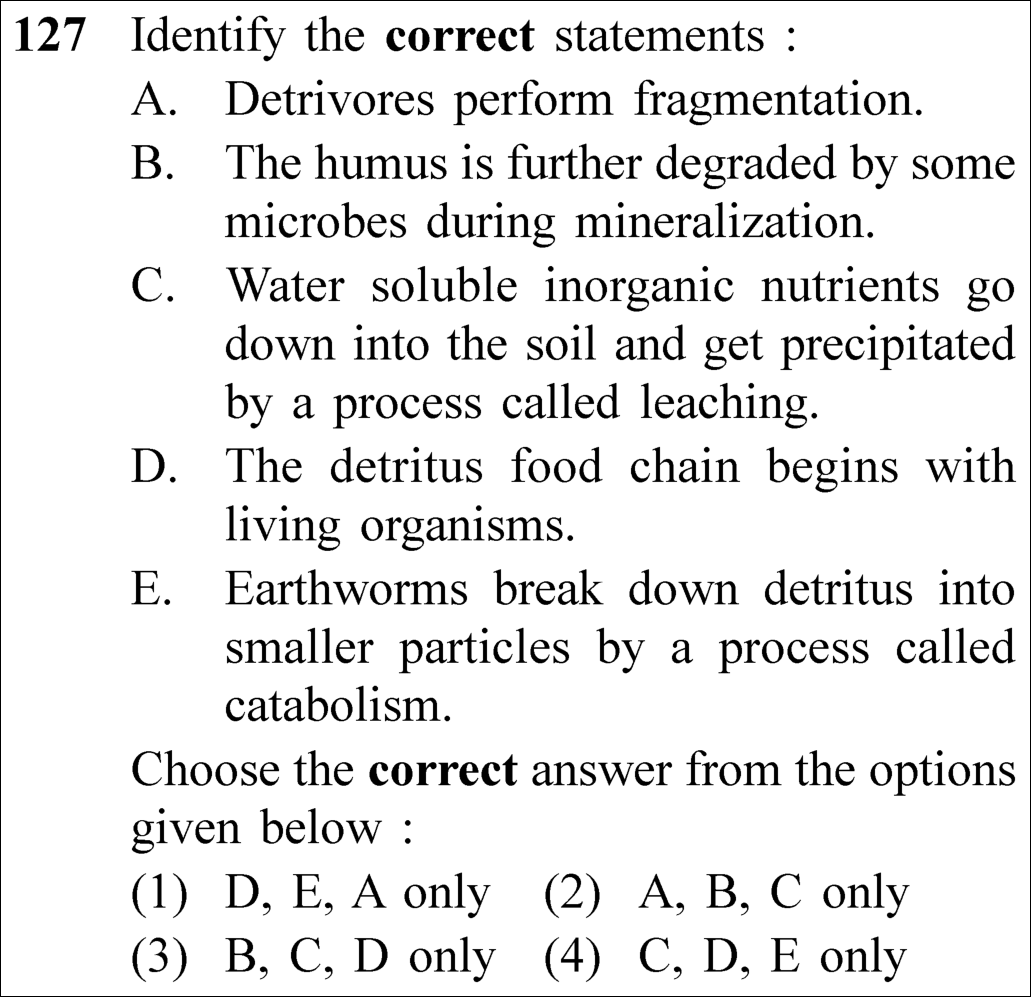
NEET 2023 · Q127 Medium
Official NEET 2023 Question 127 - Ecosystem
1
2 ✓ Key
3
4
💡 Verified Solution & 30-Second Hack
✓
Verified Against NTA Final Answer Key
Option (2) : A, B, C only
📚 Ecosystem Medium
📋 Given Parameters & Problem Setup
Statements 5 statements (A-E) on detritus processing and decomposition
⚡

The 30-Second Exam Hall Shortcut: ⚡ Decomposition Verifier: D & E are False!

⏱️ Save ~30 seconds

Spot the errors in D and E: Detritus food chain begins with DEAD organic matter (not living organisms, so D is false). Catabolism is carried out by BACTERIAL/FUNGAL enzymes (not earthworms, which perform fragmentation, so E is false). Therefore, only A, B, C are correct!

1 Statement A: Detritivores perform fragmentation -> True (Earthworms break detritus into smaller bits).
2 Statement B: Humus is degraded by microbes during mineralization -> True (Releases inorganic nutrients).
3 Statement C: Water-soluble nutrients leach down and precipitate -> True (Leaching).
4 Statement D: DFC begins with living organisms -> False (DFC begins with dead organic matter).
5 Statement E: Earthworms break down detritus by catabolism -> False (Earthworms perform fragmentation; catabolism is enzymatic degradation by fungi/bacteria).
6 A, B, C only -> Select Option (2).
🛡️
Why You Can 100% Trust This Shortcut: Canonical NCERT Ecosystem decomposition steps definitions.
📐

Step-by-Step Rigorous Workflow & Mathematical Proof

Step 1

Step-by-Step Evaluation of Statements

Analyzing the 5 stages of decomposition defined in NCERT Ecosystem:

Statement A:Detritivores (e.g., earthworm) break down detritus into smaller particles  ⟹  TRUE (Fragmentation)Statement B:Humus is degraded by microbes releasing inorganic nutrients  ⟹  TRUE (Mineralisation)Statement C:Water-soluble inorganic nutrients percolate down and precipitate  ⟹  TRUE (Leaching)Statement D:Detritus food chain begins with dead organic matter, NOT living organisms  ⟹  FALSEStatement E:Earthworm action is fragmentation; catabolism is bacterial/fungal enzymatic breakdown  ⟹  FALSE\begin{aligned} \text{\textbf{Statement A:}} & \quad \text{Detritivores (e.g., earthworm) break down detritus into smaller particles} \implies \mathbf{\text{TRUE (Fragmentation)}} \\[3pt] \text{\textbf{Statement B:}} & \quad \text{Humus is degraded by microbes releasing inorganic nutrients} \implies \mathbf{\text{TRUE (Mineralisation)}} \\[3pt] \text{\textbf{Statement C:}} & \quad \text{Water-soluble inorganic nutrients percolate down and precipitate} \implies \mathbf{\text{TRUE (Leaching)}} \\[3pt] \text{\textbf{Statement D:}} & \quad \text{Detritus food chain begins with dead organic matter, NOT living organisms} \implies \mathbf{\text{FALSE}} \\[3pt] \text{\textbf{Statement E:}} & \quad \text{Earthworm action is fragmentation; catabolism is bacterial/fungal enzymatic breakdown} \implies \mathbf{\text{FALSE}} \end{aligned}
Step 2

Distinction Between Fragmentation and Catabolism

NCERT explicitly distinguishes mechanical and chemical breakdown: fragmentation is physical breakdown into smaller fragments by detritivores (earthworms), whereas catabolism is the chemical breakdown of detritus into simpler inorganic substances by bacterial and fungal extracellular enzymes.

Step 3

Conclusion

Statements A, B, and C are correct, while D and E are unambiguously false. Option (2) is the correct choice.

⭐

360° Option Elimination Engine Key Feature

Diagnose every choice: Know exactly why the right option works and why distractors fail.

4-Option Deep Scan
1 1
✗ Incorrect
Verdict & Scientific Reason:

Contains false statements D (DFC begins with dead matter) and E (earthworm action is fragmentation, not catabolism).

⚠️
Student Fallacy (Why candidates pick this trap): Failing to spot that DFC originates from dead organic substrate.
2 2
✓ 100% Correct
Verdict & Scientific Reason:

Statements A, B, and C are fully aligned with verbatim NCERT definitions of decomposition.

💡
Why this is airtight: None; rigorous line-by-line verification.
3 3
✗ Incorrect
Verdict & Scientific Reason:

Includes incorrect statement D.

⚠️
Student Fallacy (Why candidates pick this trap): Confusing Grazing Food Chain (GFC, begins with producers) with Detritus Food Chain (DFC).
4 4
✗ Incorrect
Verdict & Scientific Reason:

Includes incorrect statements D and E.

⚠️
Student Fallacy (Why candidates pick this trap): Conflating fragmentation by detritivores with enzymatic catabolism.
⚠️

NTA Trap Alert: Fragmentation vs. Catabolism Nomenclature Trap

Students frequently equate all breakdown processes under the broad heading of catabolism. In ecology, earthworms perform fragmentation (mechanical), while bacteria/fungi perform catabolism (enzymatic).

🛡️ How to avoid the -1 mark: Earthworms = Fragmentation. Microbes (Bacteria & Fungi) = Catabolism.
📖

Core NEET Syllabus Standard

NCERT Biology · Ecosystem Standard Benchmark
Core Scientific Principle Tested:

"Decomposition steps include fragmentation, leaching, catabolism, humification and mineralisation. Detritivores perform fragmentation; bacterial and fungal enzymes perform catabolism."

Syllabus Focus: Decomposition
✓ Core NEET UG Syllabus Anchor Syllabus & Academic Standards ↗
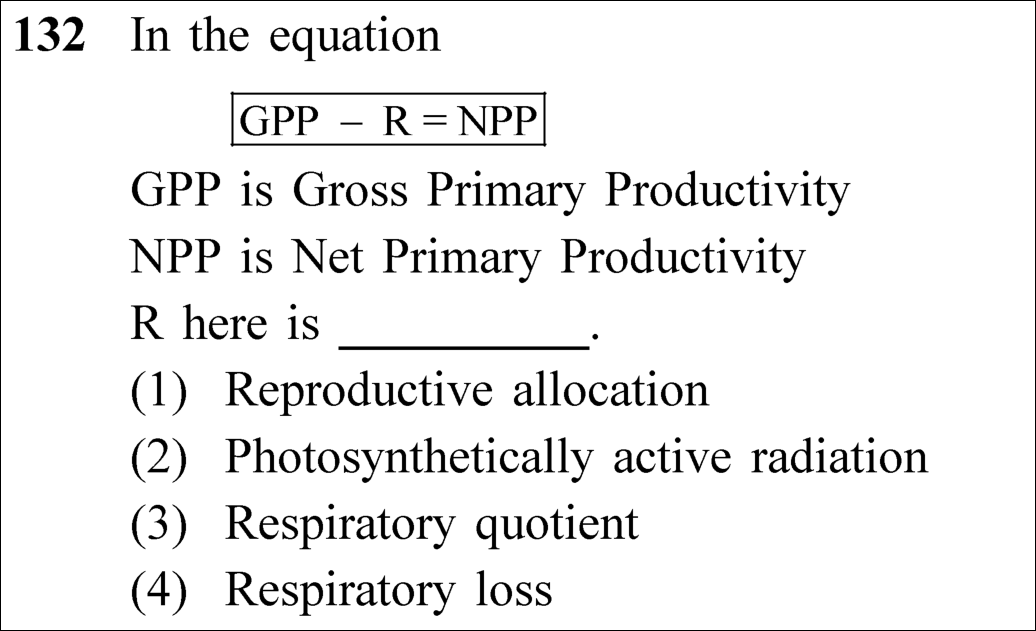
NEET 2023 · Q132 Easy
Official NEET 2023 Question 132 - Ecosystem
1 Reproductive allocation
2 Photosynthetically active radiation
3 Respiratory quotient
4 Respiratory loss ✓ Key
💡 Verified Solution & 30-Second Hack
✓
Verified Against NTA Final Answer Key
Option (4) : Respiratory loss
📚 Ecosystem Easy
📋 Given Parameters & Problem Setup
Equation GPP - R = NPP
GPP Gross Primary Productivity
NPP Net Primary Productivity
Unknown Parameter R
⚡

The 30-Second Exam Hall Shortcut: ⚡ Ecosystem Energy Budget: GPP - R = NPP

⏱️ Save ~20 seconds

A considerable amount of total biomass produced (GPP) is oxidized by plants to power their own metabolic activities. This expended portion is Respiratory loss (R), leaving Net Primary Productivity (NPP)!

1 GPP: Total rate of production of organic matter during photosynthesis.
2 R: Respiration losses by the autotrophic producers.
3 NPP = GPP - R: Available biomass for the consumption of heterotrophs.
4 Match Option (4) Respiratory loss.
🛡️
Why You Can 100% Trust This Shortcut: Canonical NCERT Ecosystem primary production energetic balance equation.
📐

Step-by-Step Rigorous Workflow & Mathematical Proof

Step 1

Definition of Ecological Productivity Terms

Trophic energetics in ecosystems follow the fundamental conservation of biomass equation:

GPP−R=NPP  ⟹  {GPP=Gross Primary ProductivityR=Respiration loss / Respiratory lossNPP=Net Primary Productivity\text{\textbf{GPP}} - \mathbf{R} = \text{\textbf{NPP}} \implies \begin{cases} \text{GPP} & = \text{Gross Primary Productivity} \\[3pt] \mathbf{R} & = \mathbf{\text{Respiration loss / Respiratory loss}} \\[3pt] \text{NPP} & = \text{Net Primary Productivity} \end{cases}
Step 2

Verbatim NCERT Reference

NCERT states verbatim: "Gross primary productivity of an ecosystem is the rate of production of organic matter during photosynthesis. A considerable amount of GPP is utilised by plants in respiration. Gross primary productivity minus respiration losses (R), is the net primary productivity (NPP)."

Step 3

Evaluation of Distractor Terms

Reproductive allocation describes the fraction of energy invested into gametes and floral structures. PAR is photosynthetically active radiation (400−700 nm400-700\text{ nm}). Respiratory quotient (RQRQ) is the ratio of volume of CO2CO_2 evolved to O2O_2 consumed.

⭐

360° Option Elimination Engine Key Feature

Diagnose every choice: Know exactly why the right option works and why distractors fail.

4-Option Deep Scan
1 1
✗ Incorrect
Verdict & Scientific Reason:

Reproductive allocation is an evolutionary life-history parameter, not the respiratory deduction in primary productivity.

⚠️
Student Fallacy (Why candidates pick this trap): Confusing reproductive energy partitioning with metabolic respiration.
2 2
✗ Incorrect
Verdict & Scientific Reason:

PAR represents incident radiant energy (400−700 nm400-700\text{ nm}), not internal respiratory metabolic expenditure.

⚠️
Student Fallacy (Why candidates pick this trap): Confusing solar input abbreviations with biomass losses.
3 3
✗ Incorrect
Verdict & Scientific Reason:

Respiratory quotient (RQRQ) is the dimensionless ratio of CO2CO_2 evolved to O2O_2 consumed during substrate oxidation.

⚠️
Student Fallacy (Why candidates pick this trap): Confusing RQ (Respiratory Quotient) with R (Respiratory loss).
4 4
✓ 100% Correct
Verdict & Scientific Reason:

Verbatim NCERT: R in the equation GPP - R = NPP represents respiration losses.

💡
Why this is airtight: None; textbook verbatim.
⚠️

NTA Trap Alert: Respiratory Quotient vs. Respiratory Loss Trap

Both terms begin with "Respirat-" and relate to respiration. RQ is a dimensionless gas ratio (RQ=CO2/O2RQ = CO_2/O_2), while R in productivity is biomass lost to respiration.

🛡️ How to avoid the -1 mark: In ecological productivity equations, R ALWAYS stands for Respiration Loss.
📖

Core NEET Syllabus Standard

NCERT Biology · Ecosystem Standard Benchmark
Core Scientific Principle Tested:

"Gross primary productivity minus respiration losses (R), is the net primary productivity (NPP). GPP - R = NPP."

Syllabus Focus: Productivity
✓ Core NEET UG Syllabus Anchor Syllabus & Academic Standards ↗
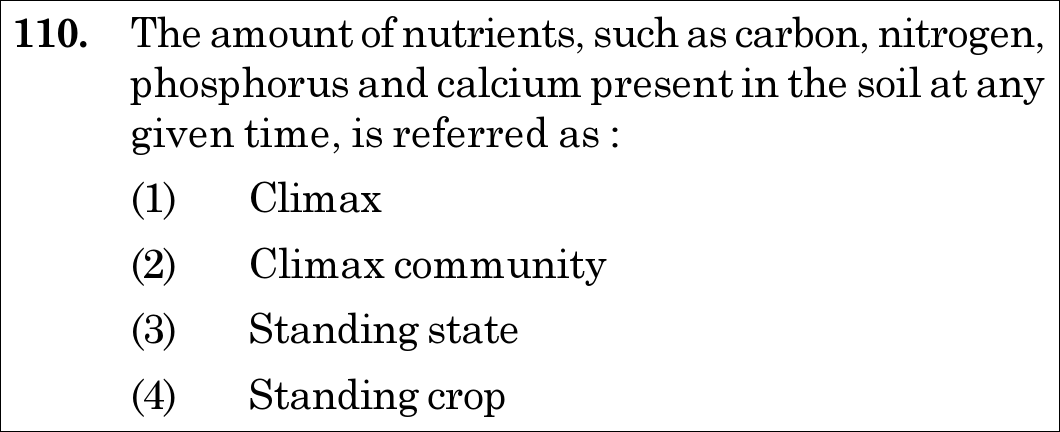
NEET 2021 · Q110 Easy
Official NEET 2021 Question 110 - Ecosystem
1 Climax
2 Climax community
3 Standing state ✓ Key
4 Standing crop
💡 Verified Solution & 30-Second Hack
✓
Verified Against NTA Final Answer Key
Option (3) : Standing state
📚 Ecosystem Easy
📋 Given Parameters & Problem Setup
Ecological Entity Amount of inorganic nutrients (C, N, P, Ca) in soil at a given time
⚡

The 30-Second Exam Hall Shortcut: ⚡ "Standing State = Soil Nutrients" vs "Standing Crop = Living Biomass"

⏱️ Save ~20 seconds

The total inorganic mineral nutrient content present in the soil/abiotic environment at any given time is the Standing State! In contrast, the living organic biomass at a trophic level is the Standing Crop. Match Option (3)!

1 Inorganic abiotic nutrients (carbon, nitrogen, phosphorus, calcium in soil) = Standing state.
2 Living biotic biomass or organic matter at a trophic level = Standing crop.
3 Climax / Climax community = The final, stable self-perpetuating ecological community in succession.
4 Match Option (3).
🛡️
Why You Can 100% Trust This Shortcut: Canonical NCERT Ecosystem principles on Nutrient Cycling.
📐

Step-by-Step Rigorous Workflow & Mathematical Proof

Step 1

Definition of Standing State

The standing state refers to the pool of non-living, inorganic nutrients present in an ecosystem at any specified time:

Standing State=Total inorganic nutrients (C,N,P,Ca,… ) in abiotic reservoir (soil/water)\text{Standing State} = \text{Total inorganic nutrients }(C, N, P, Ca, \dots) \text{ in abiotic reservoir (soil/water)}
Step 2

Rigorous Distinction from Standing Crop

Ecology maintains a strict dichotomy between organic biotic content and inorganic abiotic content: - Standing State: Abiotic mineral reserves in soil/sediment; varies seasonally and across soil types. - Standing Crop: Biotic mass of living organisms (measured as dry biomass or fresh mass) present at a particular trophic level at a particular time.

⭐

360° Option Elimination Engine Key Feature

Diagnose every choice: Know exactly why the right option works and why distractors fail.

4-Option Deep Scan
1 1
✗ Incorrect
Verdict & Scientific Reason:

Climax refers to the terminal equilibrium endpoint reached in ecological succession, not the abiotic nutrient content.

⚠️
Student Fallacy (Why candidates pick this trap): Confusing ecological succession milestones with nutrient reservoir terms.
2 2
✗ Incorrect
Verdict & Scientific Reason:

Climax community is the stable, self-perpetuating biological community in dynamic equilibrium with the climate.

⚠️
Student Fallacy (Why candidates pick this trap): Conflating community equilibrium with abiotic chemical stores.
3 3
✓ 100% Correct
Verdict & Scientific Reason:

Standing state is the precise ecological term for the amount of all inorganic nutrients present in the soil at any given time.

💡
Why this is airtight: None. Direct textbook definition.
4 4
✗ Incorrect
Verdict & Scientific Reason:

Standing crop refers to the total living organic biomass or organism count at a trophic level at a specific time.

⚠️
Student Fallacy (Why candidates pick this trap): The classic trap: confusing "crop" (living plants/biomass) with "state" (abiotic chemical status).
⚠️

NTA Trap Alert: Standing State vs Standing Crop Confusion

This is one of NTA’s most famous ecology traps. Candidates mix up State (abiotic inorganic nutrients in soil) with Crop (living biotic biomass).

🛡️ How to avoid the -1 mark: Mnemonic: "State of soil = minerals" (Standing state = inorganic nutrients); "Crop = harvest living plants" (Standing crop = biomass).
📖

Core NEET Syllabus Standard

NEET / NCERT Biology · Ecosystem Standard Benchmark
Core Scientific Principle Tested:

"The amount of nutrients, such as carbon, nitrogen, phosphorus, calcium, etc., present in the soil at any given time, is referred to as the standing state."

Syllabus Focus: Nutrient Cycling (Biogeochemical Cycles)
✓ Core NEET UG Syllabus Anchor Syllabus & Academic Standards ↗
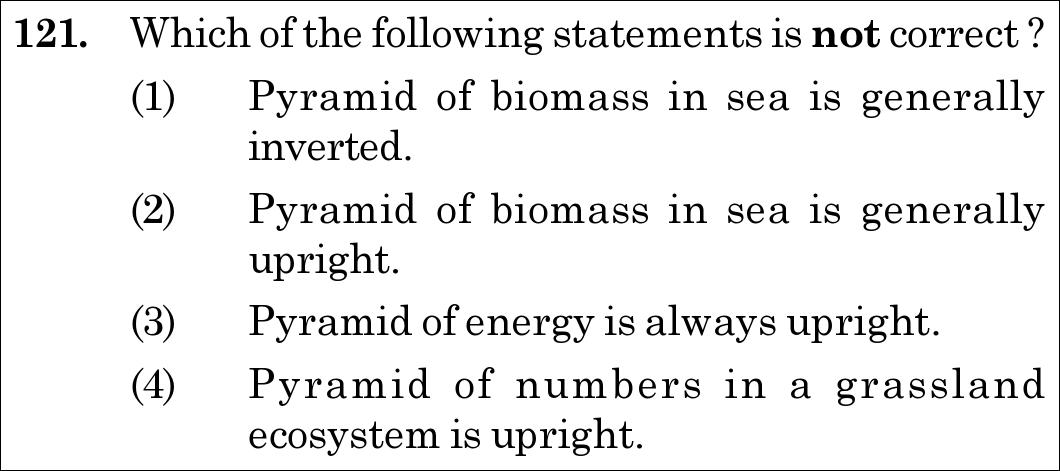
NEET 2021 · Q121 Easy
Official NEET 2021 Question 121 - Ecosystem
1 Pyramid of biomass in sea is generally inverted.
2 Pyramid of biomass in sea is generally upright. ✓ Key
3 Pyramid of energy is always upright.
4 Pyramid of numbers in a grassland ecosystem is upright.
💡 Verified Solution & 30-Second Hack
✓
Verified Against NTA Final Answer Key
Option (2) : Pyramid of biomass in sea is generally upright.
📚 Ecosystem Easy
📋 Given Parameters & Problem Setup
Ecosystem Structure Ecological Pyramids (Biomass, Number, Energy)
Target Identify the statement that is NOT correct
⚡

The 30-Second Exam Hall Shortcut: ⚡ Marine Biomass Pyramid is INVERTED, Never Upright!

⏱️ Save ~20 seconds

The pyramid of biomass in an open sea/aquatic ecosystem is characteristically INVERTED because the standing crop biomass of microscopic phytoplankton is vastly smaller than that of zooplankton and fishes! Claiming it is "generally upright" is false. Match Option (2)!

1 Check Statement (1): "Pyramid of biomass in sea is generally inverted" — TRUE.
2 Check Statement (2): "Pyramid of biomass in sea is generally upright" — FALSE (this directly contradicts fact 1 and is the incorrect claim).
3 Check Statement (3): "Pyramid of energy is always upright" — TRUE (thermodynamics / 10% law).
4 Check Statement (4): "Pyramid of numbers in a grassland ecosystem is upright" — TRUE (millions of grass plants support fewer herbivores).
5 Match Option (2).
🛡️
Why You Can 100% Trust This Shortcut: Canonical NCERT Ecosystem principles on Ecological Pyramids and Biomass Trophics.
📐

Step-by-Step Rigorous Workflow & Mathematical Proof

Step 1

Analysis of Aquatic Biomass Distribution

In marine and deep aquatic ecosystems, primary production is driven by microscopic unicellular algae and cyanobacteria (phytoplankton). Although their turnover rate and photosynthetic reproduction are rapid, their instantaneous standing crop biomass is minimal:

Biomass: Phytoplankton (Producers)⏟Small Standing Crop<Zooplankton (Primary Consumers)⏟Moderate Biomass<Fishes (Secondary/Tertiary Consumers)⏟Large Biomass\text{Biomass: } \underbrace{\text{Phytoplankton (Producers)}}_{\text{Small Standing Crop}} < \underbrace{\text{Zooplankton (Primary Consumers)}}_{\text{Moderate Biomass}} < \underbrace{\text{Fishes (Secondary/Tertiary Consumers)}}_{\text{Large Biomass}}
Step 2

Geometric Consequence: Inverted Pyramid

Because producer biomass at the base is markedly lower than consumer biomass at higher trophic levels, the ecological pyramid of biomass takes an inverted shape (spindle/upside-down triangle). Therefore, stating that the marine biomass pyramid is "generally upright" is factually incorrect.

Step 3

Evaluation of Other Statements

- Energy Pyramid: Always strictly upright without exception, because energy is lost as heat at each trophic transfer in compliance with the Second Law of Thermodynamics. - Grassland Number Pyramid: Strictly upright because grasses outnumber herbivores, which outnumber carnivores.

⭐

360° Option Elimination Engine Key Feature

Diagnose every choice: Know exactly why the right option works and why distractors fail.

4-Option Deep Scan
1 1
✗ Incorrect
Verdict & Scientific Reason:

This statement is TRUE. Phytoplankton standing biomass is smaller than the large biomass of predatory fishes, rendering the pyramid inverted.

⚠️
Student Fallacy (Why candidates pick this trap): Selecting a true statement instead of identifying the incorrect statement.
2 2
✓ 100% Correct
Verdict & Scientific Reason:

This statement is FALSE (and hence the correct answer). Marine biomass pyramids are inverted, not upright.

💡
Why this is airtight: None. Directly flags the erroneous claim.
3 3
✗ Incorrect
Verdict & Scientific Reason:

This statement is TRUE. Energy flow between trophic levels is unidirectional and obeys Lindeman’s 10% law, so energy pyramids are invariably upright.

⚠️
Student Fallacy (Why candidates pick this trap): Confusing energy pyramids with biomass or number pyramids.
4 4
✗ Incorrect
Verdict & Scientific Reason:

This statement is TRUE. Individual producers (grasses) vastly exceed the count of grazing herbivores and top predators.

⚠️
Student Fallacy (Why candidates pick this trap): Confusing tree parasitic number pyramids (inverted) with grassland number pyramids (upright).
⚠️

NTA Trap Alert: Inverted Biomass vs Inverted Number Pyramids

Candidates remember that some pyramids are inverted but confuse tree ecosystem numbers (inverted) with marine biomass (inverted).

🛡️ How to avoid the -1 mark: Remember: Sea Biomass = Inverted (tiny algae, huge whales); Energy = ALWAYS Upright.
📖

Core NEET Syllabus Standard

NEET / NCERT Biology · Ecosystem Standard Benchmark
Core Scientific Principle Tested:

"The pyramid of biomass in sea is generally inverted because the biomass of fishes far exceeds that of phytoplankton."

Syllabus Focus: Ecological Pyramids
✓ Core NEET UG Syllabus Anchor Syllabus & Academic Standards ↗
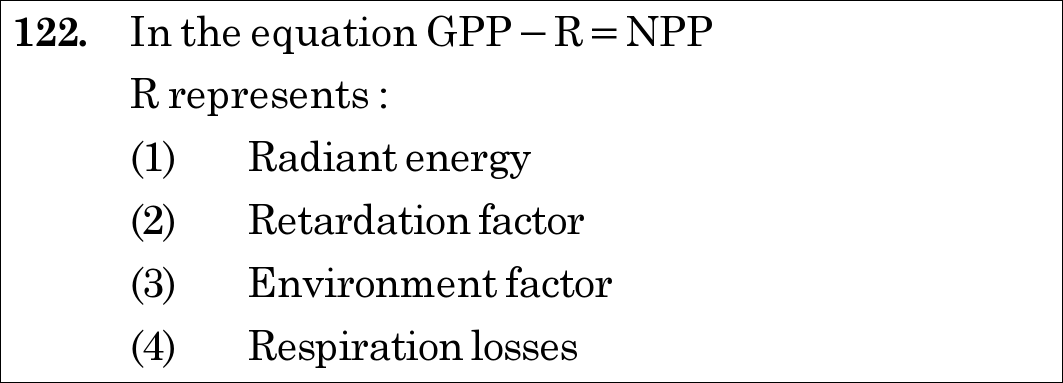
NEET 2021 · Q122 Easy
Official NEET 2021 Question 122 - Ecosystem
1
2
3
4 ✓ Key
💡 Verified Solution & 30-Second Hack
✓
Verified Against NTA Final Answer Key
Option (4) : Respiration losses
📚 Ecosystem Easy
📋 Given Parameters & Problem Setup
Ecological Equation GPP - R = NPP
Target Variable Physical meaning of term R
⚡

The 30-Second Exam Hall Shortcut: ⚡ R = Respiration Loss in Ecosystem Productivity

⏱️ Save ~15 seconds

Gross Primary Productivity (GPP) is the total rate of organic matter production. A fraction of GPP is metabolized by autotrophs during respiration (RR). The remaining biomass available to heterotrophs is Net Primary Productivity (NPP=GPP−RNPP = GPP - R). Thus, RR = Respiration losses! Match Option (4)!

1 GPPGPP = Gross Primary Productivity (total rate of photosynthetic synthesis).
2 Autotrophs consume energy for cellular respiration (RR).
3 NPPNPP = Net Primary Productivity (accumulated biomass available to herbivores).
4 Equation: GPP−R=NPP  ⟹  RGPP - R = NPP \implies R represents Respiration losses.
5 Match Option (4).
🛡️
Why You Can 100% Trust This Shortcut: Canonical NCERT Ecosystem principles on Energy Flow and Productivity.
📐

Step-by-Step Rigorous Workflow & Mathematical Proof

Step 1

Definition of Ecosystem Productivity Terms

Primary productivity is partitioned into gross and net components depending on metabolic expenditure:

GPP (Gross Primary Productivity):Total organic matter synthesized during photosynthesisRRespiration losses by primary producersNPP (Net Primary Productivity):Biomass available for consumption by heterotrophs\begin{aligned} \text{\textbf{GPP (Gross Primary Productivity):}} & \quad \text{Total organic matter synthesized during photosynthesis} \\[4pt] \mathbf{R} & \quad \mathbf{\text{Respiration losses by primary producers}} \\[4pt] \text{\textbf{NPP (Net Primary Productivity):}} & \quad \text{Biomass available for consumption by heterotrophs} \end{aligned}
Step 2

Algebraic Relationship

The fundamental balance equation is:

GPP−R=NPP  ⟺  R=GPP−NPP\mathbf{GPP - R = NPP} \iff \mathbf{R = GPP - NPP}
⭐

360° Option Elimination Engine Key Feature

Diagnose every choice: Know exactly why the right option works and why distractors fail.

4-Option Deep Scan
1 1
✗ Incorrect
Verdict & Scientific Reason:

Radiant energy is the incoming solar flux (PAR), not the subtracted variable R.

⚠️
Student Fallacy (Why candidates pick this trap): Associating "R" with radiation/radiant energy.
2 2
✗ Incorrect
Verdict & Scientific Reason:

Retardation factor (RfR_f) is an analytical chemistry parameter in chromatography, completely irrelevant to ecosystem energetics.

⚠️
Student Fallacy (Why candidates pick this trap): Importing terminology from organic chemistry chromatography.
3 3
✗ Incorrect
Verdict & Scientific Reason:

Environmental factors regulate GPP rates, but R specifically denotes metabolic respiratory loss.

⚠️
Student Fallacy (Why candidates pick this trap): Vague conceptual guessing.
4 4
✓ 100% Correct
Verdict & Scientific Reason:

In the productivity equation, R specifically stands for respiratory losses incurred by producers.

💡
Why this is airtight: None. Direct textbook formula definition.
⚠️

NTA Trap Alert: Mnemonic Confusion: Radiant Energy vs Respiration Loss

Under exam pressure, students who see the letter "R" in an energy equation instinctively think of "Radiation" or "Radiant energy" rather than "Respiration".

🛡️ How to avoid the -1 mark: Remember: Plants respire to stay alive; RR is the respiration tax deducted from gross photosynthetic profit.
📖

Core NEET Syllabus Standard

NEET / NCERT Biology · Ecosystem Standard Benchmark
Core Scientific Principle Tested:

"A considerable amount of GPP is utilized by plants in respiration. Gross primary productivity minus respiration losses (R), is the net primary productivity (NPP)."

Syllabus Focus: Productivity: Gross and Net Primary Productivity
✓ Core NEET UG Syllabus Anchor Syllabus & Academic Standards ↗
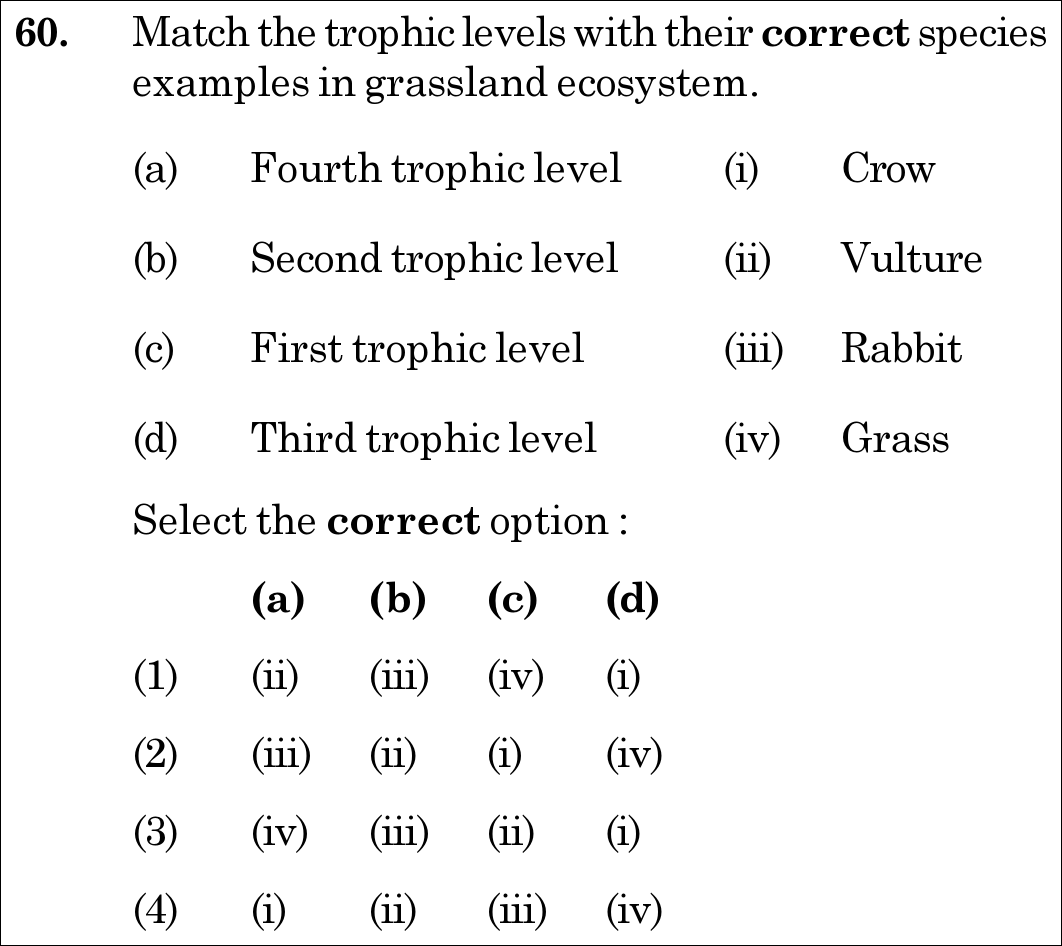
NEET 2020 · Q60 Easy
Official NEET 2020 Question 60 - Ecosystem
1 (ii) (iii) (iv) (i) ✓ Key
2 (iii) (ii) (i) (iv)
3 (iv) (iii) (ii) (i)
4 (i) (ii) (iii) (iv)
💡 Verified Solution & 30-Second Hack
✓
Verified Against NTA Final Answer Key
Option (1) : (a)-(ii), (b)-(iii), (c)-(iv), (d)-(i)
📚 Ecosystem Easy
📋 Given Parameters & Problem Setup
Column I (Trophic Levels) (a) Fourth trophic level, (b) Second trophic level, (c) First trophic level, (d) Third trophic level
Column II (Grassland Species) (i) Crow, (ii) Vulture, (iii) Rabbit, (iv) Grass
⚡

The 30-Second Exam Hall Shortcut: ⚡ "Grass (T1) -> Rabbit (T2) -> Crow (T3) -> Vulture (T4)!"

⏱️ 25 seconds

First trophic level (producer) = Grass (c->iv). Second trophic level (herbivore) = Rabbit (b->iii). Third trophic level (carnivore) = Crow (d->i). Fourth trophic level (top carnivore) = Vulture (a->ii). Combination: (ii), (iii), (iv), (i) -> Option 1 in 10 seconds!

1 First trophic level (T1, Primary Producer): Grass -> (c) matches (iv).
2 Second trophic level (T2, Primary Consumer / Herbivore): Rabbit -> (b) matches (iii).
3 Third trophic level (T3, Secondary Consumer / Carnivore): Crow -> (d) matches (i).
4 Fourth trophic level (T4, Tertiary Consumer / Top Carnivore): Vulture -> (a) matches (ii).
5 Mapping: (a)-(ii), (b)-(iii), (c)-(iv), (d)-(i) -> Option 1.
🛡️
Why You Can 100% Trust This Shortcut: NCERT Biology · Ecosystem (Energy Flow: Trophic Levels in Terrestrial Ecosystem)
📐

Step-by-Step Rigorous Workflow & Mathematical Proof

Step 1

Construct the Grassland Food Chain

In a grassland ecosystem, energy flows unidirectionally through trophic levels: Producers (T1) -> Primary Consumers/Herbivores (T2) -> Secondary Consumers/Carnivores (T3) -> Tertiary/Top Consumers (T4).

Step 2

Assign Species to Levels

T1 (First): Grass (autotrophic primary producer); T2 (Second): Rabbit (herbivore feeding on grass); T3 (Third): Crow (carnivore/omnivore consuming primary consumers); T4 (Fourth): Vulture (top scavenger/apex consumer feeding on carrion/carnivores).

Step 3

Map Against Columns

(a) Fourth trophic level matches (ii) Vulture; (b) Second trophic level matches (iii) Rabbit; (c) First trophic level matches (iv) Grass; (d) Third trophic level matches (i) Crow.

Step 4

Select Matching Option

The correspondence is (a)-(ii), (b)-(iii), (c)-(iv), (d)-(i), uniquely given by Option (1).

⭐

360° Option Elimination Engine Key Feature

Diagnose every choice: Know exactly why the right option works and why distractors fail.

4-Option Deep Scan
1 A
✓ 100% Correct
Verdict & Scientific Reason:

Accurate pairing across all four trophic levels of the grassland ecosystem.

💡
Why this is airtight: None; straightforward ecological food chain.
2 B
✗ Incorrect
Verdict & Scientific Reason:

Incorrect; places rabbit at fourth trophic level and vulture at second.

⚠️
Student Fallacy (Why candidates pick this trap): Inverting producers and top carnivores.
3 C
✗ Incorrect
Verdict & Scientific Reason:

Incorrect; assigns grass to the fourth trophic level.

⚠️
Student Fallacy (Why candidates pick this trap): Confusing highest trophic level with primary producers.
4 D
✗ Incorrect
Verdict & Scientific Reason:

Incorrect; assigns crow to fourth and grass to third trophic level.

⚠️
Student Fallacy (Why candidates pick this trap): Arbitrary sequence mapping.
⚠️

NTA Trap Alert: Trophic Level Numbering

First trophic level is ALWAYS the Producer (T1). Herbivores are T2. Never count top carnivore as T1!

🛡️ How to avoid the -1 mark: Always start counting from the green plant: Grass = T1 (First trophic level)!
📖

Core NEET Syllabus Standard

Zoology · Ecosystem Standard Benchmark
Core Scientific Principle Tested:

""

Syllabus Focus: Trophic Level Assignment in Grassland Ecosystem Food Chain
✓ Core NEET UG Syllabus Anchor Syllabus & Academic Standards ↗
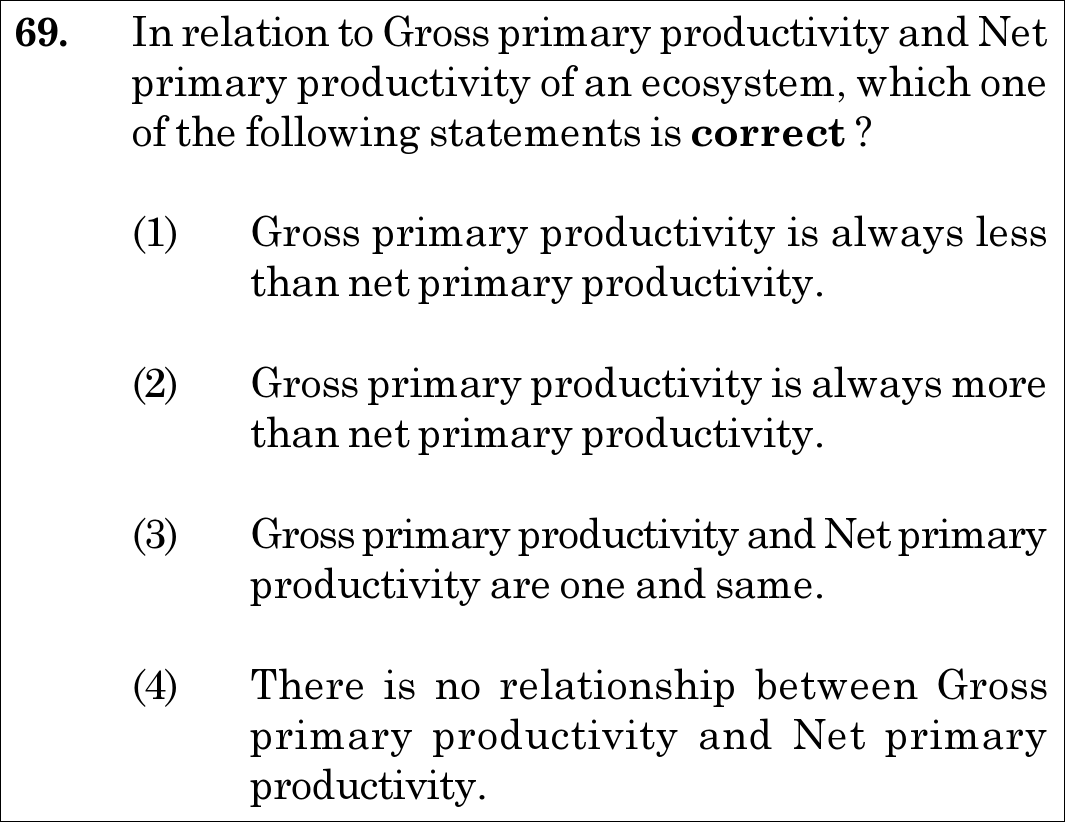
NEET 2020 · Q69 Easy
Official NEET 2020 Question 69 - Ecosystem
1 Gross primary productivity is always less than net primary productivity.
2 Gross primary productivity is always more than net primary productivity. ✓ Key
3 Gross primary productivity and Net primary productivity are one and same.
4 There is no relationship between Gross primary productivity and Net primary productivity.
💡 Verified Solution & 30-Second Hack
✓
Verified Against NTA Final Answer Key
Option (2) : Gross primary productivity is always more than net primary productivity.
📚 Ecosystem Easy
📋 Given Parameters & Problem Setup
Ecological Concepts Gross Primary Productivity (GPP), Net Primary Productivity (NPP), Respiration Losses (R)
Biophysical Relationship NPP = GPP - R
⚡

The 30-Second Exam Hall Shortcut: ⚡ "NPP = GPP - R: GPP is ALWAYS MORE than NPP!"

⏱️ 20 seconds

Gross primary productivity (GPP) is the total rate of organic matter synthesis. A considerable portion is consumed in plant respiration (R). Net primary productivity is the remainder: NPP=GPP−RNPP = GPP - R. Since plants always respire (R>0R > 0), GPP is ALWAYS MORE than NPP! Mark Option (2) in 5 seconds.

1 Recall formula: NPP = GPP - R.
2 Total production = GPP; Respiration loss = R; Remaining available biomass = NPP.
3 Since R is always greater than 0, GPP must always exceed NPP.
4 Select Option (2) Gross primary productivity is always more than net primary productivity.
🛡️
Why You Can 100% Trust This Shortcut: NCERT Biology · Ecosystem (Productivity: Gross vs Net Primary Productivity)
📐

Step-by-Step Rigorous Workflow & Mathematical Proof

Step 1

Define Gross Primary Productivity (GPP)

Gross primary productivity of an ecosystem is the rate of production of organic matter during photosynthesis by all primary producers.

Step 2

Account for Respiration Losses (R)

Plants must continually utilize their synthesized organic compounds for their own cellular respiration (R) to support active transport, maintenance, and metabolic processes.

Step 3

Define Net Primary Productivity (NPP)

Net primary productivity is the biomass remaining after accounting for respiratory losses: NPP=GPP−R\text{NPP} = \text{GPP} - R This net biomass is what is available to herbivores and decomposers.

Step 4

Deduce Relative Magnitude

Because living autotrophs inevitably lose energy through respiration (R>0R > 0), Gross Primary Productivity is strictly and always greater than Net Primary Productivity.

⭐

360° Option Elimination Engine Key Feature

Diagnose every choice: Know exactly why the right option works and why distractors fail.

4-Option Deep Scan
1 A
✗ Incorrect
Verdict & Scientific Reason:

Physically impossible; total synthesized energy (GPP) cannot be less than the net energy remaining after metabolic losses.

⚠️
Student Fallacy (Why candidates pick this trap): Confusing Gross and Net definitions.
2 B
✓ 100% Correct
Verdict & Scientific Reason:

Factually and ecologically exact; GPP equals NPP plus respiratory losses, so GPP is always greater than NPP.

💡
Why this is airtight: None; fundamental ecological energy balance.
3 C
✗ Incorrect
Verdict & Scientific Reason:

Incorrect; they could only be equal if respiration were zero (R=0R = 0), which is biologically impossible in living organisms.

⚠️
Student Fallacy (Why candidates pick this trap): Ignoring respiratory losses in autotrophs.
4 D
✗ Incorrect
Verdict & Scientific Reason:

Incorrect; they are mathematically and biologically linked by the equation NPP=GPP−R\text{NPP} = \text{GPP} - R.

⚠️
Student Fallacy (Why candidates pick this trap): Dismissing the definitive physiological relationship.
⚠️

NTA Trap Alert: Accounting Analogy: Gross Salary vs Net Salary

Gross Salary (Total Earned) = GPP. Taxes (Cost of Living/Respiration) = R. Net Take-Home Salary = NPP. Gross is always greater than Net!

🛡️ How to avoid the -1 mark: Gross = Total before deduction; Net = Leftover after deduction. GPP > NPP always!
📖

Core NEET Syllabus Standard

Zoology · Ecosystem Standard Benchmark
Core Scientific Principle Tested:

""

Syllabus Focus: Gross Primary Productivity (GPP) vs Net Primary Productivity (NPP)
✓ Core NEET UG Syllabus Anchor Syllabus & Academic Standards ↗

Solve 4 NEET Questions a Day — One per Subject

Cover all 1,140 official NEET questions in 285 days at your own pace. Progress is saved on your device. No login needed.