MyCompetitiveExams Logo MyCompetitiveExams
Search 1,140+ Questions
Chapters, formulas, speed tricks
→
⚡ Brahmastra NEET 2027
720 MARKS

Dynamic 180-question full-length simulator mixed dynamically from all 6 years for 2027 & 2026 aspirants.

Launch Brahmastra 2027 Test →
Start Practice →
100% Free · No Login Required
Q.127 Botany ⭐ 360° Option Elimination Active
Vault ↗

NEET 2023 Botany Question 127 Solution

Topic: Ecosystem · Official NTA Booklet Code G5
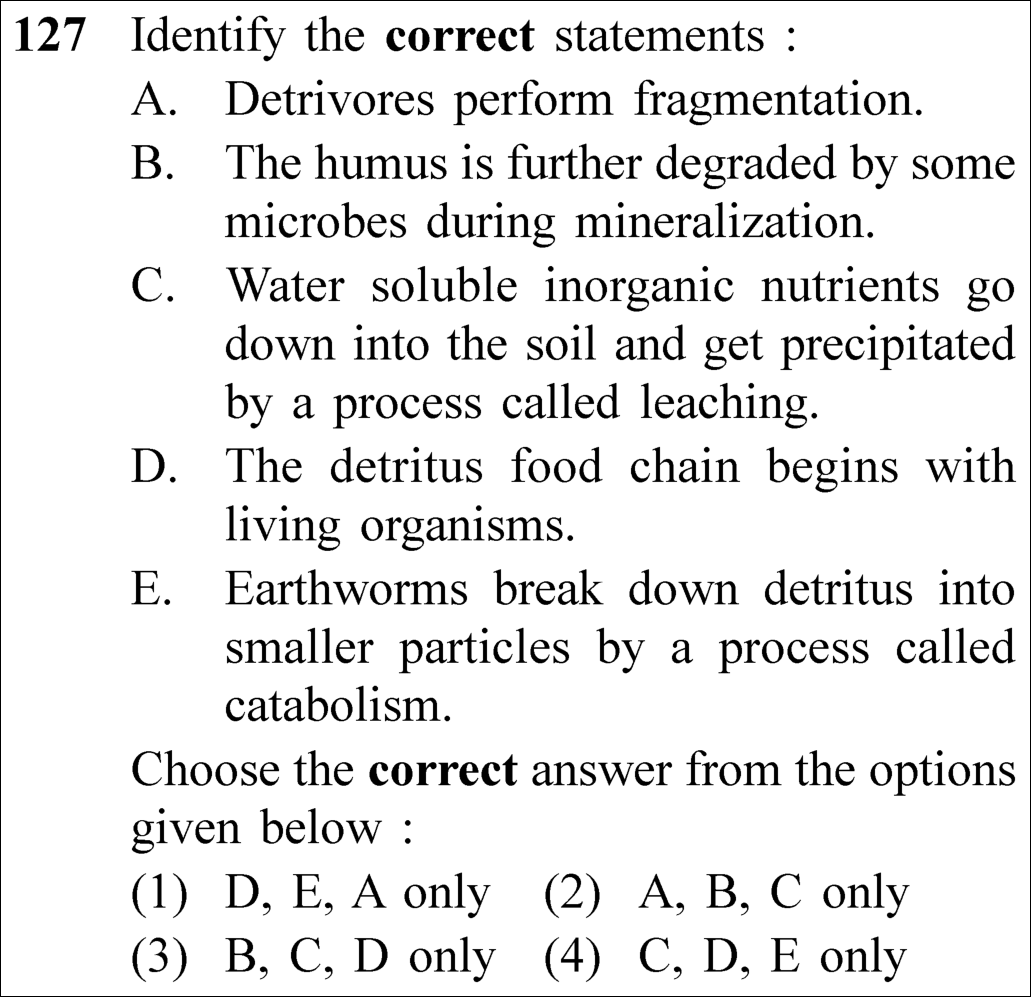
NEET 2023 Botany Question 127: Stages of Decomposition: Fragmentation, Leaching, Catabolism, Mineralization

Question

Identify the correct statements: A. Detrivores perform fragmentation. B. The humus is further degraded by some microbes during mineralization. C. Water soluble inorganic nutrients go down into the soil and get precipitated by a process called leaching. D. The detritus food chain begins with living organisms. E. Earthworms break down detritus into smaller particles by a process called catabolism. Choose the correct answer from the options given below:

✓
Verified Against NTA Final Answer Key
Option (2) : A, B, C only
📚 Ecosystem Medium
📋 Given Parameters & Problem Setup
Statements 5 statements (A-E) on detritus processing and decomposition
⚡

The 30-Second Exam Hall Shortcut: ⚡ Decomposition Verifier: D & E are False!

⏱️ Save ~30 seconds

Spot the errors in D and E: Detritus food chain begins with DEAD organic matter (not living organisms, so D is false). Catabolism is carried out by BACTERIAL/FUNGAL enzymes (not earthworms, which perform fragmentation, so E is false). Therefore, only A, B, C are correct!

1 Statement A: Detritivores perform fragmentation -> True (Earthworms break detritus into smaller bits).
2 Statement B: Humus is degraded by microbes during mineralization -> True (Releases inorganic nutrients).
3 Statement C: Water-soluble nutrients leach down and precipitate -> True (Leaching).
4 Statement D: DFC begins with living organisms -> False (DFC begins with dead organic matter).
5 Statement E: Earthworms break down detritus by catabolism -> False (Earthworms perform fragmentation; catabolism is enzymatic degradation by fungi/bacteria).
6 A, B, C only -> Select Option (2).
🛡️
Why You Can 100% Trust This Shortcut: Canonical NCERT Ecosystem decomposition steps definitions.
📐

Step-by-Step Rigorous Workflow & Mathematical Proof

Step 1

Step-by-Step Evaluation of Statements

Analyzing the 5 stages of decomposition defined in NCERT Ecosystem:

Statement A:Detritivores (e.g., earthworm) break down detritus into smaller particles  ⟹  TRUE (Fragmentation)Statement B:Humus is degraded by microbes releasing inorganic nutrients  ⟹  TRUE (Mineralisation)Statement C:Water-soluble inorganic nutrients percolate down and precipitate  ⟹  TRUE (Leaching)Statement D:Detritus food chain begins with dead organic matter, NOT living organisms  ⟹  FALSEStatement E:Earthworm action is fragmentation; catabolism is bacterial/fungal enzymatic breakdown  ⟹  FALSE\begin{aligned} \text{\textbf{Statement A:}} & \quad \text{Detritivores (e.g., earthworm) break down detritus into smaller particles} \implies \mathbf{\text{TRUE (Fragmentation)}} \\[3pt] \text{\textbf{Statement B:}} & \quad \text{Humus is degraded by microbes releasing inorganic nutrients} \implies \mathbf{\text{TRUE (Mineralisation)}} \\[3pt] \text{\textbf{Statement C:}} & \quad \text{Water-soluble inorganic nutrients percolate down and precipitate} \implies \mathbf{\text{TRUE (Leaching)}} \\[3pt] \text{\textbf{Statement D:}} & \quad \text{Detritus food chain begins with dead organic matter, NOT living organisms} \implies \mathbf{\text{FALSE}} \\[3pt] \text{\textbf{Statement E:}} & \quad \text{Earthworm action is fragmentation; catabolism is bacterial/fungal enzymatic breakdown} \implies \mathbf{\text{FALSE}} \end{aligned}
Step 2

Distinction Between Fragmentation and Catabolism

NCERT explicitly distinguishes mechanical and chemical breakdown: fragmentation is physical breakdown into smaller fragments by detritivores (earthworms), whereas catabolism is the chemical breakdown of detritus into simpler inorganic substances by bacterial and fungal extracellular enzymes.

Step 3

Conclusion

Statements A, B, and C are correct, while D and E are unambiguously false. Option (2) is the correct choice.

⭐

360° Option Elimination Engine Key Feature

Diagnose every choice: Know exactly why the right option works and why distractors fail.

4-Option Deep Scan
1 1
✗ Incorrect
Verdict & Scientific Reason:

Contains false statements D (DFC begins with dead matter) and E (earthworm action is fragmentation, not catabolism).

⚠️
Student Fallacy (Why candidates pick this trap): Failing to spot that DFC originates from dead organic substrate.
2 2
✓ 100% Correct
Verdict & Scientific Reason:

Statements A, B, and C are fully aligned with verbatim NCERT definitions of decomposition.

💡
Why this is airtight: None; rigorous line-by-line verification.
3 3
✗ Incorrect
Verdict & Scientific Reason:

Includes incorrect statement D.

⚠️
Student Fallacy (Why candidates pick this trap): Confusing Grazing Food Chain (GFC, begins with producers) with Detritus Food Chain (DFC).
4 4
✗ Incorrect
Verdict & Scientific Reason:

Includes incorrect statements D and E.

⚠️
Student Fallacy (Why candidates pick this trap): Conflating fragmentation by detritivores with enzymatic catabolism.
⚠️

NTA Trap Alert: Fragmentation vs. Catabolism Nomenclature Trap

Students frequently equate all breakdown processes under the broad heading of catabolism. In ecology, earthworms perform fragmentation (mechanical), while bacteria/fungi perform catabolism (enzymatic).

🛡️ How to avoid the -1 mark: Earthworms = Fragmentation. Microbes (Bacteria & Fungi) = Catabolism.
📖

Core NEET Syllabus Standard

NCERT Biology · Ecosystem Standard Benchmark
Core Scientific Principle Tested:

"Decomposition steps include fragmentation, leaching, catabolism, humification and mineralisation. Detritivores perform fragmentation; bacterial and fungal enzymes perform catabolism."

Syllabus Focus: Decomposition
✓ Core NEET UG Syllabus Anchor Syllabus & Academic Standards ↗

Ready to attempt under real exam pressure?

Test your speed and accuracy in the authentic 200-minute timed NTA simulator.

Launch NEET 2023 CBT Test →

Spotted a mistake in this solution? Report an error ([email protected])

⚖️ Legal & Fair Dealing Notice: Sourced from publicly released NEET 2023 question papers and NEET answer keys for private study, research, and non-commercial educational practice under Fair Dealing (Section 52(1)(a) of the Indian Copyright Act, 1957). Not affiliated with or endorsed by NTA or NMC.

Solve 4 NEET Questions a Day — One per Subject

Cover all 1,140 official NEET questions in 285 days at your own pace. Progress is saved on your device. No login needed.