MyCompetitiveExams Logo MyCompetitiveExams
Search 1,140+ Questions
Chapters, formulas, speed tricks
→
⚡ Brahmastra NEET 2027
720 MARKS

Dynamic 180-question full-length simulator mixed dynamically from all 6 years for 2027 & 2026 aspirants.

Launch Brahmastra 2027 Test →
Start Practice →
100% Free · No Login Required
Q.169 Zoology ⭐ 360° Option Elimination Active
Vault ↗

NEET 2025 Zoology Question 169 Solution

Topic: Structural Organisation in Animals · Official NTA Booklet Code 45
NEET 2025 Zoology Question 169: Vascular System of Frog: Renal Portal System vs Hepatic Portal System

Question

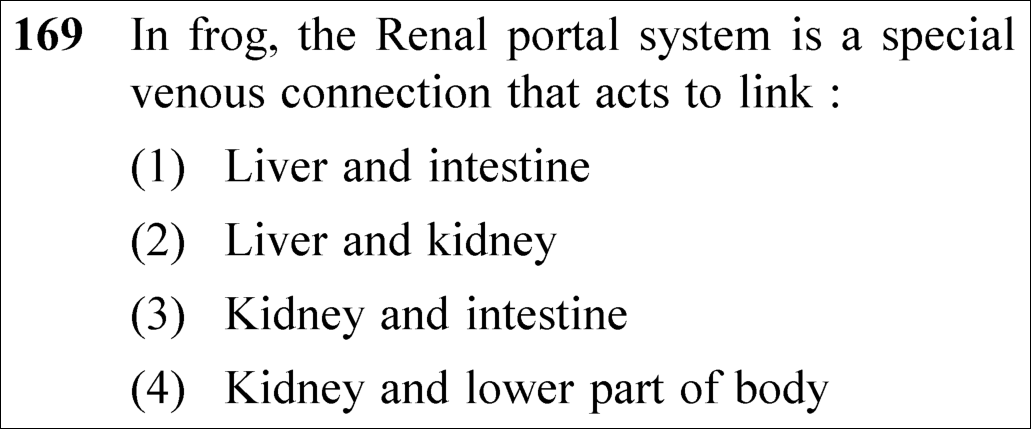
In frog, the Renal portal system is a special venous connection that acts to link:

  1. (1)Liver and intestine
  2. (2)Liver and kidney
  3. (3)Kidney and intestine
  4. (4)Kidney and lower part of body
✓
Verified Against NTA Final Answer Key
Option (4) : Kidney and lower part of body
📚 Structural Organisation in Animals Easy
📋 Given Parameters & Problem Setup
Organism Frog (Rana tigrina)
Circulatory Structure Renal portal system
Target Link Organs / body regions linked by this venous portal connection
⚡

The 30-Second Exam Hall Shortcut: ⚡ Frog Portal Systems Fingerprint

⏱️ Save ~15 seconds

Frog has TWO portal systems: Hepatic portal system links Liver and Intestine! Renal portal system links KIDNEY and LOWER PART OF BODY! Option (4)!

1 Recall NCERT Section 7.4.2 (Frog - Vascular System) verbatim:
2 - "Special venous connection between liver and intestine as well as the kidney and lower parts of the body are present in frogs."
3 - "The former is called hepatic portal system and the latter is called renal portal system."
4 - Hepatic portal = Liver and intestine.
5 - Renal portal = Kidney and lower part of body.
6 Target: Renal portal system = Kidney and lower part of body!
7 Select Option (4)!
🛡️
Why You Can 100% Trust This Shortcut: Periplaneta americana Reproductive & Circulatory Systems (NCERT Biology · Structural Organisation in Animals: Spermatophores and mushroom gland).
📐

Step-by-Step Rigorous Workflow & Mathematical Proof

Step 1

Definition of a Portal Venous System

A portal venous system is a vascular arrangement in which blood collected from one capillary bed is conveyed via a portal vein into a second capillary network in an intermediate organ before returning to the heart.

  • • In amphibians such as frogs, two well-developed portal venous circuits exist: the hepatic portal system and the renal portal system.
  • • Humans and mammals retain the hepatic portal system and hypophysial portal system, but the renal portal system is absent (reduced/vestigial).
Step 2

Venous Anatomy of the Frog's Renal Portal System

Tracing the blood vessels in the posterior body:

  • • Deoxygenated venous blood from the hindlimbs and pelvic region is collected by the femoral and sciatic veins.
  • • These bifurcate to form the renal portal veins, which enter the kidneys and break up into a secondary capillary plexus.
  • • This allows the renal tubular epithelium to clear nitrogenous waste and filter blood directly from the lower extremities.
  • • The blood is subsequently collected by renal veins into the postcaval vein (posterior vena cava).
  • • Thus, the renal portal system specifically links the kidney and lower part of the body.
Step 3

Contrast with the Hepatic Portal System

Evaluating Option (1):

  • • The venous connection that links the intestine (alimentary canal) to the liver is the hepatic portal system.
  • • Conflating the hepatic and renal portal systems is an examiner's deliberate trap.
Step 4

Conclusion

The renal portal system acts to link the kidney and lower parts of the body, matching Option (4).

Renal Portal System=Lower part of body→Kidney\text{Renal Portal System} = \text{Lower part of body} \rightarrow \text{Kidney}
⭐

360° Option Elimination Engine Key Feature

Diagnose every choice: Know exactly why the right option works and why distractors fail.

4-Option Deep Scan
1 A
✗ Incorrect
Verdict & Scientific Reason:

Incorrect. The connection between liver and intestine is the hepatic portal system, not the renal portal system.

⚠️
Student Fallacy (Why candidates pick this trap): Confusing hepatic portal system with renal portal system.
2 B
✗ Incorrect
Verdict & Scientific Reason:

Incorrect. There is no direct portal system connecting liver and kidney.

⚠️
Student Fallacy (Why candidates pick this trap): Fabricating a link between two internal visceral organs.
3 C
✗ Incorrect
Verdict & Scientific Reason:

Incorrect. Intestinal veins drain into the hepatic portal system, not the kidney.

⚠️
Student Fallacy (Why candidates pick this trap): Mismatched organ drainage.
4 D
✓ 100% Correct
Verdict & Scientific Reason:

100% correct. Direct verbatim NCERT fact: the renal portal system connects the kidney and lower parts of the body.

💡
Why this is airtight: None; textbook mastery of frog anatomy.
⚠️

NTA Trap Alert: Renal Portal vs Hepatic Portal Systems

Hepatic portal = Intestine -> Liver (carries absorbed food). Renal portal = Hindlimbs / Lower body -> Kidney (carries metabolic waste).

🛡️ How to avoid the -1 mark: Renal = Kidney; connects lower legs/body to the kidney.
📖

Core NEET Syllabus Standard

NEET Biology Core Syllabus · Structural Organisation in Animals Standard Benchmark
Core Scientific Principle Tested:

"In frogs, the renal portal system is a venous connection linking the kidneys with the lower parts of the body."

Syllabus Focus: Frog Anatomy · Vascular System
✓ Core NEET UG Syllabus Anchor Syllabus & Academic Standards ↗
Renal = Running legs to Kidney (Lower body to Kidney)!

Ready to attempt under real exam pressure?

Test your speed and accuracy in the authentic 180-minute timed NTA simulator.

Launch NEET 2025 CBT Test →

Spotted a mistake in this solution? Report an error ([email protected])

⚖️ Legal & Fair Dealing Notice: Sourced from publicly released NEET 2025 question papers and NEET answer keys for private study, research, and non-commercial educational practice under Fair Dealing (Section 52(1)(a) of the Indian Copyright Act, 1957). Not affiliated with or endorsed by NTA or NMC.

Solve 4 NEET Questions a Day — One per Subject

Cover all 1,140 official NEET questions in 285 days at your own pace. Progress is saved on your device. No login needed.