MyCompetitiveExams Logo MyCompetitiveExams
Search 1,140+ Questions
Chapters, formulas, speed tricks
→
⚡ Brahmastra NEET 2027
720 MARKS

Dynamic 180-question full-length simulator mixed dynamically from all 6 years for 2027 & 2026 aspirants.

Launch Brahmastra 2027 Test →
Start Practice →
100% Free · No Login Required
Q.184 Zoology ⭐ 360° Option Elimination Active
Vault ↗

NEET 2021 Zoology Question 184 Solution

Topic: Reproductive Health · Official NTA Booklet Code M1
NEET 2021 Zoology Question 184: Transmission Pathways of Sexually Transmitted Infections (STIs / Venereal Diseases)

Question

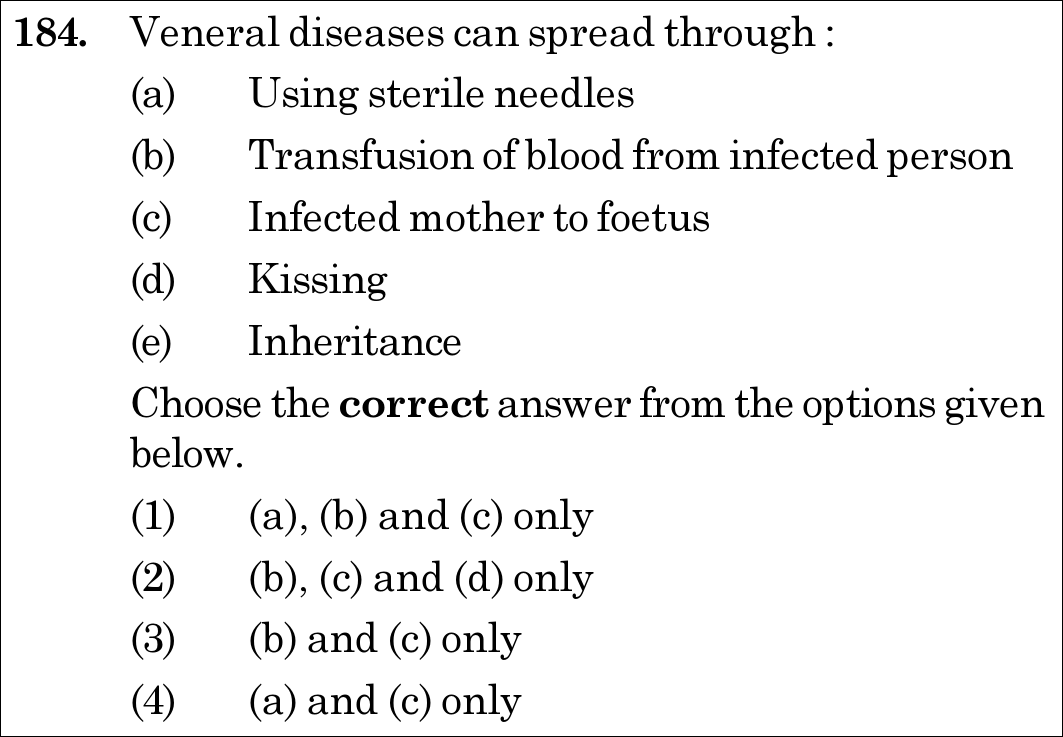
Veneral diseases can spread through: (a) Using sterile needles (b) Transfusion of blood from infected person (c) Infected mother to foetus (d) Kissing (e) Inheritance Choose the correct answer from the options given below.

  1. (1)(a), (b) and (c) only
  2. (2)(b), (c) and (d) only
  3. (3)(b) and (c) only
  4. (4)(a) and (c) only
✓
Verified Against NTA Final Answer Key
Option (3) : (b) and (c) only
📚 Reproductive Health Easy
📋 Given Parameters & Problem Setup
Transmission Route (a) Using sterile needles
Transmission Route (b) Transfusion of blood from infected person
Transmission Route (c) Infected mother to foetus
Transmission Route (d) Kissing
Transmission Route (e) Inheritance
⚡

The 30-Second Exam Hall Shortcut: ⚡ "STIs Spread via Blood & Vertical Transmission (b & c); Sterile Needles Prevent!"

⏱️ Save ~25 seconds

Sterile needles prevent disease transmission (eliminates (a)). STIs are infectious microbial diseases, not inherited genetic disorders (eliminates (e)). Blood transfusion (b) and vertical transmission from mother to foetus (c) are canonical transmission routes for STIs like Hepatitis-B and HIV. Option (3) is the only valid choice!

1 Evaluate (a): "Using sterile needles" is a prophylactic barrier that PREVENTS infection. Discard options with (a) -> Eliminates Options (1) and (4).
2 Evaluate (e): "Inheritance" refers to Mendelian genetic transmission, whereas STIs are acquired infectious diseases caused by microbes.
3 Evaluate (b) and (c): Blood transfusion from infected persons and vertical transmission (mother to foetus) are well-established non-sexual transmission routes of STIs (Hepatitis B, HIV, Syphilis).
4 Conclude (b) and (c) only -> Option (3).
🛡️
Why You Can 100% Trust This Shortcut: NCERT Biology · Reproductive Health (Sexually Transmitted Infections: Some of these infections like hepatitis-B and HIV can also be transmitted by sharing of injection needles, surgical instruments, etc., with infected persons, transfusion of blood, or from an infected mother to the foetus).
📐

Step-by-Step Rigorous Workflow & Mathematical Proof

Step 1

Transmission Dynamics of Sexually Transmitted Infections (STIs)

Sexually Transmitted Infections (STIs) or Venereal Diseases (VDs) / Reproductive Tract Infections (RTIs) are infections transmitted predominantly through sexual intercourse. However, several systemic STIs (notably Hepatitis B virus and Human Immunodeficiency Virus, HIV) share additional parenteral and vertical routes: - (b) Transfusion of contaminated blood: Direct intravenous inoculation of blood or blood products from an infected donor transmits pathogens. - (c) Transplacental / Vertical transmission: Pathogens can cross the placenta from an infected mother to the developing foetus (e.g. *Treponema pallidum* causing congenital syphilis; HIV causing pediatric AIDS; Hepatitis B during parturition).

Step 2

Disqualification of Distractor Options

- (a) Using sterile needles: Sterile needles are single-use, pathogen-free instruments that prevent microbial transmission; unsterile / shared needles transmit infections. - (d) Kissing: Casual contact and saliva exchange through social kissing do not transmit classic venereal diseases or HIV/Hepatitis B. - (e) Inheritance: STIs are communicable infectious diseases caused by viruses, bacteria, or protozoa, not heritable genetic traits passed down via gametic DNA chromosomes.

⭐

360° Option Elimination Engine Key Feature

Diagnose every choice: Know exactly why the right option works and why distractors fail.

4-Option Deep Scan
1 1
✗ Incorrect
Verdict & Scientific Reason:

Incorrect because statement (a) claims sterile needles spread disease, which is the exact opposite of medical reality.

⚠️
Student Fallacy (Why candidates pick this trap): Misreading "sterile" as "shared" or "contaminated".
2 2
✗ Incorrect
Verdict & Scientific Reason:

Incorrect because kissing (d) is not a standard route of transmission for STIs.

⚠️
Student Fallacy (Why candidates pick this trap): Assuming all close physical contacts transmit venereal diseases.
3 3
✓ 100% Correct
Verdict & Scientific Reason:

Correct. Accurately identifies blood transfusion and maternal-foetal transmission as verified routes.

💡
Why this is airtight: None. Candidate correctly distinguishes transmission vectors from sterile prophylaxis.
4 4
✗ Incorrect
Verdict & Scientific Reason:

Incorrect due to the false inclusion of sterile needles (a).

⚠️
Student Fallacy (Why candidates pick this trap): Failing to notice the word "sterile".
⚠️

NTA Trap Alert: The "Sterile Needle" Speed-Reading Trap

Under exam pressure, students see "needle" and instinctively associate it with HIV/hepatitis transmission, failing to register the critical adjective "sterile". Sterile needles eliminate risk!

🛡️ How to avoid the -1 mark: Read every qualifying adjective carefully: "sterile needles" prevent transmission, only "shared/contaminated needles" spread disease.
📖

Core NEET Syllabus Standard

NEET / NCERT Biology · Reproductive Health Standard Benchmark
Core Scientific Principle Tested:

"STIs can spread through blood transfusion from infected persons and from an infected mother to foetus."

Syllabus Focus: Sexually Transmitted Infections (STIs)
✓ Core NEET UG Syllabus Anchor Syllabus & Academic Standards ↗

Ready to attempt under real exam pressure?

Test your speed and accuracy in the authentic 200-minute timed NTA simulator.

Launch NEET 2021 CBT Test →

Spotted a mistake in this solution? Report an error ([email protected])

⚖️ Legal & Fair Dealing Notice: Sourced from publicly released NEET 2021 question papers and NEET answer keys for private study, research, and non-commercial educational practice under Fair Dealing (Section 52(1)(a) of the Indian Copyright Act, 1957). Not affiliated with or endorsed by NTA or NMC.

Solve 4 NEET Questions a Day — One per Subject

Cover all 1,140 official NEET questions in 285 days at your own pace. Progress is saved on your device. No login needed.