MyCompetitiveExams Logo MyCompetitiveExams
Search 1,140+ Questions
Chapters, formulas, speed tricks
→
⚡ Brahmastra NEET 2027
720 MARKS

Dynamic 180-question full-length simulator mixed dynamically from all 6 years for 2027 & 2026 aspirants.

Launch Brahmastra 2027 Test →
Start Practice →
100% Free · No Login Required
Q.32 Physics ⭐ 360° Option Elimination Active
Vault ↗

NEET 2021 Physics Question 32 Solution

Topic: Moving Charges and Magnetism · Official NTA Booklet Code M1
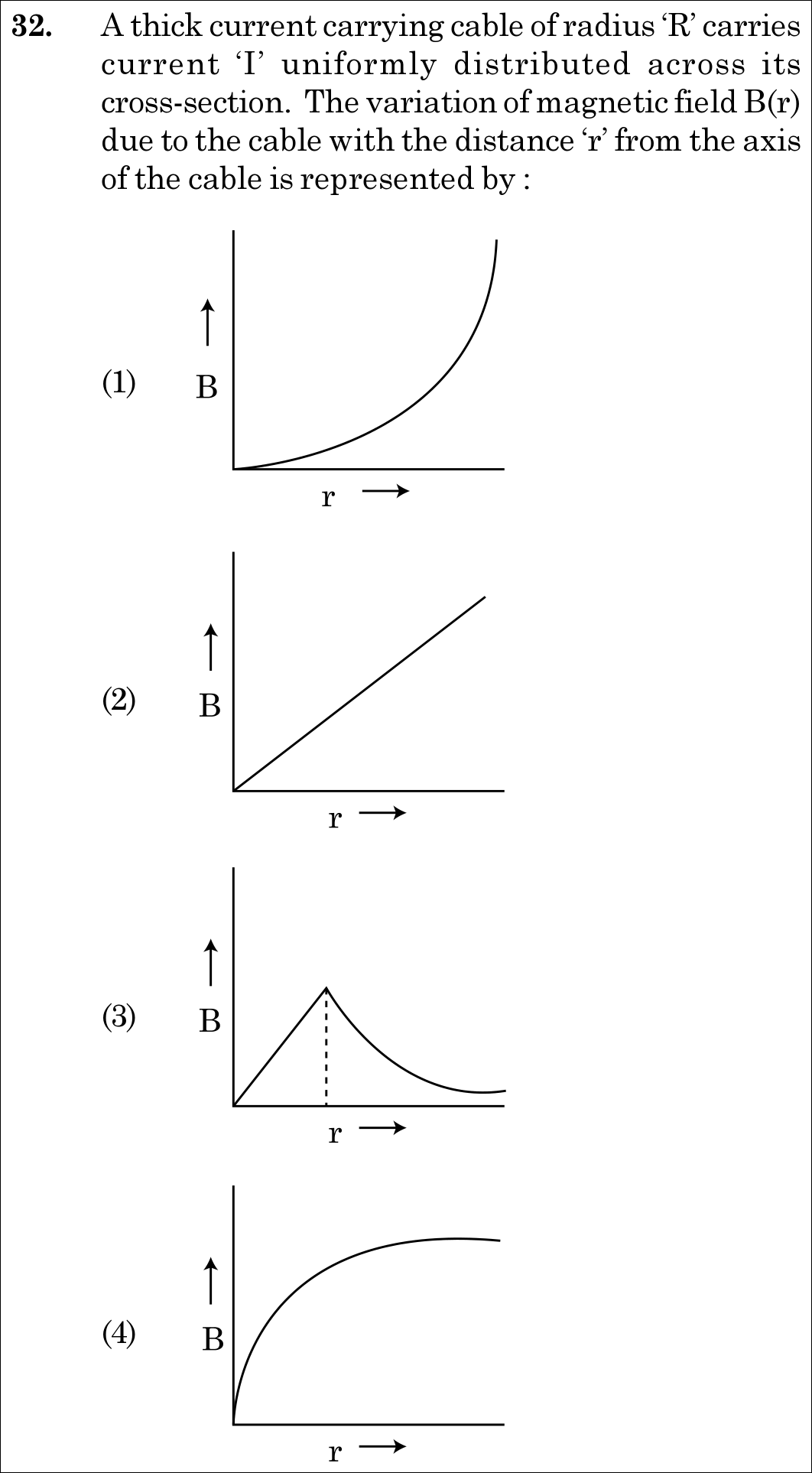
NEET 2021 Physics Question 32: Magnetic Field of a Thick Cylindrical Wire: Inside and Outside Variation

Question

A thick current carrying cable of radius 'R' carries current 'I' uniformly distributed across its cross-section. The variation of magnetic field B(r) due to the cable with the distance 'r' from the axis of the cable is represented by:

✓
Verified Against NTA Final Answer Key
Option (3) : Graph (3): Linear rise from origin inside (r <= R), hyperbolic decay outside (r >= R)
📚 Moving Charges and Magnetism Easy
📋 Given Parameters & Problem Setup
Cable Radius R
Current Distribution Uniformly distributed current I across cross-section
⚡

The 30-Second Exam Hall Shortcut: ⚡ Ampere's Law Signature: B ∝ r (Inside) and B ∝ 1/r (Outside)

⏱️ Save ~20 seconds

For uniform current density inside a thick cable: Bin∝rB_{\text{in}} \propto r (straight line passing through the origin up to r=Rr = R). Outside the cable, total current is constant, so Bout∝1/rB_{\text{out}} \propto 1/r (hyperbolic decay). Only Graph (3) displays this linear-increase followed by hyperbolic-decrease profile! Match Option (3)!

1 Inside (r≤Rr \le R): Enclosed current Ienc=I(r2/R2)I_{\text{enc}} = I (r^2 / R^2). By Ampere's law, B(2πr)=μ0I(r2/R2)  ⟹  B∝rB(2\pi r) = \mu_0 I (r^2 / R^2) \implies B \propto r (straight line).
2 Outside (r≥Rr \ge R): Enclosed current is total II. By Ampere's law, B(2πr)=μ0I  ⟹  B∝1rB(2\pi r) = \mu_0 I \implies B \propto \frac{1}{r} (hyperbolic curve).
3 At surface (r=Rr = R): Magnetic field attains its maximum value Bmax=μ0I2πRB_{\text{max}} = \frac{\mu_0 I}{2\pi R}.
4 Match Graph (3).
🛡️
Why You Can 100% Trust This Shortcut: Canonical Ampere's circuital law evaluation for solid cylindrical conductors.
📐

Step-by-Step Rigorous Workflow & Mathematical Proof

Step 1

Applying Ampere's Circuital Law Inside the Cable (r <= R)

Consider an Amperian loop of radius r≤Rr \le R concentric with the cable axis. Because current II is uniformly distributed over the cross-sectional area πR2\pi R^2, the current enclosed by the loop is:

Ienc=J⋅(πr2)=(IπR2)(πr2)=Ir2R2I_{\text{enc}} = J \cdot (\pi r^2) = \left(\frac{I}{\pi R^2}\right) (\pi r^2) = I \frac{r^2}{R^2}
Step 2

Finding the Magnetic Field Inside

By Ampere's circuital law ∮B⃗⋅dl⃗=μ0Ienc\oint \vec{B} \cdot d\vec{l} = \mu_0 I_{\text{enc}}:

Bin(2πr)=μ0I(r2R2)  ⟹  Bin=μ0Ir2πR2  ⟹  Bin∝rB_{\text{in}} (2\pi r) = \mu_0 I \left(\frac{r^2}{R^2}\right) \implies B_{\text{in}} = \frac{\mu_0 I r}{2\pi R^2} \implies \mathbf{B_{\text{in}} \propto r}
Step 3

Finding the Magnetic Field Outside the Cable (r >= R)

For an Amperian loop of radius r≥Rr \ge R, the entire current II is enclosed:

Bout(2πr)=μ0I  ⟹  Bout=μ0I2πr  ⟹  Bout∝1rB_{\text{out}} (2\pi r) = \mu_0 I \implies B_{\text{out}} = \frac{\mu_0 I}{2\pi r} \implies \mathbf{B_{\text{out}} \propto \frac{1}{r}}
Step 4

Identifying the Correct Graphical Representation

The field starts at 0 at the center (r=0r = 0), rises linearly with distance rr up to the surface r=Rr = R, where it reaches a peak value, and then decreases asymptotically as 1/r1/r for r>Rr > R. This corresponds uniquely to Graph (3).

⭐

360° Option Elimination Engine Key Feature

Diagnose every choice: Know exactly why the right option works and why distractors fail.

4-Option Deep Scan
1 1
✗ Incorrect
Verdict & Scientific Reason:

Falsely shows field increasing indefinitely with quadratic curvature.

⚠️
Student Fallacy (Why candidates pick this trap): Confusing enclosed area (pir2pi r^2) with field variation without dividing by circumference (2pir2pi r).
2 2
✗ Incorrect
Verdict & Scientific Reason:

Shows BproptorB propto r everywhere, ignoring that outside the cable the enclosed current no longer increases.

⚠️
Student Fallacy (Why candidates pick this trap): Extrapolating the internal field equation outside the conductor boundary.
3 3
✓ 100% Correct
Verdict & Scientific Reason:

Exact textbook graph showing B∝rB \propto r for r≤Rr \le R and B∝1/rB \propto 1/r for r≥Rr \ge R.

💡
Why this is airtight: None; canonical NCERT Ampere's law curve.
4 4
✗ Incorrect
Verdict & Scientific Reason:

Fails to show linear behavior inside the cable.

⚠️
Student Fallacy (Why candidates pick this trap): Confusing magnetic field profile with electrostatic potential curves.
⚠️

NTA Trap Alert: Solid vs. Hollow Cylinder Field Trap

For a hollow cylindrical pipe, B=0B = 0 inside and B∝1/rB \propto 1/r outside. For a SOLID cable carrying uniform current, BB is NOT zero inside—it increases linearly with rr (B∝rB \propto r).

🛡️ How to avoid the -1 mark: Solid cable   ⟹  Bin∝r\implies B_{\text{in}} \propto r. Hollow pipe   ⟹  Bin=0\implies B_{\text{in}} = 0.
📖

Core NEET Syllabus Standard

NCERT Physics · Moving Charges and Magnetism Standard Benchmark
Core Scientific Principle Tested:

"Inside a uniform wire, B=μ0Ir2πR2∝rB = \frac{\mu_0 I r}{2\pi R^2} \propto r; outside, B=μ0I2πr∝1rB = \frac{\mu_0 I}{2\pi r} \propto \frac{1}{r}."

Syllabus Focus: Magnetic Field Due to a Cylindrical Wire (Ampere's Circuital Law)
✓ Core NEET UG Syllabus Anchor Syllabus & Academic Standards ↗

Ready to attempt under real exam pressure?

Test your speed and accuracy in the authentic 200-minute timed NTA simulator.

Launch NEET 2021 CBT Test →

Spotted a mistake in this solution? Report an error ([email protected])

⚖️ Legal & Fair Dealing Notice: Sourced from publicly released NEET 2021 question papers and NEET answer keys for private study, research, and non-commercial educational practice under Fair Dealing (Section 52(1)(a) of the Indian Copyright Act, 1957). Not affiliated with or endorsed by NTA or NMC.

Solve 4 NEET Questions a Day — One per Subject

Cover all 1,140 official NEET questions in 285 days at your own pace. Progress is saved on your device. No login needed.