MyCompetitiveExams Logo MyCompetitiveExams
Search 1,140+ Questions
Chapters, formulas, speed tricks
→
⚡ Brahmastra NEET 2027
720 MARKS

Dynamic 180-question full-length simulator mixed dynamically from all 6 years for 2027 & 2026 aspirants.

Launch Brahmastra 2027 Test →
Start Practice →
100% Free · No Login Required
Q.119 Botany ⭐ 360° Option Elimination Active
Vault ↗

NEET 2021 Botany Question 119 Solution

Topic: Sexual Reproduction in Flowering Plants · Official NTA Booklet Code M1
NEET 2021 Botany Question 119: Classification of Pollination: Xenogamy (Cross-Pollination)

Question

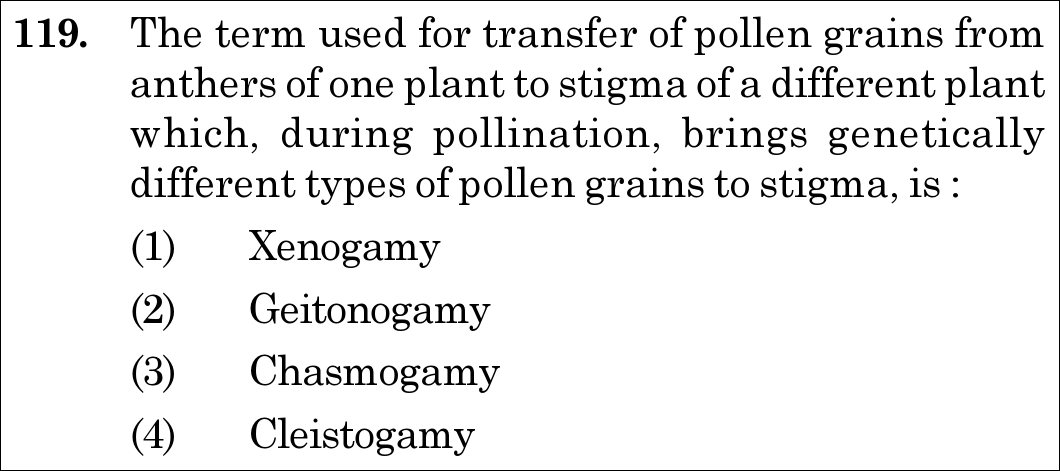
The term used for transfer of pollen grains from anthers of one plant to stigma of a different plant which, during pollination, brings genetically different types of pollen grains to stigma, is:

  1. (1)Xenogamy
  2. (2)Geitonogamy
  3. (3)Chasmogamy
  4. (4)Cleistogamy
✓
Verified Against NTA Final Answer Key
Option (1) : Xenogamy
📚 Sexual Reproduction in Flowering Plants Easy
📋 Given Parameters & Problem Setup
Pollen Source Anther of one plant
Stigma Target Stigma of a different plant
Genetic Consequence Brings genetically different types of pollen to stigma
⚡

The 30-Second Exam Hall Shortcut: ⚡ "Different Plant = Xenogamy" (Genetically Unique Pollen)

⏱️ Save ~15 seconds

Xenogamy is the ONLY type of pollination that transfers pollen from an anther of one plant to the stigma of a genetically different plant, introducing new genetic variations! Geitonogamy is between flowers of the same plant (genetically autogamous). Match Option (1)!

1 Autogamy: Pollination within the same flower   ⟹  \implies genetically identical.
2 Geitonogamy: Transfer between different flowers on the same plant   ⟹  \implies functionally cross-pollination, but genetically autogamy.
3 Xenogamy: Transfer of pollen from anther to stigma of a different plant   ⟹  \implies both functionally and genetically cross-pollination.
4 Match Option (1).
🛡️
Why You Can 100% Trust This Shortcut: Canonical NCERT Angiosperm Reproduction on Modes of Pollination.
📐

Step-by-Step Rigorous Workflow & Mathematical Proof

Step 1

Classification of Pollination by Pollen Source

Angiosperm pollination is categorized into three types depending on the genetic relatedness of the pollen donor and recipient:

Autogamy:Within the same flower (Genetically identical)Geitonogamy:Between different flowers on same individual (Genetically identical)Xenogamy:Between flowers on different individuals (Genetically distinct)\begin{aligned} \text{\textbf{Autogamy:}} & \quad \text{Within the same flower (Genetically identical)} \\[3pt] \text{\textbf{Geitonogamy:}} & \quad \text{Between different flowers on same individual (Genetically identical)} \\[3pt] \text{\textbf{Xenogamy:}} & \quad \mathbf{\text{Between flowers on different individuals (Genetically distinct)}} \end{aligned}
Step 2

Genetic Implications of Xenogamy

Because pollen originates from a genetically distinct donor sporophyte, xenogamy introduces novel allele combinations and promotes outcrossing vigor, providing the ultimate raw material for adaptive evolutionary variation.

⭐

360° Option Elimination Engine Key Feature

Diagnose every choice: Know exactly why the right option works and why distractors fail.

4-Option Deep Scan
1 1
✓ 100% Correct
Verdict & Scientific Reason:

Xenogamy is the transfer of pollen grains from anther to the stigma of a different plant, bringing genetically different pollen to the stigma.

💡
Why this is airtight: None. Direct textbook definition.
2 2
✗ Incorrect
Verdict & Scientific Reason:

Geitonogamy involves transfer to another flower of the same plant, meaning all pollen grains are genetically identical to the parent.

⚠️
Student Fallacy (Why candidates pick this trap): Confusing functional cross-pollination via pollinators (geitonogamy) with true genetic cross-pollination (xenogamy).
3 3
✗ Incorrect
Verdict & Scientific Reason:

Chasmogamy refers to flowers with exposed anthers and stigmas that open at maturity, not a classification of pollination based on pollen origin.

⚠️
Student Fallacy (Why candidates pick this trap): Conflating floral opening morphology (chasmogamous) with pollen source categories.
4 4
✗ Incorrect
Verdict & Scientific Reason:

Cleistogamy refers to closed, non-opening flowers that undergo obligate autogamous self-pollination.

⚠️
Student Fallacy (Why candidates pick this trap): Selecting a floral structural adaptation rather than the genetic pollination category.
⚠️

NTA Trap Alert: Geitonogamy vs Xenogamy Genetic Reality

Geitonogamy involves pollinating agents (looks like cross-pollination ecologically), but genetically it is pure self-pollination since pollen comes from the same plant.

🛡️ How to avoid the -1 mark: Fix the rule: Only XENOGAMY brings genetically different pollen to the stigma.
📖

Core NEET Syllabus Standard

NEET / NCERT Biology · Sexual Reproduction in Flowering Plants Standard Benchmark
Core Scientific Principle Tested:

"Xenogamy: Transfer of pollen grains from anther to the stigma of a different plant. This is the only type of pollination which during pollination brings genetically different types of pollen grains to the stigma."

Syllabus Focus: Pollination: Types of Pollination
✓ Core NEET UG Syllabus Anchor Syllabus & Academic Standards ↗

Ready to attempt under real exam pressure?

Test your speed and accuracy in the authentic 200-minute timed NTA simulator.

Launch NEET 2021 CBT Test →

Spotted a mistake in this solution? Report an error ([email protected])

⚖️ Legal & Fair Dealing Notice: Sourced from publicly released NEET 2021 question papers and NEET answer keys for private study, research, and non-commercial educational practice under Fair Dealing (Section 52(1)(a) of the Indian Copyright Act, 1957). Not affiliated with or endorsed by NTA or NMC.

Solve 4 NEET Questions a Day — One per Subject

Cover all 1,140 official NEET questions in 285 days at your own pace. Progress is saved on your device. No login needed.