MyCompetitiveExams Logo MyCompetitiveExams
Search 1,140+ Questions
Chapters, formulas, speed tricks
→
⚡ Brahmastra NEET 2027
720 MARKS

Dynamic 180-question full-length simulator mixed dynamically from all 6 years for 2027 & 2026 aspirants.

Launch Brahmastra 2027 Test →
Start Practice →
100% Free · No Login Required
Q.156 Zoology ⭐ 360° Option Elimination Active
Vault ↗

NEET 2026 Zoology Question 156 Solution

Topic: Sexual Reproduction in Flowering Plants · Official NTA Booklet Code 50
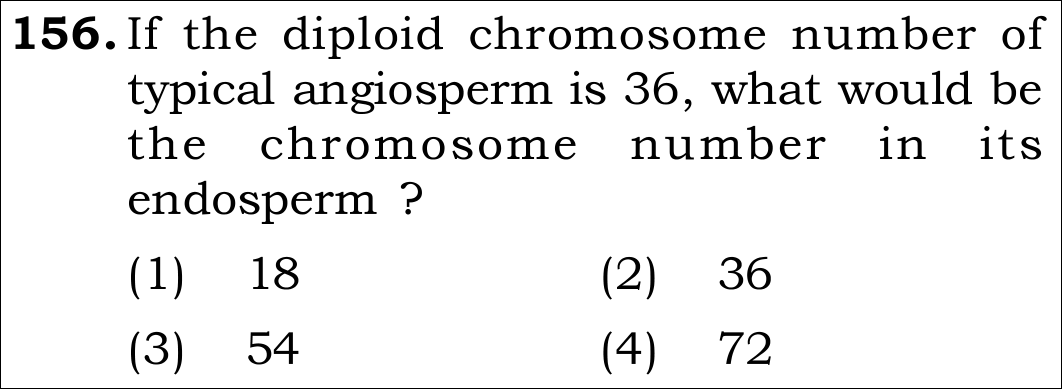
NEET 2026 Zoology Question 156: Calculation of Endosperm Ploidy from Diploid Number

Question

If the diploid chromosome number of typical angiosperm is 36, what would be the chromosome number in its endosperm?

  1. (1)18
  2. (2)36
  3. (3)54
  4. (4)72
✓
Verified Against NTA Final Answer Key
Option (3) : 54
📚 Sexual Reproduction in Flowering Plants Easy
📋 Given Parameters & Problem Setup
Plant Type Angiosperm
Diploid Number (2n) 36
Target Structure Endosperm Chromosome Number
⚡

The 30-Second Exam Hall Shortcut: ⚡ 3-Halves Ploidy Formula

⏱️ Save ~30 seconds

Endosperm = 3n = (3/2) × 2n = 1.5 × 36 = 54!

1 Recall angiosperm ploidy rules: Vegetative/sporophytic body is diploid (2n = 36).
2 Find haploid genome number: n = 36 / 2 = 18.
3 In angiosperms, endosperm is formed by triple fusion (1 male gamete n + 2 polar nuclei 2n = 3n).
4 Calculate: Endosperm = 3n = 3 × 18 = 54.
5 Match Option (3) = 54 instantly.
🛡️
Why You Can 100% Trust This Shortcut: NCERT Biology · Sexual Reproduction in Flowering Plants (Double Fertilization: Syngamy produces zygote, triple fusion produces PEN).
📐

Step-by-Step Rigorous Workflow & Mathematical Proof

Step 1

Determine Haploid Number (n)

Given that the diploid number of chromosomes (2n) of the angiospermic plant is 36, the haploid number (n) present in gametes is half of this value.

2n=36  ⟹  n=362=182n = 36 \implies n = \frac{36}{2} = 18
  • • Haploid number n = 18 applies to male gametes, egg cell, synergids, and antipodals.
Step 2

Triple Fusion and Endosperm Ploidy

In angiosperms, double fertilization involves triple fusion where one haploid male gamete (n) fuses with two haploid polar nuclei (or one secondary diploid nucleus 2n) to produce the triploid primary endosperm nucleus (PEN).

PEN Ploidy=n+n+n=3n=3×18=54\text{PEN Ploidy} = n + n + n = 3n = 3 \times 18 = 54
  • • In gymnosperms, endosperm is haploid (n = 18); in angiosperms, it is triploid (3n = 54).
⭐

360° Option Elimination Engine Key Feature

Diagnose every choice: Know exactly why the right option works and why distractors fail.

4-Option Deep Scan
1 A
✗ Incorrect
Verdict & Scientific Reason:

Incorrect. 18 is the haploid number (n), characteristic of gametes, synergids, and antipodals, or gymnosperm endosperm.

⚠️
Student Fallacy (Why candidates pick this trap): Confusing angiosperm endosperm (3n) with haploid gametes or gymnosperm endosperm (n).
2 B
✗ Incorrect
Verdict & Scientific Reason:

Incorrect. 36 is the diploid number (2n), characteristic of root, stem, leaf, integuments, and zygote.

⚠️
Student Fallacy (Why candidates pick this trap): Assuming endosperm has regular somatic diploid ploidy (2n).
3 C
✓ 100% Correct
Verdict & Scientific Reason:

100% mathematically and biologically correct. Angiosperm endosperm is triploid: 3n = 3 × 18 = 54.

💡
Why this is airtight: None; straightforward calculation.
4 D
✗ Incorrect
Verdict & Scientific Reason:

Incorrect. 72 would represent tetraploid (4n), which does not correspond to standard angiosperm endosperm.

⚠️
Student Fallacy (Why candidates pick this trap): Arbitrary multiplication by 4.
⚠️

NTA Trap Alert: Gymnosperm vs. Angiosperm Endosperm Ploidy Trap

In gymnosperms, endosperm is formed before fertilization and is haploid (n). In angiosperms, it is formed after double fertilization (triple fusion) and is triploid (3n).

🛡️ How to avoid the -1 mark: Always check if the question specifies "angiosperm" -> Endosperm is ALWAYS 3n.
📖

Core NEET Syllabus Standard

NEET Biology Core Syllabus · Sexual Reproduction in Flowering Plants Standard Benchmark
Core Scientific Principle Tested:

"Triple fusion results in a triploid (3n) primary endosperm nucleus."

Syllabus Focus: Double Fertilization & Endosperm
✓ Core NEET UG Syllabus Anchor Syllabus & Academic Standards ↗
Triple Fusion = 3 × n = 3 × 18 = 54!

Ready to attempt under real exam pressure?

Test your speed and accuracy in the authentic 180-minute timed NTA simulator.

Launch NEET 2026 CBT Test →

Spotted a mistake in this solution? Report an error ([email protected])

⚖️ Legal & Fair Dealing Notice: Sourced from publicly released NEET 2026 question papers and NEET answer keys for private study, research, and non-commercial educational practice under Fair Dealing (Section 52(1)(a) of the Indian Copyright Act, 1957). Not affiliated with or endorsed by NTA or NMC.

Solve 4 NEET Questions a Day — One per Subject

Cover all 1,140 official NEET questions in 285 days at your own pace. Progress is saved on your device. No login needed.