MyCompetitiveExams Logo MyCompetitiveExams
Search 1,140+ Questions
Chapters, formulas, speed tricks
→
⚡ Brahmastra NEET 2027
720 MARKS

Dynamic 180-question full-length simulator mixed dynamically from all 6 years for 2027 & 2026 aspirants.

Launch Brahmastra 2027 Test →
Start Practice →
100% Free · No Login Required
Q.157 Zoology ⭐ 360° Option Elimination Active
Vault ↗

NEET 2026 Zoology Question 157 Solution

Topic: Excretory Products and their Elimination · Official NTA Booklet Code 50
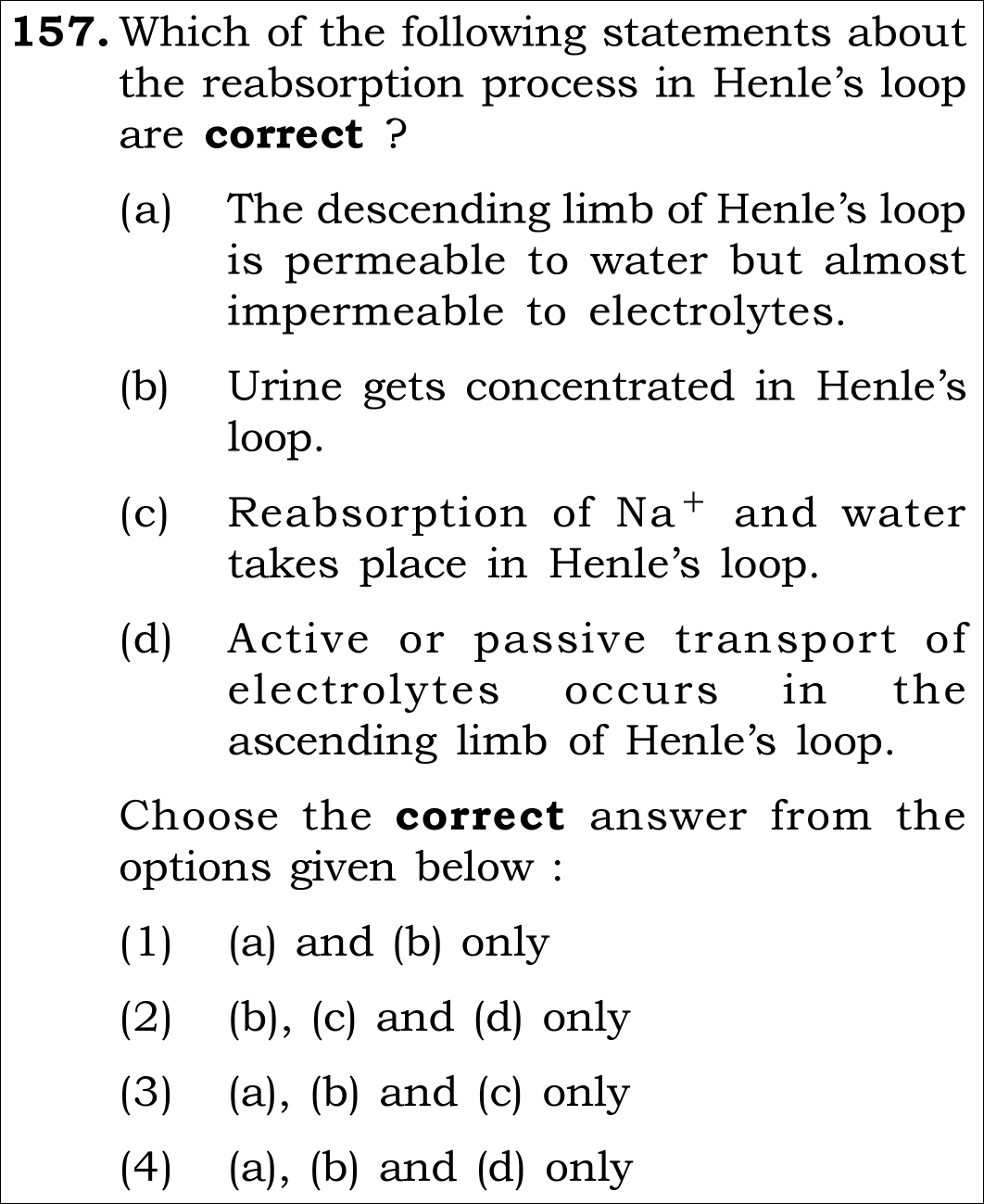
NEET 2026 Zoology Question 157: Henle's Loop Permeability & Counter-Current Mechanism

Question

Which of the following statements about the reabsorption process in Henle's loop are correct? (a) The descending limb of Henle's loop is permeable to water but almost impermeable to electrolytes. (b) Urine gets concentrated in Henle's loop. (c) Reabsorption of Na⁺ and water takes place in Henle's loop. (d) Active or passive transport of electrolytes occurs in the ascending limb of Henle's loop. Choose the correct answer from the options given below:

✓
Verified Against NTA Final Answer Key
Option (4) : (a), (b) and (d) only
📚 Excretory Products and their Elimination Medium
📋 Given Parameters & Problem Setup
Anatomical Structure Loop of Henle (Nephron)
Given Statements (a) Descending limb permeable to water, impermeable to electrolytes; (b) Concentrates filtrate downward; (c) Ascending limb permeable to water; (d) Dilution occurs moving upward in ascending limb
⚡

The 30-Second Exam Hall Shortcut: ⚡ Descending = H₂O, Ascending = Salt Rule

⏱️ Save ~50 seconds

Descending limb lets Water out; Ascending limb NEVER lets Water out (Impermeable)!

1 Check Statement (a): Descending limb permeable to water, impermeable to electrolytes -> TRUE.
2 Check Statement (b): Concentrates filtrate as it moves down (300 -> 1200 mOsm/L) -> TRUE.
3 Check Statement (c): "Ascending limb is permeable to water..." -> FALSE! Ascending limb is completely IMPERMEABLE to water.
4 Eliminate any option containing (c): Options (1), (2), and (3) all contain (c)!
5 Only Option (4) remains: (a), (b) and (d) only. Solved in 10 seconds via option elimination!
🛡️
Why You Can 100% Trust This Shortcut: NCERT Biology · Excretory Products and their Elimination (Juxtaglomerular Apparatus: RAAS pathway regulates GFR and blood pressure).
📐

Step-by-Step Rigorous Workflow & Mathematical Proof

Step 1

Physiology of Henle's Descending Limb

The descending limb of loop of Henle is permeable to water but almost impermeable to electrolytes. As the filtrate flows downward into the hypertonic medullary interstitium, water leaves by osmosis, concentrating the filtrate up to 1200 mOsm/L at the hairpin turn.

Descending Limb→Permeable to H2OWater Reabsorption  ⟹  Filtrate Concentrates (300 →1200 mOsm/L)\text{Descending Limb} \xrightarrow{\text{Permeable to } \text{H}_2\text{O}} \text{Water Reabsorption} \implies \text{Filtrate Concentrates (300 } \rightarrow 1200\text{ mOsm/L)}
  • • Statements (a) and (b) are both factually correct.
Step 2

Physiology of Henle's Ascending Limb

The ascending limb is impermeable to water but allows transport of electrolytes actively or passively. Therefore, as the concentrated filtrate passes upward, it gets diluted due to the passage of electrolytes out into the medullary fluid, dropping osmolarity to ~200 mOsm/L.

Ascending Limb→Impermeable to H2OActive/Passive NaCl Transport  ⟹  Filtrate Dilutes (1200 →200 mOsm/L)\text{Ascending Limb} \xrightarrow{\text{Impermeable to } \text{H}_2\text{O}} \text{Active/Passive NaCl Transport} \implies \text{Filtrate Dilutes (1200 } \rightarrow 200\text{ mOsm/L)}
  • • Statement (c) is false because it wrongly asserts ascending limb is permeable to water.
  • • Statement (d) is correct because filtrate is progressively diluted upward.
⭐

360° Option Elimination Engine Key Feature

Diagnose every choice: Know exactly why the right option works and why distractors fail.

4-Option Deep Scan
1 A
✗ Incorrect
Verdict & Scientific Reason:

Incorrect. Contains false statement (c); ascending limb is strictly impermeable to water.

⚠️
Student Fallacy (Why candidates pick this trap): Overlooking that ascending limb has zero water permeability.
2 B
✗ Incorrect
Verdict & Scientific Reason:

Incorrect. Contains false statement (c).

⚠️
Student Fallacy (Why candidates pick this trap): Failing to reject (c).
3 C
✗ Incorrect
Verdict & Scientific Reason:

Incorrect. Contains false statement (c) and omits valid statement (d).

⚠️
Student Fallacy (Why candidates pick this trap): Accepting (c) while ignoring (d).
4 D
✓ 100% Correct
Verdict & Scientific Reason:

100% correct. Statements (a), (b), and (d) are canonical NCERT facts, while statement (c) is false.

💡
Why this is airtight: None; flawless single-elimination logic.
⚠️

NTA Trap Alert: Water Permeability Inversion in Ascending Limb

Examiners frequently test the contrast between limbs. Descending limb = permeable to water, impermeable to salt. Ascending limb = impermeable to water, permeable to salt.

🛡️ How to avoid the -1 mark: Remember: Down = Dry out (water leaves); Up = Un-salt (salt leaves, water stays trapped).
📖

Core NEET Syllabus Standard

NEET Biology Core Syllabus · Excretory Products and their Elimination Standard Benchmark
Core Scientific Principle Tested:

"Descending limb is permeable to water, ascending limb is impermeable to water and transports electrolytes."

Syllabus Focus: Mechanism of Concentration of the Filtrate
✓ Core NEET UG Syllabus Anchor Syllabus & Academic Standards ↗
Down = Drink Water out (concentrates); Up = Unleash Salt (dilutes)!

Ready to attempt under real exam pressure?

Test your speed and accuracy in the authentic 180-minute timed NTA simulator.

Launch NEET 2026 CBT Test →

Spotted a mistake in this solution? Report an error ([email protected])

⚖️ Legal & Fair Dealing Notice: Sourced from publicly released NEET 2026 question papers and NEET answer keys for private study, research, and non-commercial educational practice under Fair Dealing (Section 52(1)(a) of the Indian Copyright Act, 1957). Not affiliated with or endorsed by NTA or NMC.

Solve 4 NEET Questions a Day — One per Subject

Cover all 1,140 official NEET questions in 285 days at your own pace. Progress is saved on your device. No login needed.