MyCompetitiveExams Logo MyCompetitiveExams
Search 1,140+ Questions
Chapters, formulas, speed tricks
→
⚡ Brahmastra NEET 2027
720 MARKS

Dynamic 180-question full-length simulator mixed dynamically from all 6 years for 2027 & 2026 aspirants.

Launch Brahmastra 2027 Test →
Start Practice →
100% Free · No Login Required
Q.125 Botany ⭐ 360° Option Elimination Active
Vault ↗

NEET 2025 Botany Question 125 Solution

Topic: Excretory Products and their Elimination · Official NTA Booklet Code 45
NEET 2025 Botany Question 125: Substance Transport in PCT (P) and DCT (D) of Nephron

Question

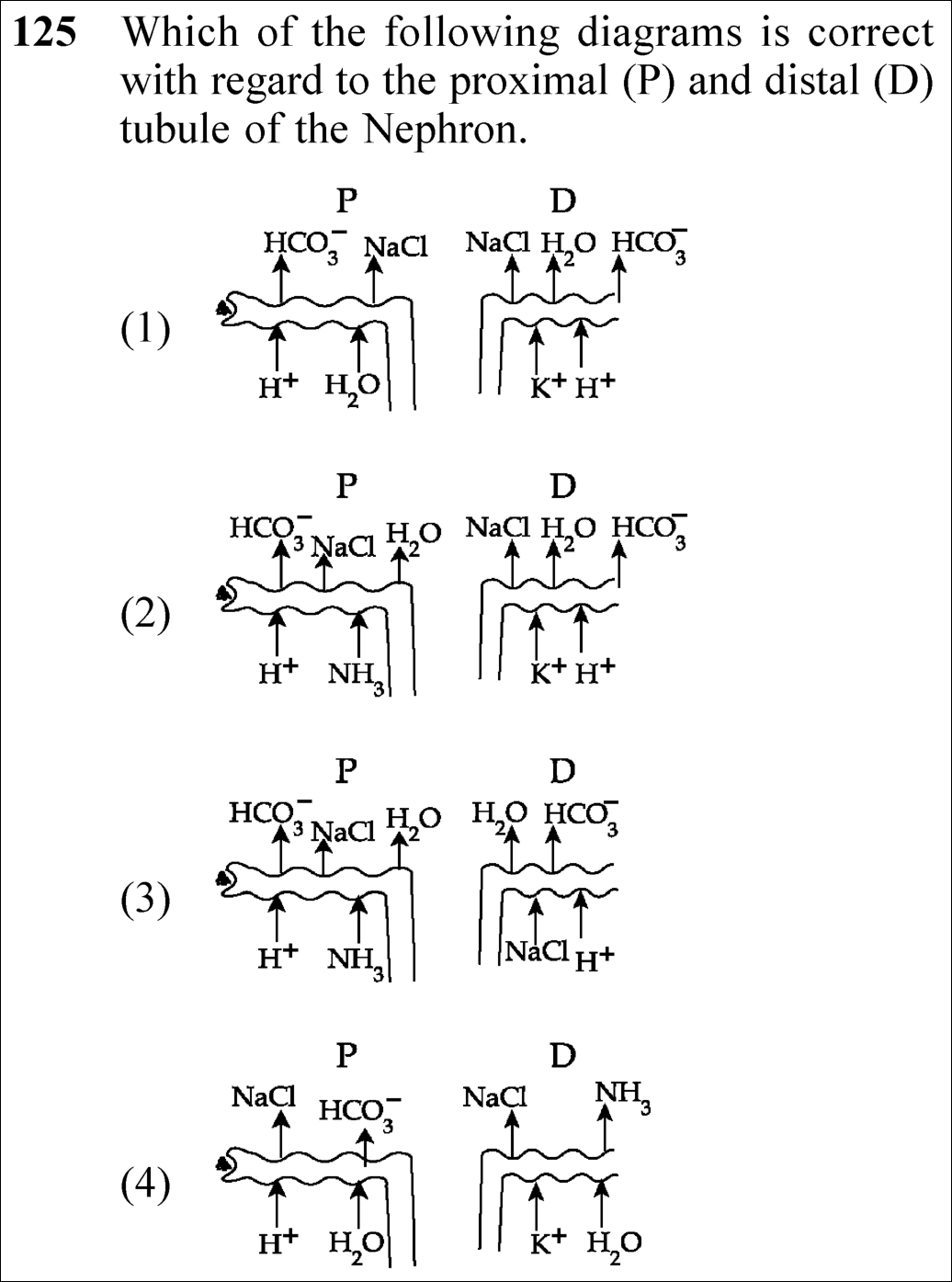
Which of the following diagrams is correct with regard to the proximal (P) and distal (D) tubule of the Nephron?

✓
Verified Against NTA Final Answer Key
Option (2) : P: Reabsorbs HCO₃⁻, NaCl, H₂O; Secretes H⁺, NH₃. D: Reabsorbs NaCl, H₂O, HCO₃⁻; Secretes K⁺, H⁺
📚 Excretory Products and their Elimination Medium
📋 Given Parameters & Problem Setup
Tubule P Proximal Convoluted Tubule (PCT)
Tubule D Distal Convoluted Tubule (DCT)
Target Correct arrow directions for reabsorption (out) and secretion (in)
⚡

The 30-Second Exam Hall Shortcut: ⚡ Nephron Transport Arrow Diagnostic

⏱️ Save ~35 seconds

PCT (P): REABSORBS HCO₃⁻, NaCl, H₂O (arrows pointing OUT); SECRETES H⁺, NH₃ (arrows pointing IN)! DCT (D): REABSORBS NaCl, H₂O, HCO₃⁻; SECRETES K⁺, H⁺! Option (2) matches NCERT Figure 19.5 with 100% precision!

1 Recall the canonical NCERT nephron diagram (Figure 19.5):
2 - Proximal Convoluted Tubule (P):
3 * Outward arrows (Reabsorbed into blood/interstitium): HCO₃⁻, NaCl, H₂O, Nutrients, K⁺.
4 * Inward arrows (Secreted from blood into filtrate): H⁺, NH₃.
5 - Distal Convoluted Tubule (D):
6 * Outward arrows (Conditional reabsorption): NaCl, H₂O, HCO₃⁻.
7 * Inward arrows (Selective secretion): K⁺, H⁺.
8 Compare with Option diagrams:
9 - In diagram (2), P shows outward arrows for HCO₃⁻, NaCl, H₂O and inward arrows for H⁺, NH₃.
10 - In diagram (2), D shows outward arrows for NaCl, H₂O, HCO₃⁻ and inward arrows for K⁺, H⁺.
11 Matches Option (2) perfectly!
12 Select Option (2)!
🛡️
Why You Can 100% Trust This Shortcut: Counter-Current Multiplier Mechanism (NCERT Biology · Excretory Products and their Elimination: Henle’s loop and vasa recta).
📐

Step-by-Step Rigorous Workflow & Mathematical Proof

Step 1

Physiology of the Proximal Convoluted Tubule (PCT / P)

PCT is lined by simple cuboidal brush border epithelium which greatly increases the surface area for reabsorption:

  • • Nearly all essential nutrients (glucose, amino acids) and 70–80% of electrolytes and water are reabsorbed here (indicated by outward arrows from lumen to interstitium: HCO3−HCO_3^-, NaClNaCl, H2OH_2O).
  • • PCT maintains pH and ionic balance of body fluids by selective secretion of hydrogen ions (H+H^+) and ammonia (NH3NH_3) into the filtrate (indicated by inward arrows into the tubule lumen).
Step 2

Physiology of the Distal Convoluted Tubule (DCT / D)

DCT performs conditional, hormonally regulated reabsorption and fine-tuning of acid-base balance:

  • • Conditional reabsorption of Na+Na^+ and water takes place in DCT under the influence of aldosterone and ADH (arrows pointing outwards: NaClNaCl, H2OH_2O).
  • • DCT is also capable of reabsorbing bicarbonate ions (HCO3−HCO_3^-) to preserve buffer capacity (arrow pointing outwards: HCO3−HCO_3^-).
  • • DCT selectively secretes potassium (K+K^+) and hydrogen (H+H^+) ions into the tubular fluid to maintain blood pH and Na+Na^+-K+K^+ balance (arrows pointing inwards into lumen: K+K^+, H+H^+).
Step 3

Comparison of the Given Diagrammatic Options

Evaluating the arrow schematics in Option (2):

  • • Diagram P has upward (outward) arrows for HCO3−HCO_3^-, NaClNaCl, and H2OH_2O, and upward (inward) arrows entering from the bottom for H+H^+ and NH3NH_3.
  • • Diagram D has upward (outward) arrows for NaClNaCl, H2OH_2O, and HCO3−HCO_3^-, and upward (inward) arrows entering from the bottom for K+K^+ and H+H^+.
  • • This is a literal, 1:1 reproduction of NCERT Figure 19.5.
Step 4

Conclusion

Diagram (2) represents the true transport vectors of the nephron.

Correct Schematic=Diagram (2)\text{Correct Schematic} = \text{Diagram (2)}
⭐

360° Option Elimination Engine Key Feature

Diagnose every choice: Know exactly why the right option works and why distractors fail.

4-Option Deep Scan
1 A
✗ Incorrect
Verdict & Scientific Reason:

Incorrect. Shows H₂O entering P (secreted into tubule) instead of being reabsorbed.

⚠️
Student Fallacy (Why candidates pick this trap): Failing to notice the inward water arrow in PCT.
2 B
✓ 100% Correct
Verdict & Scientific Reason:

100% correct. Correctly portrays all reabsorption and secretion vectors for both PCT and DCT.

💡
Why this is airtight: None; exceptional visual and physiological mastery of nephron dynamics.
3 C
✗ Incorrect
Verdict & Scientific Reason:

Incorrect. Shows NaCl entering D from interstitial fluid (secreted), which is physiologically impossible.

⚠️
Student Fallacy (Why candidates pick this trap): Overlooking the reverse arrow for NaCl in DCT.
4 D
✗ Incorrect
Verdict & Scientific Reason:

Incorrect. Reverses water and electrolyte vectors across both tubules.

⚠️
Student Fallacy (Why candidates pick this trap): Inverting tubular secretion and reabsorption.
⚠️

NTA Trap Alert: Secreted vs Reabsorbed Arrow Directions

Arrows pointing OUT of the tubule indicate REABSORPTION back into the peritubular capillaries (saving substances for the body). Arrows pointing INTO the tubule indicate SECRETION into urine (excretion). Never invert the direction!

🛡️ How to avoid the -1 mark: Out = Reabsorption (NaCl, H₂O, HCO₃⁻); In = Secretion (H⁺, NH₃, K⁺).
📖

Core NEET Syllabus Standard

NEET Biology Core Syllabus · Excretory Products and their Elimination Standard Benchmark
Core Scientific Principle Tested:

"PCT reabsorbs HCO₃⁻, NaCl, H₂O and secretes H⁺, NH₃; DCT reabsorbs NaCl, H₂O, HCO₃⁻ and secretes K⁺, H⁺."

Syllabus Focus: Function of the Tubules · PCT and DCT
✓ Core NEET UG Syllabus Anchor Syllabus & Academic Standards ↗
PCT spits out Salt & Water, sucks in Acid (H⁺/NH₃); DCT spits out Salt/Water/Bicarb, dumps K⁺ and H⁺!

Ready to attempt under real exam pressure?

Test your speed and accuracy in the authentic 180-minute timed NTA simulator.

Launch NEET 2025 CBT Test →

Spotted a mistake in this solution? Report an error ([email protected])

⚖️ Legal & Fair Dealing Notice: Sourced from publicly released NEET 2025 question papers and NEET answer keys for private study, research, and non-commercial educational practice under Fair Dealing (Section 52(1)(a) of the Indian Copyright Act, 1957). Not affiliated with or endorsed by NTA or NMC.

Solve 4 NEET Questions a Day — One per Subject

Cover all 1,140 official NEET questions in 285 days at your own pace. Progress is saved on your device. No login needed.