MyCompetitiveExams Logo MyCompetitiveExams
Search 1,140+ Questions
Chapters, formulas, speed tricks
→
⚡ Brahmastra NEET 2027
720 MARKS

Dynamic 180-question full-length simulator mixed dynamically from all 6 years for 2027 & 2026 aspirants.

Launch Brahmastra 2027 Test →
Start Practice →
100% Free · No Login Required
Q.124 Botany ⭐ 360° Option Elimination Active
Vault ↗

NEET 2025 Botany Question 124 Solution

Topic: Morphology of Flowering Plants · Official NTA Booklet Code 45
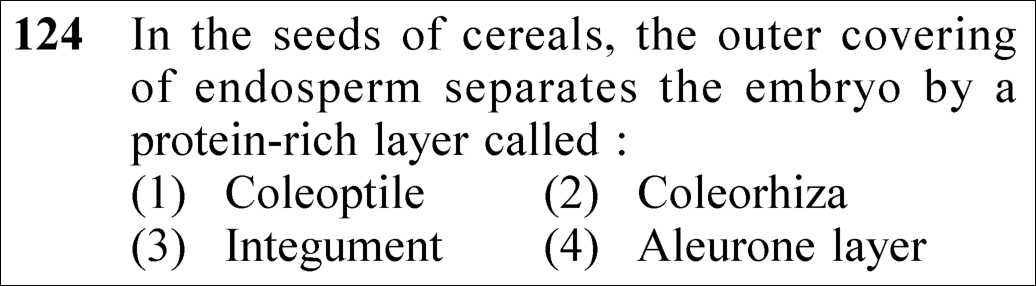
NEET 2025 Botany Question 124: Structure of Monocotyledonous Seed (Aleurone Layer)

Question

In the seeds of cereals, the outer covering of endosperm separates the embryo by a protein-rich layer called:

  1. (1)Coleoptile
  2. (2)Coleorhiza
  3. (3)Integument
  4. (4)Aleurone layer
✓
Verified Against NTA Final Answer Key
Option (4) : Aleurone layer
📚 Morphology of Flowering Plants Easy
📋 Given Parameters & Problem Setup
Plant Group Cereal grains (Monocotyledonous seeds, e.g., maize, wheat)
Structure Description Outer protein-rich layer of endosperm separating it from the embryo
⚡

The 30-Second Exam Hall Shortcut: ⚡ Monocot Seed Protein Layer Fingerprint

⏱️ Save ~20 seconds

Endosperm of cereal grains is surrounded by a special PROTEIN-RICH layer separating it from the scutellum/embryo -> ALEURONE LAYER (3n)!

1 Recall monocot seed anatomy (maize grain) from NCERT:
2 - Seed coat is fused with the pericarp (caryopsis fruit).
3 - Endosperm is bulky and stores food (starch).
4 - The outer covering of endosperm separates the embryo by a proteinous layer called the ALEURONE LAYER.
5 - Coleoptile protects plumule; coleorhiza protects radicle.
6 Protein-rich layer = Aleurone layer!
7 Select Option (4) directly!
🛡️
Why You Can 100% Trust This Shortcut: Fruit Types & Pericarp Differentiation (NCERT Biology · Morphology of Flowering Plants: Drupe in Mango and Coconut).
📐

Step-by-Step Rigorous Workflow & Mathematical Proof

Step 1

Anatomy of a Monocotyledonous (Cereal) Seed

Cereal grains (such as maize, wheat, barley, and rice) are single-seeded fruits (caryopsis) where the seed coat is membranous and generally fused with the fruit wall (pericarp):

  • • The seed is divided into two unequal regions: a large storage endosperm and a small laterally placed embryo.
  • • The outer covering of the endosperm differentiates into a specialized protein-rich peripheral layer termed the aleurone layer.
  • • The aleurone layer synthesizes hydrolytic enzymes (such as α\alpha-amylase induced by gibberellins) during seed germination to mobilize stored starch from the endosperm to the developing embryo.
Step 2

Evaluating Alternative Embryonic Structures

Distinguishing protective coverings of the monocot embryo:

  • • Coleoptile: A conical protective foliar sheath enclosing the plumule (shoot tip).
  • • Coleorhiza: An undifferentiated protective sheath enclosing the radicle and root cap.
  • • Integument: The diploid maternal layer enveloping the ovule that matures into the seed coat (testa and tegmen).
Step 3

Conclusion

The protein-rich boundary layer separating the endosperm from the embryo is the Aleurone layer.

Outer Endosperm Protein Layer=Aleurone Layer\text{Outer Endosperm Protein Layer} = \text{Aleurone Layer}
⭐

360° Option Elimination Engine Key Feature

Diagnose every choice: Know exactly why the right option works and why distractors fail.

4-Option Deep Scan
1 A
✗ Incorrect
Verdict & Scientific Reason:

Incorrect. Coleoptile is the sheath protecting the plumule, not a protein layer separating endosperm from embryo.

⚠️
Student Fallacy (Why candidates pick this trap): Confusing shoot sheath with endosperm covering.
2 B
✗ Incorrect
Verdict & Scientific Reason:

Incorrect. Coleorhiza is the sheath covering the radicle and root cap.

⚠️
Student Fallacy (Why candidates pick this trap): Confusing root sheath with endosperm covering.
3 C
✗ Incorrect
Verdict & Scientific Reason:

Incorrect. Integument is the ovular covering that becomes the seed coat.

⚠️
Student Fallacy (Why candidates pick this trap): Confusing seed coat origin with internal seed layers.
4 D
✓ 100% Correct
Verdict & Scientific Reason:

100% correct. Verbatim NCERT fact: "The outer covering of endosperm separates the embryo by a proteinous layer called aleurone layer."

💡
Why this is airtight: None; textbook mastery.
⚠️

NTA Trap Alert: Ploidy and Nature of Aleurone Layer

Because the aleurone layer is morphologically the outermost cell layer of the endosperm, its cells are triploid (3n) in angiosperms and specialized for protein storage and hydrolytic enzyme secretion.

🛡️ How to avoid the -1 mark: Aleurone = Protein layer of endosperm (3n). Coleoptile/Coleorhiza = Sheaths of the embryo (2n).
📖

Core NEET Syllabus Standard

NEET Biology Core Syllabus · Morphology of Flowering Plants Standard Benchmark
Core Scientific Principle Tested:

"In cereal seeds, a proteinous layer called the aleurone layer separates the endosperm from the embryo."

Syllabus Focus: Structure of Monocotyledonous Seed
✓ Core NEET UG Syllabus Anchor Syllabus & Academic Standards ↗
ALEURONE = All-protein outer endosperm zone!

Ready to attempt under real exam pressure?

Test your speed and accuracy in the authentic 180-minute timed NTA simulator.

Launch NEET 2025 CBT Test →

Spotted a mistake in this solution? Report an error ([email protected])

⚖️ Legal & Fair Dealing Notice: Sourced from publicly released NEET 2025 question papers and NEET answer keys for private study, research, and non-commercial educational practice under Fair Dealing (Section 52(1)(a) of the Indian Copyright Act, 1957). Not affiliated with or endorsed by NTA or NMC.

Solve 4 NEET Questions a Day — One per Subject

Cover all 1,140 official NEET questions in 285 days at your own pace. Progress is saved on your device. No login needed.