MyCompetitiveExams Logo MyCompetitiveExams
Search 1,140+ Questions
Chapters, formulas, speed tricks
→
⚡ Brahmastra NEET 2027
720 MARKS

Dynamic 180-question full-length simulator mixed dynamically from all 6 years for 2027 & 2026 aspirants.

Launch Brahmastra 2027 Test →
Start Practice →
100% Free · No Login Required
Q.105 Botany ⭐ 360° Option Elimination Active
Vault ↗

NEET 2026 Botany Question 105 Solution

Topic: Morphology of Flowering Plants · Official NTA Booklet Code 50
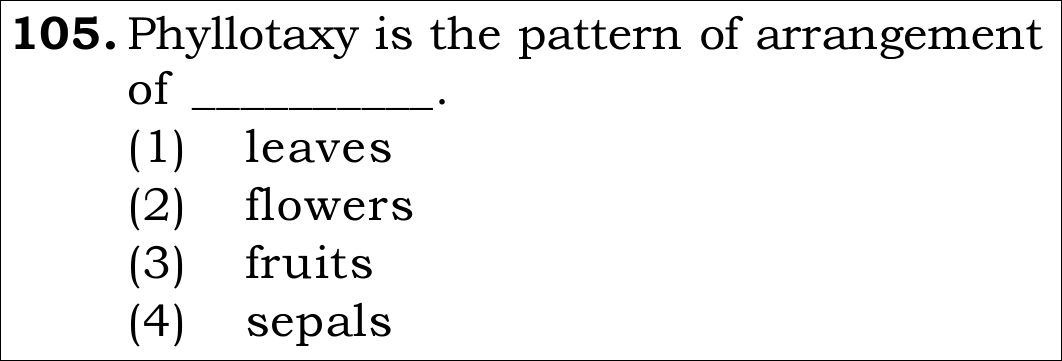
NEET 2026 Botany Question 105: Definition and Patterns of Phyllotaxy (Leaf Arrangement)

Question

Phyllotaxy is the pattern of arrangement of

  1. (1)leaves
  2. (2)flowers
  3. (3)fruits
  4. (4)sepals
✓
Verified Against NTA Final Answer Key
Option (1) : leaves
📚 Morphology of Flowering Plants Easy
📋 Given Parameters & Problem Setup
Morphological Term Phyllotaxy (Greek: phyllon = leaf, taxis = arrangement)
Target Organ whose pattern of arrangement is described by phyllotaxy
⚡

The 30-Second Exam Hall Shortcut: ⚡ Root Word Decoder: Phyllo = Leaf!

⏱️ Save ~40 seconds

Phyllo means LEAF! Phyllotaxy is the arrangement of leaves on stem or branch!

1 Etymology: "Phyllo-" is the biological prefix for leaf (e.g., chlorophyll, phyllode, phylloclade).
2 "Taxis" means orderly arrangement.
3 Phyllotaxy = Arrangement of LEAVES.
4 Contrast: Inflorescence = arrangement of flowers; Aestivation = arrangement of sepals/petals.
5 Option (1) is Leaves! Pick Option (1) in 3 seconds flat!
🛡️
Why You Can 100% Trust This Shortcut: NCERT Morphology of Flowering Plants verbatim: Phyllotaxy is the pattern of arrangement of leaves on the stem or branch.
📐

Step-by-Step Rigorous Workflow & Mathematical Proof

Step 1

Define Phyllotaxy

Phyllotaxy is the pattern of arrangement of leaves on the stem or branch. Its primary adaptive purpose is to orient leaves in a manner that avoids self-shading and maximizes light interception for photosynthesis.

Phyllotaxy≡Pattern of arrangement of leaves on stem/branch\text{Phyllotaxy} \equiv \text{Pattern of arrangement of leaves on stem/branch}
  • • There are three primary types of phyllotaxy: Alternate, Opposite, and Whorled.
Step 2

Review Types and Canonical Examples of Phyllotaxy

1. Alternate Phyllotaxy: A single leaf arises at each node in an alternate manner (e.g., China rose, Mustard, Sunflower). 2. Opposite Phyllotaxy: A pair of leaves arise at each node and lie opposite to each other (e.g., Calotropis, Guava). 3. Whorled Phyllotaxy: More than two leaves arise at a node and form a whorl (e.g., Alstonia).

Types: Alternate (Mustard), Opposite (Guava), Whorled (Alstonia)\text{Types: Alternate (Mustard), Opposite (Guava), Whorled (Alstonia)}
  • • All three describe patterns of leaf arrangement.
Step 3

Contrast with Other Botanical Terms in Options

1. Flowers: The arrangement of flowers on the floral axis is called INFLORESCENCE (Racemose or Cymose). 2. Sepals and Petals: The mode of arrangement of sepals or petals in floral bud with respect to other members is called AESTIVATION (Valvate, Twisted, Imbricate, Vexillary). 3. Fruits: Developed from fertilized ovaries; arrangement is not termed phyllotaxy.

Flowers →Inflorescence;Sepals/Petals →Aestivation;Leaves →Phyllotaxy\text{Flowers } \to \text{Inflorescence}; \quad \text{Sepals/Petals } \to \text{Aestivation}; \quad \text{Leaves } \to \text{Phyllotaxy}
  • • Matches Option (1).
⭐

360° Option Elimination Engine Key Feature

Diagnose every choice: Know exactly why the right option works and why distractors fail.

4-Option Deep Scan
1 A
✓ 100% Correct
Verdict & Scientific Reason:

Exact botanical definition matching NCERT Morphology chapter verbatim.

💡
Why this is airtight: None; fundamental botanical terminology.
2 B
✗ Incorrect
Verdict & Scientific Reason:

Incorrect. Arrangement of flowers on the floral axis is called inflorescence.

⚠️
Student Fallacy (Why candidates pick this trap): Confusing phyllotaxy with inflorescence.
3 C
✗ Incorrect
Verdict & Scientific Reason:

Incorrect. Phyllotaxy has nothing to do with fruit distribution.

⚠️
Student Fallacy (Why candidates pick this trap): Random morphological guess.
4 D
✗ Incorrect
Verdict & Scientific Reason:

Incorrect. Arrangement of sepals or petals in the floral bud is called aestivation.

⚠️
Student Fallacy (Why candidates pick this trap): Confusing phyllotaxy with aestivation.
⚠️

NTA Trap Alert: Confusing Phyllotaxy, Inflorescence, and Aestivation

NEET examiners love testing these three arrangement terms together: (1) Leaves = Phyllotaxy; (2) Flowers = Inflorescence; (3) Sepals/Petals = Aestivation.

🛡️ How to avoid the -1 mark: Phyllo = Leaf (Phyllotaxy); Flora = Flower (Inflorescence); Bud Petals = Aestivation.
📖

Core NEET Syllabus Standard

NEET Biology Core Syllabus · Morphology of Flowering Plants Standard Benchmark
Core Scientific Principle Tested:

"Phyllotaxy is the pattern of arrangement of leaves on the stem or branch (alternate, opposite, whorled)."

Syllabus Focus: The Leaf - Venation, types of leaves, and phyllotaxy
✓ Core NEET UG Syllabus Anchor Syllabus & Academic Standards ↗
Phyllo means Leaf: Phyllotaxy lays leaves without grief!

Ready to attempt under real exam pressure?

Test your speed and accuracy in the authentic 180-minute timed NTA simulator.

Launch NEET 2026 CBT Test →

Spotted a mistake in this solution? Report an error ([email protected])

⚖️ Legal & Fair Dealing Notice: Sourced from publicly released NEET 2026 question papers and NEET answer keys for private study, research, and non-commercial educational practice under Fair Dealing (Section 52(1)(a) of the Indian Copyright Act, 1957). Not affiliated with or endorsed by NTA or NMC.

Solve 4 NEET Questions a Day — One per Subject

Cover all 1,140 official NEET questions in 285 days at your own pace. Progress is saved on your device. No login needed.