MyCompetitiveExams Logo MyCompetitiveExams
Search 1,140+ Questions
Chapters, formulas, speed tricks
→
⚡ Brahmastra NEET 2027
720 MARKS

Dynamic 180-question full-length simulator mixed dynamically from all 6 years for 2027 & 2026 aspirants.

Launch Brahmastra 2027 Test →
Start Practice →
100% Free · No Login Required
Q.104 Botany ⭐ 360° Option Elimination Active
Vault ↗

NEET 2026 Botany Question 104 Solution

Topic: Locomotion and Movement · Official NTA Booklet Code 50
NEET 2026 Botany Question 104: Proximal-to-Distal Anatomical Sequence of Human Lower Limb Bones

Question

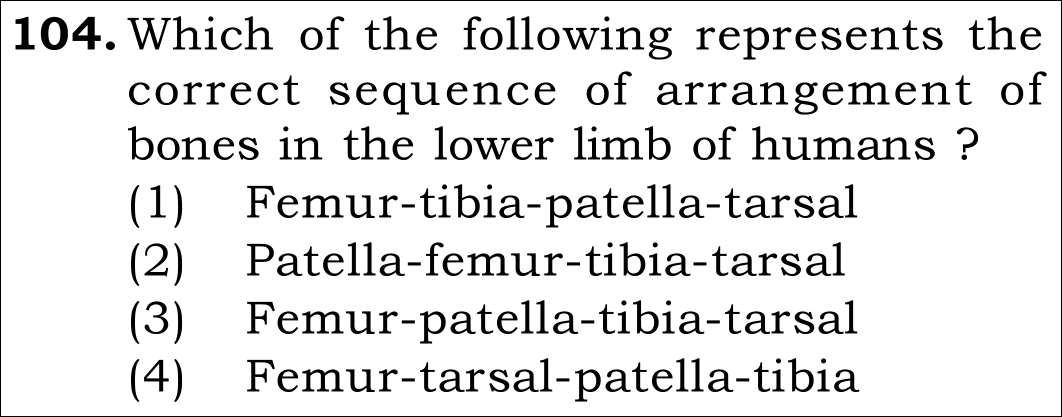
Which of the following represents the correct sequence of arrangement of bones in the lower limb of humans?

✓
Verified Against NTA Final Answer Key
Option (3) : Femur-patella-tibia-tarsal
📚 Locomotion and Movement Easy
📋 Given Parameters & Problem Setup
Region Human lower limb (leg skeleton)
Required Arrangement Correct anatomical sequence from proximal to distal
⚡

The 30-Second Exam Hall Shortcut: ⚡ Thigh to Ankle Anatomical Ladder

⏱️ Save ~45 seconds

Thigh (Femur) -> Knee cap (Patella) -> Shin (Tibia) -> Ankle (Tarsals)!

1 Start at the hip joint: FEMUR (thigh bone, most proximal).
2 Move down to the knee joint: PATELLA (sesamoid knee cap covering the joint).
3 Move down to the shank: TIBIA (medial weight-bearing shin bone) & Fibula.
4 Move down to the ankle: TARSALS (7 ankle bones).
5 Sequence: Femur -> Patella -> Tibia -> Tarsal.
6 Look at Option (3): Femur-patella-tibia-tarsal. Pick Option (3) in 10 seconds!
🛡️
Why You Can 100% Trust This Shortcut: Standard anatomical sequence of the 30 bones of the human lower limb: Femur (1), Patella (1), Tibia (1), Fibula (1), Tarsals (7), Metatarsals (5), Phalanges (14).
📐

Step-by-Step Rigorous Workflow & Mathematical Proof

Step 1

Review the Bones of the Human Lower Limb

Each human lower limb is made of 30 bones arranged in a linear anatomical hierarchy from proximal (hip articulation) to distal (toes): 1. Femur: Longest, heaviest bone (thigh bone). 2. Patella: Cup-shaped sesamoid bone covering the knee ventrally. 3. Tibia and Fibula: Two parallel long bones of the shank (tibia is medial and larger). 4. Tarsals: Ankle bones (7 in number). 5. Metatarsals: Sole bones (5 in number). 6. Phalanges: Toe bones (14 in number, formula 2,3,3,3,3).

Proximal ⟶ Distal: Femur →Patella →Tibia →Tarsals\text{Proximal } \longrightarrow \text{ Distal: Femur } \to \text{Patella } \to \text{Tibia } \to \text{Tarsals}
  • • Femur articulates with acetabulum proximally and tibia/patella distally.
Step 2

Evaluate the Options Against the Anatomical Sequence

1. Option (1): Femur - tibia - patella - tarsal (Incorrect: places patella distal to tibia). 2. Option (2): Patella - femur - tibia - tarsal (Incorrect: places patella proximal to femur). 3. Option (3): Femur - patella - tibia - tarsal (Correct: strictly proximal to distal order). 4. Option (4): Femur - tarsal - patella - tibia (Incorrect: places tarsals before knee and shin).

Sequence: Femur ⟶ Patella ⟶ Tibia ⟶ Tarsal\text{Sequence: Femur } \longrightarrow \text{ Patella } \longrightarrow \text{ Tibia } \longrightarrow \text{ Tarsal}
  • • Option (3) is the only correct sequence.
Step 3

Conclusion

The correct sequence is Femur-patella-tibia-tarsal.

Matches Option (3)\text{Matches Option (3)}
  • • Matches Option (3).
⭐

360° Option Elimination Engine Key Feature

Diagnose every choice: Know exactly why the right option works and why distractors fail.

4-Option Deep Scan
1 A
✗ Incorrect
Verdict & Scientific Reason:

Incorrect. Patella is situated at the knee between femur and tibia, not below the tibia.

⚠️
Student Fallacy (Why candidates pick this trap): Forgetting the anatomical position of the knee cap.
2 B
✗ Incorrect
Verdict & Scientific Reason:

Incorrect. Femur is the uppermost thigh bone, superior to the patella.

⚠️
Student Fallacy (Why candidates pick this trap): Placing the knee cap above the thigh bone.
3 C
✓ 100% Correct
Verdict & Scientific Reason:

Exact anatomical sequence from top to bottom: Thigh (Femur) -> Knee (Patella) -> Shin (Tibia) -> Ankle (Tarsal).

💡
Why this is airtight: None; flawless appendicular skeletal knowledge.
4 D
✗ Incorrect
Verdict & Scientific Reason:

Incorrect. Tarsals are in the foot/ankle and cannot precede the shin or knee.

⚠️
Student Fallacy (Why candidates pick this trap): Scrambling proximal and distal bone positions.
⚠️

NTA Trap Alert: Confusing Tarsals (Ankle) with Carpals (Wrist)

Carpals belong to the upper limb (wrist); Tarsals belong to the lower limb (ankle). Both are distal to the long bones of the limb.

🛡️ How to avoid the -1 mark: Remember: Legs walk on Tarsals; Hands write with Carpals.
📖

Core NEET Syllabus Standard

NEET Biology Core Syllabus · Locomotion and Movement Standard Benchmark
Core Scientific Principle Tested:

"The human lower limb bones from proximal to distal are Femur, Patella, Tibia/Fibula, Tarsals, Metatarsals, Phalanges."

Syllabus Focus: Appendicular skeleton - Bones of the lower limb
✓ Core NEET UG Syllabus Anchor Syllabus & Academic Standards ↗
From Hip to Toe: Femur first, Patella in the bend, Tibia on the shin, Tarsals at the end!

Ready to attempt under real exam pressure?

Test your speed and accuracy in the authentic 180-minute timed NTA simulator.

Launch NEET 2026 CBT Test →

Spotted a mistake in this solution? Report an error ([email protected])

⚖️ Legal & Fair Dealing Notice: Sourced from publicly released NEET 2026 question papers and NEET answer keys for private study, research, and non-commercial educational practice under Fair Dealing (Section 52(1)(a) of the Indian Copyright Act, 1957). Not affiliated with or endorsed by NTA or NMC.

Solve 4 NEET Questions a Day — One per Subject

Cover all 1,140 official NEET questions in 285 days at your own pace. Progress is saved on your device. No login needed.