MyCompetitiveExams Logo MyCompetitiveExams
Search 1,140+ Questions
Chapters, formulas, speed tricks
→
⚡ Brahmastra NEET 2027
720 MARKS

Dynamic 180-question full-length simulator mixed dynamically from all 6 years for 2027 & 2026 aspirants.

Launch Brahmastra 2027 Test →
Start Practice →
100% Free · No Login Required
Q.120 Botany ⭐ 360° Option Elimination Active
Vault ↗

NEET 2026 Botany Question 120 Solution

Topic: Morphology of Flowering Plants · Official NTA Booklet Code 50
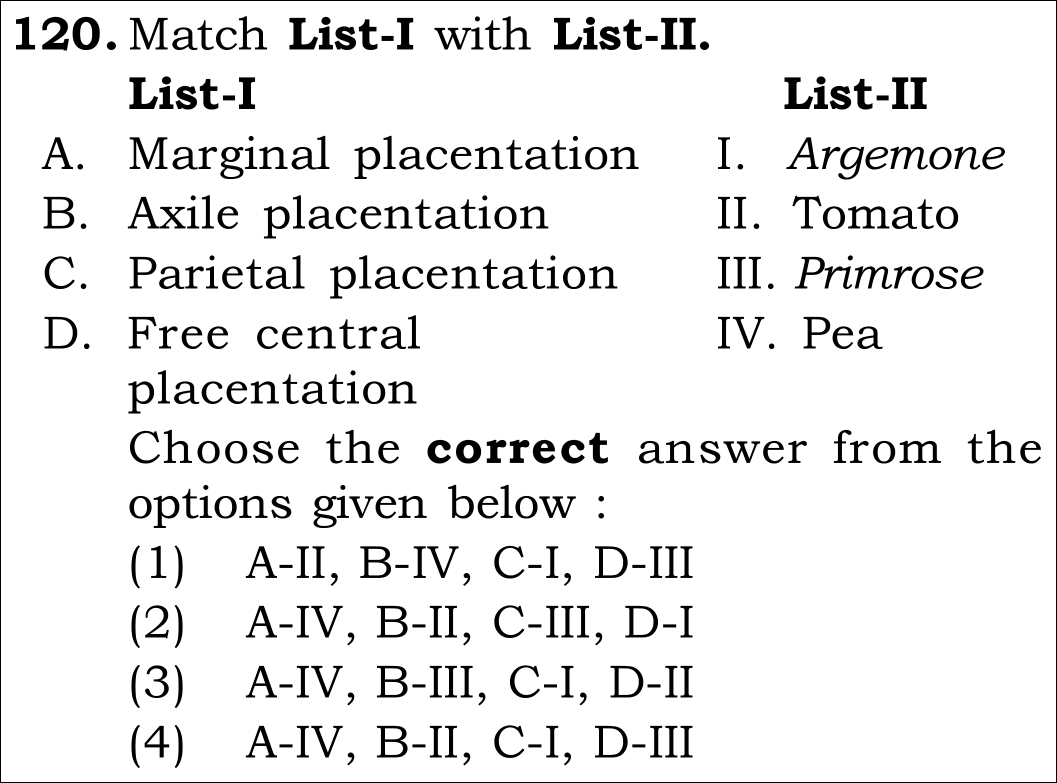
NEET 2026 Botany Question 120: Types of Placentation in Angiospermic Ovaries

Question

Match List-I with List-II. List I: A. Marginal placentation; B. Axile placentation; C. Parietal placentation; D. Free central placentation. List II: I. Argemone; II. Tomato; III. Primrose; IV. Pea. Choose the correct answer from the options given below:

✓
Verified Against NTA Final Answer Key
Option (4) : A-IV, B-II, C-I, D-III
📚 Morphology of Flowering Plants Easy
📋 Given Parameters & Problem Setup
List-I Placentation Types A. Marginal, B. Axile, C. Parietal, D. Free central
List-II Plant Examples I. Argemone, II. Tomato, III. Primrose, IV. Pea
⚡

The 30-Second Exam Hall Shortcut: ⚡ Placentation Rapid Matcher

⏱️ Save ~40 seconds

Marginal = Pea (IV), Axile = Tomato (II), Parietal = Argemone (I), Free central = Primrose (III)!

1 Recall canonical NCERT placentation examples:
2 A. Marginal -> Pea (IV).
3 B. Axile -> Tomato / China rose / Lemon (II).
4 C. Parietal -> Argemone / Mustard (I).
5 D. Free central -> Primrose / Dianthus (III).
6 Direct pairing: A-IV, B-II, C-I, D-III -> Option (4)!
7 Select Option (4) in under 5 seconds.
🛡️
Why You Can 100% Trust This Shortcut: NCERT Biology · Morphology of Flowering Plants (Placentation Types: Marginal, axile, parietal, free central, and basal placentation).
📐

Step-by-Step Rigorous Workflow & Mathematical Proof

Step 1

Understand Marginal Placentation (A)

In marginal placentation, the placenta forms a ridge along the ventral suture of the monocarpellary ovary, and ovules are borne along this ridge in two rows. Canonical example: Pea (Pisum sativum).

Marginal→ExamplePea (IV)\text{Marginal} \xrightarrow{\text{Example}} \text{Pea (IV)}
  • • A pairs with IV.
Step 2

Understand Axile Placentation (B)

In axile placentation, the placenta is axial and the ovules are attached to it in a multilocular ovary divided by septa. Canonical examples: Tomato, China rose, Lemon.

Axile→ExampleTomato (II)\text{Axile} \xrightarrow{\text{Example}} \text{Tomato (II)}
  • • B pairs with II.
Step 3

Understand Parietal Placentation (C)

In parietal placentation, ovules develop on the inner wall of the unilocular ovary or on peripheral parts. The ovary becomes two-chambered due to the formation of a false septum (replum). Canonical examples: Mustard, Argemone.

Parietal→ExampleArgemone (I)\text{Parietal} \xrightarrow{\text{Example}} \text{Argemone (I)}
  • • C pairs with I.
Step 4

Understand Free Central Placentation (D)

In free central placentation, ovules are borne on a central axis and septa are completely absent. Canonical examples: Dianthus, Primrose.

Free central→ExamplePrimrose (III)\text{Free central} \xrightarrow{\text{Example}} \text{Primrose (III)}
  • • D pairs with III.
Step 5

Synthesize the Complete Match

Assembling all pairs gives: A-IV, B-II, C-I, D-III. Looking at the options, this matches Option (4).

Match:A-IV,  B-II,  C-I,  D-III  ⟹  Option (4)\text{Match}: \mathbf{A}\text{-IV}, \; \mathbf{B}\text{-II}, \; \mathbf{C}\text{-I}, \; \mathbf{D}\text{-III} \implies \text{Option (4)}
  • • Matches official NTA final answer key Option D / (4).
⭐

360° Option Elimination Engine Key Feature

Diagnose every choice: Know exactly why the right option works and why distractors fail.

4-Option Deep Scan
1 A
✗ Incorrect
Verdict & Scientific Reason:

Incorrect. Assigns Tomato to Marginal and Pea to Axile.

⚠️
Student Fallacy (Why candidates pick this trap): Swapped Marginal and Axile placentation examples.
2 B
✗ Incorrect
Verdict & Scientific Reason:

Incorrect. Swaps Argemone and Primrose.

⚠️
Student Fallacy (Why candidates pick this trap): Confusing Parietal with Free Central placentation.
3 C
✗ Incorrect
Verdict & Scientific Reason:

Incorrect. Places Primrose in Axile and Tomato in Free Central.

⚠️
Student Fallacy (Why candidates pick this trap): Confusing multilocular axile with unilocular central.
4 D
✓ 100% Correct
Verdict & Scientific Reason:

100% accurate match for all four placentation types according to NCERT Morphology.

💡
Why this is airtight: None; textbook precision.
⚠️

NTA Trap Alert: Confusing Parietal (False Septum) and Free Central (No Septum)

Both Parietal (Argemone) and Free Central (Primrose) feature unilocular ovaries, but Parietal ovules are on peripheral walls with false septa, while Free Central ovules are on an unattached central axis.

🛡️ How to avoid the -1 mark: Remember: Free Central has "Dian & Prim" running FREE (Dianthus & Primrose).
📖

Core NEET Syllabus Standard

NEET Biology Core Syllabus · Morphology of Flowering Plants Standard Benchmark
Core Scientific Principle Tested:

"Placentation types: Marginal in Pea, Axile in Tomato/Citrus, Parietal in Argemone/Mustard, Free Central in Primrose/Dianthus."

Syllabus Focus: The Flower - Gynoecium & Placentation
✓ Core NEET UG Syllabus Anchor Syllabus & Academic Standards ↗
Pea is on the Margin; Tomato has Axile chambers; Argemone is on the Parietal wall; Primrose is Free in the middle of it all!

Ready to attempt under real exam pressure?

Test your speed and accuracy in the authentic 180-minute timed NTA simulator.

Launch NEET 2026 CBT Test →

Spotted a mistake in this solution? Report an error ([email protected])

⚖️ Legal & Fair Dealing Notice: Sourced from publicly released NEET 2026 question papers and NEET answer keys for private study, research, and non-commercial educational practice under Fair Dealing (Section 52(1)(a) of the Indian Copyright Act, 1957). Not affiliated with or endorsed by NTA or NMC.

Solve 4 NEET Questions a Day — One per Subject

Cover all 1,140 official NEET questions in 285 days at your own pace. Progress is saved on your device. No login needed.