MyCompetitiveExams Logo MyCompetitiveExams
Search 1,140+ Questions
Chapters, formulas, speed tricks
→
⚡ Brahmastra NEET 2027
720 MARKS

Dynamic 180-question full-length simulator mixed dynamically from all 6 years for 2027 & 2026 aspirants.

Launch Brahmastra 2027 Test →
Start Practice →
100% Free · No Login Required
Q.119 Botany ⭐ 360° Option Elimination Active
Vault ↗

NEET 2026 Botany Question 119 Solution

Topic: The Living World · Official NTA Booklet Code 50
NEET 2026 Botany Question 119: Ascending Order of Taxonomic Categories from Lowest to Highest Rank

Question

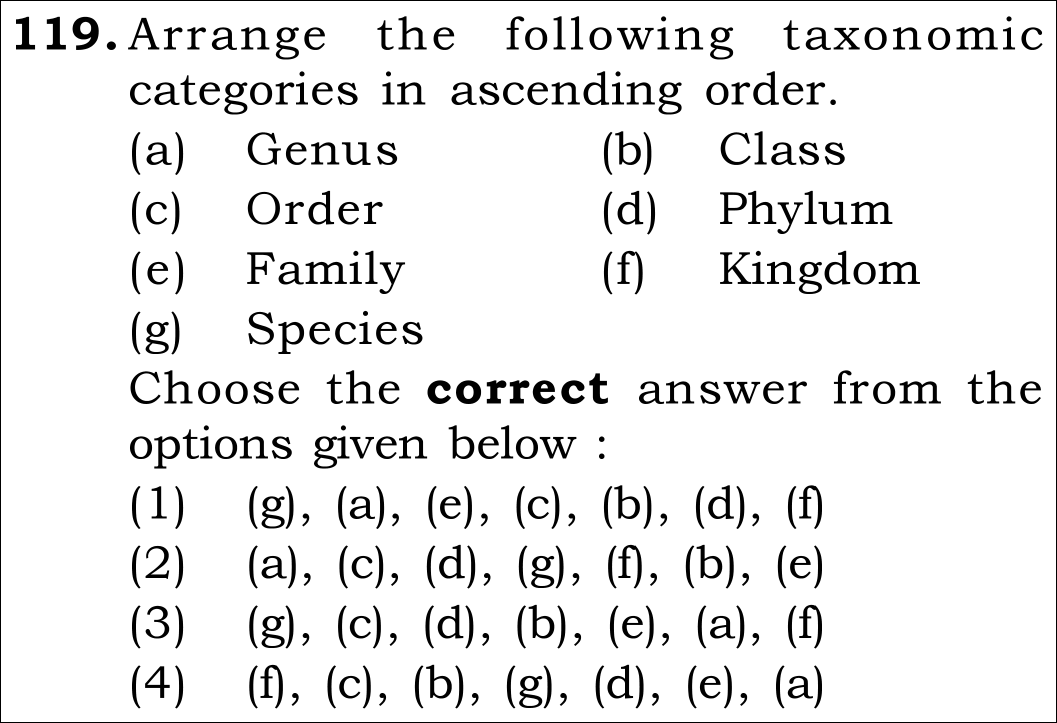
Arrange the following taxonomic categories in ascending order. (a) Genus (b) Class (c) Order (d) Phylum (e) Family (f) Kingdom (g) Species Choose the correct answer from the options given below:

✓
Verified Against NTA Final Answer Key
Option (1) : (g), (a), (e), (c), (b), (d), (f)
📚 The Living World Easy
📋 Given Parameters & Problem Setup
Direction of Hierarchy Ascending order (from lowest taxon to highest taxon)
Listed Ranks (a) Genus, (b) Class, (c) Order, (d) Phylum, (e) Family, (f) Kingdom, (g) Species
⚡

The 30-Second Exam Hall Shortcut: ⚡ Ascending Hierarchy Ladder

⏱️ Save ~40 seconds

Species (Lowest) -> Genus -> Family -> Order -> Class -> Phylum -> Kingdom (Highest)!

1 Note the keyword: "ASCENDING order" means lowest rank FIRST.
2 Lowest rank is Species (g). Highest rank is Kingdom (f).
3 Check start and end: must start with (g) and end with (f).
4 Look at Option (1): (g), (a), (e), (c), (b), (d), (f).
5 Verify sequence: Species (g) -> Genus (a) -> Family (e) -> Order (c) -> Class (b) -> Phylum (d) -> Kingdom (f).
6 Mark Option (1) in under 5 seconds!
🛡️
Why You Can 100% Trust This Shortcut: NCERT Biology · The Living World (Linnaean Taxonomic Hierarchy: Species -> Genus -> Family -> Order -> Class -> Phylum/Division -> Kingdom).
📐

Step-by-Step Rigorous Workflow & Mathematical Proof

Step 1

Understand Ascending Order in Taxonomy

Taxonomic categories form an obligate hierarchy. An ascending sequence starts from the basic, most specific taxonomic unit containing maximum shared similarities (Species) and ascends to the broadest, most inclusive rank (Kingdom).

Ascending Order:Species→Genus→Family→Order→Class→Phylum/Division→Kingdom\text{Ascending Order}: \text{Species} \rightarrow \text{Genus} \rightarrow \text{Family} \rightarrow \text{Order} \rightarrow \text{Class} \rightarrow \text{Phylum/Division} \rightarrow \text{Kingdom}
  • • Specificity decreases and generality increases as one ascends.
Step 2

Map Given Labels to Taxonomic Ranks

Assign each letter code to its corresponding level:

1.  Species=(g)2.  Genus=(a)3.  Family=(e)4.  Order=(c)5.  Class=(b)6.  Phylum=(d)7.  Kingdom=(f)\begin{aligned} 1. \; &\text{Species} &&= (\text{g}) \\ 2. \; &\text{Genus} &&= (\text{a}) \\ 3. \; &\text{Family} &&= (\text{e}) \\ 4. \; &\text{Order} &&= (\text{c}) \\ 5. \; &\text{Class} &&= (\text{b}) \\ 6. \; &\text{Phylum} &&= (\text{d}) \\ 7. \; &\text{Kingdom} &&= (\text{f}) \end{aligned}
  • • Resulting sequential string: (g), (a), (e), (c), (b), (d), (f).
Step 3

Select Matching Option

Option (1) displays: (g), (a), (e), (c), (b), (d), (f). None of the other options provide this correct ascending arrangement.

Correct String=(g),(a),(e),(c),(b),(d),(f)  ⟹  Option (1)\text{Correct String} = (\text{g}), (\text{a}), (\text{e}), (\text{c}), (\text{b}), (\text{d}), (\text{f}) \implies \text{Option (1)}
  • • Matches official NTA final answer key Option A / (1).
⭐

360° Option Elimination Engine Key Feature

Diagnose every choice: Know exactly why the right option works and why distractors fail.

4-Option Deep Scan
1 A
✓ 100% Correct
Verdict & Scientific Reason:

100% accurate ascending Linnaean hierarchy from Species up to Kingdom.

💡
Why this is airtight: None; flawless hierarchical recall.
2 B
✗ Incorrect
Verdict & Scientific Reason:

Incorrect. Scrambled sequence placing Genus first and Species in the middle.

⚠️
Student Fallacy (Why candidates pick this trap): Random arrangement.
3 C
✗ Incorrect
Verdict & Scientific Reason:

Incorrect. Places Order and Phylum before Family and Genus.

⚠️
Student Fallacy (Why candidates pick this trap): Confusing ranks within the hierarchy.
4 D
✗ Incorrect
Verdict & Scientific Reason:

Incorrect. Starts with Kingdom (f) but continues in haphazard order instead of pure descending or ascending.

⚠️
Student Fallacy (Why candidates pick this trap): Confusing ascending with descending, and scrambling middle ranks.
⚠️

NTA Trap Alert: Ascending vs Descending Direction Trap

Students frequently read "taxonomic hierarchy" and immediately write the descending sequence (Kingdom -> Phylum -> Class -> Order -> Family -> Genus -> Species). NTA specifically requested ASCENDING order (Species up to Kingdom).

🛡️ How to avoid the -1 mark: Ascending = Going UP from smallest (Species) to biggest (Kingdom).
📖

Core NEET Syllabus Standard

NEET Biology Core Syllabus · The Living World Standard Benchmark
Core Scientific Principle Tested:

"Taxonomic categories arranged in ascending order: Species, Genus, Family, Order, Class, Phylum/Division, Kingdom."

Syllabus Focus: Taxonomic Hierarchy
✓ Core NEET UG Syllabus Anchor Syllabus & Academic Standards ↗
Ascending ladder: Specific Geese Find Old Cars Pretty Keen (Species, Genus, Family, Order, Class, Phylum, Kingdom)!

Ready to attempt under real exam pressure?

Test your speed and accuracy in the authentic 180-minute timed NTA simulator.

Launch NEET 2026 CBT Test →

Spotted a mistake in this solution? Report an error ([email protected])

⚖️ Legal & Fair Dealing Notice: Sourced from publicly released NEET 2026 question papers and NEET answer keys for private study, research, and non-commercial educational practice under Fair Dealing (Section 52(1)(a) of the Indian Copyright Act, 1957). Not affiliated with or endorsed by NTA or NMC.

Solve 4 NEET Questions a Day — One per Subject

Cover all 1,140 official NEET questions in 285 days at your own pace. Progress is saved on your device. No login needed.