MyCompetitiveExams Logo MyCompetitiveExams
Search 1,140+ Questions
Chapters, formulas, speed tricks
→
⚡ Brahmastra NEET 2027
720 MARKS

Dynamic 180-question full-length simulator mixed dynamically from all 6 years for 2027 & 2026 aspirants.

Launch Brahmastra 2027 Test →
Start Practice →
100% Free · No Login Required
🧬 Zoology 📌 Standard Frequency (~1–2 Qs/Year)

NEET The Living World Previous Year Questions with Solutions

Complete repository of official NTA NEET questions for The Living World from 2020 to 2026. Every question includes 30-second elimination tricks, step-by-step NCERT solutions, option-by-option traps, and official answer keys.

4 Questions 2 Exam Years (2026, 2021) 4 Easy · 0 Medium · 0 Challenging
NEET 2026 · Q118 Easy
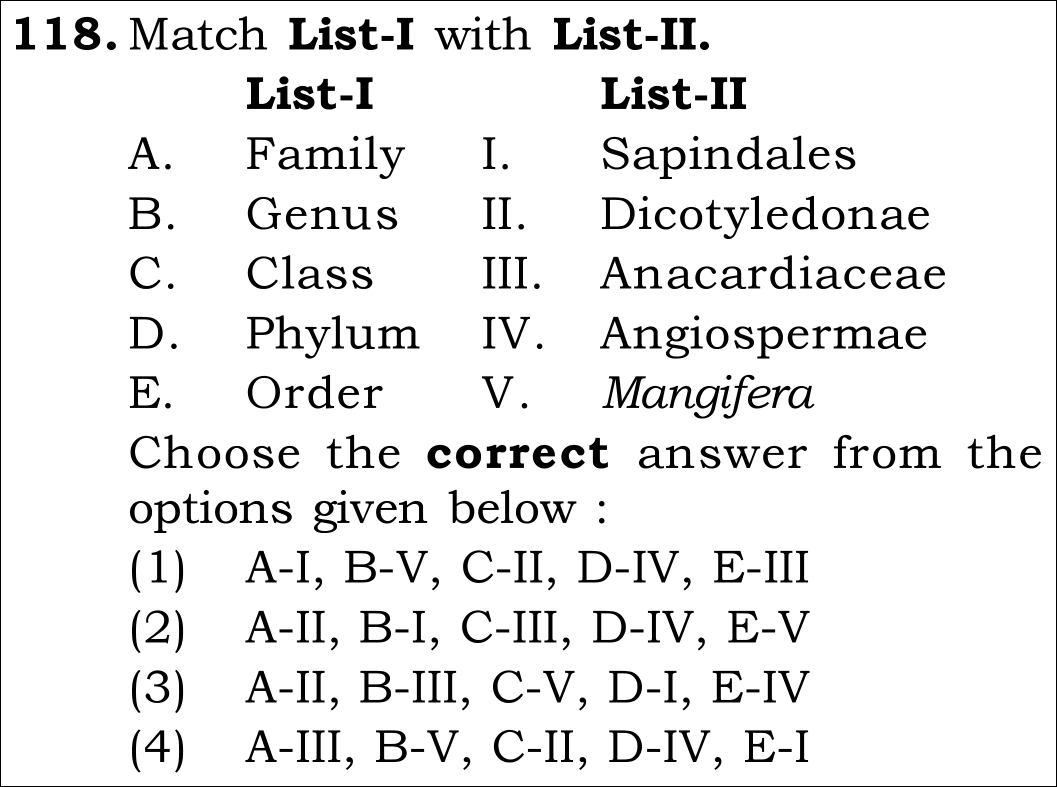
Official NEET 2026 Question 118 - The Living World
1
2
3
4 ✓ Key
💡 Verified Solution & 30-Second Hack
✓
Verified Against NTA Final Answer Key
Option (4) : A-III, B-V, C-II, D-IV, E-I
📚 The Living World Easy
📋 Given Parameters & Problem Setup
Taxon Studied Mango (Mangifera indica)
List-I Taxonomic Categories A. Family, B. Genus, C. Class, D. Phylum/Division, E. Order
List-II Taxon Names I. Sapindales, II. Dicotyledonae, III. Anacardiaceae, IV. Angiospermae, V. Mangifera
⚡

The 30-Second Exam Hall Shortcut: ⚡ Mango Taxonomy Anchor Trick

⏱️ Save ~45 seconds

Genus = Mangifera (V) & Family = Anacardiaceae (III)!

1 Recognize Genus: Mangifera (B -> V).
2 Recognize Family: Anacardiaceae (A -> III).
3 Check which option has both A-III and B-V:
4 Only Option (4) has A-III and B-V!
5 Confirm: Class = Dicotyledonae (C-II), Phylum/Division = Angiospermae (D-IV), Order = Sapindales (E-I).
6 Pick Option (4) in under 10 seconds!
🛡️
Why You Can 100% Trust This Shortcut: NCERT Biology · The Living World (Taxonomic Categories: Mangifera indica family Anacardiaceae, order Sapindales).
📐

Step-by-Step Rigorous Workflow & Mathematical Proof

Step 1

Recall Taxonomic Ranks of Mango (Mangifera indica)

According to Table 1.1 in NCERT The Living World, the complete classification of mango is:

Common Name:MangoBiological Name:Mangifera indicaGenus (B):Mangifera (V)Family (A):Anacardiaceae (III)Order (E):Sapindales (I)Class (C):Dicotyledonae (II)Division/Phylum (D):Angiospermae (IV)\begin{aligned} \text{Common Name} &: \text{Mango} \\ \text{Biological Name} &: \text{Mangifera indica} \\ \text{Genus (B)} &: \mathbf{Mangifera\text{ (V)}} \\ \text{Family (A)} &: \mathbf{Anacardiaceae\text{ (III)}} \\ \text{Order (E)} &: \mathbf{Sapindales\text{ (I)}} \\ \text{Class (C)} &: \mathbf{Dicotyledonae\text{ (II)}} \\ \text{Division/Phylum (D)} &: \mathbf{Angiospermae\text{ (IV)}} \end{aligned}
  • • Division is standard botanical terminology for Phylum.
Step 2

Map List-I to List-II

Systematically correlate each category with its corresponding taxon:

A-IIIB-VC-IID-IVE-I\mathbf{A}\text{-III} \quad \mathbf{B}\text{-V} \quad \mathbf{C}\text{-II} \quad \mathbf{D}\text{-IV} \quad \mathbf{E}\text{-I}
  • • A. Family -> III. Anacardiaceae
  • • B. Genus -> V. Mangifera
  • • C. Class -> II. Dicotyledonae
  • • D. Phylum/Division -> IV. Angiospermae
  • • E. Order -> I. Sapindales
Step 3

Select Matching Option

Comparing with options: Option (1) has A-I; Option (2) has A-II; Option (3) has A-II; Option (4) has A-III, B-V, C-II, D-IV, E-I.

Correct Option=Option (4)\text{Correct Option} = \text{Option (4)}
  • • Matches official NTA final answer key Option D / (4).
⭐

360° Option Elimination Engine Key Feature

Diagnose every choice: Know exactly why the right option works and why distractors fail.

4-Option Deep Scan
1 A
✗ Incorrect
Verdict & Scientific Reason:

Incorrect. Assigns Sapindales as Family and Anacardiaceae as Order.

⚠️
Student Fallacy (Why candidates pick this trap): Swapped Family and Order.
2 B
✗ Incorrect
Verdict & Scientific Reason:

Incorrect. Assigns Dicotyledonae as Family and Mangifera as Order.

⚠️
Student Fallacy (Why candidates pick this trap): Scrambled taxonomic hierarchy.
3 C
✗ Incorrect
Verdict & Scientific Reason:

Incorrect. Mismatches virtually all taxonomic categories.

⚠️
Student Fallacy (Why candidates pick this trap): Confusing class with genus and order with division.
4 D
✓ 100% Correct
Verdict & Scientific Reason:

100% accurate match for all five categories per NCERT Table 1.1.

💡
Why this is airtight: None; perfect recall of Table 1.1.
⚠️

NTA Trap Alert: Confusing Order (-ales) and Family (-aceae)

In plant taxonomy, Order names typically end in "-ales" (Sapindales, Polymoniales) while Family names end in "-aceae" (Anacardiaceae, Solanaceae).

🛡️ How to avoid the -1 mark: Remember the suffixes: -aceae = Family; -ales = Order!
📖

Core NEET Syllabus Standard

NEET Biology Core Syllabus · The Living World Standard Benchmark
Core Scientific Principle Tested:

"Mango classification: Genus Mangifera, Family Anacardiaceae, Order Sapindales, Class Dicotyledonae, Division Angiospermae."
Syllabus Focus: Taxonomic Categories - Table 1.1
✓ Core NEET UG Syllabus Anchor Syllabus & Academic Standards ↗
-ACEAE is the Family place, -ALES is the Order in the race!
NEET 2026 · Q119 Easy
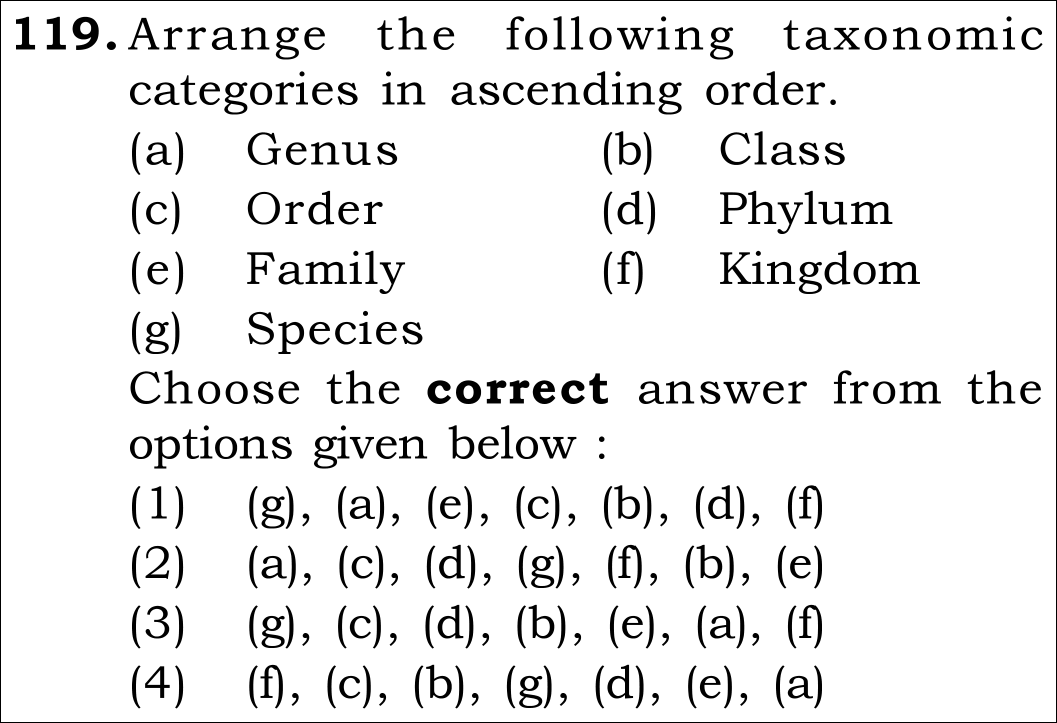
Official NEET 2026 Question 119 - The Living World
1 ✓ Key
2
3
4
💡 Verified Solution & 30-Second Hack
✓
Verified Against NTA Final Answer Key
Option (1) : (g), (a), (e), (c), (b), (d), (f)
📚 The Living World Easy
📋 Given Parameters & Problem Setup
Direction of Hierarchy Ascending order (from lowest taxon to highest taxon)
Listed Ranks (a) Genus, (b) Class, (c) Order, (d) Phylum, (e) Family, (f) Kingdom, (g) Species
⚡

The 30-Second Exam Hall Shortcut: ⚡ Ascending Hierarchy Ladder

⏱️ Save ~40 seconds

Species (Lowest) -> Genus -> Family -> Order -> Class -> Phylum -> Kingdom (Highest)!

1 Note the keyword: "ASCENDING order" means lowest rank FIRST.
2 Lowest rank is Species (g). Highest rank is Kingdom (f).
3 Check start and end: must start with (g) and end with (f).
4 Look at Option (1): (g), (a), (e), (c), (b), (d), (f).
5 Verify sequence: Species (g) -> Genus (a) -> Family (e) -> Order (c) -> Class (b) -> Phylum (d) -> Kingdom (f).
6 Mark Option (1) in under 5 seconds!
🛡️
Why You Can 100% Trust This Shortcut: NCERT Biology · The Living World (Linnaean Taxonomic Hierarchy: Species -> Genus -> Family -> Order -> Class -> Phylum/Division -> Kingdom).
📐

Step-by-Step Rigorous Workflow & Mathematical Proof

Step 1

Understand Ascending Order in Taxonomy

Taxonomic categories form an obligate hierarchy. An ascending sequence starts from the basic, most specific taxonomic unit containing maximum shared similarities (Species) and ascends to the broadest, most inclusive rank (Kingdom).

Ascending Order:Species→Genus→Family→Order→Class→Phylum/Division→Kingdom\text{Ascending Order}: \text{Species} \rightarrow \text{Genus} \rightarrow \text{Family} \rightarrow \text{Order} \rightarrow \text{Class} \rightarrow \text{Phylum/Division} \rightarrow \text{Kingdom}
  • • Specificity decreases and generality increases as one ascends.
Step 2

Map Given Labels to Taxonomic Ranks

Assign each letter code to its corresponding level:

1.  Species=(g)2.  Genus=(a)3.  Family=(e)4.  Order=(c)5.  Class=(b)6.  Phylum=(d)7.  Kingdom=(f)\begin{aligned} 1. \; &\text{Species} &&= (\text{g}) \\ 2. \; &\text{Genus} &&= (\text{a}) \\ 3. \; &\text{Family} &&= (\text{e}) \\ 4. \; &\text{Order} &&= (\text{c}) \\ 5. \; &\text{Class} &&= (\text{b}) \\ 6. \; &\text{Phylum} &&= (\text{d}) \\ 7. \; &\text{Kingdom} &&= (\text{f}) \end{aligned}
  • • Resulting sequential string: (g), (a), (e), (c), (b), (d), (f).
Step 3

Select Matching Option

Option (1) displays: (g), (a), (e), (c), (b), (d), (f). None of the other options provide this correct ascending arrangement.

Correct String=(g),(a),(e),(c),(b),(d),(f)  ⟹  Option (1)\text{Correct String} = (\text{g}), (\text{a}), (\text{e}), (\text{c}), (\text{b}), (\text{d}), (\text{f}) \implies \text{Option (1)}
  • • Matches official NTA final answer key Option A / (1).
⭐

360° Option Elimination Engine Key Feature

Diagnose every choice: Know exactly why the right option works and why distractors fail.

4-Option Deep Scan
1 A
✓ 100% Correct
Verdict & Scientific Reason:

100% accurate ascending Linnaean hierarchy from Species up to Kingdom.

💡
Why this is airtight: None; flawless hierarchical recall.
2 B
✗ Incorrect
Verdict & Scientific Reason:

Incorrect. Scrambled sequence placing Genus first and Species in the middle.

⚠️
Student Fallacy (Why candidates pick this trap): Random arrangement.
3 C
✗ Incorrect
Verdict & Scientific Reason:

Incorrect. Places Order and Phylum before Family and Genus.

⚠️
Student Fallacy (Why candidates pick this trap): Confusing ranks within the hierarchy.
4 D
✗ Incorrect
Verdict & Scientific Reason:

Incorrect. Starts with Kingdom (f) but continues in haphazard order instead of pure descending or ascending.

⚠️
Student Fallacy (Why candidates pick this trap): Confusing ascending with descending, and scrambling middle ranks.
⚠️

NTA Trap Alert: Ascending vs Descending Direction Trap

Students frequently read "taxonomic hierarchy" and immediately write the descending sequence (Kingdom -> Phylum -> Class -> Order -> Family -> Genus -> Species). NTA specifically requested ASCENDING order (Species up to Kingdom).

🛡️ How to avoid the -1 mark: Ascending = Going UP from smallest (Species) to biggest (Kingdom).
📖

Core NEET Syllabus Standard

NEET Biology Core Syllabus · The Living World Standard Benchmark
Core Scientific Principle Tested:

"Taxonomic categories arranged in ascending order: Species, Genus, Family, Order, Class, Phylum/Division, Kingdom."

Syllabus Focus: Taxonomic Hierarchy
✓ Core NEET UG Syllabus Anchor Syllabus & Academic Standards ↗
Ascending ladder: Specific Geese Find Old Cars Pretty Keen (Species, Genus, Family, Order, Class, Phylum, Kingdom)!
NEET 2026 · Q125 Easy
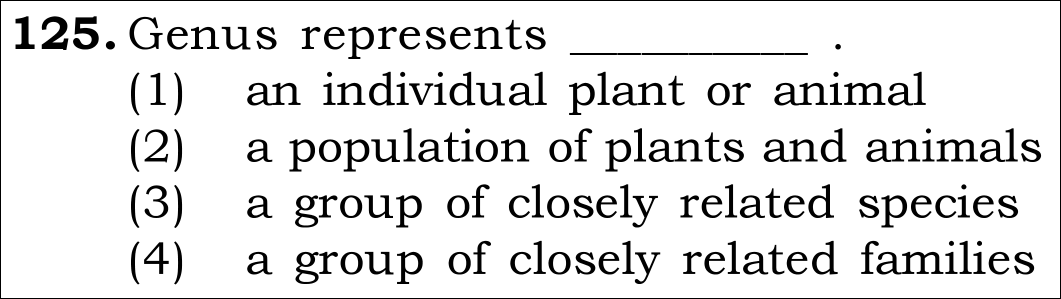
Official NEET 2026 Question 125 - The Living World
1
2
3 ✓ Key
4
💡 Verified Solution & 30-Second Hack
✓
Verified Against NTA Final Answer Key
Option (3) : a group of closely related species
📚 The Living World Easy
📋 Given Parameters & Problem Setup
Taxonomic Category Genus (Plural: Genera)
Context Linnaean taxonomic hierarchy
⚡

The 30-Second Exam Hall Shortcut: ⚡ Genus Definition Reflex

⏱️ Save ~40 seconds

Genus = An assemblage of closely related species!

1 Recall definition from NCERT The Living World:
2 "Genus comprises a group of related species which has more characters in common in comparison to species of other genera."
3 Look at Option (3): "a group of closely related species".
4 Direct textbook definition match!
5 Pick Option (3) in 3 seconds.
🛡️
Why You Can 100% Trust This Shortcut: NCERT Biology · The Living World (Taxonomic Hierarchy: Solanum tuberosum, Solanum melongena, and Solanum nigrum share genus Solanum).
📐

Step-by-Step Rigorous Workflow & Mathematical Proof

Step 1

Definition of Genus in Biological Classification

In the biological hierarchy, taxonomic categories are nested. A genus comprises an aggregate or group of closely related species that share common structural and morphological characters distinct from species of other genera.

Genus=∑Closely Related Species with Common Morphological Traits\text{Genus} = \sum \text{Closely Related Species with Common Morphological Traits}
  • • For example: Panthera is a genus comprising Panthera leo (lion), Panthera pardus (leopard), and Panthera tigris (tiger).
Step 2

Distinguish Between Hierarchy Levels

1. Individual plant or animal = Organism (Option 1). 2. Population of plants and animals = Community or biological population (Option 2). 3. Group of closely related species = Genus (Option 3). 4. Group of closely related families = Order (Option 4).

Group of related species=GenusGroup of related genera=FamilyGroup of related families=Order\begin{aligned} \text{Group of related species} &= \mathbf{Genus} \\ \text{Group of related genera} &= \text{Family} \\ \text{Group of related families} &= \text{Order} \end{aligned}
  • • Option (3) is uniquely correct.
Step 3

Conclusion

Genus definitively represents a group of closely related species.

Correct Concept="a group of closely related species"  ⟹  Option (3)\text{Correct Concept} = \text{"a group of closely related species"} \implies \text{Option (3)}
  • • Matches official NTA final answer key Option C / (3).
⭐

360° Option Elimination Engine Key Feature

Diagnose every choice: Know exactly why the right option works and why distractors fail.

4-Option Deep Scan
1 A
✗ Incorrect
Verdict & Scientific Reason:

Incorrect. An individual represents a single organism at the base of ecological hierarchy, not a genus.

⚠️
Student Fallacy (Why candidates pick this trap): Confusing taxon with individual organism.
2 B
✗ Incorrect
Verdict & Scientific Reason:

Incorrect. A population refers to individuals of the same species living in a geographical area.

⚠️
Student Fallacy (Why candidates pick this trap): Confusing ecological hierarchy with taxonomic classification.
3 C
✓ 100% Correct
Verdict & Scientific Reason:

100% accurate. Canonical definition of Genus per NCERT Chapter 1.

💡
Why this is airtight: None; precise textbook recall.
4 D
✗ Incorrect
Verdict & Scientific Reason:

Incorrect. A group of closely related families constitutes an Order (e.g. Polymoniales includes Solanaceae and Convolvulaceae).

⚠️
Student Fallacy (Why candidates pick this trap): Confusing Genus with Order.
⚠️

NTA Trap Alert: Taxon Jump Confusion

Students frequently swap "group of related species" (Genus) with "group of related genera" (Family) or "group of related families" (Order).

🛡️ How to avoid the -1 mark: Hierarchy step: Species make a Genus; Genera make a Family; Families make an Order.
📖

Core NEET Syllabus Standard

NEET Biology Core Syllabus · The Living World Standard Benchmark
Core Scientific Principle Tested:

"Genus comprises a group of related species sharing common diagnostic characters."

Syllabus Focus: Taxonomic Categories - Genus
✓ Core NEET UG Syllabus Anchor Syllabus & Academic Standards ↗
Species unite to form a Genus; Genera unite in the Family arena!
NEET 2021 · Q161 Easy
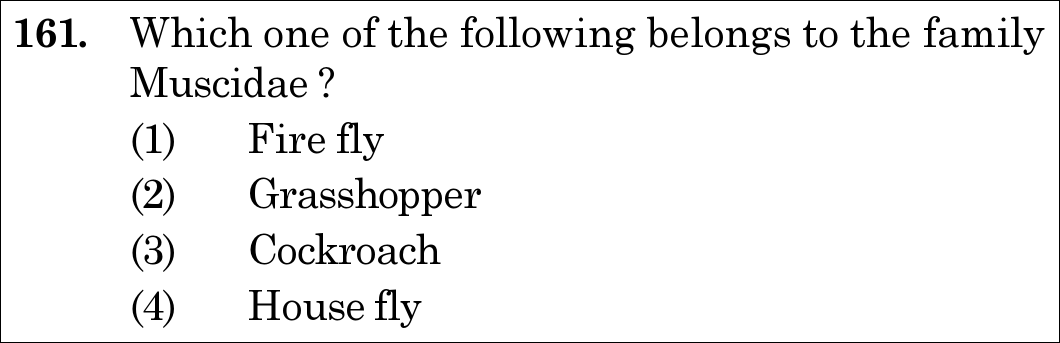
Official NEET 2021 Question 161 - The Living World
1 Fire fly
2 Grasshopper
3 Cockroach
4 House fly ✓ Key
💡 Verified Solution & 30-Second Hack
✓
Verified Against NTA Final Answer Key
Option (4) : House fly
📚 The Living World Easy
📋 Given Parameters & Problem Setup
Family Muscidae
Candidate Insects (1) Fire fly, (2) Grasshopper, (3) Cockroach, (4) House fly
⚡

The 30-Second Exam Hall Shortcut: ⚡ "Musca domestica → Family Muscidae"

⏱️ Save ~20 seconds

The common housefly is Musca domestica. Genus: Musca; Family: Muscidae (NCERT taxonomy table). Cockroach belongs to Blattidae, grasshopper to Acrididae, firefly to Lampyridae. Match Option (4) in 5 seconds!

1 Recall the scientific name of the housefly: Musca domestica.
2 Recall its taxonomic hierarchy: Genus = Musca, Family = Muscidae, Order = Diptera, Class = Insecta, Phylum = Arthropoda.
3 Select Option (4).
🛡️
Why You Can 100% Trust This Shortcut: NCERT Biology · The Living World (Organisms with their Taxonomic Categories: Housefly: Musca domestica, genus Musca, family Muscidae, order Diptera).
📐

Step-by-Step Rigorous Workflow & Mathematical Proof

Step 1

Taxonomic Hierarchy of Musca domestica

NCERT provides a mandatory reference table of model organisms and their complete taxonomic hierarchy: - Common Name: Housefly - Biological Name: *Musca domestica* - Genus: *Musca* - Family: *Muscidae* - Order: *Diptera* - Class: *Insecta* - Phylum: *Arthropoda*

Housefly  ⟹  {Genus:MuscaFamily:MuscidaeOrder:DipteraClass:InsectaPhylum:Arthropoda\text{Housefly} \implies \begin{cases} \textbf{Genus:} & \text{Musca} \\[2pt] \textbf{Family:} & \mathbf{Muscidae} \\[2pt] \textbf{Order:} & \text{Diptera} \\[2pt] \textbf{Class:} & \text{Insecta} \\[2pt] \textbf{Phylum:} & \text{Arthropoda} \end{cases}
Step 2

Taxonomic Families of Other Candidate Insects

- Fire fly: Order Coleoptera, Family *Lampyridae* (bioluminescent beetles). - Grasshopper: Order Orthoptera, Family *Acrididae*. - Cockroach (*Periplaneta americana*): Order Blattodea, Family *Blattidae*.

⭐

360° Option Elimination Engine Key Feature

Diagnose every choice: Know exactly why the right option works and why distractors fail.

4-Option Deep Scan
1 1
✗ Incorrect
Verdict & Scientific Reason:

Incorrect. Fireflies are winged beetles of the family Lampyridae.

⚠️
Student Fallacy (Why candidates pick this trap): Associating "fly" in the common name with the family Muscidae.
2 2
✗ Incorrect
Verdict & Scientific Reason:

Incorrect. Grasshopper belongs to Acrididae.

⚠️
Student Fallacy (Why candidates pick this trap): Conflating different insect orders (Orthoptera vs Diptera).
3 3
✗ Incorrect
Verdict & Scientific Reason:

Incorrect. Cockroach (*Periplaneta americana*) belongs to the family Blattidae.

⚠️
Student Fallacy (Why candidates pick this trap): Assuming common laboratory insect models belong to the same taxonomic family.
4 4
✓ 100% Correct
Verdict & Scientific Reason:

Correct. The housefly (*Musca domestica*) is the quintessential member of the family Muscidae.

💡
Why this is airtight: None. Direct recall of NCERT classification table.
⚠️

NTA Trap Alert: Common Name "Fly" Misconception

Insects named "fly" (dragonfly, firefly, butter-fly, housefly) belong to wildly different orders: firefly = Coleoptera, dragonfly = Odonata, butterfly = Lepidoptera, housefly = Diptera.

🛡️ How to avoid the -1 mark: True flies belong to Diptera (two wings) and housefly specifically belongs to Muscidae.
📖

Core NEET Syllabus Standard

NEET / NCERT Biology · The Living World Standard Benchmark
Core Scientific Principle Tested:

"The housefly (Musca domestica) belongs to genus Musca and family Muscidae in order Diptera."

Syllabus Focus: Taxonomic Categories and Classification
✓ Core NEET UG Syllabus Anchor Syllabus & Academic Standards ↗

Solve 4 NEET Questions a Day — One per Subject

Cover all 1,140 official NEET questions in 285 days at your own pace. Progress is saved on your device. No login needed.