MyCompetitiveExams Logo MyCompetitiveExams
Search 1,140+ Questions
Chapters, formulas, speed tricks
→
⚡ Brahmastra NEET 2027
720 MARKS

Dynamic 180-question full-length simulator mixed dynamically from all 6 years for 2027 & 2026 aspirants.

Launch Brahmastra 2027 Test →
Start Practice →
100% Free · No Login Required
Q.121 Botany ⭐ 360° Option Elimination Active
Vault ↗

NEET 2026 Botany Question 121 Solution

Topic: Plant Kingdom · Official NTA Booklet Code 50
NEET 2026 Botany Question 121: Classification of Pteridophytes - Class Sphenopsida

Question

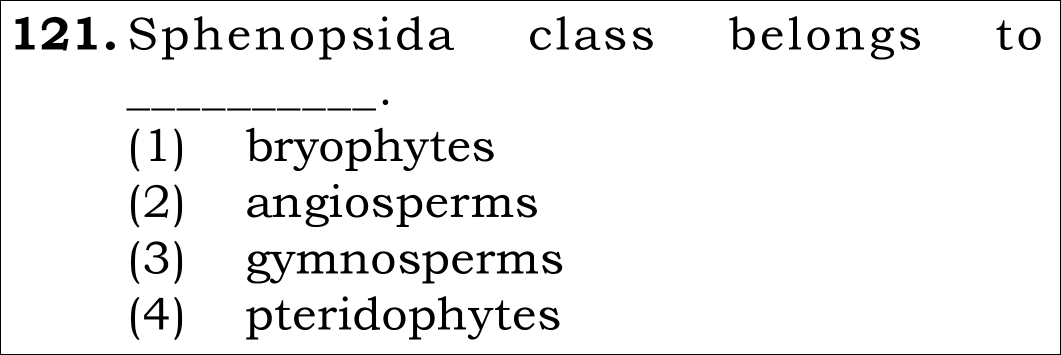
Sphenopsida class belongs' to

  1. (1)bryophytes
  2. (2)angiosperms
  3. (3)gymnosperms
  4. (4)pteridophytes
✓
Verified Against NTA Final Answer Key
Option (4) : pteridophytes
📚 Plant Kingdom Easy
📋 Given Parameters & Problem Setup
Taxonomic Class Sphenopsida (Horsetails)
Representative Organism Equisetum
⚡

The 30-Second Exam Hall Shortcut: ⚡ Four Classes of Pteridophytes

⏱️ Save ~40 seconds

Psilopsida, Lycopsida, Sphenopsida, Pteropsida = Pteridophytes!

1 Recall the four canonical classes of Pteridophyta in NCERT Plant Kingdom:
2 Psilopsida (e.g., Psilotum)
3 Lycopsida (e.g., Selaginella, Lycopodium)
4 Sphenopsida (e.g., Equisetum - horsetails)
5 Pteropsida (e.g., Dryopteris, Pteris, Adiantum)
6 Sphenopsida is unequivocally a class of pteridophytes.
7 Select Option (4) in under 5 seconds!
🛡️
Why You Can 100% Trust This Shortcut: NCERT Biology · Plant Kingdom (Pteridophyte Classification: Psilopsida, Lycopsida, Sphenopsida, and Pteropsida).
📐

Step-by-Step Rigorous Workflow & Mathematical Proof

Step 1

Taxonomic System of Pteridophytes

Pteridophytes are vascular cryptogams possessing xylem and phloem, exhibiting alternation of generations with a dominant sporophytic phase. They are subdivided into four distinct taxonomic classes based on vegetative and reproductive morphology.

Pteridophyta={Psilopsida,  Lycopsida,  Sphenopsida,  Pteropsida}\text{Pteridophyta} = \{\text{Psilopsida}, \; \text{Lycopsida}, \; \mathbf{Sphenopsida}, \; \text{Pteropsida}\}
  • • First terrestrial plants to possess vascular tissues.
Step 2

Diagnostic Characters of Sphenopsida

Members of class Sphenopsida (commonly called horsetails or scouring rushes) feature articulated, jointed stems with distinct nodes and internodes, whorls of scale leaves at nodes, silica-impregnated epidermal cell walls, and compact strobili/cones at branch apices.

Sphenopsida  ⟹  Equisetum (Horsetail)∈Pteridophytes\text{Sphenopsida} \implies \text{Equisetum (Horsetail)} \in \text{Pteridophytes}
  • • Possess ribbed stems with vallecular and carinal canals.
Step 3

Eliminate Other Divisions

Bryophytes are non-vascular plants divided into liverworts and mosses. Gymnosperms are naked-seeded phanerogams (Conifers, Cycads, Ginkgo). Angiosperms are flowering plants (Monocots, Dicots). Sphenopsida belongs solely to pteridophytes.

Sphenopsida∈Pteridophytes  ⟹  Option (4)\text{Sphenopsida} \in \mathbf{Pteridophytes} \implies \text{Option (4)}
  • • Matches official NTA final answer key Option D / (4).
⭐

360° Option Elimination Engine Key Feature

Diagnose every choice: Know exactly why the right option works and why distractors fail.

4-Option Deep Scan
1 A
✗ Incorrect
Verdict & Scientific Reason:

Incorrect. Bryophytes include Hepaticopsida (liverworts) and Bryopsida (mosses), not Sphenopsida.

⚠️
Student Fallacy (Why candidates pick this trap): Confusing non-vascular cryptogams with vascular cryptogams.
2 B
✗ Incorrect
Verdict & Scientific Reason:

Incorrect. Angiosperms are flowering plants classified into Monocotyledonae and Dicotyledonae.

⚠️
Student Fallacy (Why candidates pick this trap): Complete taxonomic mismatch.
3 C
✗ Incorrect
Verdict & Scientific Reason:

Incorrect. Gymnosperms include Cycadopsida, Coniferopsida, and Gnetopsida.

⚠️
Student Fallacy (Why candidates pick this trap): Conflating naked seed plants with seedless vascular plants.
4 D
✓ 100% Correct
Verdict & Scientific Reason:

100% accurate. Sphenopsida is one of the four textbook classes of pteridophytes.

💡
Why this is airtight: None; standard direct recall.
⚠️

NTA Trap Alert: Class Suffix "-opsida" Ambiguity

The suffix "-opsida" is used in bryophytes (e.g. Hepaticopsida), pteridophytes (e.g. Sphenopsida), and gymnosperms (e.g. Cycadopsida). Students who only look at the suffix can get disoriented unless they anchor to Equisetum.

🛡️ How to avoid the -1 mark: Anchor: Sphenopsida -> Equisetum -> Horsetail -> Pteridophyte!
📖

Core NEET Syllabus Standard

NEET Biology Core Syllabus · Plant Kingdom Standard Benchmark
Core Scientific Principle Tested:

"Pteridophytes comprise four classes: Psilopsida, Lycopsida, Sphenopsida, and Pteropsida."

Syllabus Focus: Pteridophytes - Classification
✓ Core NEET UG Syllabus Anchor Syllabus & Academic Standards ↗
P-L-S-P: Please Let Science Prevail (Psilopsida, Lycopsida, Sphenopsida, Pteropsida in Pteridophytes)!

Ready to attempt under real exam pressure?

Test your speed and accuracy in the authentic 180-minute timed NTA simulator.

Launch NEET 2026 CBT Test →

Spotted a mistake in this solution? Report an error ([email protected])

⚖️ Legal & Fair Dealing Notice: Sourced from publicly released NEET 2026 question papers and NEET answer keys for private study, research, and non-commercial educational practice under Fair Dealing (Section 52(1)(a) of the Indian Copyright Act, 1957). Not affiliated with or endorsed by NTA or NMC.

Solve 4 NEET Questions a Day — One per Subject

Cover all 1,140 official NEET questions in 285 days at your own pace. Progress is saved on your device. No login needed.