MyCompetitiveExams Logo MyCompetitiveExams
Search 1,140+ Questions
Chapters, formulas, speed tricks
→
⚡ Brahmastra NEET 2027
720 MARKS

Dynamic 180-question full-length simulator mixed dynamically from all 6 years for 2027 & 2026 aspirants.

Launch Brahmastra 2027 Test →
Start Practice →
100% Free · No Login Required
Q.141 Zoology ⭐ 360° Option Elimination Active
Vault ↗

NEET 2025 Zoology Question 141 Solution

Topic: Sexual Reproduction in Flowering Plants · Official NTA Booklet Code 45
NEET 2025 Zoology Question 141: Embryo Structures and Seed Types (Scutellum, Epiblast, Perisperm)

Question

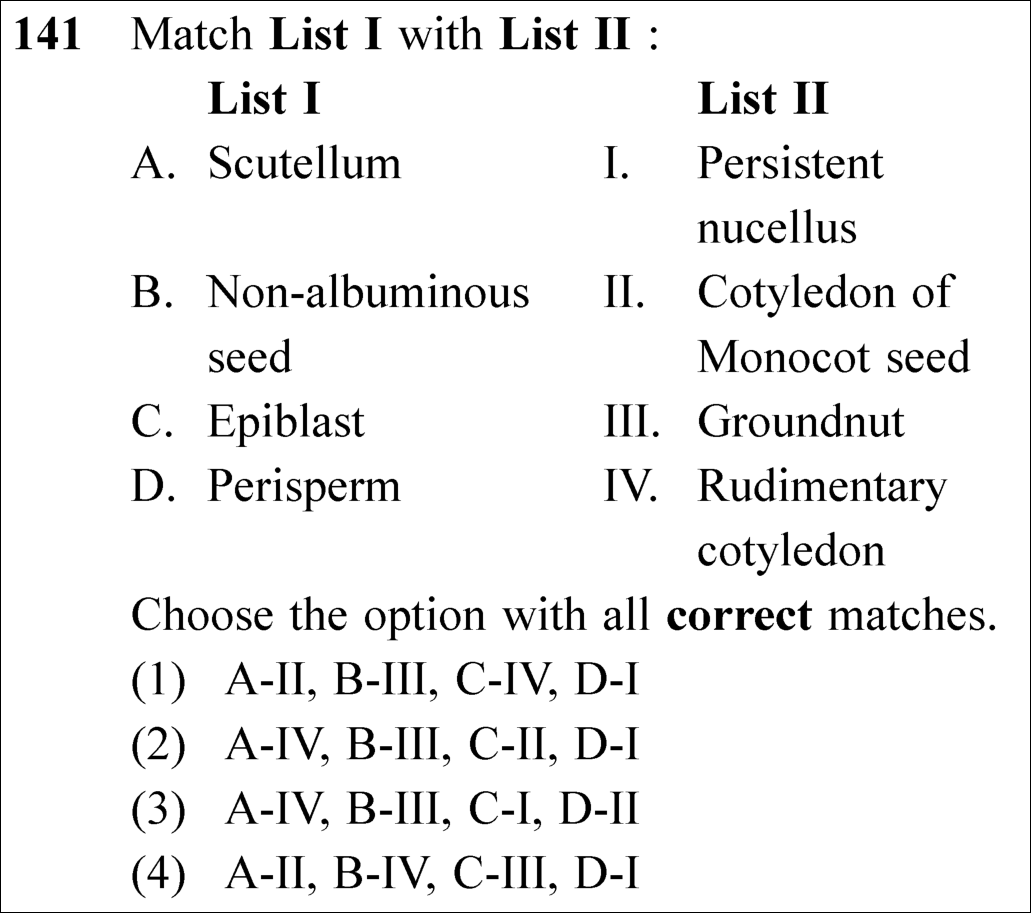
Match List I with List II. List I: A. Scutellum; B. Non-albuminous seed; C. Epiblast; D. Perisperm. List II: I. Persistent nucellus; II. Cotyledon of Monocot seed; III. Groundnut; IV. Rudimentary cotyledon. Choose the option with all correct matches.

✓
Verified Against NTA Final Answer Key
Option (1) : A-II, B-III, C-IV, D-I
📚 Sexual Reproduction in Flowering Plants Easy
📋 Given Parameters & Problem Setup
List I (Botanical Terms) A. Scutellum, B. Non-albuminous seed, C. Epiblast, D. Perisperm
List II (Definitions / Examples) I. Persistent nucellus, II. Cotyledon of Monocot seed, III. Groundnut, IV. Rudimentary cotyledon
⚡

The 30-Second Exam Hall Shortcut: ⚡ Seed Anatomy Match Fingerprint

⏱️ Save ~30 seconds

Scutellum = Monocot shield cotyledon (II); Non-albuminous = Groundnut (endosperm fully consumed) (III); Epiblast = Rudimentary 2nd cotyledon (IV); Perisperm = Persistent nucellus (I)! Code: A-II, B-III, C-IV, D-I!

1 Match each term directly from NCERT Section 2.4:
2 - Scutellum: The single large cotyledon of a monocotyledonous (grass) embryo (A -> II).
3 - Non-albuminous seed: Seeds with no residual endosperm (e.g. Groundnut, pea, gram) (B -> III).
4 - Epiblast: Represents the rudimentary second cotyledon opposite the scutellum in grass embryos (C -> IV).
5 - Perisperm: Persistent residual nucellus found in black pepper and beet (D -> I).
6 Unique combination: A-II, B-III, C-IV, D-I (Option 1)!
7 Solved in under 10 seconds!
🛡️
Why You Can 100% Trust This Shortcut: Apomixis and Polyembryony Mechanisms (NCERT Biology · Sexual Reproduction in Flowering Plants: Agamospermy and nucellar adventive embryony).
📐

Step-by-Step Rigorous Workflow & Mathematical Proof

Step 1

Review of the Embryological and Seed Terms

Analyzing each specialized botanical structure:

  • • A. Scutellum: In monocot embryos (especially the grass family / Poaceae), the single shield-shaped cotyledon situated towards one side of the embryonal axis is called the scutellum. Hence, A matches II.
  • • B. Non-albuminous seed: Non-albuminous (exalbuminous) seeds retain no residual endosperm because it is entirely consumed during embryo development. Classic examples include groundnut, pea, and bean. Hence, B matches III.
  • • C. Epiblast: In grass embryos, a small flap-like rudimentary outgrowth situated opposite the scutellum represents the reduced remnant of the second cotyledon, termed the epiblast. Hence, C matches IV.
  • • D. Perisperm: In most seeds, the nucellus is completely consumed during embryo sac enlargement and endosperm development. However, in certain seeds such as black pepper (*Piper nigrum*) and beet (*Beta vulgaris*), remnants of persistent nucellus are retained, known as perisperm. Hence, D matches I.
Step 2

Assembling the Matching Matrix

Compiling the verified associations:

  • • A -> II (Cotyledon of Monocot seed)
  • • B -> III (Groundnut)
  • • C -> IV (Rudimentary cotyledon)
  • • D -> I (Persistent nucellus)
Step 3

Conclusion

The unambiguous combination is A-II, B-III, C-IV, D-I, which is Option (1).

Matching: A-II,  B-III,  C-IV,  D-I\text{Matching: } A\text{-II}, \; B\text{-III}, \; C\text{-IV}, \; D\text{-I}
⭐

360° Option Elimination Engine Key Feature

Diagnose every choice: Know exactly why the right option works and why distractors fail.

4-Option Deep Scan
1 A
✓ 100% Correct
Verdict & Scientific Reason:

100% correct. Accurately matches all 4 seed and embryo structures with their precise definitions.

💡
Why this is airtight: None; comprehensive botanical recall.
2 B
✗ Incorrect
Verdict & Scientific Reason:

Incorrect. Assigns rudimentary cotyledon to scutellum and monocot cotyledon to epiblast.

⚠️
Student Fallacy (Why candidates pick this trap): Swapping scutellum and epiblast.
3 C
✗ Incorrect
Verdict & Scientific Reason:

Incorrect. Reverses perisperm and epiblast mappings.

⚠️
Student Fallacy (Why candidates pick this trap): Confusing persistent nucellus with rudimentary cotyledon.
4 D
✗ Incorrect
Verdict & Scientific Reason:

Incorrect. Claims groundnut is an epiblast.

⚠️
Student Fallacy (Why candidates pick this trap): Careless misreading of List II options.
⚠️

NTA Trap Alert: Scutellum vs Epiblast

Both relate to cotyledons in grasses: SCUTELLUM is the functional, single large shield cotyledon. EPIBLAST is the rudimentary, reduced remnant of the second cotyledon.

🛡️ How to avoid the -1 mark: Scutellum = Shield (1st functional cotyledon); Epiblast = Echo/Rudimentary 2nd cotyledon.
📖

Core NEET Syllabus Standard

NEET Biology Core Syllabus · Sexual Reproduction in Flowering Plants Standard Benchmark
Core Scientific Principle Tested:

"Scutellum is the monocot cotyledon, groundnut is non-albuminous, epiblast is rudimentary cotyledon, and perisperm is persistent nucellus."

Syllabus Focus: Development of Seed and Embryo
✓ Core NEET UG Syllabus Anchor Syllabus & Academic Standards ↗
S-Cot (Scutellum), G-Non (Groundnut), E-Rudi (Epiblast), P-Nuc (Perisperm)!

Ready to attempt under real exam pressure?

Test your speed and accuracy in the authentic 180-minute timed NTA simulator.

Launch NEET 2025 CBT Test →

Spotted a mistake in this solution? Report an error ([email protected])

⚖️ Legal & Fair Dealing Notice: Sourced from publicly released NEET 2025 question papers and NEET answer keys for private study, research, and non-commercial educational practice under Fair Dealing (Section 52(1)(a) of the Indian Copyright Act, 1957). Not affiliated with or endorsed by NTA or NMC.

Solve 4 NEET Questions a Day — One per Subject

Cover all 1,140 official NEET questions in 285 days at your own pace. Progress is saved on your device. No login needed.