📋 Given Parameters & Problem Setup
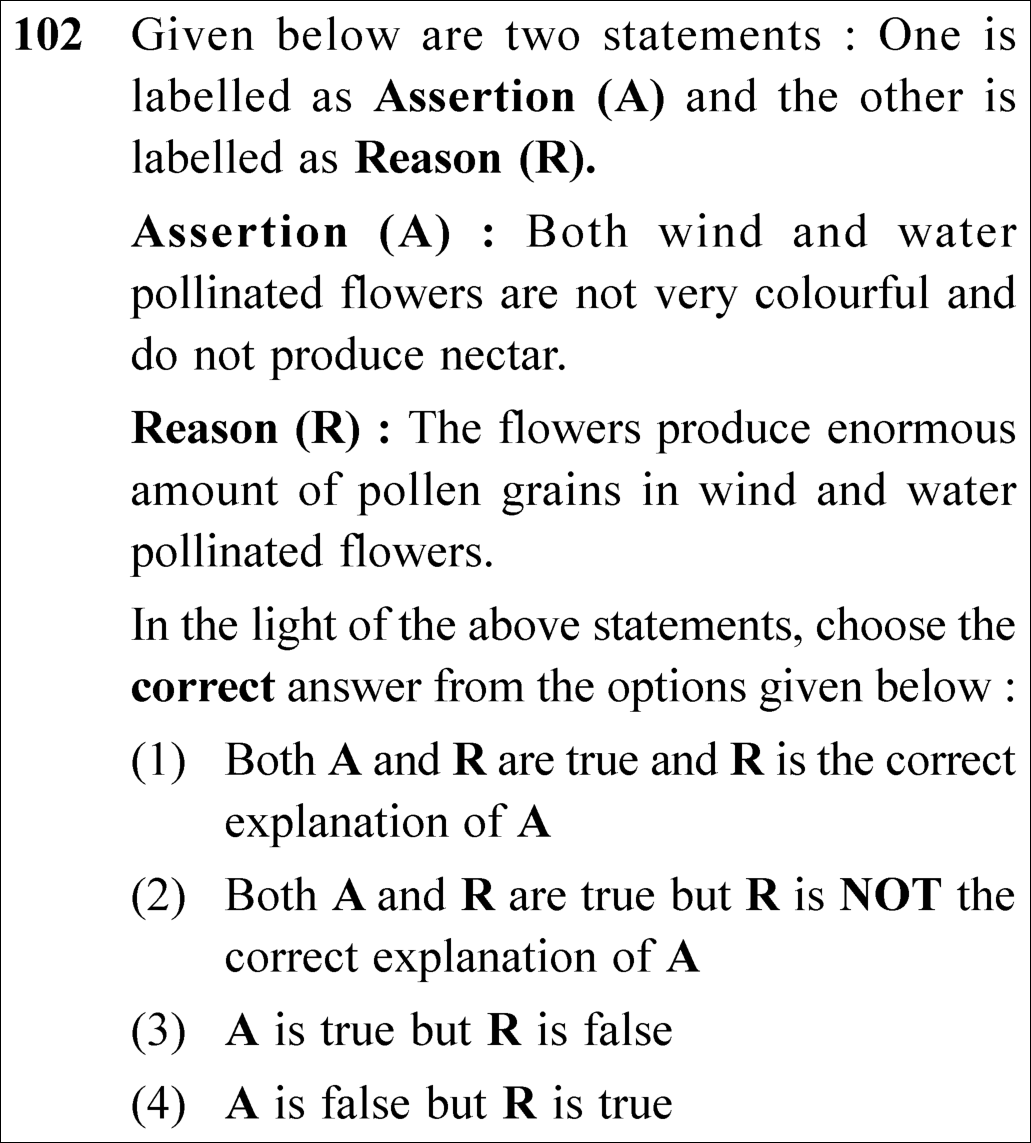
Assertion (A) Both wind and water pollinated flowers are not very colourful and do not produce nectar.
Reason (R) The flowers produce enormous amount of pollen grains in wind and water pollinated flowers.
Assertion is TRUE (wind and water do not have eyes or tongues, so no bright petals or sweet nectar are needed)! Reason is TRUE (wind/water transport is random and wasteful, so flowers produce enormous pollen to compensate)! But enormous pollen does NOT explain why flowers lack color/nectar! ⟹ Both true, R NOT explanation (Option 2)!
1 Evaluate Assertion (A): Wind-pollinated (anemophilous) and water-pollinated (hydrophilous) flowers rely on non-living physical currents. They do not need to attract animal pollinators, so investing energy in colorful petals, fragrance, or sugary nectar is unnecessary. Assertion (A) is TRUE.
2 Evaluate Reason (R): Abiotic pollination is directional and passive; vast quantities of pollen are lost during dispersal. To compensate for this high probability of loss, flowers produce immense numbers of pollen grains per ovule. Reason (R) is TRUE.
3 Evaluate Causal Relationship: Flowers lack nectar and color because abiotic agents DO NOT NEED ATTRACTION. Enormous pollen production compensates for WASTAGE during flight/floating. The reason for lack of color is absence of animal pollinators, not pollen quantity!
4 Therefore, Both A and R are true, but R is NOT the correct explanation of A.
5 Select Option (2) in under 15 seconds!
🛡️ Why You Can 100% Trust This Shortcut: Anatropous Ovule Anatomy & Megasporogenesis (NCERT Biology · Sexual Reproduction in Flowering Plants).
⚠️
Students frequently assume that if both statements are in the same paragraph of NCERT, R must explain A! Always ask: "DOES producing lots of pollen CAUSE flowers to lose color and nectar?" No! Flowers lack color because wind cannot see!
🛡️ How to avoid the -1 mark: Use the "Because" test: Flowers lack color BECAUSE wind doesn’t need visuals, NOT because they make more pollen!
📖
NEET Biology Core Syllabus · Sexual Reproduction in Flowering Plants Standard Benchmark
Core Scientific Principle Tested:
"Wind/water pollinated flowers lack color and nectar (no animal vectors) and produce abundant pollen to counter loss."
Syllabus Focus: Agents of Pollination: Wind and Water Pollination
Wind cannot see (No color/nectar, A); Wind loses pollen (High count, R) ⟹ Both true, but separate reasons (Option 2)!