MyCompetitiveExams Logo MyCompetitiveExams
Search 1,140+ Questions
Chapters, formulas, speed tricks
→
⚡ Brahmastra NEET 2027
720 MARKS

Dynamic 180-question full-length simulator mixed dynamically from all 6 years for 2027 & 2026 aspirants.

Launch Brahmastra 2027 Test →
Start Practice →
100% Free · No Login Required
Q.82 Chemistry ⭐ 360° Option Elimination Active
Vault ↗

NEET 2021 Chemistry Question 82 Solution

Topic: States of Matter · Official NTA Booklet Code M1
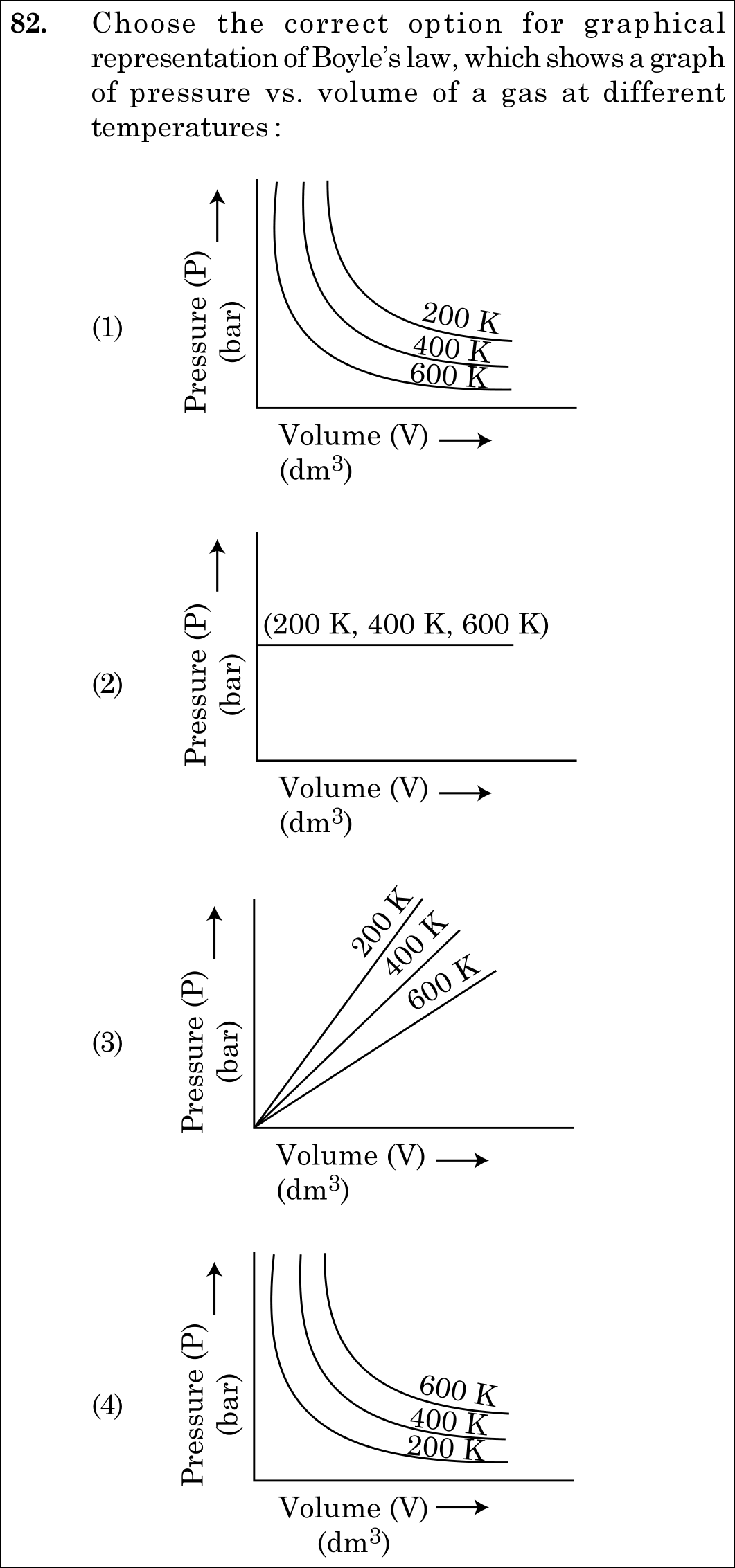
NEET 2021 Chemistry Question 82: Boyle's Law: Pressure vs. Volume Isotherms at Different Temperatures

Question

Choose the correct option for graphical representation of Boyle's law, which shows a graph of pressure vs. volume of a gas at different temperatures:

✓
Verified Against NTA Final Answer Key
Option (4) : Graph (4) (Rectangular hyperbolas with 600 K highest, 200 K lowest)
📚 States of Matter Easy
📋 Given Parameters & Problem Setup
Governing Law Boyle's Law (P vs V at constant T)
Temperatures 200 K, 400 K, 600 K
⚡

The 30-Second Exam Hall Shortcut: ⚡ Higher T = Higher Curve (P ∝ T at constant V)

⏱️ Save ~15 seconds

From ideal gas equation PV=nRTPV = nRT, at any fixed volume VV, pressure is directly proportional to temperature: P∝TP \propto T. Thus, the highest temperature isotherm (600 K600\text{ K}) must lie at the highest pressure, followed by 400 K400\text{ K}, and the lowest is 200 K200\text{ K}. The curves are rectangular hyperbolas. This corresponds uniquely to Graph (4)! Match Option (4)!

1 Boyle's law states P∝1VP \propto \frac{1}{V} at constant TT, producing rectangular hyperbolic isotherms.
2 Draw a vertical line of constant volume V0V_0.
3 At constant volume: P=(nRV0)T  ⟹  P∝TP = \left(\frac{nR}{V_0}\right) T \implies P \propto T.
4 As TT increases (200 K→400 K→600 K200\text{ K} \to 400\text{ K} \to 600\text{ K}), the pressure must increase.
5 The uppermost curve is 600 K600\text{ K}, middle is 400 K400\text{ K}, and lowest is 200 K200\text{ K}.
6 Match Graph (4).
🛡️
Why You Can 100% Trust This Shortcut: Canonical NCERT States of Matter Fig. 5.1 (P vs V isotherms of Boyle's Law).
📐

Step-by-Step Rigorous Workflow & Mathematical Proof

Step 1

Mathematical Formulation of Boyle's Law Isotherms

Boyle's law states that at constant temperature TT, the pressure of a fixed mass of gas is inversely proportional to its volume: P=k1V  ⟹  PV=k1=nRTP = \frac{k_1}{V} \implies PV = k_1 = nRT A plot of PP versus VV at constant temperature gives a rectangular hyperbola called an isotherm.

Step 2

Temperature Dependence of the Constant k1 = nRT

The constant k1k_1 is directly proportional to the absolute temperature TT. A higher temperature corresponds to a larger value of k1=nRTk_1 = nRT. For any given volume VV on the horizontal axis:

P=nRTV  ⟹  P600 K>P400 K>P200 KP = \frac{nRT}{V} \implies P_{600\text{ K}} > P_{400\text{ K}} > P_{200\text{ K}}
Step 3

Identifying the Correct Graph

- Graph (1): Inverted temperature labels (200 K200\text{ K} is shown at top and 600 K600\text{ K} at bottom), which violates thermodynamics. - Graph (2): Shows pressure independent of volume (horizontal line), which is false. - Graph (3): Shows linear increase (P∝VP \propto V), which is isobaric/Charles law plot type, not PP vs VV. - Graph (4): Shows three hyperbolic isotherms with 600 K600\text{ K} on top, 400 K400\text{ K} in the middle, and 200 K200\text{ K} at the bottom. This is the exact NCERT textbook plot.

⭐

360° Option Elimination Engine Key Feature

Diagnose every choice: Know exactly why the right option works and why distractors fail.

4-Option Deep Scan
1 1
✗ Incorrect
Verdict & Scientific Reason:

Inverted temperature order (places 200 K200\text{ K} above 600 K600\text{ K}).

⚠️
Student Fallacy (Why candidates pick this trap): Assuming lower temperature has higher curve.
2 2
✗ Incorrect
Verdict & Scientific Reason:

Horizontal line implies pressure is independent of volume, completely violating Boyle's law.

⚠️
Student Fallacy (Why candidates pick this trap): Confusing PVPV vs PP plot with PP vs VV plot.
3 3
✗ Incorrect
Verdict & Scientific Reason:

Straight lines through origin represent direct proportionality (P∝VP \propto V), not inverse.

⚠️
Student Fallacy (Why candidates pick this trap): Confusing PP vs 1/V1/V plot with PP vs VV plot.
4 4
✓ 100% Correct
Verdict & Scientific Reason:

Flawless representation of Boyle's law isotherms with 600 K>400 K>200 K600\text{ K} > 400\text{ K} > 200\text{ K}.

💡
Why this is airtight: None; canonical NCERT isotherm diagram.
⚠️

NTA Trap Alert: Graph (1) Inverted Temperature Trap

Candidates who know the curves are hyperbolas often rush and pick Graph (1) without checking the temperature labels. Graph (1) places 200 K200\text{ K} at the top, which is physically impossible. At higher temperature, gas particles have higher kinetic energy and exert GREATER pressure, shifting the curve UPWARDS (Graph 4).

🛡️ How to avoid the -1 mark: Fix a vertical line at constant V: higher temperature MUST give higher pressure (600 K600\text{ K} on top).
📖

Core NEET Syllabus Standard

NCERT Chemistry · States of Matter Standard Benchmark
Core Scientific Principle Tested:

"Each curve on a P-V graph corresponds to a different constant temperature and is known as an isotherm. Higher curves correspond to higher temperatures."

Syllabus Focus: The Gas Laws (Boyle's Law - Pressure-Volume Relationship)
✓ Core NEET UG Syllabus Anchor Syllabus & Academic Standards ↗

Ready to attempt under real exam pressure?

Test your speed and accuracy in the authentic 200-minute timed NTA simulator.

Launch NEET 2021 CBT Test →

Spotted a mistake in this solution? Report an error ([email protected])

⚖️ Legal & Fair Dealing Notice: Sourced from publicly released NEET 2021 question papers and NEET answer keys for private study, research, and non-commercial educational practice under Fair Dealing (Section 52(1)(a) of the Indian Copyright Act, 1957). Not affiliated with or endorsed by NTA or NMC.

Solve 4 NEET Questions a Day — One per Subject

Cover all 1,140 official NEET questions in 285 days at your own pace. Progress is saved on your device. No login needed.