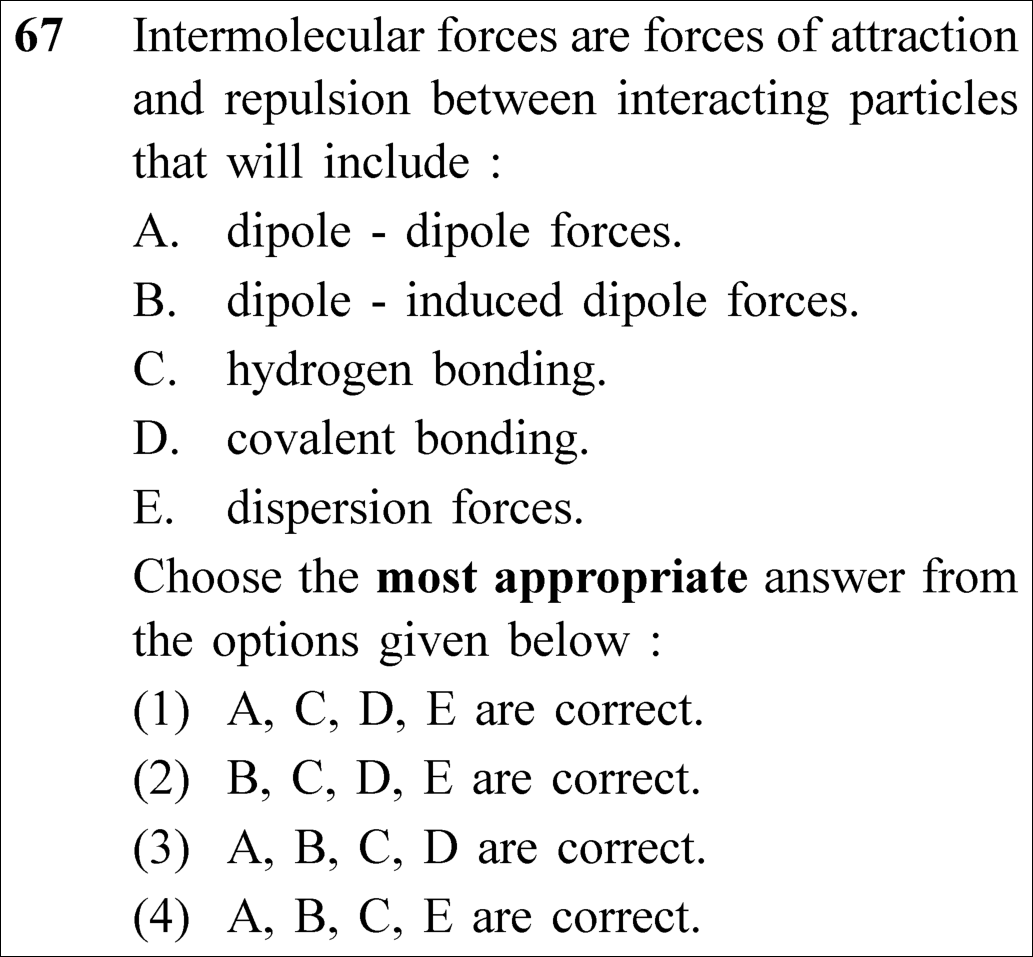
The 30-Second Exam Hall Shortcut: ⚡ Intramolecular Exclusion Hack: Covalent Bonds are INTRAmolecular!
Covalent bonds hold atoms together INSIDE a molecule (intramolecular, ~400 kJ/mol). Intermolecular forces act BETWEEN separate molecules (van der Waals + H-bonding, < 40 kJ/mol). Exclude D ⟹ A, B, C, E are correct in 5 seconds!
Step-by-Step Rigorous Workflow & Mathematical Proof
Verbatim NCERT Definition of Intermolecular Forces
Intermolecular forces are the forces of attraction and repulsion between interacting particles (atoms and molecules). The term covers van der Waals forces and hydrogen bonding. As explicitly defined in standard textbooks, this term does not include electrostatic ionic bonds or the chemical forces that hold atoms together within a molecule, namely covalent bonds:
Item-by-Item Classification
Analyzing the physical nature of each given interaction:
Exclusion of Covalent Bonding
Because covalent bonding (D) is an intramolecular interaction, any valid option must include A, B, C, and E while omitting D.
360° Option Elimination Engine Key Feature
Diagnose every choice: Know exactly why the right option works and why distractors fail.
Erroneously includes covalent bonding (D) and omits dipole-induced dipole forces (B).
Erroneously includes covalent bonding (D) and omits dipole-dipole forces (A).
Erroneously includes covalent bonding (D) and omits dispersion forces (E).
Accurate: A, B, C, and E are intermolecular interactions; covalent bonding (D) is strictly intramolecular.
NTA Trap Alert: Including Covalent Bonding as an Intermolecular Force
Covalent bonds are strong chemical bonds holding atoms within a molecule (H–O bond in water, ~460 kJ/mol). Intermolecular forces are weak attractions between separate molecules (between water molecules, ~20 kJ/mol). Confusing the prefixes INTER (between) and INTRA (within) is the primary trap.
Core NEET Syllabus Standard
"Intermolecular forces include dispersion forces, dipole-dipole forces, and dipole-induced dipole forces, as well as hydrogen bonding, but strictly exclude covalent and ionic bonds."