MyCompetitiveExams Logo MyCompetitiveExams
Search 1,140+ Questions
Chapters, formulas, speed tricks
→
⚡ Brahmastra NEET 2027
720 MARKS

Dynamic 180-question full-length simulator mixed dynamically from all 6 years for 2027 & 2026 aspirants.

Launch Brahmastra 2027 Test →
Start Practice →
100% Free · No Login Required
Q.67 Chemistry ⭐ 360° Option Elimination Active
Vault ↗

NEET 2023 Chemistry Question 67 Solution

Topic: States of Matter: Gases and Liquids · Official NTA Booklet Code G5
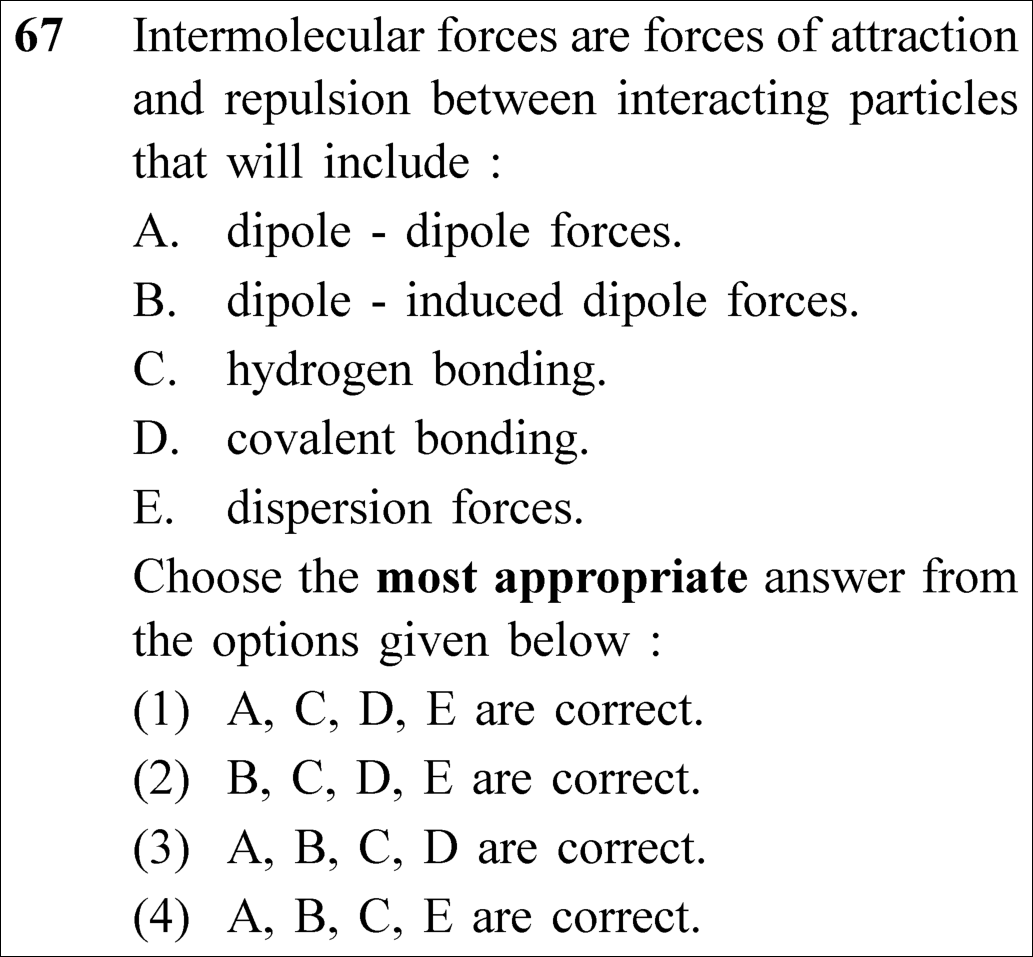
NEET 2023 Chemistry Question 67: Classification of Intermolecular Forces (Exclusion of Covalent Bonding)

Question

Intermolecular forces are forces of attraction and repulsion between interacting particles that will include: A. dipole - dipole forces. B. dipole - induced dipole forces. C. hydrogen bonding. D. covalent bonding. E. dispersion forces. Choose the most appropriate answer from the options given below:

✓
Verified Against NTA Final Answer Key
Option (4) : A, B, C, E are correct.
📚 States of Matter: Gases and Liquids Easy
📋 Given Parameters & Problem Setup
List of interactions A: Dipole-dipole, B: Dipole-induced dipole, C: Hydrogen bonding, D: Covalent bonding, E: Dispersion forces
Target criterion Forces that are classified as INTERMOLECULAR forces
⚡

The 30-Second Exam Hall Shortcut: ⚡ Intramolecular Exclusion Hack: Covalent Bonds are INTRAmolecular!

⏱️ Save ~30 seconds

Covalent bonds hold atoms together INSIDE a molecule (intramolecular, ~400 kJ/mol). Intermolecular forces act BETWEEN separate molecules (van der Waals + H-bonding, < 40 kJ/mol). Exclude D ⟹ A, B, C, E are correct in 5 seconds!

1 Recall NCERT’s strict definition of intermolecular forces:
2 - Intermolecular forces act BETWEEN interacting particles (molecules/atoms).
3 - It EXPLICITLY excludes covalent bonds and ionic bonds (which are intramolecular chemical bonds).
4 Evaluate each item:
5 - A. Dipole-dipole forces ⟶ Intermolecular (van der Waals).
6 - B. Dipole-induced dipole forces ⟶ Intermolecular (van der Waals).
7 - C. Hydrogen bonding ⟶ Intermolecular (special dipole-dipole).
8 - D. Covalent bonding ⟶ INTRAmolecular chemical bond (EXCLUDED!).
9 - E. Dispersion forces (London forces) ⟶ Intermolecular (van der Waals).
10 Thus, A, B, C, and E are intermolecular forces; D is NOT.
11 Select Option (4) A, B, C, E are correct!
🛡️
Why You Can 100% Trust This Shortcut: States of Matter · Intermolecular Forces Standards (NCERT verbatim: "This term does not include the electrostatic forces that exist between the two oppositely charged ions and the forces that hold atoms of a molecule together, i.e., covalent bonds").
📐

Step-by-Step Rigorous Workflow & Mathematical Proof

Step 1

Verbatim NCERT Definition of Intermolecular Forces

Intermolecular forces are the forces of attraction and repulsion between interacting particles (atoms and molecules). The term covers van der Waals forces and hydrogen bonding. As explicitly defined in standard textbooks, this term does not include electrostatic ionic bonds or the chemical forces that hold atoms together within a molecule, namely covalent bonds:

Intermolecular Forces=van der Waals Forces+Hydrogen Bonds(Excludes Covalent Bonds)\text{Intermolecular Forces} = \text{van der Waals Forces} + \text{Hydrogen Bonds} \quad (\text{Excludes Covalent Bonds})
Step 2

Item-by-Item Classification

Analyzing the physical nature of each given interaction:

A. Dipole-dipole forces:Between polar molecules with permanent dipoles (Intermolecular)B. Dipole-induced dipole:Between a polar and a non-polar molecule (Intermolecular)C. Hydrogen bonding:Strong directional dipole-dipole interaction (Intermolecular)D. Covalent bonding:Electron sharing holding atoms inside a molecule (Intramolecular)E. Dispersion forces:London attractive forces between all particles (Intermolecular)\begin{aligned} \text{A. Dipole-dipole forces} &: \text{Between polar molecules with permanent dipoles } (\text{Intermolecular}) \\[4pt] \text{B. Dipole-induced dipole} &: \text{Between a polar and a non-polar molecule } (\text{Intermolecular}) \\[4pt] \text{C. Hydrogen bonding} &: \text{Strong directional dipole-dipole interaction } (\text{Intermolecular}) \\[4pt] \text{D. Covalent bonding} &: \text{Electron sharing holding atoms inside a molecule } (\text{Intramolecular}) \\[4pt] \text{E. Dispersion forces} &: \text{London attractive forces between all particles } (\text{Intermolecular}) \end{aligned}
Step 3

Exclusion of Covalent Bonding

Because covalent bonding (D) is an intramolecular interaction, any valid option must include A, B, C, and E while omitting D.

Valid Set={A,B,C,E}\text{Valid Set} = \{A, B, C, E\}
⭐

360° Option Elimination Engine Key Feature

Diagnose every choice: Know exactly why the right option works and why distractors fail.

4-Option Deep Scan
1 (1)
✗ Incorrect
Verdict & Scientific Reason:

Erroneously includes covalent bonding (D) and omits dipole-induced dipole forces (B).

⚠️
Student Fallacy (Why candidates pick this trap): Candidate treated covalent bonds as intermolecular.
2 (2)
✗ Incorrect
Verdict & Scientific Reason:

Erroneously includes covalent bonding (D) and omits dipole-dipole forces (A).

⚠️
Student Fallacy (Why candidates pick this trap): Candidate confused inter- and intra-molecular bonding.
3 (3)
✗ Incorrect
Verdict & Scientific Reason:

Erroneously includes covalent bonding (D) and omits dispersion forces (E).

⚠️
Student Fallacy (Why candidates pick this trap): Candidate included chemical bonds in intermolecular category.
4 (4)
✓ 100% Correct
Verdict & Scientific Reason:

Accurate: A, B, C, and E are intermolecular interactions; covalent bonding (D) is strictly intramolecular.

💡
Why this is airtight: None. Candidate correctly excluded covalent bonding.
⚠️

NTA Trap Alert: Including Covalent Bonding as an Intermolecular Force

Covalent bonds are strong chemical bonds holding atoms within a molecule (H–O bond in water, ~460 kJ/mol). Intermolecular forces are weak attractions between separate molecules (between water molecules, ~20 kJ/mol). Confusing the prefixes INTER (between) and INTRA (within) is the primary trap.

🛡️ How to avoid the -1 mark: Rule: "Inter-" means between two different molecules (like international = between nations). Covalent bonds are within a single molecule.
📖

Core NEET Syllabus Standard

National Eligibility cum Entrance Test (NEET UG) · States of Matter: Gases and Liquids Standard Benchmark
Core Scientific Principle Tested:

"Intermolecular forces include dispersion forces, dipole-dipole forces, and dipole-induced dipole forces, as well as hydrogen bonding, but strictly exclude covalent and ionic bonds."

Syllabus Focus: Intermolecular Forces – Types and Characteristics
Preserved in Rationalized Curriculum Syllabus & Academic Standards ↗

Ready to attempt under real exam pressure?

Test your speed and accuracy in the authentic 200-minute timed NTA simulator.

Launch NEET 2023 CBT Test →

Spotted a mistake in this solution? Report an error ([email protected])

⚖️ Legal & Fair Dealing Notice: Sourced from publicly released NEET 2023 question papers and NEET answer keys for private study, research, and non-commercial educational practice under Fair Dealing (Section 52(1)(a) of the Indian Copyright Act, 1957). Not affiliated with or endorsed by NTA or NMC.

Solve 4 NEET Questions a Day — One per Subject

Cover all 1,140 official NEET questions in 285 days at your own pace. Progress is saved on your device. No login needed.