NEET 2021 Botany Question 142 Solution
Question
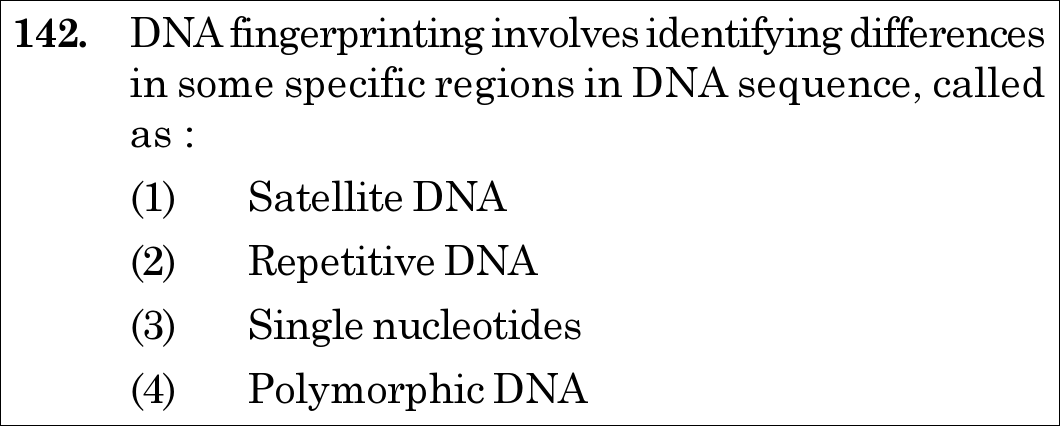
DNA fingerprinting involves identifying differences in some specific regions in DNA sequence, called as:
- (1)Satellite DNA
- (2)Repetitive DNA
- (3)Single nucleotides
- (4)Polymorphic DNA
Dynamic 180-question full-length simulator mixed dynamically from all 6 years for 2027 & 2026 aspirants.
DNA fingerprinting involves identifying differences in some specific regions in DNA sequence, called as:
DNA fingerprinting involves identifying differences in specific regions of DNA called Repetitive DNA, where a small stretch of DNA is repeated tandemly many times! These repetitive sequences form satellite DNA that exhibits high degree of polymorphism. Match Option (2)!
Human genomic DNA contains regions that do not code for proteins but consist of tandemly repeated nucleotide sequences:
Verbatim from the textbook: *"DNA fingerprinting involves identifying differences in some specific regions in DNA sequence called as repetitive DNA, because in these sequences, a small stretch of DNA is repeated many times."*
During density gradient centrifugation, bulk genomic DNA forms a major peak, while repetitive DNA separates out as distinct smaller peaks termed satellite DNA. The underlying DNA sequence category is repetitive DNA.
Diagnose every choice: Know exactly why the right option works and why distractors fail.
Satellite DNA is the physical sub-fraction observed upon density gradient centrifugation; the general sequence category targeted by the definition is repetitive DNA.
Verbatim NCERT textbook definition: differences are identified in specific regions called repetitive DNA.
Single nucleotides are individual monomer subunits, not repetitive genomic regions.
Polymorphism is the biological property of variation, not the specific name of the repetitive DNA sequence region.
Both terms appear in the DNA fingerprinting section. NCERT explicitly states: "...specific regions in DNA sequence, called as repetitive DNA".
"DNA fingerprinting involves identifying differences in some specific regions in DNA sequence, called as repetitive DNA, because in these sequences, a small stretch of DNA is repeated many times."
Test your speed and accuracy in the authentic 200-minute timed NTA simulator.
Spotted a mistake in this solution? Report an error ([email protected])
Cover all 1,140 official NEET questions in 285 days at your own pace. Progress is saved on your device. No login needed.