MyCompetitiveExams Logo MyCompetitiveExams
Search 1,140+ Questions
Chapters, formulas, speed tricks
→
⚡ Brahmastra NEET 2027
720 MARKS

Dynamic 180-question full-length simulator mixed dynamically from all 6 years for 2027 & 2026 aspirants.

Launch Brahmastra 2027 Test →
Start Practice →
100% Free · No Login Required
Q.143 Botany ⭐ 360° Option Elimination Active
Vault ↗

NEET 2021 Botany Question 143 Solution

Topic: Sexual Reproduction in Flowering Plants · Official NTA Booklet Code M1
NEET 2021 Botany Question 143: Longevity and Viability of Pollen Grains Across Angiosperm Families

Question

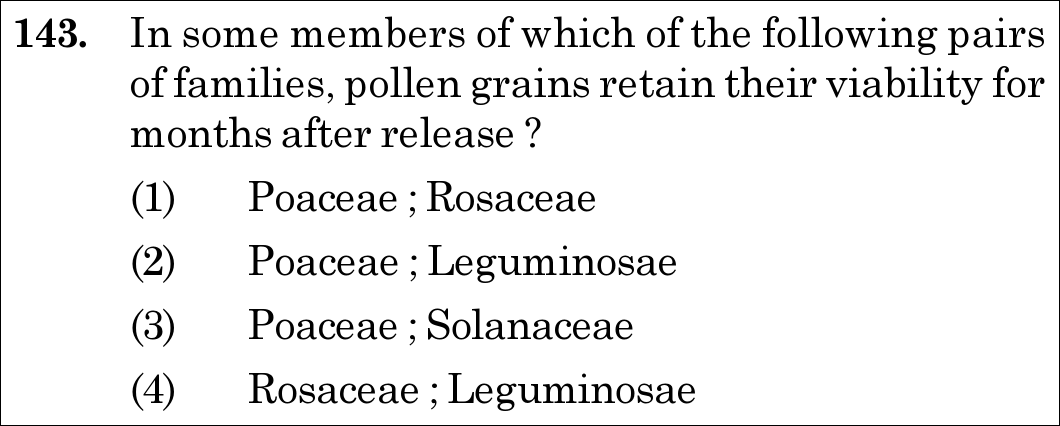
In some members of which of the following pairs of families, pollen grains retain their viability for months after release?

  1. (1)Poaceae; Rosaceae
  2. (2)Poaceae; Leguminosae
  3. (3)Poaceae; Solanaceae
  4. (4)Rosaceae; Leguminosae
✓
Verified Against NTA Final Answer Key
Option (4) : Rosaceae ; Leguminosae
📚 Sexual Reproduction in Flowering Plants Easy
📋 Given Parameters & Problem Setup
Pollen Characteristic Retains viability for months after shedding
Candidate Families Poaceae, Rosaceae, Leguminosae, Solanaceae
⚡

The 30-Second Exam Hall Shortcut: ⚡ "Cereals (Poaceae) = 30 Minutes" vs "Rosaceae, Leguminosae, Solanaceae = Months!"

⏱️ Save ~15 seconds

In cereals like rice and wheat (family Poaceae), pollen grains lose viability within 30 minutes of release! In contrast, in members of Rosaceae, Leguminosae, and Solanaceae, pollen grains retain viability for months! Looking for families with months of viability rules out Poaceae immediately, leaving Rosaceae & Leguminosae. Match Option (4)!

1 Poaceae (Gramineae - cereals like wheat, rice): Pollen viability = 30 minutes.
2 Rosaceae (rose family), Leguminosae (pea/legume family), and Solanaceae (potato family): Pollen viability = Several months.
3 Options (1), (2), and (3) all contain Poaceae   ⟹  \implies Eliminate all three!
4 Option (4) pairs Rosaceae with Leguminosae   ⟹  \implies Both retain viability for months!
5 Match Option (4).
🛡️
Why You Can 100% Trust This Shortcut: Canonical NCERT Sexual Reproduction in Flowering Plants on Pollen Viability.
📐

Step-by-Step Rigorous Workflow & Mathematical Proof

Step 1

Pollen Grain Viability Spectrum

The period for which pollen grains remain viable is highly variable and depends on ambient temperature and relative humidity:

Poaceae (Rice, Wheat, Cereals):Viability lost rapidly within 30 minutesRosaceae, Leguminosae, Solanaceae:Pollen retains viability for months\begin{aligned} \text{\textbf{Poaceae (Rice, Wheat, Cereals):}} & \quad \text{Viability lost rapidly within } \mathbf{30 \text{ minutes}} \\[4pt] \mathbf{\text{Rosaceae, Leguminosae, Solanaceae:}} & \quad \mathbf{\text{Pollen retains viability for months}} \end{aligned}
Step 2

Option Elimination Strategy

Because Poaceae exhibits short-lived viability (30 minutes), any option featuring Poaceae is automatically disqualified: - Option (1): Poaceae ; Rosaceae →\to Disqualified due to Poaceae. - Option (2): Poaceae ; Leguminosae →\to Disqualified due to Poaceae. - Option (3): Poaceae ; Solanaceae →\to Disqualified due to Poaceae. - Option (4): Rosaceae ; Leguminosae →\to Both families retain viability for months!

⭐

360° Option Elimination Engine Key Feature

Diagnose every choice: Know exactly why the right option works and why distractors fail.

4-Option Deep Scan
1 1
✗ Incorrect
Verdict & Scientific Reason:

Poaceae pollens lose viability in just 30 minutes.

⚠️
Student Fallacy (Why candidates pick this trap): Ignoring the rapid loss of pollen viability in grasses and cereals.
2 2
✗ Incorrect
Verdict & Scientific Reason:

Poaceae pollen is short-lived (30 minutes).

⚠️
Student Fallacy (Why candidates pick this trap): Overlooking the Poaceae disqualifier.
3 3
✗ Incorrect
Verdict & Scientific Reason:

Poaceae pollen is short-lived (30 minutes).

⚠️
Student Fallacy (Why candidates pick this trap): Failing to eliminate Poaceae.
4 4
✓ 100% Correct
Verdict & Scientific Reason:

Both Rosaceae and Leguminosae (along with Solanaceae) maintain pollen grain viability for several months.

💡
Why this is airtight: None. Accurate multi-family botanical recall.
⚠️

NTA Trap Alert: Poaceae Present in 3 Out of 4 Options Trap

Students who remember that "cereals" have short viability can eliminate 3 out of 4 options in 2 seconds flat by crossing out every choice with Poaceae.

🛡️ How to avoid the -1 mark: Poaceae = 30 minutes; Rosaceae + Leguminosae + Solanaceae = Months.
📖

Core NEET Syllabus Standard

NEET / NCERT Biology · Sexual Reproduction in Flowering Plants Standard Benchmark
Core Scientific Principle Tested:

"In some cereals such as rice and wheat, pollen grains lose viability within 30 minutes of their release, and in some members of Rosaceae, Leguminosae and Solanaceae, they maintain viability for months."

Syllabus Focus: Pre-fertilisation: Microsporogenesis and Pollen Grain
✓ Core NEET UG Syllabus Anchor Syllabus & Academic Standards ↗

Ready to attempt under real exam pressure?

Test your speed and accuracy in the authentic 200-minute timed NTA simulator.

Launch NEET 2021 CBT Test →

Spotted a mistake in this solution? Report an error ([email protected])

⚖️ Legal & Fair Dealing Notice: Sourced from publicly released NEET 2021 question papers and NEET answer keys for private study, research, and non-commercial educational practice under Fair Dealing (Section 52(1)(a) of the Indian Copyright Act, 1957). Not affiliated with or endorsed by NTA or NMC.

Solve 4 NEET Questions a Day — One per Subject

Cover all 1,140 official NEET questions in 285 days at your own pace. Progress is saved on your device. No login needed.