MyCompetitiveExams Logo MyCompetitiveExams
Search 1,140+ Questions
Chapters, formulas, speed tricks
→
⚡ Brahmastra NEET 2027
720 MARKS

Dynamic 180-question full-length simulator mixed dynamically from all 6 years for 2027 & 2026 aspirants.

Launch Brahmastra 2027 Test →
Start Practice →
100% Free · No Login Required
Q.115 Botany ⭐ 360° Option Elimination Active
Vault ↗

NEET 2021 Botany Question 115 Solution

Topic: Plant Growth and Development · Official NTA Booklet Code M1
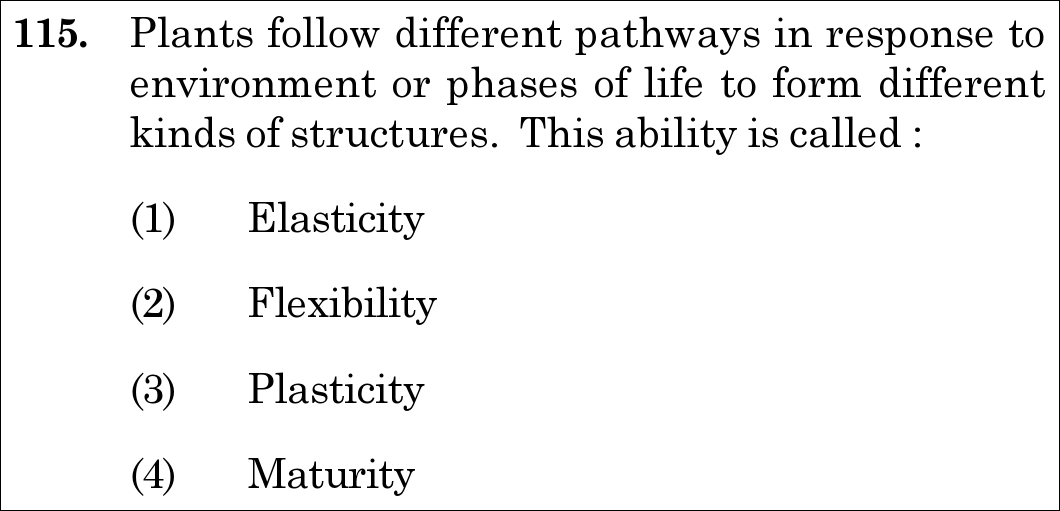
NEET 2021 Botany Question 115: Plasticity and Heterophylly in Plant Development

Question

Plants follow different pathways in response to environment or phases of life to form different kinds of structures. This ability is called:

  1. (1)Elasticity
  2. (2)Flexibility
  3. (3)Plasticity
  4. (4)Maturity
✓
Verified Against NTA Final Answer Key
Option (3) : Plasticity
📚 Plant Growth and Development Easy
📋 Given Parameters & Problem Setup
Phenomenon Formation of different kinds of structures in response to environment or life phases
⚡

The 30-Second Exam Hall Shortcut: ⚡ Different Forms in Different Conditions = Plasticity

⏱️ Save ~15 seconds

The ability of plants to follow different developmental pathways in response to environmental cues or phases of life to produce different structures is defined as Plasticity (e.g., heterophylly in cotton, coriander, larkspur, and buttercup)! Match Option (3)!

1 Recall the textbook definition: Plants follow different pathways in response to environment or phases of life to form different kinds of structures.
2 This phenomenon is termed Plasticity.
3 Classic example: Heterophylly in cotton, coriander, and larkspur (phase-dependent) vs buttercup (environment-dependent).
4 Match Option (3).
🛡️
Why You Can 100% Trust This Shortcut: Canonical NCERT Plant Growth and Development on Plasticity.
📐

Step-by-Step Rigorous Workflow & Mathematical Proof

Step 1

Definition of Plasticity in Plant Biology

Plants exhibit developmental flexibility termed plasticity:

Plasticity=Capacity of a plant to alter morphology/phenotype in response to environmental or life-cycle cues\text{Plasticity} = \text{Capacity of a plant to alter morphology/phenotype in response to environmental or life-cycle cues}
Step 2

Types of Heterophylly Expressed via Plasticity

NCERT categorizes heterophylly under plasticity into two distinct classes: - Developmental (Phase-dependent): Leaves of juvenile plant differ from mature plant, e.g., cotton, coriander, larkspur. - Environmental: Leaves produced in air differ from submerged leaves in water, e.g., buttercup (*Ranunculus*).

⭐

360° Option Elimination Engine Key Feature

Diagnose every choice: Know exactly why the right option works and why distractors fail.

4-Option Deep Scan
1 1
✗ Incorrect
Verdict & Scientific Reason:

Elasticity is a physical/mechanical property of returning to original shape after stress, not a developmental biological adaptation.

⚠️
Student Fallacy (Why candidates pick this trap): Confusing physical mechanical terminology with developmental concepts.
2 2
✗ Incorrect
Verdict & Scientific Reason:

Flexibility is a general descriptive term, not the scientific term defined in plant physiology.

⚠️
Student Fallacy (Why candidates pick this trap): Selecting a colloquial synonym instead of the precise scientific term.
3 3
✓ 100% Correct
Verdict & Scientific Reason:

Plasticity is the canonical biological term for the ability to produce different structures along alternative developmental pathways.

💡
Why this is airtight: None. Verbatim textbook match.
4 4
✗ Incorrect
Verdict & Scientific Reason:

Maturity refers to the completion of growth and reproductive readiness, not phenotypic adaptability.

⚠️
Student Fallacy (Why candidates pick this trap): Equating phase-dependent differences solely with the arrival of maturity.
⚠️

NTA Trap Alert: Colloquial Terminology Distraction

Terms like "Flexibility" sound biologically intuitive. However, NCERT strictly uses the technical term "Plasticity".

🛡️ How to avoid the -1 mark: Remember: Forming different leaf shapes = Plasticity (manifested as Heterophylly).
📖

Core NEET Syllabus Standard

NEET / NCERT Biology · Plant Growth and Development Standard Benchmark
Core Scientific Principle Tested:

"Plants follow different pathways in response to environment or phases of life to form different kinds of structures. This ability is called plasticity."

Syllabus Focus: Development: Plasticity
✓ Core NEET UG Syllabus Anchor Syllabus & Academic Standards ↗

Ready to attempt under real exam pressure?

Test your speed and accuracy in the authentic 200-minute timed NTA simulator.

Launch NEET 2021 CBT Test →

Spotted a mistake in this solution? Report an error ([email protected])

⚖️ Legal & Fair Dealing Notice: Sourced from publicly released NEET 2021 question papers and NEET answer keys for private study, research, and non-commercial educational practice under Fair Dealing (Section 52(1)(a) of the Indian Copyright Act, 1957). Not affiliated with or endorsed by NTA or NMC.

Solve 4 NEET Questions a Day — One per Subject

Cover all 1,140 official NEET questions in 285 days at your own pace. Progress is saved on your device. No login needed.