MyCompetitiveExams Logo MyCompetitiveExams
Search 1,140+ Questions
Chapters, formulas, speed tricks
→
⚡ Brahmastra NEET 2027
720 MARKS

Dynamic 180-question full-length simulator mixed dynamically from all 6 years for 2027 & 2026 aspirants.

Launch Brahmastra 2027 Test →
Start Practice →
100% Free · No Login Required
Q.94 Chemistry ⭐ 360° Option Elimination Active
Vault ↗

NEET 2021 Chemistry Question 94 Solution

Topic: Electrochemistry · Official NTA Booklet Code M1
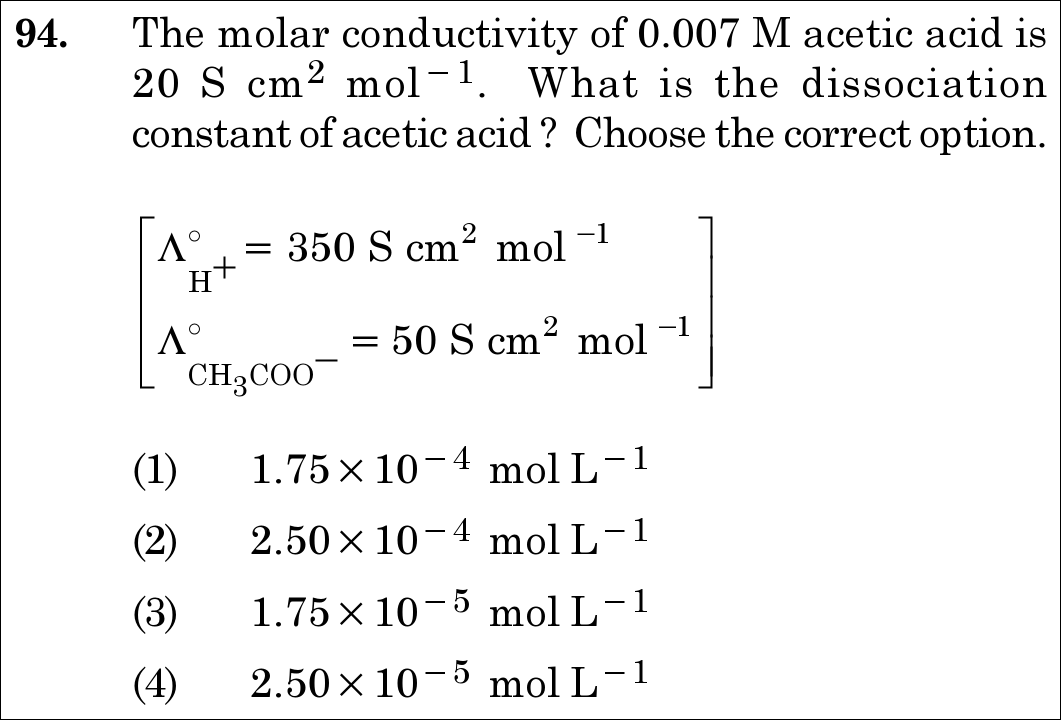
NEET 2021 Chemistry Question 94: Calculation of Dissociation Constant (Ka) of Acetic Acid from Molar Conductivity

Question

The molar conductivity of 0.007 M acetic acid is 20 S cm² mol⁻¹. What is the dissociation constant of acetic acid? Choose the correct option. [Λ°(H⁺) = 350 S cm² mol⁻¹, Λ°(CH₃COO⁻) = 50 S cm² mol⁻¹]

✓
Verified Against NTA Final Answer Key
Option (3) : 1.75 × 10^-5 mol L^-1
📚 Electrochemistry Easy
📋 Given Parameters & Problem Setup
Concentration (c) 0.007 M = 7 × 10^-3 mol L^-1
Molar Conductivity (Λm) 20 S cm^2 mol^-1
Λ°(H+) 350 S cm^2 mol^-1
Λ°(CH3COO-) 50 S cm^2 mol^-1
⚡

The 30-Second Exam Hall Shortcut: ⚡ Fast Ka: α = 20/400 = 0.05   ⟹  \implies Ka = c · α² = 0.007 × 0.0025 = 1.75 × 10⁻⁵

⏱️ Save ~20 seconds

Limiting molar conductivity: Λm∘=350+50=400 S cm2 mol−1\Lambda_m^\circ = 350 + 50 = 400\text{ S cm}^2\text{ mol}^{-1}. Degree of dissociation: α=ΛmΛm∘=20400=0.05\alpha = \frac{\Lambda_m}{\Lambda_m^\circ} = \frac{20}{400} = 0.05. By Ostwald dilution law: Ka≈cα2=(7×10−3)×(5×10−2)2=(7×10−3)×(2.5×10−3)=17.5×10−6=1.75×10⁻⁵ mol L−1K_a \approx c \alpha^2 = (7 \times 10^{-3}) \times (5 \times 10^{-2})^2 = (7 \times 10^{-3}) \times (2.5 \times 10^{-3}) = 17.5 \times 10^{-6} = 1.75 \times 10^{-5}\text{ mol L}^{-1}! Match Option (3)!

1 Compute Λm∘(CH3COOH)=λ∘(H+)+λ∘(CH3COO−)=350+50=400 S cm2 mol−1\Lambda_m^\circ(CH_3COOH) = \lambda^\circ(H^+) + \lambda^\circ(CH_3COO^-) = 350 + 50 = 400\text{ S cm}^2\text{ mol}^{-1}.
2 Calculate degree of dissociation: α=ΛmΛm∘=20400=0.05\alpha = \frac{\Lambda_m}{\Lambda_m^\circ} = \frac{20}{400} = 0.05.
3 Apply Ostwald's formula: Ka≈cα2K_a \approx c \alpha^2 (since α=0.05≪1\alpha = 0.05 \ll 1).
4 Substitute values: Ka=(0.007)×(0.05)2=0.007×0.0025=1.75×10⁻⁵ mol L−1K_a = (0.007) \times (0.05)^2 = 0.007 \times 0.0025 = 1.75 \times 10^{-5}\text{ mol L}^{-1}.
5 Match Option (3).
🛡️
Why You Can 100% Trust This Shortcut: Canonical Ostwald dilution law and Kohlrausch limiting molar conductivity.
📐

Step-by-Step Rigorous Workflow & Mathematical Proof

Step 1

Determining Limiting Molar Conductivity via Kohlrausch's Law

According to Kohlrausch's law of independent migration of ions, the limiting molar conductivity of acetic acid is the sum of the individual ionic limiting molar conductivities:

Λm∘(CH3COOH)=λ∘(H+)+λ∘(CH3COO−)=350+50=400 S cm2 mol−1\Lambda_m^\circ(\text{CH}_3\text{COOH}) = \lambda^\circ(\text{H}^+) + \lambda^\circ(\text{CH}_3\text{COO}^-) = 350 + 50 = 400\text{ S cm}^2\text{ mol}^{-1}
Step 2

Calculating Degree of Dissociation (α)

The degree of dissociation α\alpha of a weak electrolyte at concentration cc is the ratio of its molar conductivity Λm\Lambda_m to its limiting molar conductivity Λm∘\Lambda_m^\circ:

α=ΛmΛm∘=20400=120=0.05\alpha = \frac{\Lambda_m}{\Lambda_m^\circ} = \frac{20}{400} = \frac{1}{20} = 0.05
Step 3

Evaluating Dissociation Constant (Ka)

Applying Ostwald's dilution law for weak monobasic acids: Ka=cα21−αK_a = \frac{c \alpha^2}{1 - \alpha} Because α=0.05\alpha = 0.05, 1−α=0.95≈11 - \alpha = 0.95 \approx 1. Using the standard approximation:

Ka=cα2=(7×10−3)×(0.05)2=(7×10−3)×(2.5×10−3)=1.75×10⁻⁵ mol L−1K_a = c \alpha^2 = (7 \times 10^{-3}) \times (0.05)^2 = (7 \times 10^{-3}) \times (2.5 \times 10^{-3}) = 1.75 \times 10^{-5}\text{ mol L}^{-1}
⭐

360° Option Elimination Engine Key Feature

Diagnose every choice: Know exactly why the right option works and why distractors fail.

4-Option Deep Scan
1 1
✗ Incorrect
Verdict & Scientific Reason:

Off by an order of magnitude of 10 (10−410^{-4} instead of 10−510^{-5}).

⚠️
Student Fallacy (Why candidates pick this trap): Power of 10 decimal shifting error.
2 2
✗ Incorrect
Verdict & Scientific Reason:

Result of omitting concentration cc and using only α2/10\alpha^2 / 10.

⚠️
Student Fallacy (Why candidates pick this trap): Incomplete formula substitution.
3 3
✓ 100% Correct
Verdict & Scientific Reason:

Exact dissociation constant of acetic acid: 1.75×10⁻⁵ mol L−11.75 \times 10^{-5}\text{ mol L}^{-1}.

💡
Why this is airtight: None; flawless electrochemistry calculation.
4 4
✗ Incorrect
Verdict & Scientific Reason:

Corresponds to α2/100\alpha^2 / 100 without factoring in the stoichiometric concentration factor 7.

⚠️
Student Fallacy (Why candidates pick this trap): Miscalculating molarity product.
⚠️

NTA Trap Alert: Power of 10 Exponent Trap (10^-4 vs 10^-5)

Option (1) and Option (3) have the identical significand (1.751.75), differing solely by their powers of 10 (10−410^{-4} vs 10−510^{-5}). Carefully keep track of exponents: c=7×10⁻³c = 7 \times 10^{-3}, α=5×10⁻²  ⟹  α2=25×10−4=2.5×10⁻³\alpha = 5 \times 10^{-2} \implies \alpha^2 = 25 \times 10^{-4} = 2.5 \times 10^{-3}. Ka=7×10−3×2.5×10−3=17.5×10−6=1.75×10⁻⁵K_a = 7 \times 10^{-3} \times 2.5 \times 10^{-3} = 17.5 \times 10^{-6} = 1.75 \times 10^{-5}.

🛡️ How to avoid the -1 mark: Count negative exponents carefully: (−3)+(−3)=−6  ⟹  17.5×10−6=1.75×10⁻⁵(-3) + (-3) = -6 \implies 17.5 \times 10^{-6} = 1.75 \times 10^{-5}.
📖

Core NEET Syllabus Standard

NCERT Chemistry · Electrochemistry Standard Benchmark
Core Scientific Principle Tested:

"The degree of dissociation is given by α=Λm/Λm∘\alpha = \Lambda_m / \Lambda_m^\circ, and dissociation constant is Ka=cα2/(1−α)K_a = c \alpha^2 / (1-\alpha)."

Syllabus Focus: Applications of Kohlrausch's Law (Dissociation Constant of Weak Electrolyte)
✓ Core NEET UG Syllabus Anchor Syllabus & Academic Standards ↗

Ready to attempt under real exam pressure?

Test your speed and accuracy in the authentic 200-minute timed NTA simulator.

Launch NEET 2021 CBT Test →

Spotted a mistake in this solution? Report an error ([email protected])

⚖️ Legal & Fair Dealing Notice: Sourced from publicly released NEET 2021 question papers and NEET answer keys for private study, research, and non-commercial educational practice under Fair Dealing (Section 52(1)(a) of the Indian Copyright Act, 1957). Not affiliated with or endorsed by NTA or NMC.

Solve 4 NEET Questions a Day — One per Subject

Cover all 1,140 official NEET questions in 285 days at your own pace. Progress is saved on your device. No login needed.