The 30-Second Exam Hall Shortcut: ⚡ The ΔG° / nE° Additivity Formula
Never add or subtract E° directly! Add nE° products: n₃E₃° = n₁E₁° - n₂E₂°!
Step-by-Step Rigorous Workflow & Mathematical Proof
State the Chemical Equations and Associated Gibbs Free Energies
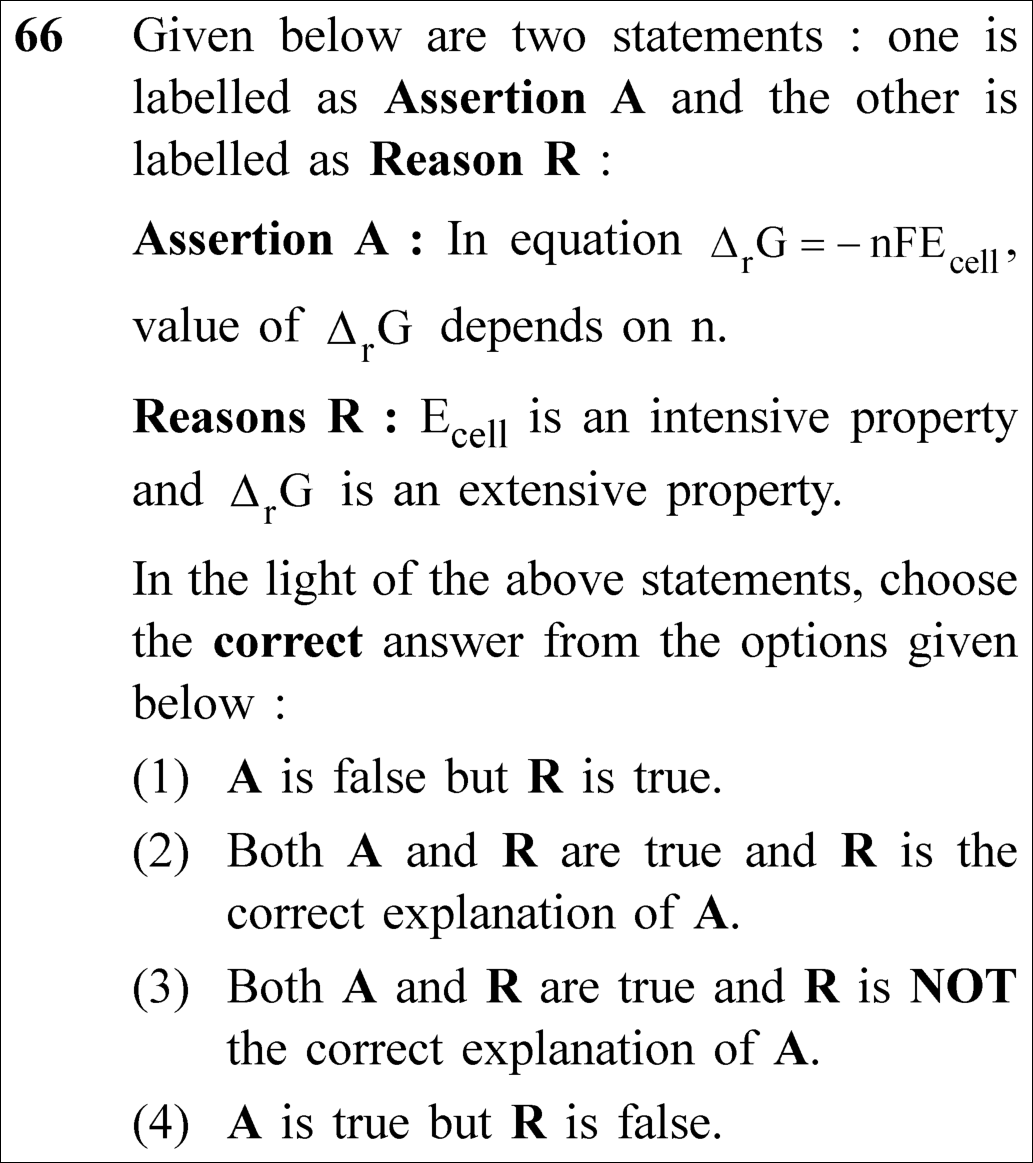
Because standard reduction potential is an intensive property, potentials cannot be directly added or subtracted. We must convert each half-reaction to its extensive standard Gibbs free energy change: ΔG° = -nFE°
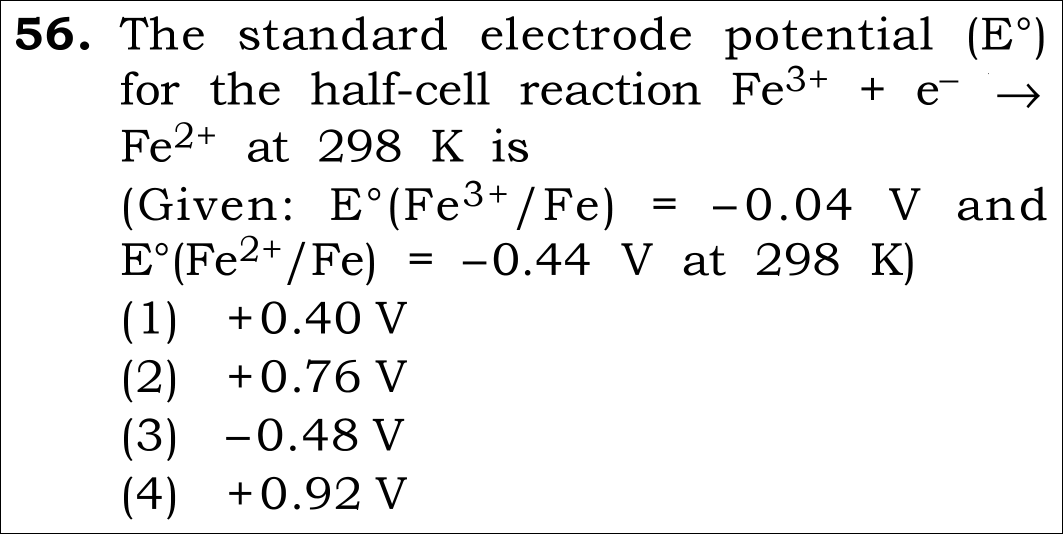
- • Reaction 1: Fe³⁺ + 3e⁻ → Fe, n₁ = 3, E₁° = -0.04 V.
- • Reaction 2: Fe²⁺ + 2e⁻ → Fe, n₂ = 2, E₂° = -0.44 V.
- • Target Reaction 3: Fe³⁺ + e⁻ → Fe²⁺, n₃ = 1, E₃° = ?
Relate Target Reaction to Given Reactions via Hess's Law
Subtracting Reaction 2 from Reaction 1 yields Target Reaction 3: [Fe³⁺ + 3e⁻ → Fe] - [Fe²⁺ + 2e⁻ → Fe] = Fe³⁺ + e⁻ → Fe²⁺ Therefore: ΔG₃° = ΔG₁° - ΔG₂°
- • Faraday's constant F cancels from all terms.
Substitute Numerical Values and Compute E₃°
Substitute n₁ = 3, E₁° = -0.04 V, n₂ = 2, E₂° = -0.44 V, and n₃ = 1 into the equation.
- • E°(Fe³⁺/Fe²⁺) = +0.76 V.
- • Matches Option (2).
360° Option Elimination Engine Key Feature
Diagnose every choice: Know exactly why the right option works and why distractors fail.
Incorrect. The classic trap of naively subtracting standard potentials: E₁° - E₂° = -0.04 - (-0.44) = +0.40 V.
Thermodynamically exact, calculated using ΔG° = -nFE° additivity.
Incorrect. Result of adding -0.04 + (-0.44) directly.
Incorrect. Result of multiplying by incorrect electron numbers.
NTA Trap Alert: Direct Subtraction of Electrode Potentials (E°₁ - E°₂)
Nearly 40% of test-takers subtract -0.04 - (-0.44) to get +0.40 V (Option 1). Standard potential E° is INTENSIVE and can NEVER be directly added or subtracted for non-complete galvanic cells!
Core NEET Syllabus Standard
"Standard reduction potentials are intensive properties; Gibbs free energy is used for combining half-reactions."