NEET 2026 Chemistry Question 56 Solution
Question
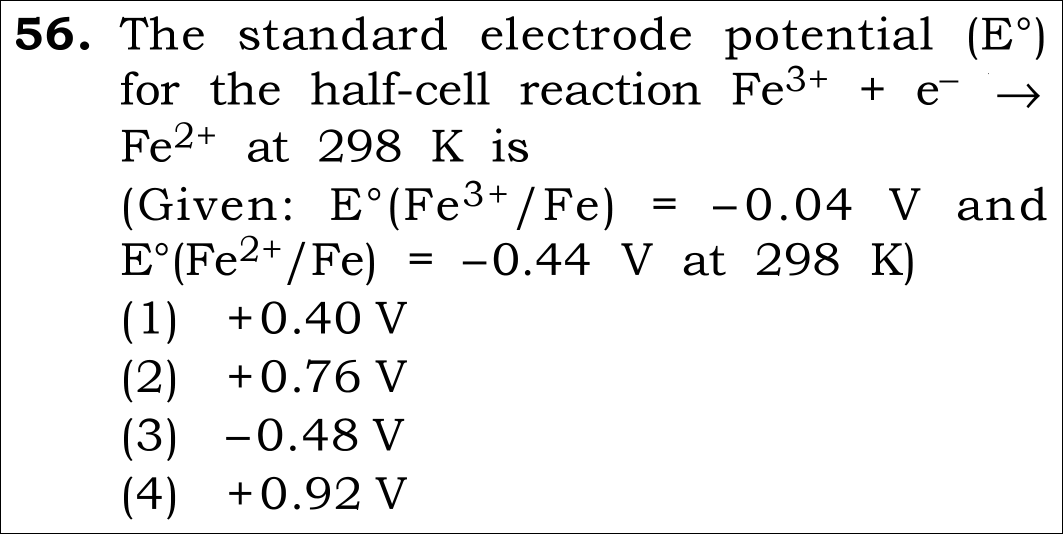
The standard electrode potential (E°) for the half-cell reaction Fe³⁺ + e⁻ → Fe²⁺ at 298 K is (Given: E°(Fe³⁺/Fe) = −0.04 V and E°(Fe²⁺/Fe) = −0.44 V at 298 K)
Dynamic 180-question full-length simulator mixed dynamically from all 6 years for 2027 & 2026 aspirants.
The standard electrode potential (E°) for the half-cell reaction Fe³⁺ + e⁻ → Fe²⁺ at 298 K is (Given: E°(Fe³⁺/Fe) = −0.04 V and E°(Fe²⁺/Fe) = −0.44 V at 298 K)
Never add or subtract E° directly! Add nE° products: n₃E₃° = n₁E₁° - n₂E₂°!
Because standard reduction potential is an intensive property, potentials cannot be directly added or subtracted. We must convert each half-reaction to its extensive standard Gibbs free energy change: ΔG° = -nFE°
Subtracting Reaction 2 from Reaction 1 yields Target Reaction 3: [Fe³⁺ + 3e⁻ → Fe] - [Fe²⁺ + 2e⁻ → Fe] = Fe³⁺ + e⁻ → Fe²⁺ Therefore: ΔG₃° = ΔG₁° - ΔG₂°
Substitute n₁ = 3, E₁° = -0.04 V, n₂ = 2, E₂° = -0.44 V, and n₃ = 1 into the equation.
Diagnose every choice: Know exactly why the right option works and why distractors fail.
Incorrect. The classic trap of naively subtracting standard potentials: E₁° - E₂° = -0.04 - (-0.44) = +0.40 V.
Thermodynamically exact, calculated using ΔG° = -nFE° additivity.
Incorrect. Result of adding -0.04 + (-0.44) directly.
Incorrect. Result of multiplying by incorrect electron numbers.
Nearly 40% of test-takers subtract -0.04 - (-0.44) to get +0.40 V (Option 1). Standard potential E° is INTENSIVE and can NEVER be directly added or subtracted for non-complete galvanic cells!
"Standard reduction potentials are intensive properties; Gibbs free energy is used for combining half-reactions."
Test your speed and accuracy in the authentic 180-minute timed NTA simulator.
Spotted a mistake in this solution? Report an error ([email protected])
Cover all 1,140 official NEET questions in 285 days at your own pace. Progress is saved on your device. No login needed.