MyCompetitiveExams Logo MyCompetitiveExams
Search 1,140+ Questions
Chapters, formulas, speed tricks
→
⚡ Brahmastra NEET 2027
720 MARKS

Dynamic 180-question full-length simulator mixed dynamically from all 6 years for 2027 & 2026 aspirants.

Launch Brahmastra 2027 Test →
Start Practice →
100% Free · No Login Required
Q.57 Chemistry ⭐ 360° Option Elimination Active
Vault ↗

NEET 2026 Chemistry Question 57 Solution

Topic: Redox Reactions · Official NTA Booklet Code 50
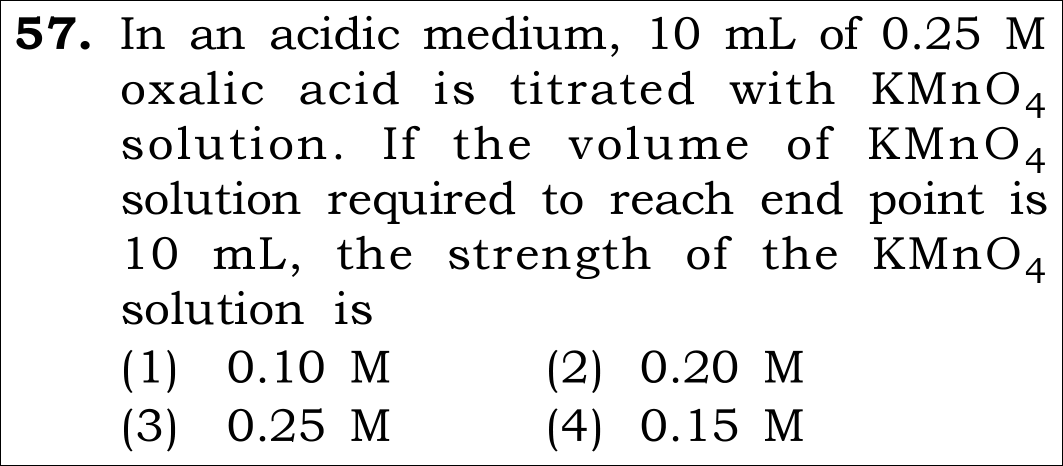
NEET 2026 Chemistry Question 57: Equivalence Point & n-factor in Permanganate-Oxalate Titration

Question

In an acidic medium, 10 mL of 0.25 M oxalic acid is titrated with KMnO₄ solution. If the volume of KMnO₄ solution required to reach end point is 10 mL, the strength of the KMnO₄ solution is

✓
Verified Against NTA Final Answer Key
Option (1) : 0.10 M
📚 Redox Reactions Medium
📋 Given Parameters & Problem Setup
Medium Acidic medium (H₂SO₄)
Oxalic Acid Volume (V₂) 10 mL
Oxalic Acid Molarity (M₂) 0.25 M
KMnO₄ Volume (V₁) 10 mL
Target Molarity (strength) of KMnO₄ solution (M₁)
⚡

The 30-Second Exam Hall Shortcut: ⚡ The 5:2 n-factor Redox Ratio

⏱️ Save ~60 seconds

Permanganate transfers 5 electrons; Oxalate transfers 2 electrons!

1 Equate equivalents: N₁V₁ = N₂V₂, which means M₁ × n₁ × V₁ = M₂ × n₂ × V₂.
2 In acidic medium: KMnO₄ has n₁ = 5 (Mn⁺⁷ → Mn²⁺).
3 Oxalic acid has n₂ = 2 (C₂O₄²⁻ → 2CO₂ + 2e⁻).
4 Since volumes are equal (V₁ = V₂ = 10 mL): M₁ × 5 = 0.25 × 2.
5 5 M₁ = 0.50 -> M₁ = 0.10 M!
6 Select Option (1) in 15 seconds!
🛡️
Why You Can 100% Trust This Shortcut: Balanced redox equation: 2 MnO₄⁻ + 5 C₂O₄²⁻ + 16 H⁺ → 2 Mn²⁺ + 10 CO₂ + 8 H₂O.
📐

Step-by-Step Rigorous Workflow & Mathematical Proof

Step 1

Determine the n-factors of the Reactants in Acidic Medium

1. Potassium permanganate (KMnO₄): Manganese is reduced from +7 in MnO₄⁻ to +2 in Mn²⁺. The change in oxidation state per mole is |+7 - (+2)| = 5. 2. Oxalic acid (H₂C₂O₄): Carbon is oxidized from +3 in C₂O₄²⁻ to +4 in CO₂. For two carbon atoms per molecule, total electron loss = 2 × 1 = 2.

n1(KMnO4)=5,n2(H2C2O4)=2n_1(\text{KMnO}_4) = 5, \quad n_2(\text{H}_2\text{C}_2\text{O}_4) = 2
  • • n-factor of KMnO₄ in acidic medium = 5.
  • • n-factor of oxalic acid = 2.
Step 2

Apply the Law of Chemical Equivalence

At the equivalence (end) point of a titration, the number of gram equivalents of oxidizing agent equals the number of gram equivalents of reducing agent: Number of equivalents = Molarity × n-factor × Volume

M1×n1×V1=M2×n2×V2M_1 \times n_1 \times V_1 = M_2 \times n_2 \times V_2
  • • V₁ = 10 mL.
  • • V₂ = 10 mL.
  • • M₂ = 0.25 M.
Step 3

Calculate Molarity of KMnO₄

Substitute the given values into the equivalence equation.

M1×5×10=0.25×2×10  ⟹  50M1=5.0  ⟹  M1=5.050=0.10 MM_1 \times 5 \times 10 = 0.25 \times 2 \times 10 \implies 50 M_1 = 5.0 \implies M_1 = \frac{5.0}{50} = 0.10\text{ M}
  • • Strength = 0.10 M.
  • • Matches Option (1).
⭐

360° Option Elimination Engine Key Feature

Diagnose every choice: Know exactly why the right option works and why distractors fail.

4-Option Deep Scan
1 A
✓ 100% Correct
Verdict & Scientific Reason:

Exact stoichiometric result derived from the law of equivalence and standard n-factors.

💡
Why this is airtight: None; rigorous application of redox stoichiometry.
2 B
✗ Incorrect
Verdict & Scientific Reason:

Incorrect. Arises from using n = 1 for oxalic acid.

⚠️
Student Fallacy (Why candidates pick this trap): Forgetting that oxalic acid (C₂O₄²⁻) possesses two carbon atoms and loses 2 electrons.
3 C
✗ Incorrect
Verdict & Scientific Reason:

Incorrect. Assuming a 1:1 molar ratio (M₁V₁ = M₂V₂), which is completely invalid for redox reactions.

⚠️
Student Fallacy (Why candidates pick this trap): Using simple molarity equation without n-factor multipliers.
4 D
✗ Incorrect
Verdict & Scientific Reason:

Incorrect. Arithmetic miscalculation.

⚠️
Student Fallacy (Why candidates pick this trap): Using incorrect n-factor ratio.
⚠️

NTA Trap Alert: Using M₁V₁ = M₂V₂ Instead of N₁V₁ = N₂V₂

The most widespread error in quantitative titrations is using acid-base molarity equality for a redox reaction with unequal electron transfers (5 electrons vs 2 electrons).

🛡️ How to avoid the -1 mark: Always use equivalents: M₁ × n₁ × V₁ = M₂ × n₂ × V₂.
📖

Core NEET Syllabus Standard

NEET Chemistry Core Syllabus · Redox Reactions Standard Benchmark
Core Scientific Principle Tested:

"In acidic solution, MnO₄⁻ acts as a 5-electron acceptor while C₂O₄²⁻ acts as a 2-electron donor."

Syllabus Focus: Redox titrations, equivalents, and oxidation number changes
✓ Core NEET UG Syllabus Anchor Syllabus & Academic Standards ↗
KMnO₄ acid = 5; Oxalate = 2: Five times M₁ equals Two times M₂!

Ready to attempt under real exam pressure?

Test your speed and accuracy in the authentic 180-minute timed NTA simulator.

Launch NEET 2026 CBT Test →

Spotted a mistake in this solution? Report an error ([email protected])

⚖️ Legal & Fair Dealing Notice: Sourced from publicly released NEET 2026 question papers and NEET answer keys for private study, research, and non-commercial educational practice under Fair Dealing (Section 52(1)(a) of the Indian Copyright Act, 1957). Not affiliated with or endorsed by NTA or NMC.

Solve 4 NEET Questions a Day — One per Subject

Cover all 1,140 official NEET questions in 285 days at your own pace. Progress is saved on your device. No login needed.