MyCompetitiveExams Logo MyCompetitiveExams
Search 1,140+ Questions
Chapters, formulas, speed tricks
→
⚡ Brahmastra NEET 2027
720 MARKS

Dynamic 180-question full-length simulator mixed dynamically from all 6 years for 2027 & 2026 aspirants.

Launch Brahmastra 2027 Test →
Start Practice →
100% Free · No Login Required
Q.100 Chemistry · Section B ⭐ 360° Option Elimination Active
Vault ↗

NEET 2024 Chemistry Question 100 Solution

Topic: Electrochemistry · Official NTA Booklet Code T1
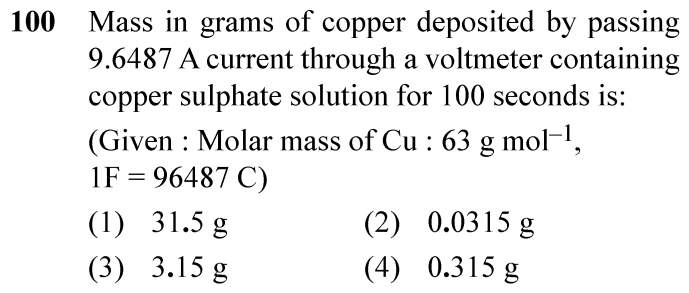
NEET 2024 Chemistry Question 100: Quantitative Electrolytic Deposition of Copper using Faraday’s Law

Question

calories remaining percentage of C. Then, the empirical formula of X is :

  1. (1)0 calorie
  2. (2)-413.14 calories (Given atomic masses ofA=64; B =40; C =32 u) (1) AB2C2
  3. (3)ABC4 92 For the given reaction:
  4. (4)A2BC2
✓
Verified Against NTA Final Answer Key
Option (4) : 0.315 g
📚 Electrochemistry Easy
📋 Given Parameters & Problem Setup
Current (I) 9.6487 A
Time of electrolysis (t) 100 seconds
Molar mass of copper (Cu) 63 g mol^-1
Faraday constant (1F) 96487 C
⚡

The 30-Second Exam Hall Shortcut: ⚡ Exact Decimal Cancellation Hack

⏱️ Save ~40 seconds

Q = I · t = 9.6487 A × 100 s = 964.87 C! Faradays = 964.87 / 96487 = 0.01 F! Cu²⁺ + 2e⁻ -> Cu: 1 F deposits 63/2 = 31.5 g -> 0.01 F deposits 0.315 g!

1 Compute total charge passed: Q = I × t = 9.6487 A × 100 s = 964.87 C.
2 Convert charge to Faradays: n_F = Q / F = 964.87 / 96487 = 0.01 F.
3 Reduction half-reaction: Cu²⁺ + 2e⁻ -> Cu.
4 2 Faradays deposit 1 mole of Cu (63 g).
5 1 Faraday deposits equivalent weight = 63 / 2 = 31.5 g.
6 0.01 Faraday deposits: 0.01 × 31.5 g = 0.315 g.
7 Option (4) in 10 seconds!
🛡️
Why You Can 100% Trust This Shortcut: NCERT Chemistry · Electrochemistry (Faraday’s first law of electrolysis: m = Z · I · t = (M / nF) · I · t).
📐

Step-by-Step Rigorous Workflow & Mathematical Proof

Step 1

Cathodic Reduction Half-Reaction

In the electrolysis of copper sulphate (CuSO4) solution, cupric ions (Cu²⁺) are reduced at the cathode by accepting two electrons per atom:

Cu2+(aq)+2e⊖⟶Cu(s)  ⟹  z=2  e⊖/atom\text{Cu}^{2+}(\text{aq}) + 2e^\ominus \longrightarrow \text{Cu}(\text{s}) \implies z = 2\; e^\ominus / \text{atom}
Step 2

Calculation of Total Electrical Charge Q

Using Q = I × t where current I = 9.6487 A and time t = 100 s:

Q=I⋅t=(9.6487  A)×(100  s)=964.87  CQ = I \cdot t = (9.6487\;\text{A}) \times (100\;\text{s}) = 964.87\;\text{C}
Step 3

Faraday’s First Law Formulation

According to Faraday’s First Law of Electrolysis, the mass m of substance deposited is proportional to charge Q:

m=Molar Massz⋅F×Q=M⋅I⋅tz⋅Fm = \frac{\text{Molar Mass}}{z \cdot F} \times Q = \frac{M \cdot I \cdot t}{z \cdot F}
Step 4

Substitution and Decimal Evaluation

Substituting M = 63 g/mol, z = 2, F = 96487 C, and Q = 964.87 C:

m=63  g/mol2×96487  C×964.87  C=632×(964.8796487)=31.5×0.01=0.315  gm = \frac{63\;\text{g/mol}}{2 \times 96487\;\text{C}} \times 964.87\;\text{C} = \frac{63}{2} \times \left(\frac{964.87}{96487}\right) = 31.5 \times 0.01 = 0.315\;\text{g}
⭐

360° Option Elimination Engine Key Feature

Diagnose every choice: Know exactly why the right option works and why distractors fail.

4-Option Deep Scan
1 (1)
✗ Incorrect
Verdict & Scientific Reason:

Represents mass deposited by 1 whole Faraday (100 times too large).

⚠️
Student Fallacy (Why candidates pick this trap): Forgetting the 0.01 factor.
2 (2)
✗ Incorrect
Verdict & Scientific Reason:

Off by a factor of 10.

⚠️
Student Fallacy (Why candidates pick this trap): Dividing by 20 instead of 2.
3 (3)
✗ Incorrect
Verdict & Scientific Reason:

Off by a factor of 10 (assumes 0.1 Faraday).

⚠️
Student Fallacy (Why candidates pick this trap): Miscounting decimal places.
4 (4)
✓ 100% Correct
Verdict & Scientific Reason:

Exact mathematical calculation: (63 / 2) × 0.01 = 0.315 g.

💡
Why this is airtight: None.
⚠️

NTA Trap Alert: Decimal Position Confusion (31.5 vs 3.15 vs 0.315)

964.87 / 96487 is exactly 1/100 = 0.01. Multiplying 31.5 by 0.01 shifts the decimal point two places to the left: 0.315 g.

🛡️ How to avoid the -1 mark: 31.5 × 10⁻² = 0.315 g. Double check decimal shifts.
📖

Core NEET Syllabus Standard

Chemistry Core Physical Chemistry · Electrochemistry Standard Benchmark
Core Scientific Principle Tested:

"Mass of substance deposited in electrolysis is m = (M / nF) · I · t."

Syllabus Focus: Quantitative Aspects of Electrolysis: Faraday’s Laws
✓ Core NEET UG Syllabus Anchor Syllabus & Academic Standards ↗
Hundred seconds at 9.6487 makes point-zero-one Faraday: Thirty-one point five times that gives zero-point-three-one-five right away!

Ready to attempt under real exam pressure?

Test your speed and accuracy in the authentic 200-minute timed NTA simulator.

Launch NEET 2024 CBT Test →

Spotted a mistake in this solution? Report an error ([email protected])

⚖️ Legal & Fair Dealing Notice: Sourced from publicly released NEET 2024 question papers and NEET answer keys for private study, research, and non-commercial educational practice under Fair Dealing (Section 52(1)(a) of the Indian Copyright Act, 1957). Not affiliated with or endorsed by NTA or NMC.

Solve 4 NEET Questions a Day — One per Subject

Cover all 1,140 official NEET questions in 285 days at your own pace. Progress is saved on your device. No login needed.