📋 Given Parameters & Problem Setup
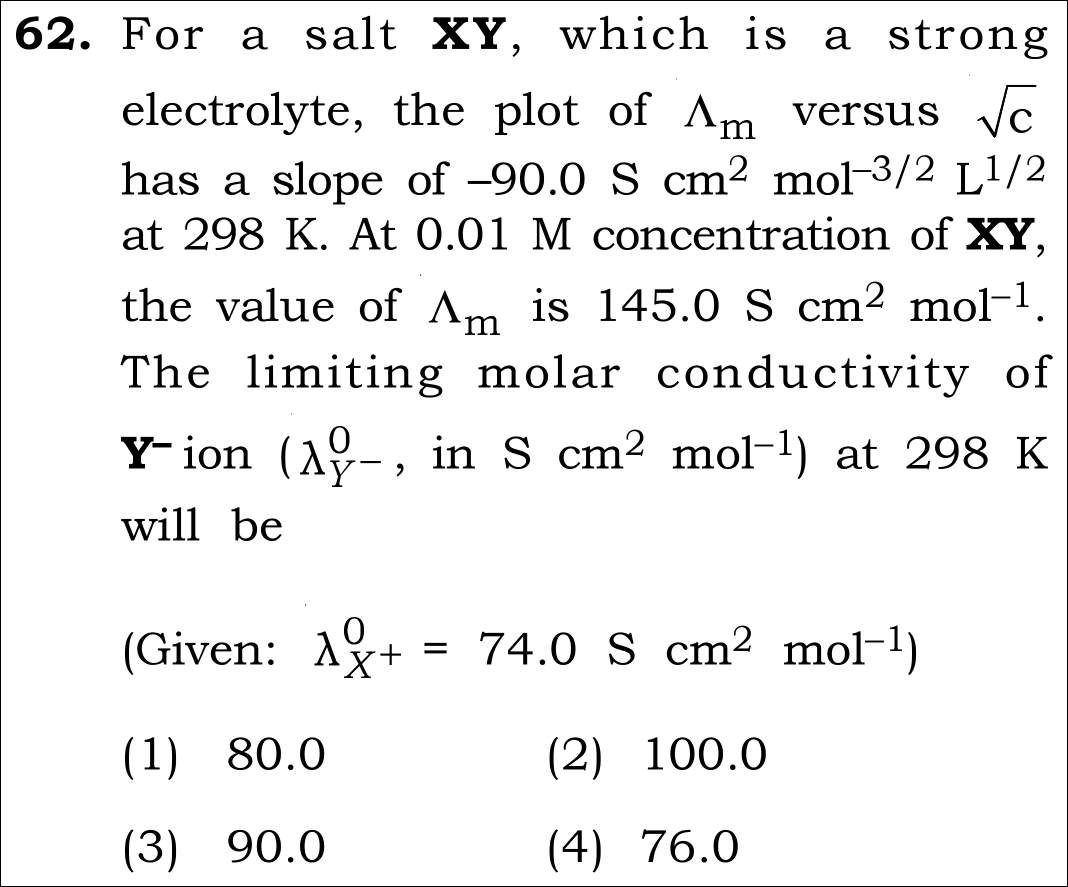
Salt XY Strong 1:1 electrolyte
Slope of Λ_m vs √c -90.0 S cm² mol⁻³/² L¹/²
Concentration (c) 0.01 M
Molar Conductivity (Λ_m at 0.01 M) 145.0 S cm² mol⁻¹
λ°(X⁺) 74.0 S cm² mol⁻¹
Target Limiting molar conductivity of Y⁻ ion (λ°_{Y⁻})
Λ_m = Λ_m° - A√c -> Add A√c to find Λ_m°, then subtract λ°(X⁺)!
1 √c = √(0.01) = 0.1.
2 Debye-Hückel-Onsager equation: Λ_m = Λ_m° - A√c, where slope = -A = -90.0 ⇒ A = 90.0.
3 Calculate Λ_m°: Λ_m° = Λ_m + A√c = 145.0 + (90.0 × 0.1) = 145.0 + 9.0 = 154.0 S cm² mol⁻¹.
4 Apply Kohlrausch's law: λ°(Y⁻) = Λ_m° - λ°(X⁺) = 154.0 - 74.0 = 80.0 S cm² mol⁻¹!
5 Select Option (1) in 25 seconds!
🛡️ Why You Can 100% Trust This Shortcut: Standard physical chemistry relationship for strong electrolytes in dilute solutions (Debye-Hückel-Onsager formulation).
⚠️
Because the equation has a minus sign (Λ_m = Λ_m° - A√c), students often mistakenly compute Λ_m° = Λ_m - A√c. Remember: limiting conductivity at zero concentration is ALWAYS higher than conductivity at non-zero concentration!
🛡️ How to avoid the -1 mark: Check intuition: As c → 0, interionic attractions disappear, so Λ_m° MUST be greater than Λ_m.
📖
NEET Chemistry Core Syllabus · Electrochemistry Standard Benchmark
Core Scientific Principle Tested:
"For strong electrolytes, Λ_m = Λ_m° - A√c, and Λ_m° = Σ ν_i λ°_i."
Syllabus Focus: Variation of conductivity and molar conductivity with concentration, Kohlrausch's law
Onsager says: At zero dilution ions are free, add A√c to find Λ_m° key!