The 30-Second Exam Hall Shortcut: ⚡ Dimensional & Physical Balance Shortcut
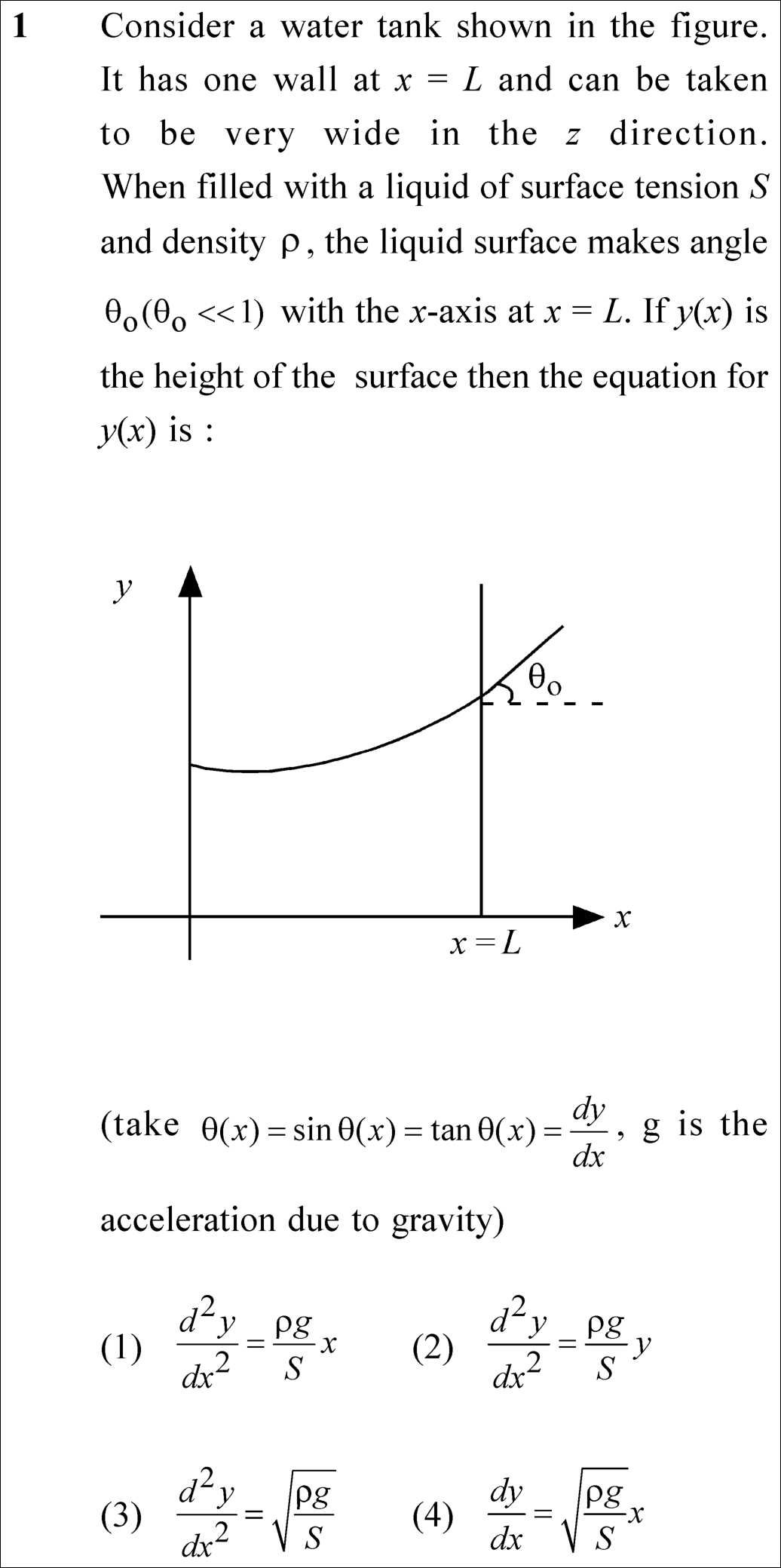
Laplace Pressure S(d²y/dx²) = Hydrostatic Column Pressure ρgy ⟹ d²y/dx² = (ρg/S) y!
Step-by-Step Conceptual & Mathematical Derivation
Young-Laplace Equation for 1D Cylindrical Meniscus
Because the tank is very wide in the z-direction, the liquid surface is cylindrical (curvature in z-direction is zero). The Laplace excess pressure across a surface with radius of curvature R is governed by surface tension S.
- • For a surface profile y(x) with small slope (dy/dx ≪ 1), the curvature simplifies to 1/R ≈ d²y/dx².
Hydrostatic Pressure Balance
At any horizontal position x, the atmospheric pressure acts above the surface. At the flat baseline level (y = 0), the pressure is atmospheric. The hydrostatic pressure difference between the liquid at height y(x) and the flat surface is ρgy.
- • Equilibrium requires excess Laplace pressure to balance the gravitational head.
Formulation of the Governing Differential Equation
Equating the Laplace pressure to the hydrostatic pressure head yields the second-order linear differential equation governing the meniscus profile.
- • This is the classical capillary rise meniscus differential equation with characteristic capillary length λ_c = √(S/ρg).
🔍 View 360° Option Elimination Analysis & NTA Trap Alert ▼
Incorrect. Hydrostatic pressure depends on vertical elevation y, not horizontal coordinate x.
100% scientifically and dimensionally exact. Directly balances Laplace curvature pressure with hydrostatic head ρgy.
Incorrect. The RHS is a constant equal to the inverse capillary length (1/λ_c), missing the variable dependence on y.
Incorrect. Laplace excess pressure relates directly to surface curvature (second derivative d²y/dx²), not slope (dy/dx).
Students frequently rush and pick Option (1) because x is on the horizontal axis. But hydrostatic pressure is caused by GRAVITY acting vertically: P = ρgy. Thus the restoring force is proportional to y, not x.