MyCompetitiveExams Logo MyCompetitiveExams
Search 1,140+ Questions
Chapters, formulas, speed tricks
→
⚡ Brahmastra NEET 2027
720 MARKS

Dynamic 180-question full-length simulator mixed dynamically from all 6 years for 2027 & 2026 aspirants.

Launch Brahmastra 2027 Test →
Start Practice →
100% Free · No Login Required
Q.167 Zoology ⭐ 360° Option Elimination Active
Vault ↗

NEET 2025 Zoology Question 167 Solution

Topic: Human Health and Disease · Official NTA Booklet Code 45
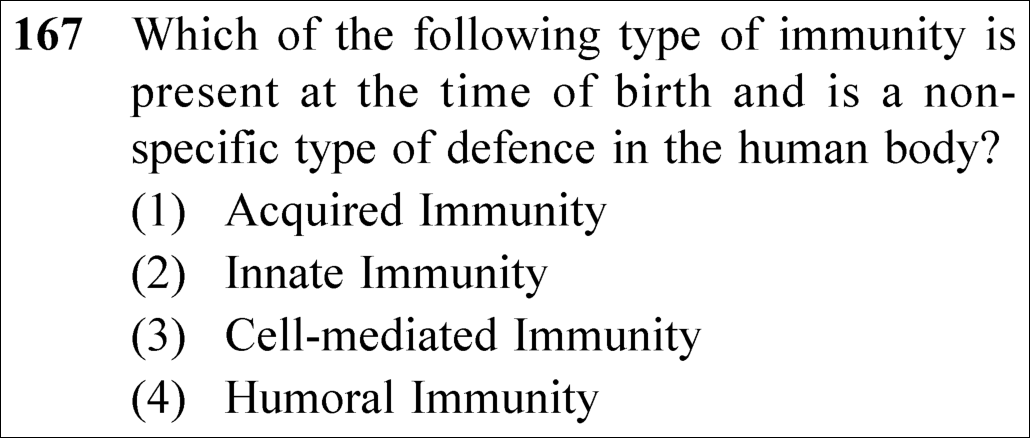
NEET 2025 Zoology Question 167: Classification of Immunity: Innate (Congenital, Non-Specific) vs Acquired

Question

Which of the following type of immunity is present at the time of birth and is a non-specific type of defence in the human body?

✓
Verified Against NTA Final Answer Key
Option (2) : Innate Immunity
📚 Human Health and Disease Easy
📋 Given Parameters & Problem Setup
Timing Present at the time of birth (inborn / congenital)
Specificity Non-specific type of defence mechanism
⚡

The 30-Second Exam Hall Shortcut: ⚡ Innate vs Acquired Immunity Fingerprint

⏱️ Save ~10 seconds

Present from birth (inborn) + Non-specific defence = INNATE IMMUNITY! Acquired (adaptive) immunity develops after birth, is pathogen-specific, and has memory!

1 Recall NCERT Section 8.2.1 (Innate Immunity) opening line:
2 - "Innate immunity is non-specific type of defence, that is present at the time of birth."
3 - It provides four types of barriers: Physical (skin, mucus), Physiological (HCl, tears, saliva), Cellular (WBCs, PMNL-neutrophils, macrophages), and Cytokine (interferons).
4 - Acquired immunity is pathogen-specific, characterized by immunological memory, and acquired during lifetime.
5 Direct answer: Innate Immunity!
6 Select Option (2) Innate Immunity!
🛡️
Why You Can 100% Trust This Shortcut: Bacterial & Viral Human Pathogens (NCERT Biology · Human Health and Disease: Typhoid Salmonella typhi & Widal test).
📐

Step-by-Step Rigorous Workflow & Mathematical Proof

Step 1

Definition and Attributes of Innate Immunity

Innate immunity represents the body's first line of natural immunological defence:

  • • It is congenital, meaning it is genetically predetermined and fully operational at the time of birth.
  • • It is non-specific, meaning it does not discriminate between distinct antigenic molecular determinants; it provides broad-spectrum resistance against invasion by foreign infectious agents.
Step 2

Four Barrier Categories of Innate Immunity

How non-specific protection is maintained:

  • • Physical barriers: Skin acts as the principal barrier preventing entry; mucus coatings of respiratory, GI, and urogenital tracts trap microbes.
  • • Physiological barriers: Gastric acid (HCl) in stomach, saliva in the mouth, and lysozyme in tears prevent microbial growth.
  • • Cellular barriers: Phagocytes like polymorphonuclear leukocytes (PMNL-neutrophils), monocytes, and tissue macrophages, plus Natural Killer (NK) cells.
  • • Cytokine barriers: Virus-infected cells secrete interferons which protect non-infected cells from further viral infection.
Step 3

Contrast with Acquired Immunity

Distinguishing features of adaptive defence:

  • • Acquired (adaptive) immunity (including humoral and cell-mediated branches) is NOT present at birth; it is acquired post-natally upon exposure to specific pathogens and is characterized by exquisite antigenic specificity and long-lasting memory.
Step 4

Conclusion

The immunity present at birth providing non-specific defence is Innate Immunity, corresponding to Option (2).

Present at Birth+Non-Specific  ⟹  Innate Immunity (Option 2)\text{Present at Birth} + \text{Non-Specific} \implies \text{Innate Immunity (Option 2)}
⭐

360° Option Elimination Engine Key Feature

Diagnose every choice: Know exactly why the right option works and why distractors fail.

4-Option Deep Scan
1 A
✗ Incorrect
Verdict & Scientific Reason:

Incorrect. Acquired immunity is developed after birth upon pathogen encounter and is pathogen-specific.

⚠️
Student Fallacy (Why candidates pick this trap): Confusing adaptive immunity with congenital immunity.
2 B
✓ 100% Correct
Verdict & Scientific Reason:

100% correct. Direct verbatim NCERT definition: non-specific defence present at the time of birth.

💡
Why this is airtight: None; fundamental immunology recall.
3 C
✗ Incorrect
Verdict & Scientific Reason:

Incorrect. Cell-mediated immunity is mediated by T-lymphocytes and is an antigen-specific component of acquired immunity.

⚠️
Student Fallacy (Why candidates pick this trap): Confusing cellular innate barriers with T-cell mediated acquired immunity.
4 D
✗ Incorrect
Verdict & Scientific Reason:

Incorrect. Humoral immunity is antibody-mediated acquired immunity produced by B-lymphocytes post-exposure.

⚠️
Student Fallacy (Why candidates pick this trap): Confusing antibody responses with inborn non-specific immunity.
⚠️

NTA Trap Alert: Innate vs Inborn Terminology

Innate literally means "inborn". It provides general non-specific protection from the first second of life. Acquired immunity takes days to weeks to build and requires prior antigen exposure.

🛡️ How to avoid the -1 mark: Birth + Non-specific = Innate.
📖

Core NEET Syllabus Standard

NEET Biology Core Syllabus · Human Health and Disease Standard Benchmark
Core Scientific Principle Tested:

"Innate immunity is a non-specific type of defence present at the time of birth."

Syllabus Focus: Immunity · Innate Immunity
✓ Core NEET UG Syllabus Anchor Syllabus & Academic Standards ↗
IN-NATE = IN-BORN: Natural, Non-specific, from day 0!

Ready to attempt under real exam pressure?

Test your speed and accuracy in the authentic 180-minute timed NTA simulator.

Launch NEET 2025 CBT Test →

Spotted a mistake in this solution? Report an error ([email protected])

⚖️ Legal & Fair Dealing Notice: Sourced from publicly released NEET 2025 question papers and NEET answer keys for private study, research, and non-commercial educational practice under Fair Dealing (Section 52(1)(a) of the Indian Copyright Act, 1957). Not affiliated with or endorsed by NTA or NMC.

Solve 4 NEET Questions a Day — One per Subject

Cover all 1,140 official NEET questions in 285 days at your own pace. Progress is saved on your device. No login needed.