MyCompetitiveExams Logo MyCompetitiveExams
Search 1,140+ Questions
Chapters, formulas, speed tricks
→
⚡ Brahmastra NEET 2027
720 MARKS

Dynamic 180-question full-length simulator mixed dynamically from all 6 years for 2027 & 2026 aspirants.

Launch Brahmastra 2027 Test →
Start Practice →
100% Free · No Login Required
🌿 Botany 🔥 High-Yield Core Topic (~3–4 Qs/Year)

NEET Human Health and Disease Previous Year Questions with Solutions

Complete repository of official NTA NEET questions for Human Health and Disease from 2020 to 2026. Every question includes 30-second elimination tricks, step-by-step NCERT solutions, option-by-option traps, and official answer keys.

21 Questions 6 Exam Years (2026, 2025, 2024, 2023, 2021, 2020) 20 Easy · 1 Medium · 0 Challenging
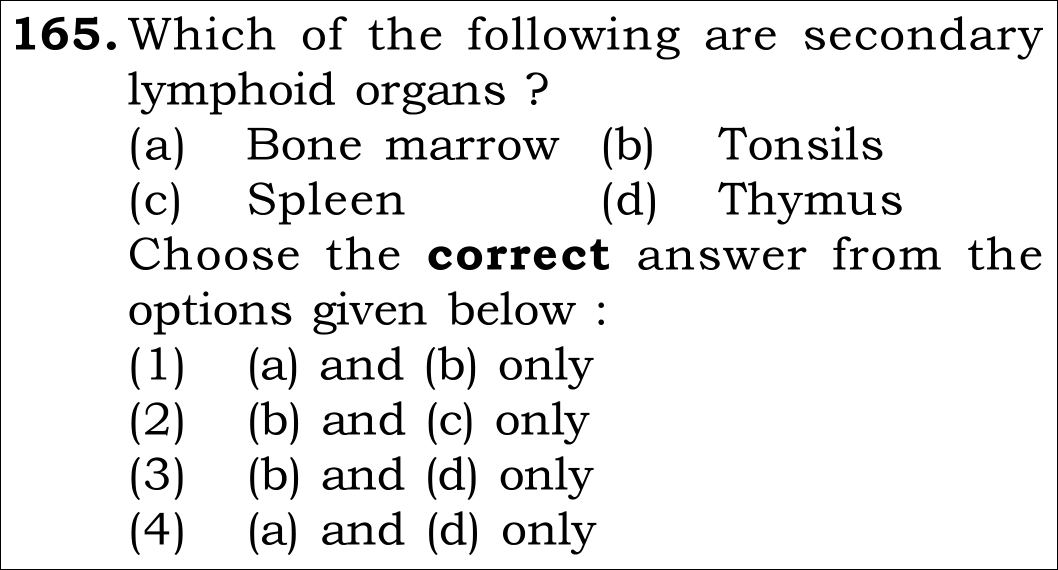
NEET 2026 · Q165 Easy
Official NEET 2026 Question 165 - Human Health and Disease
1 (a) and (b) only
2 (b) and (c) only ✓ Key
3 (b) and (d) only
4 (a) and (d) only
💡 Verified Solution & 30-Second Hack
✓
Verified Against NTA Final Answer Key
Option (2) : (b) and (c) only
📚 Human Health and Disease Easy
📋 Given Parameters & Problem Setup
Category Secondary Lymphoid Organs in Human Body
Candidate Organs (a) Bone marrow, (b) Tonsils, (c) Spleen, (d) Thymus
⚡

The 30-Second Exam Hall Shortcut: ⚡ Primary Duo vs. Secondary Battlegrounds

⏱️ Save ~35 seconds

Primary = Bone Marrow + Thymus (Birth & School); Secondary = Spleen + Tonsils + Lymph Nodes (Warzones)!

1 Classify the 4 organs into Primary and Secondary.
2 Primary Lymphoid Organs (origin and maturation of lymphocytes): Bone marrow (a) and Thymus (d).
3 Secondary Lymphoid Organs (site of interaction with antigen): Spleen (c), Tonsils (b), Lymph nodes, Peyer’s patches, MALT.
4 Target: Secondary organs = (b) Tonsils and (c) Spleen.
5 Match Option (2): (b) and (c) only.
6 Answer locked in under 10 seconds!
🛡️
Why You Can 100% Trust This Shortcut: NCERT Biology · Human Health and Disease (Autoimmune Diseases: Rheumatoid arthritis damages self-joints).
📐

Step-by-Step Rigorous Workflow & Mathematical Proof

Step 1

Primary Lymphoid Organs

The primary lymphoid organs are bone marrow and thymus where immature lymphocytes differentiate into antigen-sensitive lymphocytes.

\text{Primary Organs} = \text{Bone Marrow } (a) + \text{Thymus } (d) \implies \text{Maturation & Differentiation}
  • • All blood cells including B and T lymphocytes are produced in the bone marrow; T-lymphocytes mature in the thymus.
Step 2

Secondary Lymphoid Organs

After maturation, lymphocytes migrate to secondary lymphoid organs like spleen, lymph nodes, tonsils, Peyer’s patches of small intestine, and appendix. These organs provide the sites for interaction of lymphocytes with the antigen, which then proliferate to become effector cells.

\text{Secondary Organs} = \text{Tonsils } (b) + \text{Spleen } (c) \implies \text{Antigen Interaction & Proliferation}
  • • The spleen is a large bean-shaped organ containing lymphocytes and phagocytes, acting as a filter for blood-borne microorganisms.
⭐

360° Option Elimination Engine Key Feature

Diagnose every choice: Know exactly why the right option works and why distractors fail.

4-Option Deep Scan
1 A
✗ Incorrect
Verdict & Scientific Reason:

Incorrect. Bone marrow (a) is a primary lymphoid organ.

⚠️
Student Fallacy (Why candidates pick this trap): Mixing up primary bone marrow with secondary tonsils.
2 B
✓ 100% Correct
Verdict & Scientific Reason:

100% correct. Both tonsils (b) and spleen (c) are secondary lymphoid organs.

💡
Why this is airtight: None; precise textbook classification.
3 C
✗ Incorrect
Verdict & Scientific Reason:

Incorrect. Thymus (d) is a primary lymphoid organ where T-cells undergo selection.

⚠️
Student Fallacy (Why candidates pick this trap): Confusing primary thymus with secondary spleen.
4 D
✗ Incorrect
Verdict & Scientific Reason:

Incorrect. Bone marrow (a) and thymus (d) are PRIMARY lymphoid organs, not secondary.

⚠️
Student Fallacy (Why candidates pick this trap): Inverting the question prompt to pick primary organs instead of secondary.
⚠️

NTA Trap Alert: Inverting Primary vs. Secondary Prompt

Students frequently read "lymphoid organs" and instinctively select the famous pair Bone marrow + Thymus (Option 4), forgetting that those are PRIMARY, not SECONDARY.

🛡️ How to avoid the -1 mark: Circle SECONDARY: Secondary = Spleen, Tonsils, Lymph nodes (battlegrounds).
📖

Core NEET Syllabus Standard

NEET Biology Core Syllabus · Human Health and Disease Standard Benchmark
Core Scientific Principle Tested:

"Primary organs are bone marrow and thymus; secondary organs are spleen, lymph nodes, tonsils, and Peyer’s patches."
Syllabus Focus: Lymphoid Organs
✓ Core NEET UG Syllabus Anchor Syllabus & Academic Standards ↗
Primary = BM & T (Baby Makers); Secondary = Spleen & Tonsils (Street Fighters)!
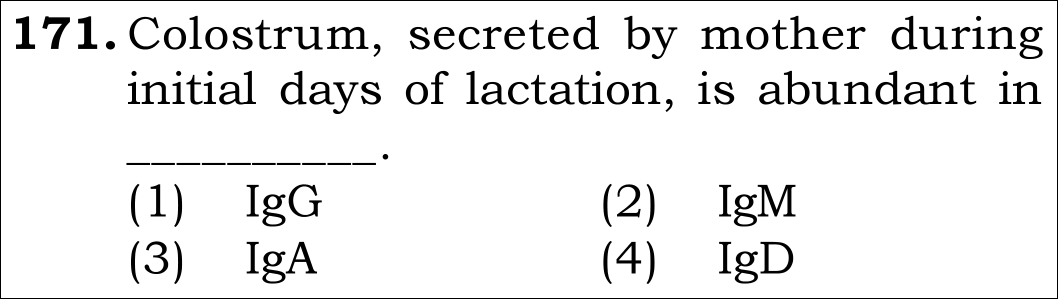
NEET 2026 · Q171 Easy
Official NEET 2026 Question 171 - Human Health and Disease
1
2
3 ✓ Key
4
💡 Verified Solution & 30-Second Hack
✓
Verified Against NTA Final Answer Key
Option (3) : IgA
📚 Human Health and Disease Easy
📋 Given Parameters & Problem Setup
Secretory Fluid Colostrum (yellowish milk of initial days of lactation)
Target Property Predominant antibody providing passive immunity to infant
⚡

The 30-Second Exam Hall Shortcut: ⚡ Secretory Antibody Recall

⏱️ Save ~30 seconds

Colostrum / Tears / Saliva / Mucus = Secretory IgA (Dimer)!

1 Identify keyword: "Colostrum".
2 Recall canonical immunological antibody distribution:
3 IgA: Present in external secretions (colostrum, breast milk, saliva, tears).
4 IgG: Most abundant in serum; only antibody that crosses the placenta.
5 IgE: Mediates allergic reactions and binds mast cells.
6 IgM: Largest antibody (pentamer); first to be produced in primary immune response.
7 Colostrum is famously packed with IgA.
8 Select Option (3) IgA.
🛡️
Why You Can 100% Trust This Shortcut: NCERT Biology · Human Health and Disease (Innate Immunity Barriers: Physical, physiological, cellular, and cytokine barriers).
📐

Step-by-Step Rigorous Workflow & Mathematical Proof

Step 1

Composition and Role of Colostrum

The yellowish fluid colostrum secreted by mother during the initial days of lactation has abundant antibodies (IgA) to protect the infant against gastrointestinal and respiratory pathogens.

Colostrum→AbundantIgA→Passive Natural ImmunityNeonatal Protection\text{Colostrum} \xrightarrow{\text{Abundant}} \mathbf{IgA} \xrightarrow{\text{Passive Natural Immunity}} \text{Neonatal Protection}
  • • This provides natural passive immunity because preformed antibodies are transferred directly to the infant.
Step 2

Structural Adaptation of IgA

Secretory IgA is typically a dimer joined by a J-chain and protected by a secretory component against proteolytic digestion in the infant’s stomach and intestines.

Secretory IgA=2×(H2L2)+J-Chain+Secretory Component\text{Secretory IgA} = 2 \times (\text{H}_2\text{L}_2) + \text{J-Chain} + \text{Secretory Component}
  • • IgG provides prenatal passive immunity via placental transfer, whereas IgA provides postnatal passive immunity via colostrum.
⭐

360° Option Elimination Engine Key Feature

Diagnose every choice: Know exactly why the right option works and why distractors fail.

4-Option Deep Scan
1 A
✗ Incorrect
Verdict & Scientific Reason:

Incorrect. IgG is the predominant serum antibody and crosses the placenta into the fetus, but it is not the primary antibody of colostrum.

⚠️
Student Fallacy (Why candidates pick this trap): Confusing placental transfer (IgG) with colostrum (IgA).
2 B
✗ Incorrect
Verdict & Scientific Reason:

Incorrect. IgM is a pentamer and the earliest antibody produced during a primary humoral immune response, not the major antibody in colostrum.

⚠️
Student Fallacy (Why candidates pick this trap): Confusing the first responder antibody (IgM) with maternal milk antibody.
3 C
✓ 100% Correct
Verdict & Scientific Reason:

100% correct. IgA is the predominant immunoglobulin found in colostrum and external mucosal secretions.

💡
Why this is airtight: None; standard NCERT fact.
4 D
✗ Incorrect
Verdict & Scientific Reason:

Incorrect. IgE is involved in hypersensitivity/allergic reactions and defense against helminth parasites.

⚠️
Student Fallacy (Why candidates pick this trap): Associating IgE with immune protection rather than allergy.
⚠️

NTA Trap Alert: IgG vs. IgA Maternal Immunity Trap

Students frequently conflate prenatal maternal protection (IgG through placenta) with postnatal maternal protection (IgA through colostrum).

🛡️ How to avoid the -1 mark: Remember: G = Gestation/Goes through placenta (IgG); A = After birth/Alimentary/colostrum (IgA).
📖

Core NEET Syllabus Standard

NEET Biology Core Syllabus · Human Health and Disease Standard Benchmark
Core Scientific Principle Tested:

"Colostrum secreted during the initial days of lactation has abundant antibodies (IgA) to protect the infant."

Syllabus Focus: Innate and Acquired Immunity
✓ Core NEET UG Syllabus Anchor Syllabus & Academic Standards ↗
IgA = Ingested by the Infant After birth (Colostrum)!
NEET 2026 · Q177 Easy
Official NEET 2026 Question 177 - Human Health and Disease
1 Interferon
2 Antibiotics
3 Morphine ✓ Key
4 Anti-retroviral drugs
💡 Verified Solution & 30-Second Hack
✓
Verified Against NTA Final Answer Key
Option (3) : Morphine
📚 Human Health and Disease Easy
📋 Given Parameters & Problem Setup
Therapeutic Profile Very effective sedative and painkiller
Clinical Application Widely prescribed to patients who have undergone surgery
⚡

The 30-Second Exam Hall Shortcut: ⚡ Post-Surgery Painkiller Gold Standard

⏱️ Save ~30 seconds

NCERT Verbatim: "Morphine is a very effective sedative and painkiller, useful in surgery patients!"

1 Recognize verbatim NCERT sentence: "Morphine is a very effective sedative and painkiller, and is very useful in patients who have undergone surgery."
2 Morphine is extracted from the latex of the poppy plant Papaver somniferum.
3 Heroin (smack) is diacetylmorphine, a depressant abused illicitly.
4 Cocaine is a CNS stimulant producing euphoria.
5 Cannabinoids affect the cardiovascular system.
6 Select Option (3) Morphine in 5 seconds.
🛡️
Why You Can 100% Trust This Shortcut: NCERT Biology · Human Health and Disease (Oncogenic Viruses & Contact Inhibition Loss in Cancer Cells).
📐

Step-by-Step Rigorous Workflow & Mathematical Proof

Step 1

Botanical Source and Chemistry of Morphine

Morphine is a natural opiate alkaloid obtained from the latex of the opium poppy plant, Papaver somniferum. It binds to specific opioid receptors present in our central nervous system and gastrointestinal tract.

\text{Papaver somniferum (Opium Poppy)} \xrightarrow{\text{Latex}} \mathbf{Morphine} \xrightarrow{\text{Opioid Receptors}} \text{CNS Analgesia & Sedation}
  • • Diacetylation of morphine yields heroin (diacetylmorphine, or smack).
Step 2

Medical Use vs. Substance Abuse

In clinical medicine, morphine is widely used as a potent analgesic (painkiller) and sedative for managing severe acute pain, particularly in patients undergoing surgery or dealing with terminal cancer pain.

\text{Clinical Utility} \equiv \text{Post-Surgical Sedative & Analgesic} \implies \text{Option (3)}
  • • However, when taken for purposes other than medicinal use, it leads to severe psychological and physical dependence.
⭐

360° Option Elimination Engine Key Feature

Diagnose every choice: Know exactly why the right option works and why distractors fail.

4-Option Deep Scan
1 A
✗ Incorrect
Verdict & Scientific Reason:

Incorrect. Cocaine is an alkaloid from Erythroxylum coca that interferes with dopamine reuptake, acting as a potent CNS stimulant and hallucinogen at high doses, not a sedative.

⚠️
Student Fallacy (Why candidates pick this trap): Confusing stimulants with sedatives.
2 B
✗ Incorrect
Verdict & Scientific Reason:

Incorrect. Heroin (diacetylmorphine) is an illicit street drug (smack) with high addiction liability, not the standard post-surgery clinical prescription.

⚠️
Student Fallacy (Why candidates pick this trap): Selecting the illicit derivative instead of clinical morphine.
3 C
✓ 100% Correct
Verdict & Scientific Reason:

100% correct. NCERT states verbatim that morphine is a very effective sedative and painkiller used for patients who have undergone surgery.

💡
Why this is airtight: None; textbook recall.
4 D
✗ Incorrect
Verdict & Scientific Reason:

Incorrect. Cannabinoids (from Cannabis sativa) interact with cannabinoid receptors in the brain and affect the cardiovascular system; they are not the classic post-surgical opioid analgesics.

⚠️
Student Fallacy (Why candidates pick this trap): Confusing cannabinoid effects with opioid analgesia.
⚠️

NTA Trap Alert: Morphine vs. Heroin Distinction

Morphine is the medically approved opioid analgesic prescribed after surgery. Heroin is its chemically modified illicit form (diacetylated morphine).

🛡️ How to avoid the -1 mark: Remember: Medicine = Morphine; Illicit abuse = Heroin.
📖

Core NEET Syllabus Standard

NEET Biology Core Syllabus · Human Health and Disease Standard Benchmark
Core Scientific Principle Tested:

"Morphine is a very effective sedative and painkiller, useful in patients who have undergone surgery."

Syllabus Focus: Drugs and Alcohol Abuse
✓ Core NEET UG Syllabus Anchor Syllabus & Academic Standards ↗
Morphine Mends post-surgery pain: Sedative & Analgesic!
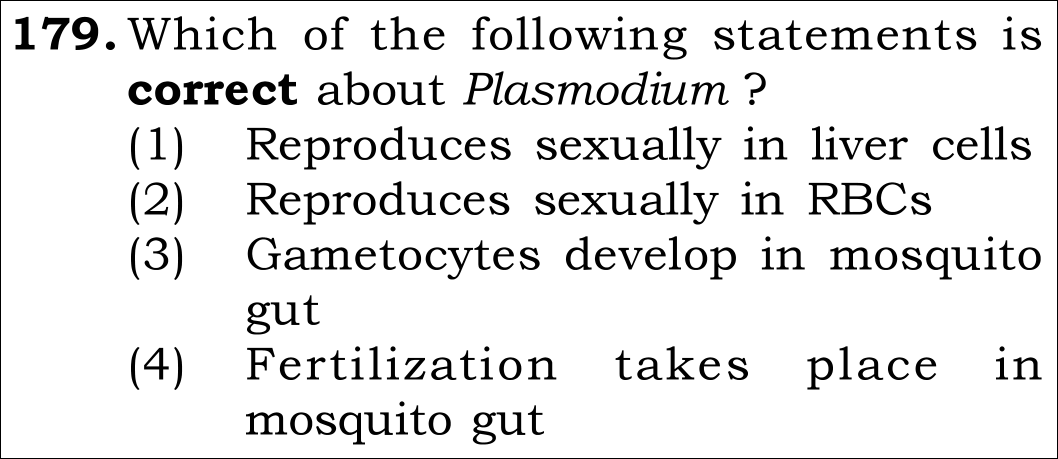
NEET 2026 · Q179 Easy
Official NEET 2026 Question 179 - Human Health and Disease
1 Reproduces sexually in liver cells
2 Reproduces sexually in RBCs
3 Gametocytes develop in mosquito gut
4 Fertilization takes place in mosquito gut ✓ Key
💡 Verified Solution & 30-Second Hack
✓
Verified Against NTA Final Answer Key
Option (4) : Fertilization and development of the parasite take place in the gut of the female Anopheles mosquito.
📚 Human Health and Disease Easy
📋 Given Parameters & Problem Setup
Pathogen Plasmodium (Malarial Parasite)
Target Statement Correct statement regarding its life cycle
⚡

The 30-Second Exam Hall Shortcut: ⚡ Plasmodium Lifecycle Binary Split

⏱️ Save ~40 seconds

Humans = ASEXUAL (Schizogony in liver & RBCs); Mosquito Gut = SEXUAL (Fertilization & Oökinete)!

1 Check Option (1): "Sporozoites reproduce sexually in the liver..." -> FALSE (Asexual multiple fission / schizogony).
2 Check Option (2): "Gametocytes develop in salivary glands..." -> FALSE (Gametocytes develop in human RBCs).
3 Check Option (3): "Parasite enters human body as merozoites" -> FALSE (Enters as infectious SPOROZOITES via mosquito bite).
4 Check Option (4): "Fertilization and development take place in the gut of the female Anopheles mosquito" -> TRUE (NCERT verbatim).
5 Pick Option (4) in under 10 seconds!
🛡️
Why You Can 100% Trust This Shortcut: NCERT Biology · Human Health and Disease (Protozoan and Helminthic Diseases: Entamoeba histolytica causing amoebiasis).
📐

Step-by-Step Rigorous Workflow & Mathematical Proof

Step 1

Asexual Cycle in Human Host

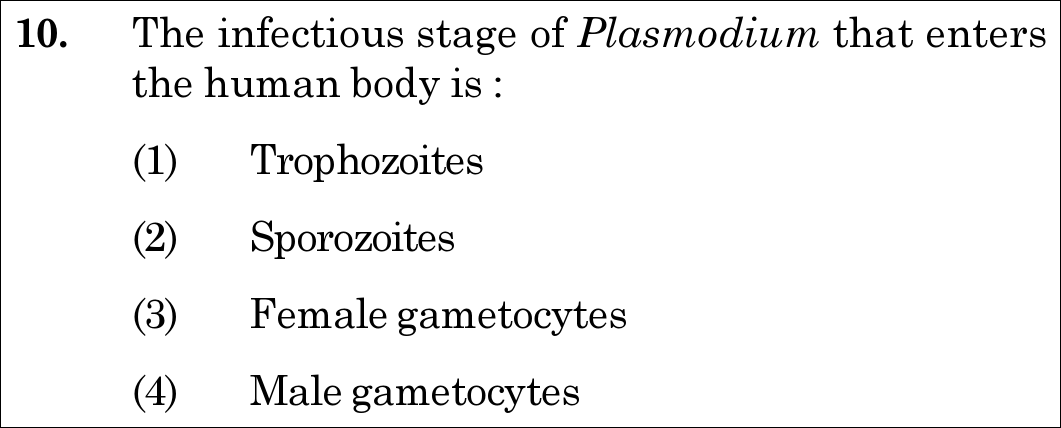
Plasmodium requires two hosts to complete its life cycle. The infectious stage is the sporozoite, injected into the human bloodstream through the bite of an infected female Anopheles mosquito. Sporozoites reach the liver and reproduce asexually (schizogony), bursting hepatocytes and invading RBCs where further asexual cycles cause paroxysms of fever due to hemozoin release.

Infectious Form: Sporozoite→Asexual SchizogonyLiver Cells→RBCs→Hemozoin Release (Fever)\text{Infectious Form: Sporozoite} \xrightarrow{\text{Asexual Schizogony}} \text{Liver Cells} \rightarrow \text{RBCs} \rightarrow \text{Hemozoin Release (Fever)}
  • • Gametocytes (sexual stages) develop in the peripheral RBCs of the human host.
Step 2

Sexual Cycle in Mosquito Vector

When a female Anopheles mosquito bites an infected person, it takes up gametocytes with the blood meal. Fertilization and development take place in the mosquito’s gut. The resulting motile ookinete penetrates the stomach wall, forms an oocyst, and divides by sporogony to produce mature sporozoites that migrate to the mosquito’s salivary glands.

Gametocytes in Blood Meal→Mosquito GutFertilization→Ookinete→Oocyst→Sporozoites in Salivary Glands\text{Gametocytes in Blood Meal} \xrightarrow{\text{Mosquito Gut}} \mathbf{Fertilization} \rightarrow \text{Ookinete} \rightarrow \text{Oocyst} \rightarrow \text{Sporozoites in Salivary Glands}
  • • Option (4) is completely correct.
⭐

360° Option Elimination Engine Key Feature

Diagnose every choice: Know exactly why the right option works and why distractors fail.

4-Option Deep Scan
1 A
✗ Incorrect
Verdict & Scientific Reason:

Incorrect. Reproduction in human liver cells is strictly asexual (hepatic schizogony).

⚠️
Student Fallacy (Why candidates pick this trap): Confusing asexual schizogony with sexual reproduction.
2 B
✗ Incorrect
Verdict & Scientific Reason:

Incorrect. Gametocytes differentiate in human RBCs; salivary glands store mature sporozoites.

⚠️
Student Fallacy (Why candidates pick this trap): Confusing salivary gland contents (sporozoites) with gametocytes.
3 C
✗ Incorrect
Verdict & Scientific Reason:

Incorrect. The parasite enters the human body as sporozoites from the mosquito’s saliva.

⚠️
Student Fallacy (Why candidates pick this trap): Confusing the infectious stage (sporozoite) with erythrocytic stages (merozoites).
4 D
✓ 100% Correct
Verdict & Scientific Reason:

100% correct. NCERT explicitly states that fertilization of gametes and development occur in the mosquito gut.

💡
Why this is airtight: None; textbook life-cycle recall.
⚠️

NTA Trap Alert: Infectious Stage vs. Trophozoite Stages

Students often mix up sporozoites, trophozoites, and merozoites. Enters human as SPOROZOITES; fertilization occurs in MOSQUITO GUT; stored in salivary glands as SPOROZOITES.

🛡️ How to avoid the -1 mark: Remember: Sporozoites start the human infection; Stomach of mosquito is where gametes mate!
📖

Core NEET Syllabus Standard

NEET Biology Core Syllabus · Human Health and Disease Standard Benchmark
Core Scientific Principle Tested:

"Fertilization and development of Plasmodium take place in the stomach/gut of the female Anopheles mosquito."

Syllabus Focus: Infectious Diseases · Malaria (Plasmodium)
✓ Core NEET UG Syllabus Anchor Syllabus & Academic Standards ↗
Human = Asexual & Gametocytes; Mosquito Gut = Sexual Union & Ookinete!
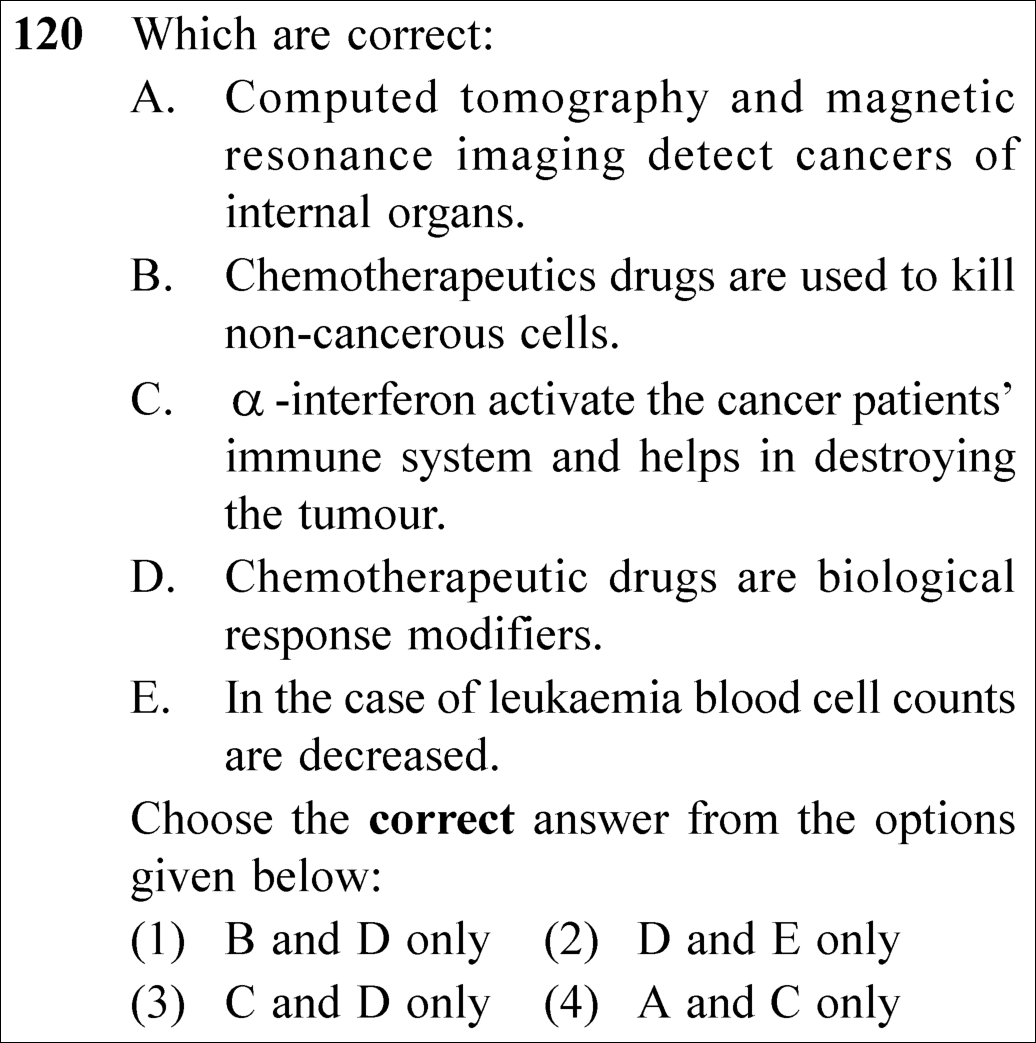
NEET 2025 · Q120 Medium
Official NEET 2025 Question 120 - Human Health and Disease
1
2
3
4 ✓ Key
💡 Verified Solution & 30-Second Hack
✓
Verified Against NTA Final Answer Key
Option (4) : A and C only
📚 Human Health and Disease Medium
📋 Given Parameters & Problem Setup
Statement A Computed tomography and magnetic resonance imaging detect cancers of internal organs.
Statement B Chemotherapeutics drugs are used to kill non-cancerous cells.
Statement C α-interferon activate the cancer patients' immune system and helps in destroying the tumour.
Statement D Chemotherapeutic drugs are biological response modifiers.
Statement E In the case of leukaemia blood cell counts are decreased.
⚡

The 30-Second Exam Hall Shortcut: ⚡ Cancer Oncology Diagnostics Fingerprint

⏱️ Save ~35 seconds

CT and MRI scan internal organs (A is TRUE)! α-interferon is the Biological Response Modifier destroying tumours (C is TRUE)! Chemotherapy targets CANCER cells (B false)! α-interferon is BRM, not chemo (D false)! Leukaemia has INCREASED WBCs (E false)! A and C only!

1 Evaluate each statement meticulously:
2 - A: "CT and MRI are very useful to detect cancers of internal organs." -> NCERT verbatim TRUE!
3 - B: Chemotherapy is intended to kill CANCEROUS cells (side effects damage normal cells, but that is not their purpose). -> FALSE!
4 - C: "Patients are given substances called biological response modifiers such as α-interferon which activates their immune system and helps destroy the tumour." -> NCERT verbatim TRUE!
5 - D: Biological response modifiers are biological agents (e.g. α-interferon), NOT conventional cytotoxic chemotherapeutic drugs. -> FALSE!
6 - E: Leukaemia is blood cancer caused by uncontrolled proliferation of leukocytes (counts are enormously INCREASED, not decreased). -> FALSE!
7 Conclusion: Statements A and C only are correct (Option 4)!
8 Select Option (4)!
🛡️
Why You Can 100% Trust This Shortcut: Infectious Pathogens & Vector Transmission (NCERT Biology · Human Health and Disease: Plasmodium, Entamoeba, Wuchereria).
📐

Step-by-Step Rigorous Workflow & Mathematical Proof

Step 1

Diagnostic Imaging in Oncology (Statement A)

Detection of cancers in internal organs (such as brain, lungs, liver, pancreas) requires non-invasive cross-sectional and high-contrast imaging:

  • • Computed tomography (CT) uses X-rays to generate a three-dimensional image of the internals of an object.
  • • Magnetic resonance imaging (MRI) uses strong magnetic fields and non-ionising radiations to accurately detect pathological and physiological changes in living tissue.
  • • NCERT states: "Computed tomography and magnetic resonance imaging are very useful to detect cancers of the internal organs." Thus, Statement A is correct.
Step 2

Chemotherapy and Its Targets (Statement B & Statement D)

Chemotherapy involves cytotoxic chemical drugs that inhibit rapid cell division:

  • • Chemotherapeutic drugs are designed specifically to kill rapidly dividing cancerous cells. Although hair loss and anaemia occur due to collateral damage to normal proliferating cells, stating they are "used to kill non-cancerous cells" is completely false. Thus, Statement B is incorrect.
  • • Statement D claims chemotherapeutic drugs are biological response modifiers. Biological response modifiers (BRMs) are immuno-stimulatory proteins (such as α\alpha-interferon) that boost the host immune surveillance, whereas chemotherapeutic drugs are small-molecule synthetic chemicals or antibiotics (e.g., cisplatin, vincristine, methotrexate). Thus, Statement D is incorrect.
Step 3

Biological Response Modifiers and α-Interferon (Statement C)

Immunotherapy in cancer treatment:

  • • Tumour cells frequently evade immune surveillance because they are self-derived.
  • • Administration of biological response modifiers such as α\alpha-interferon activates natural killer (NK) cells and cytotoxic T-lymphocytes, aiding the immune destruction of the tumour.
  • • Thus, Statement C is correct.
Step 4

Pathology of Leukaemia (Statement E)

Leukaemia is a malignant neoplasm of hematopoietic stem cells in the bone marrow characterized by abnormal, uncontrolled proliferation and massive accumulation of immature or abnormal white blood cells (leukocytes) in circulating blood. The leukocyte count is markedly elevated (often > 100,000/mm³), not decreased. Thus, Statement E is incorrect.

Step 5

Conclusion

Only Statements A and C are correct, matching Option (4).

Correct Statements=A and C only\text{Correct Statements} = A \text{ and } C \text{ only}
⭐

360° Option Elimination Engine Key Feature

Diagnose every choice: Know exactly why the right option works and why distractors fail.

4-Option Deep Scan
1 A
✗ Incorrect
Verdict & Scientific Reason:

Incorrect. Both B and D are factually and clinically false.

⚠️
Student Fallacy (Why candidates pick this trap): Thinking chemotherapeutics are aimed at non-cancerous cells or classified as BRMs.
2 B
✗ Incorrect
Verdict & Scientific Reason:

Incorrect. Both D and E are false (leukaemia increases blood cell counts, and BRMs are interferons).

⚠️
Student Fallacy (Why candidates pick this trap): Believing leukaemia causes decrease in blood cell counts.
3 C
✗ Incorrect
Verdict & Scientific Reason:

Incorrect. While C is true, D is false because chemotherapeutic drugs are not biological response modifiers.

⚠️
Student Fallacy (Why candidates pick this trap): Conflating chemical drugs with immunological response modifiers.
4 D
✓ 100% Correct
Verdict & Scientific Reason:

100% correct. CT/MRI accurately detect internal cancers (A), and α-interferon activates the patient immune system to destroy tumours (C).

💡
Why this is airtight: None; pristine knowledge of NCERT oncology.
⚠️

NTA Trap Alert: Chemotherapy Side Effects vs Therapeutic Purpose & Leukaemia Count

Two traps here: 1. Chemotherapy causes hair loss, but its purpose is killing cancer cells, not normal cells! 2. Leukaemia is a cancer of WBCs, leading to uncontrolled proliferation (INCREASE in WBC counts), not a decrease!

🛡️ How to avoid the -1 mark: Cancer = Uncontrolled proliferation = Counts INCREASE. BRMs = α-interferon, NOT chemotherapy.
📖

Core NEET Syllabus Standard

NEET Biology Core Syllabus · Human Health and Disease Standard Benchmark
Core Scientific Principle Tested:

"CT/MRI detect internal tumors; α-interferon acts as a biological response modifier to activate tumor destruction."

Syllabus Focus: Cancer · Detection and Treatment
✓ Core NEET UG Syllabus Anchor Syllabus & Academic Standards ↗
A & C are Accurate & Clinically sound: CT/MRI detects (A), α-interferon destroys (C)!
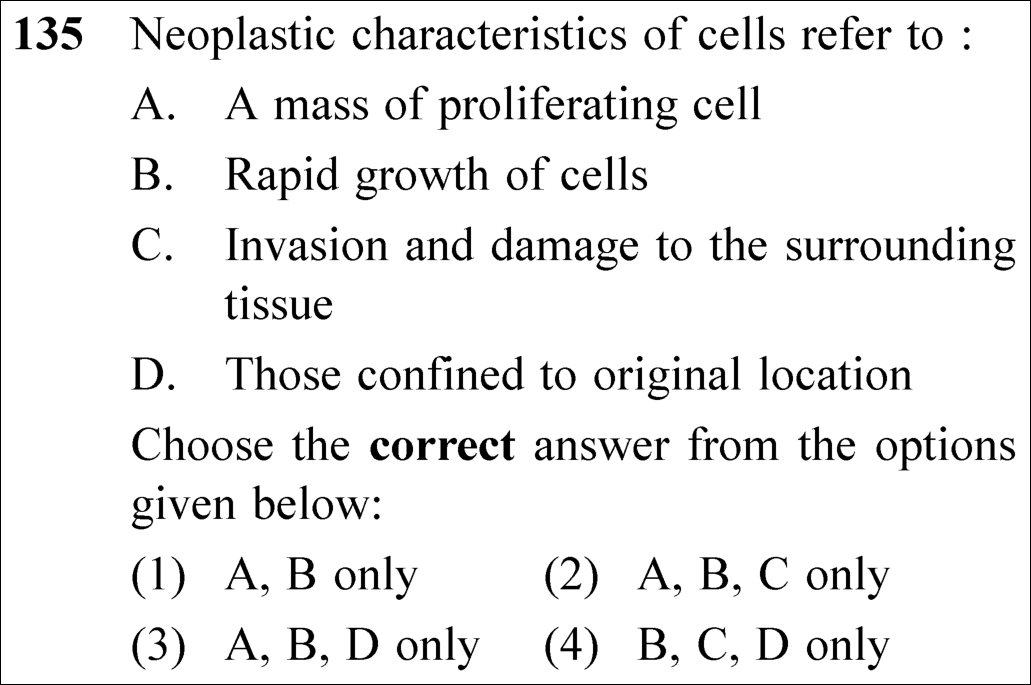
NEET 2025 · Q135 Easy
Official NEET 2025 Question 135 - Human Health and Disease
1
2 ✓ Key
3
4
💡 Verified Solution & 30-Second Hack
✓
Verified Against NTA Final Answer Key
Option (2) : A, B, C only
📚 Human Health and Disease Easy
📋 Given Parameters & Problem Setup
Feature A A mass of proliferating cell
Feature B Rapid growth of cells
Feature C Invasion and damage to the surrounding tissue
Feature D Those confined to original location
⚡

The 30-Second Exam Hall Shortcut: ⚡ Neoplasm vs Benign Tumour Fingerprint

⏱️ Save ~25 seconds

Neoplastic cells (malignant tumours) = Mass of proliferating cells (A) + Rapid uncontrolled growth (B) + Invasiveness/damage to surrounding tissues and metastasis (C)! Confined to original location (D) is the hallmark of BENIGN tumours, NOT neoplastic malignancy! A, B, C only!

1 Check each statement against NCERT Oncology Section:
2 - "Malignant tumors are a mass of proliferating cells called neoplastic or tumor cells." -> A is a neoplastic trait! [TRUE]
3 - "These cells grow very rapidly..." -> B is a neoplastic trait! [TRUE]
4 - "...invading and damaging the surrounding normal tissues." -> C is a neoplastic trait! [TRUE]
5 - "Benign tumors normally remain confined to their original location and do not spread to other parts..." -> D is a characteristic of BENIGN tumours, not invasive neoplastic cells! [FALSE]
6 Neoplastic traits = A, B, C only (Option 2)!
7 Select Option (2)!
🛡️
Why You Can 100% Trust This Shortcut: Immune System Cells & Antibody Structure (NCERT Biology · Human Health and Disease: Humoral H2L2 antibodies vs CMI).
📐

Step-by-Step Rigorous Workflow & Mathematical Proof

Step 1

Pathophysiology of Neoplasms and Tumour Classification

In cancer biology, transformation of normal cells into cancerous neoplastic cells is driven by loss of contact inhibition and uncontrolled mitotic proliferation:

  • • Tumours are classified into two major types: Benign tumours and Malignant tumours.
  • • Benign tumours remain strictly confined to their anatomical site of origin, do not spread or infiltrate surrounding tissues, and usually cause relatively little damage (Feature D).
Step 2

Hallmarks of Neoplastic / Malignant Cells

Malignant tumours consist of true neoplastic cells displaying distinct aggressive pathological hallmarks:

  • • A mass of actively proliferating cells (Feature A): Cells lose regular cell cycle checkpoints and proliferate autonomously.
  • • Rapid growth (Feature B): High mitotic index and accelerated doubling times starve surrounding normal cells by competing for vital nutrients.
  • • Invasiveness and tissue destruction (Feature C): Neoplastic cells degrade extracellular matrix, infiltrate neighboring normal parenchyma, damage local structures, and enter blood/lymphatic vessels to establish secondary distant metastases (the most feared property of malignant neoplasms).
Step 3

Conclusion

Features A, B, and C define the neoplastic characteristics of malignant tumor cells, whereas Feature D characterizes benign tumors. Thus, A, B, C only are correct.

Neoplastic Traits=A+B+C only (Option 2)\text{Neoplastic Traits} = A + B + C \text{ only (Option 2)}
⭐

360° Option Elimination Engine Key Feature

Diagnose every choice: Know exactly why the right option works and why distractors fail.

4-Option Deep Scan
1 A
✗ Incorrect
Verdict & Scientific Reason:

Incorrect. Omit statement C (invasion and damage to surrounding tissue), which is a quintessential hallmark of neoplastic cells.

⚠️
Student Fallacy (Why candidates pick this trap): Ignoring the invasive nature of neoplastic cells.
2 B
✓ 100% Correct
Verdict & Scientific Reason:

100% correct. Correctly captures proliferating mass (A), rapid growth (B), and tissue invasiveness (C) while excluding non-invasive benign localization (D).

💡
Why this is airtight: None; precise oncological knowledge.
3 C
✗ Incorrect
Verdict & Scientific Reason:

Incorrect. Confining to original location (D) is the defining attribute of benign tumors, not neoplastic malignant cells.

⚠️
Student Fallacy (Why candidates pick this trap): Confusing benign tumor localization with neoplastic behavior.
4 D
✗ Incorrect
Verdict & Scientific Reason:

Incorrect. Erroneously includes benign feature D and omits proliferating cellular mass (A).

⚠️
Student Fallacy (Why candidates pick this trap): Misclassifying tumour characteristics.
⚠️

NTA Trap Alert: Neoplastic (Malignant) vs Benign Tumours

NCERT clearly contrasts the two: Benign tumours stay at their original site (confined). Malignant/Neoplastic tumours proliferate, grow rapidly, invade surrounding normal tissues, and metastasize. Statement D describes benign tumours, NOT neoplastic cells!

🛡️ How to avoid the -1 mark: Neoplastic = Malignant = Invasive and mobile (NOT confined).
📖

Core NEET Syllabus Standard

NEET Biology Core Syllabus · Human Health and Disease Standard Benchmark
Core Scientific Principle Tested:

"Neoplastic cells form a proliferating mass, grow rapidly, and invade/damage surrounding normal tissue, unlike benign tumours which remain confined."

Syllabus Focus: Cancer · Characteristics of Neoplastic Cells
✓ Core NEET UG Syllabus Anchor Syllabus & Academic Standards ↗
NEO-Plastic: N-Mass (A), E-Explosive growth (B), O-Overrunning tissue (C)!
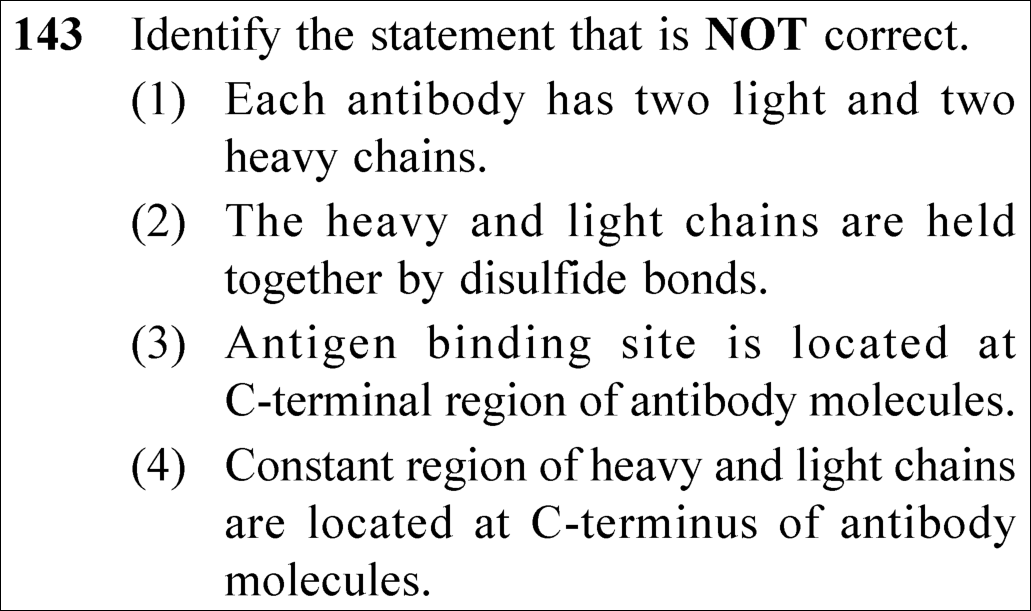
NEET 2025 · Q143 Easy
Official NEET 2025 Question 143 - Human Health and Disease
1 Each antibody has two light and two heavy chains.
2 The heavy and light chains are held together by disulfide bonds.
3 Antigen binding site is located at C-terminal region of antibody molecules. ✓ Key
4 Constant region of heavy and light chains are located at C-terminus of antibody molecules.
💡 Verified Solution & 30-Second Hack
✓
Verified Against NTA Final Answer Key
Option (3) : Antigen binding site is located at C-terminal region of antibody molecules.
📚 Human Health and Disease Easy
📋 Given Parameters & Problem Setup
Molecule Antibody (Immunoglobulin / Ig)
Target Statement Statement that is NOT correct (False statement)
⚡

The 30-Second Exam Hall Shortcut: ⚡ Antibody Molecular Structure Fingerprint

⏱️ Save ~20 seconds

Antigen binding site (paratope) is formed by the Variable (V) regions at the N-TERMINUS of heavy and light chains! The C-terminus contains the CONSTANT (Fc) region! Statement (3) claiming antigen-binding site is at C-terminus is WRONG!

1 Recall immunoglobulin structure from NCERT Section 8.2.2:
2 - Formula: H₂L₂ (two light chains, two heavy chains) -> Statement (1) is CORRECT.
3 - Chains are held together by inter-chain disulfide bonds -> Statement (2) is CORRECT.
4 - Constant (C) regions of both heavy and light chains are located towards the C-terminus -> Statement (4) is CORRECT.
5 - Antigen-binding site (Fab fragment) is located at the N-terminal (amino-terminal) variable region of each arm! Claiming it is at the C-terminus is FALSE.
6 Statement (3) is NOT correct!
7 Select Option (3)!
🛡️
Why You Can 100% Trust This Shortcut: Life Cycle of Plasmodium (NCERT Biology · Human Health and Disease: Female Anopheles primary host, human secondary host).
📐

Step-by-Step Rigorous Workflow & Mathematical Proof

Step 1

Quaternary Structure of an Antibody Molecule (H₂L₂)

An antibody (immunoglobulin) is a Y-shaped glycoprotein composed of four polypeptide chains:

  • • Two identical light (L) chains of lower molecular weight (~25 kDa each).
  • • Two identical heavy (H) chains of higher molecular weight (~50 kDa each).
  • • The four chains are held together in a Y-configuration by covalent interchain disulfide (-S-S-) bonds and non-covalent interactions. Hence, statements (1) and (2) are correct.
Step 2

Domain Architecture: N-terminus vs C-terminus

Functional differentiation between the variable tips and constant stalk:

  • • Variable regions (VLV_L and VHV_H): Located at the N-terminal (amino-terminal) ends of the Y-shaped arms. The hypervariable segments (complementarity-determining regions / CDRs) form the unique antigen-binding site (paratope) that binds specifically to an epitope.
  • • Constant regions (CLC_L and CHC_H): Located towards the C-terminal (carboxyl-terminal) end. They mediate effector functions such as complement fixation and binding to Fc receptors on phagocytes. Hence, statement (4) is correct.
Step 3

Identification of the Incorrect Statement

Statement (3) claims that the "Antigen binding site is located at C-terminal region of antibody molecules". This is biologically false; the antigen-binding site is located at the N-terminal region.

Antigen-Binding Site=N-terminus≠C-terminus\text{Antigen-Binding Site} = \text{N-terminus} \neq \text{C-terminus}
⭐

360° Option Elimination Engine Key Feature

Diagnose every choice: Know exactly why the right option works and why distractors fail.

4-Option Deep Scan
1 A
✗ Incorrect
Verdict & Scientific Reason:

Incorrect choice (true statement). Every antibody has an H₂L₂ structural formula.

⚠️
Student Fallacy (Why candidates pick this trap): Failing to realize that option 1 is a correct fact.
2 B
✗ Incorrect
Verdict & Scientific Reason:

Incorrect choice (true statement). Disulfide bridges stabilize the quaternary immunoglobulin assembly.

⚠️
Student Fallacy (Why candidates pick this trap): Thinking chains are held only by hydrogen bonds.
3 C
✓ 100% Correct
Verdict & Scientific Reason:

100% correct choice (as the incorrect statement). The antigen-binding site is formed by the N-terminal variable domains, not the C-terminal domains.

💡
Why this is airtight: None; pristine knowledge of antibody biochemistry.
4 D
✗ Incorrect
Verdict & Scientific Reason:

Incorrect choice (true statement). The constant effector domains reside at the C-terminus.

⚠️
Student Fallacy (Why candidates pick this trap): Confusing N-terminus with C-terminus.
⚠️

NTA Trap Alert: N-terminus vs C-terminus of Polypeptides in Antibodies

Polypeptides have an N-terminus (amino end) and a C-terminus (carboxyl end). The N-terminal tips are VARIABLE and BIND ANTIGEN (arms of the Y). The C-terminal base is CONSTANT (stalk of the Y).

🛡️ How to avoid the -1 mark: N = "New/Novel/Binding (Antigen site)"; C = "Constant/C-terminus (Stalk)".
📖

Core NEET Syllabus Standard

NEET Biology Core Syllabus · Human Health and Disease Standard Benchmark
Core Scientific Principle Tested:

"The antigen-binding site is located at the N-terminal variable region of the heavy and light chains."

Syllabus Focus: Innate and Acquired Immunity · Structure of Antibody Molecule
✓ Core NEET UG Syllabus Anchor Syllabus & Academic Standards ↗
N-terminus binds New antigens; C-terminus is Constant!
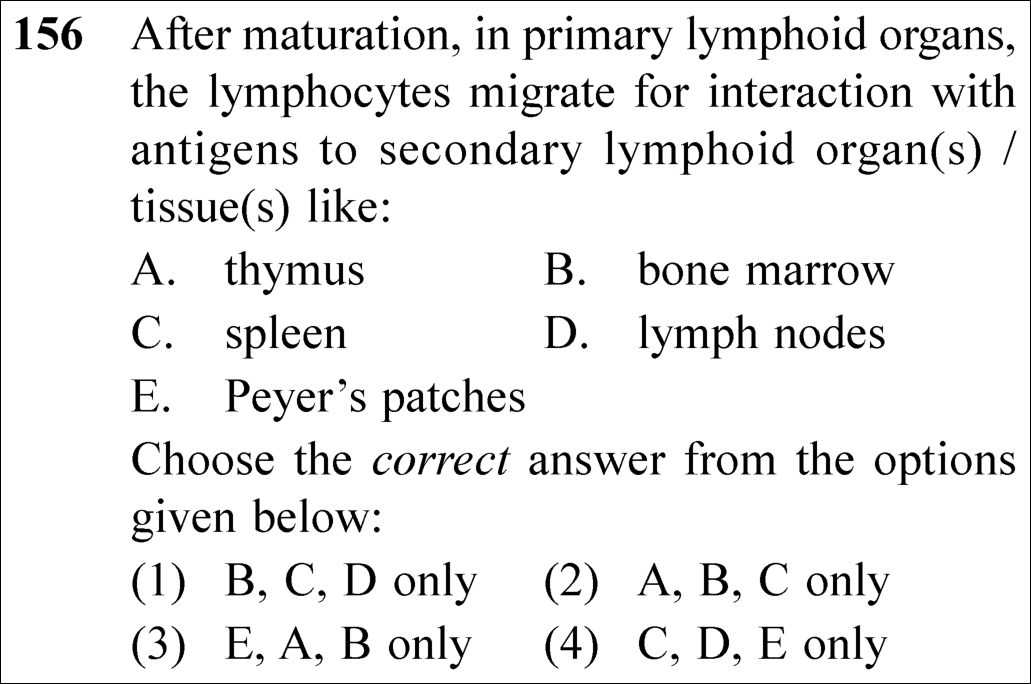
NEET 2025 · Q156 Easy
Official NEET 2025 Question 156 - Human Health and Disease
1
2
3
4 ✓ Key
💡 Verified Solution & 30-Second Hack
✓
Verified Against NTA Final Answer Key
Option (4) : C, D, E only
📚 Human Health and Disease Easy
📋 Given Parameters & Problem Setup
List of Organs A. thymus, B. bone marrow, C. spleen, D. lymph nodes, E. Peyer's patches
Target Class Secondary lymphoid organ(s) / tissue(s) where mature lymphocytes interact with antigens
⚡

The 30-Second Exam Hall Shortcut: ⚡ Lymphoid Organs Segregation Fingerprint

⏱️ Save ~25 seconds

Primary = Origin & Maturation (Bone marrow + Thymus = A & B)! Secondary = Antigen interaction & proliferation (Spleen + Lymph nodes + Peyer's patches = C, D, E)! C, D, E only!

1 Recall NCERT Section 8.2.5 (Lymphoid Organs):
2 - Primary lymphoid organs: Bone marrow and Thymus (where immature lymphocytes mature and differentiate into antigen-sensitive lymphocytes) -> A and B.
3 - Secondary lymphoid organs: Spleen, Lymph nodes, Tonsils, Peyer's patches of small intestine, and Appendix (where lymphocytes migrate, interact with antigens, and proliferate to become effector cells) -> C, D, E.
4 Target: Secondary lymphoid organs = C, D, E only (Option 4)!
5 Solved in under 10 seconds!
🛡️
Why You Can 100% Trust This Shortcut: Acquired Immunodeficiency Syndrome (AIDS) Pathology (NCERT Biology · Human Health and Disease: HIV attacks CD4+ T-helper lymphocytes).
📐

Step-by-Step Rigorous Workflow & Mathematical Proof

Step 1

Classification of the Human Lymphoid System

Lymphoid organs are categorized into primary and secondary lymphoid organs based on their anatomical and immunological roles:

  • • Primary Lymphoid Organs: Organs where immature lymphocytes originate, proliferate, and differentiate into antigen-sensitive mature lymphocytes. In humans, these are Bone marrow (B) and Thymus (A).
  • • After maturation, these immunocompetent T and B lymphocytes migrate via the bloodstream into secondary lymphoid organs.
Step 2

Secondary Lymphoid Organs and Tissues (C, D, E)

Sites of antigen capture, presentation, and clonal expansion:

  • • C. Spleen: A large bean-shaped organ containing lymphocytes and phagocytes; filters blood by trapping blood-borne microorganisms and acts as a reservoir of erythrocytes.
  • • D. Lymph nodes: Small solid structures located along the lymphatic system; trap antigens carried in lymph and tissue fluid, activating lymphocytes to elicit immune responses.
  • • E. Peyer's patches: Unencapsulated aggregates of mucosal lymphoid follicles located in the submucosa of the small intestine (ileum), representing Gut-Associated Lymphoid Tissue (GALT).
  • • All three (C, D, E) provide the microenvironment where lymphocytes interact with trapped antigens.
Step 3

Conclusion

Secondary lymphoid organs/tissues among the choices are C, D, and E only, corresponding to Option (4).

Secondary Lymphoid={C (Spleen),  D (Lymph nodes),  E (Peyer’s patches)}\text{Secondary Lymphoid} = \{C\text{ (Spleen)}, \; D\text{ (Lymph nodes)}, \; E\text{ (Peyer's patches)}\}
⭐

360° Option Elimination Engine Key Feature

Diagnose every choice: Know exactly why the right option works and why distractors fail.

4-Option Deep Scan
1 A
✗ Incorrect
Verdict & Scientific Reason:

Incorrect. Erroneously includes bone marrow (B), which is a primary lymphoid organ.

⚠️
Student Fallacy (Why candidates pick this trap): Confusing primary bone marrow with secondary organs.
2 B
✗ Incorrect
Verdict & Scientific Reason:

Incorrect. Thymus (A) and bone marrow (B) are primary lymphoid organs.

⚠️
Student Fallacy (Why candidates pick this trap): Listing primary organs instead of secondary organs.
3 C
✗ Incorrect
Verdict & Scientific Reason:

Incorrect. Contains both primary organs (A and B).

⚠️
Student Fallacy (Why candidates pick this trap): Failing to distinguish primary from secondary sites.
4 D
✓ 100% Correct
Verdict & Scientific Reason:

100% correct. Accurately isolates the three secondary lymphoid tissues (spleen, lymph nodes, Peyer's patches).

💡
Why this is airtight: None; pristine immunological classification.
⚠️

NTA Trap Alert: Primary vs Secondary Site Functions

Primary = School / Training academy (Origin & Maturation: Bone marrow & Thymus). Secondary = Battlefield (Interaction with Antigens: Spleen, Lymph nodes, Peyer's patches, Tonsils).

🛡️ How to avoid the -1 mark: B and T cells "graduate" in Bone marrow/Thymus (Primary) and "fight" in Spleen/Nodes/Peyer's (Secondary).
📖

Core NEET Syllabus Standard

NEET Biology Core Syllabus · Human Health and Disease Standard Benchmark
Core Scientific Principle Tested:

"Bone marrow and thymus are primary lymphoid organs; spleen, lymph nodes, and Peyer's patches are secondary lymphoid organs."

Syllabus Focus: Immune System in the Body · Lymphoid Organs
✓ Core NEET UG Syllabus Anchor Syllabus & Academic Standards ↗
Primary = Born & Trained (B & T: Bone marrow, Thymus); Secondary = Soldiers Patrol (Spleen, Nodes, Peyer's)!
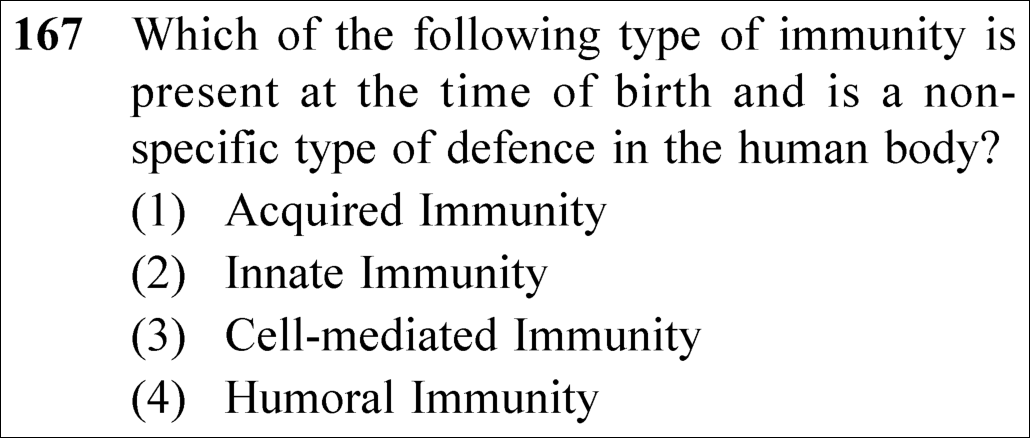
NEET 2025 · Q167 Easy
Official NEET 2025 Question 167 - Human Health and Disease
1
2 ✓ Key
3
4
💡 Verified Solution & 30-Second Hack
✓
Verified Against NTA Final Answer Key
Option (2) : Innate Immunity
📚 Human Health and Disease Easy
📋 Given Parameters & Problem Setup
Timing Present at the time of birth (inborn / congenital)
Specificity Non-specific type of defence mechanism
⚡

The 30-Second Exam Hall Shortcut: ⚡ Innate vs Acquired Immunity Fingerprint

⏱️ Save ~10 seconds

Present from birth (inborn) + Non-specific defence = INNATE IMMUNITY! Acquired (adaptive) immunity develops after birth, is pathogen-specific, and has memory!

1 Recall NCERT Section 8.2.1 (Innate Immunity) opening line:
2 - "Innate immunity is non-specific type of defence, that is present at the time of birth."
3 - It provides four types of barriers: Physical (skin, mucus), Physiological (HCl, tears, saliva), Cellular (WBCs, PMNL-neutrophils, macrophages), and Cytokine (interferons).
4 - Acquired immunity is pathogen-specific, characterized by immunological memory, and acquired during lifetime.
5 Direct answer: Innate Immunity!
6 Select Option (2) Innate Immunity!
🛡️
Why You Can 100% Trust This Shortcut: Bacterial & Viral Human Pathogens (NCERT Biology · Human Health and Disease: Typhoid Salmonella typhi & Widal test).
📐

Step-by-Step Rigorous Workflow & Mathematical Proof

Step 1

Definition and Attributes of Innate Immunity

Innate immunity represents the body's first line of natural immunological defence:

  • • It is congenital, meaning it is genetically predetermined and fully operational at the time of birth.
  • • It is non-specific, meaning it does not discriminate between distinct antigenic molecular determinants; it provides broad-spectrum resistance against invasion by foreign infectious agents.
Step 2

Four Barrier Categories of Innate Immunity

How non-specific protection is maintained:

  • • Physical barriers: Skin acts as the principal barrier preventing entry; mucus coatings of respiratory, GI, and urogenital tracts trap microbes.
  • • Physiological barriers: Gastric acid (HCl) in stomach, saliva in the mouth, and lysozyme in tears prevent microbial growth.
  • • Cellular barriers: Phagocytes like polymorphonuclear leukocytes (PMNL-neutrophils), monocytes, and tissue macrophages, plus Natural Killer (NK) cells.
  • • Cytokine barriers: Virus-infected cells secrete interferons which protect non-infected cells from further viral infection.
Step 3

Contrast with Acquired Immunity

Distinguishing features of adaptive defence:

  • • Acquired (adaptive) immunity (including humoral and cell-mediated branches) is NOT present at birth; it is acquired post-natally upon exposure to specific pathogens and is characterized by exquisite antigenic specificity and long-lasting memory.
Step 4

Conclusion

The immunity present at birth providing non-specific defence is Innate Immunity, corresponding to Option (2).

Present at Birth+Non-Specific  ⟹  Innate Immunity (Option 2)\text{Present at Birth} + \text{Non-Specific} \implies \text{Innate Immunity (Option 2)}
⭐

360° Option Elimination Engine Key Feature

Diagnose every choice: Know exactly why the right option works and why distractors fail.

4-Option Deep Scan
1 A
✗ Incorrect
Verdict & Scientific Reason:

Incorrect. Acquired immunity is developed after birth upon pathogen encounter and is pathogen-specific.

⚠️
Student Fallacy (Why candidates pick this trap): Confusing adaptive immunity with congenital immunity.
2 B
✓ 100% Correct
Verdict & Scientific Reason:

100% correct. Direct verbatim NCERT definition: non-specific defence present at the time of birth.

💡
Why this is airtight: None; fundamental immunology recall.
3 C
✗ Incorrect
Verdict & Scientific Reason:

Incorrect. Cell-mediated immunity is mediated by T-lymphocytes and is an antigen-specific component of acquired immunity.

⚠️
Student Fallacy (Why candidates pick this trap): Confusing cellular innate barriers with T-cell mediated acquired immunity.
4 D
✗ Incorrect
Verdict & Scientific Reason:

Incorrect. Humoral immunity is antibody-mediated acquired immunity produced by B-lymphocytes post-exposure.

⚠️
Student Fallacy (Why candidates pick this trap): Confusing antibody responses with inborn non-specific immunity.
⚠️

NTA Trap Alert: Innate vs Inborn Terminology

Innate literally means "inborn". It provides general non-specific protection from the first second of life. Acquired immunity takes days to weeks to build and requires prior antigen exposure.

🛡️ How to avoid the -1 mark: Birth + Non-specific = Innate.
📖

Core NEET Syllabus Standard

NEET Biology Core Syllabus · Human Health and Disease Standard Benchmark
Core Scientific Principle Tested:

"Innate immunity is a non-specific type of defence present at the time of birth."

Syllabus Focus: Immunity · Innate Immunity
✓ Core NEET UG Syllabus Anchor Syllabus & Academic Standards ↗
IN-NATE = IN-BORN: Natural, Non-specific, from day 0!
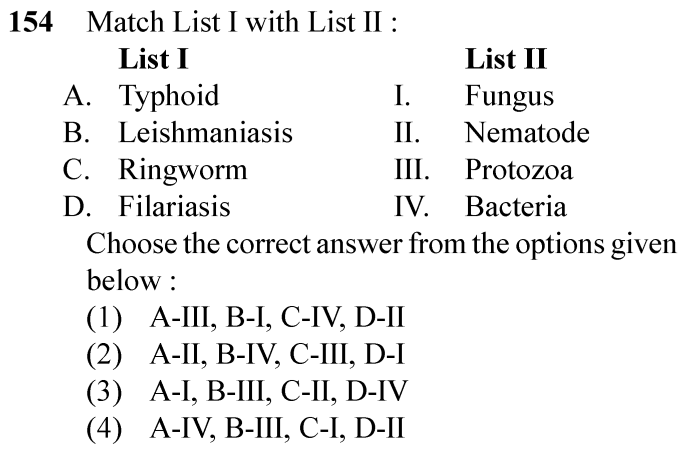
NEET 2024 · Q154 Easy
Official NEET 2024 Question 154 - Human Health and Disease
1
2
3
4 ✓ Key
💡 Verified Solution & 30-Second Hack
✓
Verified Against NTA Final Answer Key
Option (4) : A-IV, B-III, C-I, D-II
📚 Human Health and Disease Easy
📋 Given Parameters & Problem Setup
List I (Diseases) A: Typhoid; B: Leishmaniasis; C: Ringworm; D: Filariasis
List II (Pathogen Groups) I: Fungus; II: Nematode; III: Protozoa; IV: Bacteria
⚡

The 30-Second Exam Hall Shortcut: ⚡ Infectious Pathogen Grouping

⏱️ Save ~25 seconds

Typhoid = Salmonella (Bacteria IV); Leishmaniasis = Leishmania (Protozoa III); Ringworm = Trichophyton (Fungus I); Filariasis = Wuchereria (Nematode/Helminth II)! Result: A-IV, B-III, C-I, D-II!

1 A. Typhoid: caused by bacterium Salmonella typhi (IV).
2 B. Leishmaniasis (Kala-azar): caused by protozoan Leishmania donovani (III).
3 C. Ringworm: caused by fungi of genera Microsporum, Trichophyton, Epidermophyton (I).
4 D. Filariasis (Elephantiasis): caused by filarial nematode worm Wuchereria bancrofti (II).
5 Matching order: A-IV, B-III, C-I, D-II -> Option (4) / D.
🛡️
Why You Can 100% Trust This Shortcut: NCERT Biology · Human Health and Disease (Common Infectious Pathogens in Humans)
📐

Step-by-Step Rigorous Workflow & Mathematical Proof

Step 1

Match Bacterial and Protozoan Diseases

Salmonella typhi is a pathogenic bacterium which causes typhoid fever in human beings (A -> IV). Leishmania is a flagellated protozoan causing visceral leishmaniasis (B -> III).

Step 2

Match Fungal and Nematode Diseases

Many fungi belonging to the genera Microsporum, Trichophyton and Epidermophyton are responsible for ringworms in humans (C -> I). Wuchereria (W. bancrofti and W. malayi), the filarial worms, are nematodes causing slowly developing chronic inflammation in lymphatic vessels of the lower limbs (D -> II).

Step 3

Confirm Sequence

A-IV, B-III, C-I, D-II matches Option (4).

⭐

360° Option Elimination Engine Key Feature

Diagnose every choice: Know exactly why the right option works and why distractors fail.

4-Option Deep Scan
1 (1)
✗ Incorrect
Verdict & Scientific Reason:

Mismatches Typhoid with Protozoa and Ringworm with Bacteria.

⚠️
Student Fallacy (Why candidates pick this trap): Mismatches Typhoid with Protozoa and Ringworm with Bacteria.
2 (2)
✗ Incorrect
Verdict & Scientific Reason:

Mismatches Typhoid with Nematode.

⚠️
Student Fallacy (Why candidates pick this trap): Mismatches Typhoid with Nematode.
3 (3)
✗ Incorrect
Verdict & Scientific Reason:

Mismatches Typhoid with Fungus.

⚠️
Student Fallacy (Why candidates pick this trap): Mismatches Typhoid with Fungus.
4 (4)
✓ 100% Correct
Verdict & Scientific Reason:

Accurately pairs all four human infectious diseases with their corresponding pathogen taxonomical categories.

💡
Why this is airtight: None.
⚠️

NTA Trap Alert: Ringworm Name Fallacy

Assuming Ringworm is caused by a worm (helminth/nematode) due to its name.

🛡️ How to avoid the -1 mark: Ringworm is NOT a worm; it is a fungal cutaneous infection (dermatophytosis).
📖

Core NEET Syllabus Standard

Biology Core Zoology · Human Health and Disease Standard Benchmark
Core Scientific Principle Tested:

"Salmonella typhi is a pathogenic bacterium... Many fungi belonging to genera Microsporum, Trichophyton and Epidermophyton are responsible for ringworms... Wuchereria (W. bancrofti and W. malayi), the filarial worms cause filariasis."

Syllabus Focus: Causative Pathogens and Taxonomic Classification of Human Diseases
✓ Core NEET UG Syllabus Anchor Syllabus & Academic Standards ↗
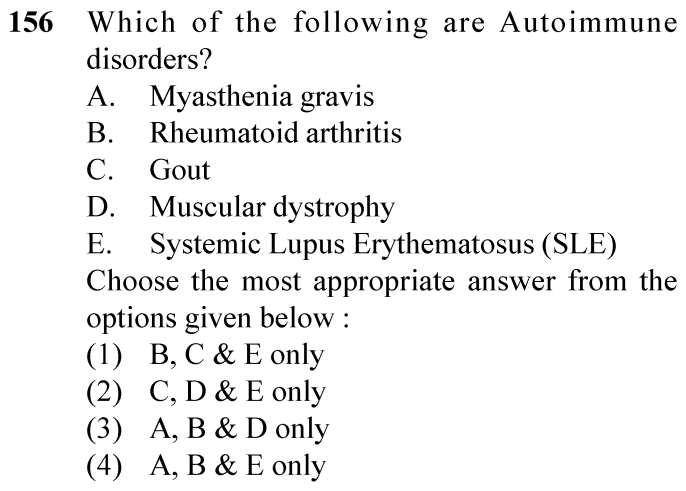
NEET 2024 · Q156 Easy
Official NEET 2024 Question 156 - Human Health and Disease
1
2
3
4 ✓ Key
💡 Verified Solution & 30-Second Hack
✓
Verified Against NTA Final Answer Key
Option (4) : A, B & E only
📚 Human Health and Disease Easy
📋 Given Parameters & Problem Setup
Category Autoimmune disorders
Candidates A: Myasthenia gravis; B: Rheumatoid arthritis; C: Gout; D: Muscular dystrophy; E: Systemic Lupus Erythematosus (SLE)
⚡

The 30-Second Exam Hall Shortcut: ⚡ Autoimmune Disease Triad Knockout

⏱️ Save ~30 seconds

Gout (C) is metabolic (uric acid crystals); Muscular dystrophy (D) is genetic (dystrophin gene defect). Eliminate C and D! Myasthenia gravis (A), Rheumatoid arthritis (B), and SLE (E) are autoimmune!

1 Classify each disorder:
2 - A: Myasthenia gravis -> Autoimmune (antibodies attack ACh receptors).
3 - B: Rheumatoid arthritis -> Autoimmune (immune attack on joints/synovium).
4 - C: Gout -> Metabolic disorder (inflammation due to uric acid crystals).
5 - D: Muscular dystrophy -> Genetic disorder (X-linked progressive muscle degeneration).
6 - E: SLE (Systemic Lupus Erythematosus) -> Classic Autoimmune disorder.
7 Select A, B & E only -> Option (4) / D.
🛡️
Why You Can 100% Trust This Shortcut: NCERT Biology · Human Health and Disease (Autoimmunity and Immune System Disorders)
📐

Step-by-Step Rigorous Workflow & Mathematical Proof

Step 1

Define Autoimmunity

Autoimmunity is a condition where the body’s immune system loses self-tolerance and generates auto-antibodies or autoreactive T-cells that attack host tissues.

Step 2

Evaluate Given Disorders

- Myasthenia gravis (A): Autoimmune disorder affecting neuromuscular junctions leading to fatigue and paralysis of skeletal muscles. - Rheumatoid arthritis (B): Autoimmune disease affecting joint synovial membranes, highlighted in NCERT. - Systemic Lupus Erythematosus (E): Multiorgan autoimmune disease. - Gout (C): Inflammation of joints due to accumulation of uric acid crystals (metabolic). - Muscular dystrophy (D): Progressive degeneration of skeletal muscle mostly due to genetic mutation in dystrophin protein.

Step 3

Formulate Correct Set

Disorders A, B, and E are autoimmune, giving A, B & E only (Option 4).

⭐

360° Option Elimination Engine Key Feature

Diagnose every choice: Know exactly why the right option works and why distractors fail.

4-Option Deep Scan
1 (1)
✗ Incorrect
Verdict & Scientific Reason:

Includes Gout (C), which is a metabolic disorder caused by hyperuricemia.

⚠️
Student Fallacy (Why candidates pick this trap): Includes Gout (C), which is a metabolic disorder caused by hyperuricemia.
2 (2)
✗ Incorrect
Verdict & Scientific Reason:

Includes Gout (metabolic) and Muscular dystrophy (genetic).

⚠️
Student Fallacy (Why candidates pick this trap): Includes Gout (metabolic) and Muscular dystrophy (genetic).
3 (3)
✗ Incorrect
Verdict & Scientific Reason:

Includes Muscular dystrophy (D), which is a genetic disorder.

⚠️
Student Fallacy (Why candidates pick this trap): Includes Muscular dystrophy (D), which is a genetic disorder.
4 (4)
✓ 100% Correct
Verdict & Scientific Reason:

Accurately groups Myasthenia gravis, Rheumatoid arthritis, and SLE as authentic autoimmune conditions.

💡
Why this is airtight: None.
⚠️

NTA Trap Alert: Muscular Dystrophy vs Myasthenia Gravis

Confusing muscular dystrophy with myasthenia gravis because both involve skeletal muscle weakness.

🛡️ How to avoid the -1 mark: Myasthenia gravis is AUTOIMMUNE (neuromuscular junction antibodies); Muscular dystrophy is GENETIC (inherited mutation).
📖

Core NEET Syllabus Standard

Biology Core Zoology · Human Health and Disease Standard Benchmark
Core Scientific Principle Tested:

"Sometimes, due to genetic and other unknown reasons, the body attacks self-cells. This results in damage to the body and is called auto-immune disease. Rheumatoid arthritis which affects many people in our society is an auto-immune disease. Myasthenia gravis is an auto-immune disorder affecting neuromuscular junction."

Syllabus Focus: Autoimmune Diseases vs Metabolic and Genetic Disorders
✓ Core NEET UG Syllabus Anchor Syllabus & Academic Standards ↗
NEET 2024 · Q162 Easy
Official NEET 2024 Question 162 - Human Health and Disease
1
2 ✓ Key
3
4
💡 Verified Solution & 30-Second Hack
✓
Verified Against NTA Final Answer Key
Option (2) : A-III, B-IV, C-I, D-II
📚 Human Health and Disease Easy
📋 Given Parameters & Problem Setup
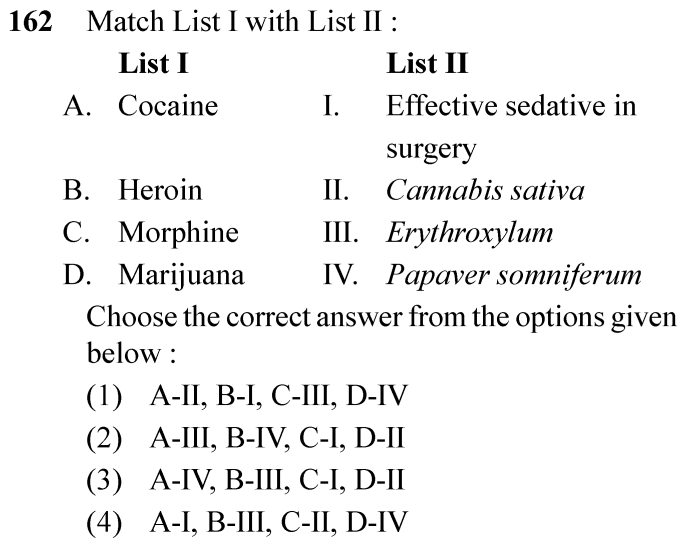
List I (Drugs) A: Cocaine; B: Heroin; C: Morphine; D: Marijuana
List II (Source / Use) I: Effective sedative in surgery; II: Cannabis sativa; III: Erythroxylum; IV: Papaver somniferum
⚡

The 30-Second Exam Hall Shortcut: ⚡ Drug Origin Match

⏱️ Save ~25 seconds

Cocaine = Erythroxylum coca (III); Heroin = Papaver somniferum (IV); Morphine = Sedative/analgesic in surgery (I); Marijuana = Cannabis sativa (II)! Match: A-III, B-IV, C-I, D-II!

1 A. Cocaine: Coca alkaloid obtained from Erythroxylum coca (III).
2 B. Heroin: Diacetylmorphine extracted from the latex of poppy plant Papaver somniferum (IV).
3 C. Morphine: Very effective sedative and painkiller, highly useful in patients undergoing surgery (I).
4 D. Marijuana: Cannabinoid obtained from inflorescences of Cannabis sativa (II).
5 Matching order: A-III, B-IV, C-I, D-II -> Option (2) / B.
🛡️
Why You Can 100% Trust This Shortcut: NCERT Biology · Human Health and Disease (Drugs and Alcohol Abuse)
📐

Step-by-Step Rigorous Workflow & Mathematical Proof

Step 1

Match Opioids and Cannabinoids

Morphine is extracted from the latex of poppy plant Papaver somniferum and is a very effective sedative and painkiller used for surgical patients (C -> I). Heroin (smack) is chemically diacetylmorphine, also obtained from Papaver somniferum (B -> IV). Cannabinoids like marijuana, hashish, charas and ganja are obtained from the inflorescences of Cannabis sativa (D -> II).

Step 2

Match Cocaine Botanical Source

Coca alkaloid or cocaine is obtained from the coca plant, Erythroxylum coca, native to South America (A -> III).

Step 3

Assemble Match

A-III, B-IV, C-I, D-II matches Option (2).

⭐

360° Option Elimination Engine Key Feature

Diagnose every choice: Know exactly why the right option works and why distractors fail.

4-Option Deep Scan
1 (1)
✗ Incorrect
Verdict & Scientific Reason:

Mismatches Cocaine with Cannabis.

⚠️
Student Fallacy (Why candidates pick this trap): Mismatches Cocaine with Cannabis.
2 (2)
✓ 100% Correct
Verdict & Scientific Reason:

Accurately pairs all four drugs with their respective botanical sources or clinical applications.

💡
Why this is airtight: None.
3 (3)
✗ Incorrect
Verdict & Scientific Reason:

Mismatches Cocaine with Papaver and Heroin with Erythroxylum.

⚠️
Student Fallacy (Why candidates pick this trap): Mismatches Cocaine with Papaver and Heroin with Erythroxylum.
4 (4)
✗ Incorrect
Verdict & Scientific Reason:

Mismatches Cocaine with sedative surgery use.

⚠️
Student Fallacy (Why candidates pick this trap): Mismatches Cocaine with sedative surgery use.
⚠️

NTA Trap Alert: Morphine vs Heroin Botanical Identity

Confusing the chemical source of heroin (Papaver somniferum) with its clinical parent compound morphine.

🛡️ How to avoid the -1 mark: Heroin is synthesized by acetylation of morphine from Papaver somniferum; morphine is used clinically as a surgical analgesic.
📖

Core NEET Syllabus Standard

Biology Core Zoology · Human Health and Disease Standard Benchmark
Core Scientific Principle Tested:

"Morphine is a very effective sedative and painkiller, and is very useful in patients who have undergone surgery. Heroin is diacetylmorphine obtained from Papaver somniferum. Coca alkaloid or cocaine is obtained from Erythroxylum coca. Cannabinoids are obtained from Cannabis sativa."

Syllabus Focus: Drug Classification: Plant Sources and Medical Applications
✓ Core NEET UG Syllabus Anchor Syllabus & Academic Standards ↗
NEET 2024 · Q178 Easy
Official NEET 2024 Question 178 - Human Health and Disease
1 ✓ Key
2
3
4
💡 Verified Solution & 30-Second Hack
✓
Verified Against NTA Final Answer Key
Option (1) : A-III, B-I, C-II, D-IV
📚 Human Health and Disease Easy
📋 Given Parameters & Problem Setup
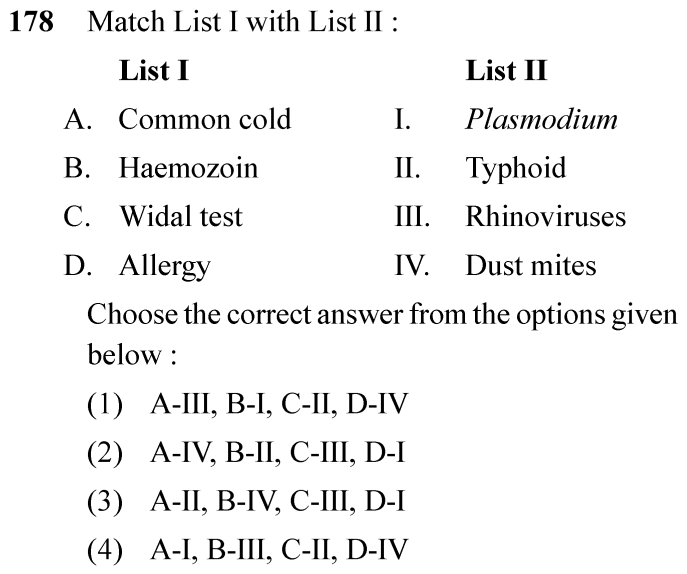
List I (Pathologies / Toxins / Tests) A: Common cold; B: Haemozoin; C: Widal test; D: Allergy
List II (Etiological Agents / Entities) I: Plasmodium; II: Typhoid; III: Rhinoviruses; IV: Dust mites
⚡

The 30-Second Exam Hall Shortcut: ⚡ Pathology-Clinical Match

⏱️ Save ~25 seconds

Common cold = Rhinoviruses (III); Haemozoin = Malaria parasite Plasmodium (I); Widal test = Typhoid fever (II); Allergy = Dust mites (IV)! Match: A-III, B-I, C-II, D-IV!

1 A. Common cold: Viral infection of upper respiratory tract caused by Rhinoviruses (III).
2 B. Haemozoin: Toxic malarial pigment released by ruptured RBCs during Plasmodium infection causing chills and recurring fever (I).
3 C. Widal test: Standard serological agglutination test used for confirming Typhoid fever (II).
4 D. Allergy: Exaggerated immune response elicited by environmental allergens like Dust mites (IV).
5 Matching order: A-III, B-I, C-II, D-IV -> Option (1) / A.
🛡️
Why You Can 100% Trust This Shortcut: NCERT Biology · Human Health and Disease (Common Infectious Pathogens and Clinical Tests)
📐

Step-by-Step Rigorous Workflow & Mathematical Proof

Step 1

Match Upper Respiratory Infection and Malarial Toxin

Rhinoviruses represent one such group of viruses which cause one of the most infectious human ailments - the common cold (A -> III). The rupture of RBCs during malaria is associated with the release of a toxic substance, haemozoin, which is responsible for the chill and high recurring fever (B -> I).

Step 2

Match Diagnostic Test and Allergy

Typhoid fever caused by Salmonella typhi is confirmed by the classic Widal test (C -> II). Common examples of allergens that trigger IgE-mediated allergic responses include mites in dust, pollens, animal dander, etc. (D -> IV).

Step 3

Assemble Combination

A-III, B-I, C-II, D-IV matches Option (1).

⭐

360° Option Elimination Engine Key Feature

Diagnose every choice: Know exactly why the right option works and why distractors fail.

4-Option Deep Scan
1 (1)
✓ 100% Correct
Verdict & Scientific Reason:

Accurately pairs each pathological phenomenon with its respective causal pathogen, pigment, test, or allergen.

💡
Why this is airtight: None.
2 (2)
✗ Incorrect
Verdict & Scientific Reason:

Mismatches Common cold with Dust mites and Haemozoin with Typhoid.

⚠️
Student Fallacy (Why candidates pick this trap): Mismatches Common cold with Dust mites and Haemozoin with Typhoid.
3 (3)
✗ Incorrect
Verdict & Scientific Reason:

Mismatches Common cold with Typhoid.

⚠️
Student Fallacy (Why candidates pick this trap): Mismatches Common cold with Typhoid.
4 (4)
✗ Incorrect
Verdict & Scientific Reason:

Mismatches Common cold with Plasmodium.

⚠️
Student Fallacy (Why candidates pick this trap): Mismatches Common cold with Plasmodium.
⚠️

NTA Trap Alert: Haemozoin vs Haemosiderin

Confusing physiological iron-storage haemosiderin with toxic malarial haemozoin.

🛡️ How to avoid the -1 mark: Haemozoin is exclusively formed by Plasmodium digesting hemoglobin inside infected erythrocytes.
📖

Core NEET Syllabus Standard

Biology Core Zoology · Human Health and Disease Standard Benchmark
Core Scientific Principle Tested:

"Rhinoviruses cause the common cold. Rupture of RBCs releases haemozoin, responsible for chill and high recurring fever in malaria. Typhoid fever could be confirmed by Widal test. Common examples of allergens are mites in dust, pollens."

Syllabus Focus: Disease Associations: Rhinoviruses, Plasmodium, Typhoid, and Allergens
✓ Core NEET UG Syllabus Anchor Syllabus & Academic Standards ↗
NEET 2024 · Q191 Easy
Official NEET 2024 Question 191 - Human Health and Disease
1
2
3 ✓ Key
4
💡 Verified Solution & 30-Second Hack
✓
Verified Against NTA Final Answer Key
Option (3) : Both Statement I and Statement II are correct.
📚 Human Health and Disease Easy
📋 Given Parameters & Problem Setup
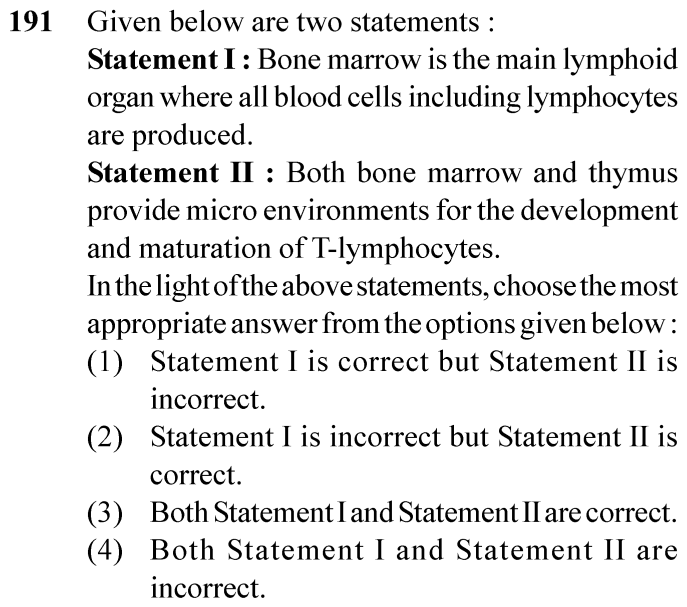
Statement I Bone marrow is the main lymphoid organ where all blood cells including lymphocytes are produced.
Statement II Both bone marrow and thymus provide micro environments for the development and maturation of T-lymphocytes.
⚡

The 30-Second Exam Hall Shortcut: ⚡ Primary Lymphoid Organ Statements Match

⏱️ Save ~20 seconds

Both statements are verbatim NCERT lines from the Primary Lymphoid Organs section! Bone marrow produces all blood cells; both bone marrow and thymus nurture T-cell maturation!

1 Evaluate Statement I: "Bone marrow is the main lymphoid organ where all blood cells including lymphocytes are produced" -> NCERT verbatim TRUE.
2 Evaluate Statement II: "Both bone-marrow and thymus provide micro-environments for the development and maturation of T-lymphocytes" -> NCERT verbatim TRUE.
3 Both statements are correct -> Option (3) / C.
🛡️
Why You Can 100% Trust This Shortcut: NCERT Biology · Human Health and Disease (Primary and Secondary Lymphoid Organs)
📐

Step-by-Step Rigorous Workflow & Mathematical Proof

Step 1

Evaluate Statement I (Bone Marrow Hemopoiesis)

NCERT explicitly states: "The bone marrow is the main lymphoid organ where all blood cells including lymphocytes are produced." Therefore, Statement I is completely true.

Step 2

Evaluate Statement II (T-cell Microenvironments)

NCERT explicitly states: "The thymus is a lobed organ located near the heart and beneath the breastbone... Both bone-marrow and thymus provide micro-environments for the development and maturation of T-lymphocytes." (Progenitor T-cells originate in bone marrow and migrate to thymus). Therefore, Statement II is completely true.

Step 3

Synthesize Conclusion

Both Statement I and Statement II are correct statements, matching Option (3).

⭐

360° Option Elimination Engine Key Feature

Diagnose every choice: Know exactly why the right option works and why distractors fail.

4-Option Deep Scan
1 (1)
✗ Incorrect
Verdict & Scientific Reason:

Statement II is an accurate verbatim excerpt from NCERT.

⚠️
Student Fallacy (Why candidates pick this trap): Statement II is an accurate verbatim excerpt from NCERT.
2 (2)
✗ Incorrect
Verdict & Scientific Reason:

Statement I is factually correct.

⚠️
Student Fallacy (Why candidates pick this trap): Statement I is factually correct.
3 (3)
✓ 100% Correct
Verdict & Scientific Reason:

Both statements match the NCERT textbook text verbatim regarding lymphoid organ function.

💡
Why this is airtight: None.
4 (4)
✗ Incorrect
Verdict & Scientific Reason:

Neither statement is incorrect.

⚠️
Student Fallacy (Why candidates pick this trap): Neither statement is incorrect.
⚠️

NTA Trap Alert: Thymus Exclusivity Fallacy

Thinking only the thymus is involved in T-lymphocytes because they mature there.

🛡️ How to avoid the -1 mark: Bone marrow produces the immature T-cell precursors and provides the initial development microenvironment before thymic migration.
📖

Core NEET Syllabus Standard

Biology Core Zoology · Human Health and Disease Standard Benchmark
Core Scientific Principle Tested:

"The bone marrow is the main lymphoid organ where all blood cells including lymphocytes are produced. The thymus is a lobed organ located near the heart... Both bone-marrow and thymus provide micro-environments for the development and maturation of T-lymphocytes."

Syllabus Focus: Primary Lymphoid Organs: Roles of Bone Marrow and Thymus
✓ Core NEET UG Syllabus Anchor Syllabus & Academic Standards ↗
NEET 2023 · Q171 Easy
Official NEET 2023 Question 171 - Human Health and Disease
1
2 ✓ Key
3
4
💡 Verified Solution & 30-Second Hack
✓
Verified Against NTA Final Answer Key
Option (2) : TH cells
📚 Human Health and Disease Easy
📋 Given Parameters & Problem Setup
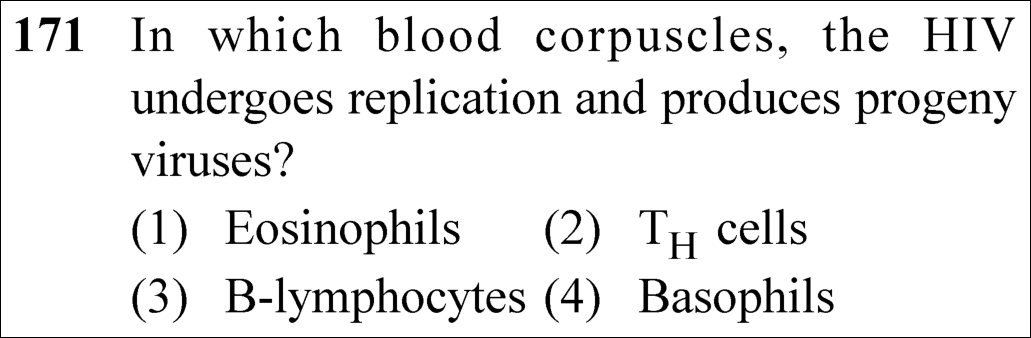
Pathogen Human Immunodeficiency Virus (HIV)
Event Replication and production of progeny viruses in blood corpuscles
⚡

The 30-Second Exam Hall Shortcut: ⚡ HIV Host Target: Helper T-Cells (TH Cells)

⏱️ Save ~20 seconds

While macrophages act as the "HIV factory" in tissue, the blood corpuscles invaded by HIV where it replicates, releases progeny, and lyses cells leading to progressive immune collapse are Helper T-Lymphocytes (THT_H cells)!

1 HIV binds to CD4 receptors on target immune cells.
2 In blood corpuscles, it selectively infects Helper T-lymphocytes (THT_H cells).
3 Inside THT_H cells, reverse transcriptase synthesizes viral DNA which integrates into host genome to produce progeny viruses.
4 Progressive destruction of THT_H cells leads to immunocompromise and opportunistic infections.
5 Match Option (2) TH cells.
🛡️
Why You Can 100% Trust This Shortcut: Canonical NCERT Human Health and Disease retroviral pathogenesis cycle.
📐

Step-by-Step Rigorous Workflow & Mathematical Proof

Step 1

Retroviral Infection Cycle of HIV

HIV envelope glycoprotein gp120 binds specifically to the CD4 surface marker present on monocytes/macrophages and helper T-cells (THT_H lymphocytes):

HIV (ssRNA)→Enters TH cellViral DNA (via Reverse Transcriptase)→Integrates into GenomeProgeny Virions\text{HIV (ssRNA)} \xrightarrow{\text{Enters } T_H\text{ cell}} \text{Viral DNA (via Reverse Transcriptase)} \xrightarrow{\text{Integrates into Genome}} \text{Progeny Virions}
Step 2

Verbatim NCERT Reference

NCERT states verbatim: "Simultaneously, HIV enters into helper T-lymphocytes (TH), replicates and produces progeny viruses. The progeny viruses released in the blood attack other helper T-lymphocytes. This is repeated leading to a progressive decrease in the number of helper T-lymphocytes in the body of the infected person."

Step 3

Evaluation of Distractor Cells

Eosinophils fight allergic reactions and helminth infections; B-lymphocytes produce humoral antibodies; basophils release histamine and heparin during inflammation. None of these support HIV replication.

⭐

360° Option Elimination Engine Key Feature

Diagnose every choice: Know exactly why the right option works and why distractors fail.

4-Option Deep Scan
1 1
✗ Incorrect
Verdict & Scientific Reason:

Eosinophils are granulocytes involved in allergic response and parasitic defense, not targets of HIV.

⚠️
Student Fallacy (Why candidates pick this trap): Random leukocyte selection.
2 2
✓ 100% Correct
Verdict & Scientific Reason:

Exact match with NCERT: HIV enters helper T-cells (TH), replicates, and generates progeny viruses.

💡
Why this is airtight: None; textbook verbatim.
3 3
✗ Incorrect
Verdict & Scientific Reason:

B-lymphocytes differentiate into plasma cells to secrete antibodies; they lack the CD4 tropism required for HIV entry.

⚠️
Student Fallacy (Why candidates pick this trap): Confusing B-cells with T-helper cells.
4 4
✗ Incorrect
Verdict & Scientific Reason:

Basophils are circulating granulocytes releasing inflammatory mediators, unaffected by HIV.

⚠️
Student Fallacy (Why candidates pick this trap): Confusing inflammatory granulocytes with target lymphocytes.
⚠️

NTA Trap Alert: Macrophage "Factory" vs. TH Cell Target Trap

NCERT calls macrophages the "HIV factory" because they survive while producing virus, but when asked about "blood corpuscles" whose depletion causes AIDS, the answer is definitively Helper T-lymphocytes (THT_H cells).

🛡️ How to avoid the -1 mark: Blood corpuscle target whose destruction defines AIDS = THT_H cells.
📖

Core NEET Syllabus Standard

NCERT Biology · Human Health and Disease Standard Benchmark
Core Scientific Principle Tested:

"HIV enters into helper T-lymphocytes (TH), replicates and produces progeny viruses, leading to a progressive decrease in TH cells."

Syllabus Focus: Acquired Immuno Deficiency Syndrome (AIDS)
✓ Core NEET UG Syllabus Anchor Syllabus & Academic Standards ↗
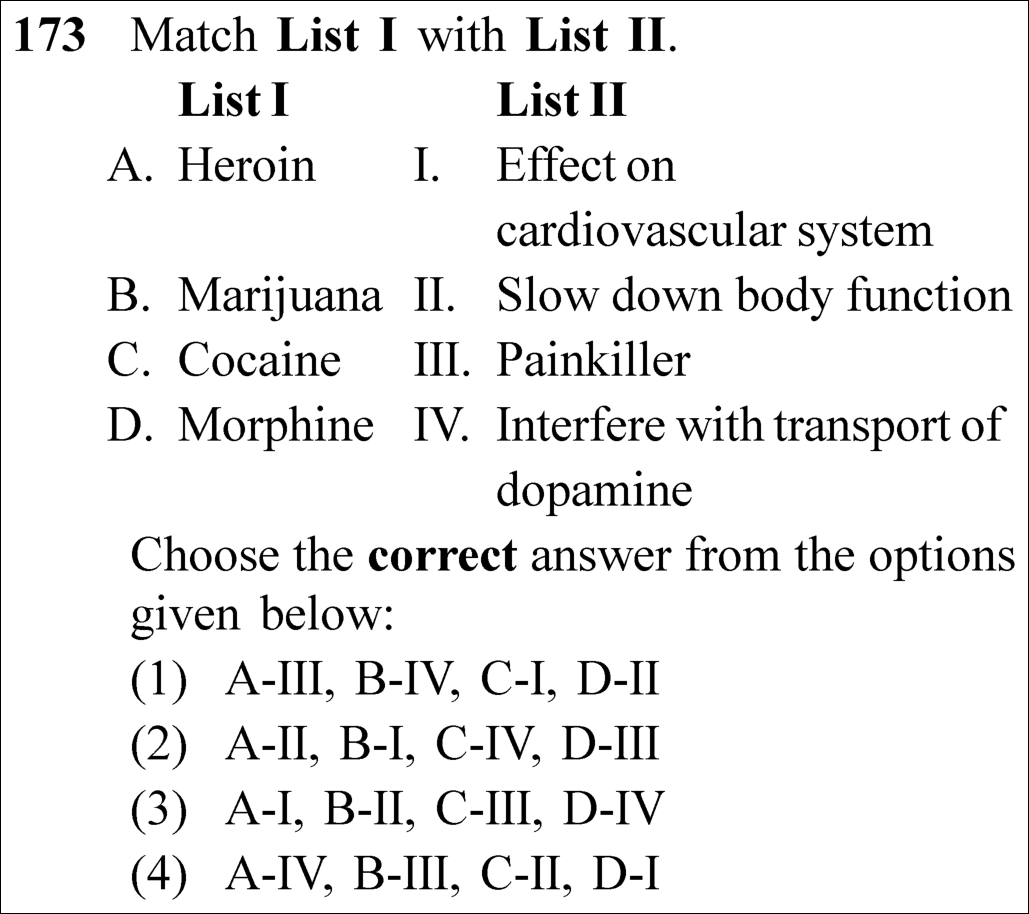
NEET 2023 · Q173 Easy
Official NEET 2023 Question 173 - Human Health and Disease
1
2 ✓ Key
3
4
💡 Verified Solution & 30-Second Hack
✓
Verified Against NTA Final Answer Key
Option (2) : A-II, B-I, C-IV, D-III
📚 Human Health and Disease Easy
📋 Given Parameters & Problem Setup
List I (Drugs) Heroin, Marijuana, Cocaine, Morphine
List II (Effects) Effect on cardiovascular system, Slow down body function, Painkiller, Interfere with transport of dopamine
⚡

The 30-Second Exam Hall Shortcut: ⚡ Drug Physiological Action Matcher

⏱️ Save ~25 seconds

Match standard NCERT drug mechanisms: Heroin = Slows down body function (II). Marijuana = Cardiovascular effects (I). Cocaine = Interferes with dopamine transport (IV). Morphine = Potent painkiller/sedative (III)! Match Option (2)!

1 Heroin (smack): Depressant, slows down body functions -> A-II.
2 Marijuana (cannabinoid): Interacts with cannabinoid receptors, effects on cardiovascular system -> B-I.
3 Cocaine (coke/crack): Interferes with the reuptake/transport of dopamine -> C-IV.
4 Morphine: Very effective sedative and painkiller used in post-operative patients -> D-III.
5 Match combination: A-II, B-I, C-IV, D-III -> Option (2).
🛡️
Why You Can 100% Trust This Shortcut: Canonical NCERT Human Health and Disease pharmacology of abused substances.
📐

Step-by-Step Rigorous Workflow & Mathematical Proof

Step 1

Pharmacological Actions of Abused Drugs

Analyzing the specific physiological targets described in NCERT:

A. Heroin:Depressant that slows down body functions  ⟹  IIB. Marijuana:Known for its effects on the cardiovascular system  ⟹  IC. Cocaine:Interferes with the transport of dopamine  ⟹  IVD. Morphine:Very effective sedative and painkiller  ⟹  III\begin{aligned} \text{\textbf{A. Heroin:}} & \quad \text{Depressant that } \mathbf{\text{slows down body functions}} \implies \mathbf{\text{II}} \\[4pt] \text{\textbf{B. Marijuana:}} & \quad \text{Known for its } \mathbf{\text{effects on the cardiovascular system}} \implies \mathbf{\text{I}} \\[4pt] \text{\textbf{C. Cocaine:}} & \quad \mathbf{\text{Interferes with the transport of dopamine}} \implies \mathbf{\text{IV}} \\[4pt] \text{\textbf{D. Morphine:}} & \quad \text{Very effective sedative and } \mathbf{\text{painkiller}} \implies \mathbf{\text{III}} \end{aligned}
Step 2

Verbatim NCERT References

NCERT states under Drugs and Alcohol Abuse: - "Heroin is a depressant and slows down body functions." - "Cannabinoids are known for their effects on cardiovascular system of the body." - "Cocaine interferes with the transport of the neuro-transmitter dopamine." - "Morphine is a very effective sedative and painkiller, and is very useful in patients who have undergone surgery."

Step 3

Option Cross-Verification

Matching A-II and B-I immediately isolates Option (2) uniquely.

⭐

360° Option Elimination Engine Key Feature

Diagnose every choice: Know exactly why the right option works and why distractors fail.

4-Option Deep Scan
1 1
✗ Incorrect
Verdict & Scientific Reason:

Mismatches Heroin with painkiller and Cocaine with cardiovascular effects.

⚠️
Student Fallacy (Why candidates pick this trap): Confusing heroin with morphine clinical use.
2 2
✓ 100% Correct
Verdict & Scientific Reason:

Flawless 1-to-1 match with canonical NCERT drug classifications.

💡
Why this is airtight: None; textbook verbatim match.
3 3
✗ Incorrect
Verdict & Scientific Reason:

Mismatches Heroin with cardiovascular effects.

⚠️
Student Fallacy (Why candidates pick this trap): Scrambling physiological responses.
4 4
✗ Incorrect
Verdict & Scientific Reason:

Mismatches Heroin with dopamine interference.

⚠️
Student Fallacy (Why candidates pick this trap): Assigning dopamine transport to opioids instead of cocaine.
⚠️

NTA Trap Alert: Morphine vs. Heroin Question Distinction Trap

Both morphine and heroin are opioids derived from Papaver somniferum. NCERT specifically reserves "painkiller for surgical patients" for Morphine, and "depressant that slows down body functions" for Heroin.

🛡️ How to avoid the -1 mark: Morphine = Medical painkiller. Heroin = Depressant slowing body functions.
📖

Core NEET Syllabus Standard

NCERT Biology · Human Health and Disease Standard Benchmark
Core Scientific Principle Tested:

"Heroin slows down body functions; Cannabinoids affect cardiovascular system; Cocaine interferes with dopamine transport; Morphine is a painkiller."

Syllabus Focus: Drugs and Alcohol Abuse
✓ Core NEET UG Syllabus Anchor Syllabus & Academic Standards ↗
NEET 2023 · Q179 Easy
Official NEET 2023 Question 179 - Human Health and Disease
1
2 ✓ Key
3
4
💡 Verified Solution & 30-Second Hack
✓
Verified Against NTA Final Answer Key
Option (2) : A-II, B-III, C-IV, D-I
📚 Human Health and Disease Easy
📋 Given Parameters & Problem Setup
Diseases Ringworm, Filariasis, Malaria, Pneumonia
Pathogens Haemophilus influenzae, Trichophyton, Wuchereria bancrofti, Plasmodium vivax
⚡

The 30-Second Exam Hall Shortcut: ⚡ Infectious Disease Etiology Matcher

⏱️ Save ~25 seconds

Match standard NCERT human pathogens: Ringworm = Trichophyton fungus (II). Filariasis = Wuchereria bancrofti filarial nematode (III). Malaria = Plasmodium vivax protozoan (IV). Pneumonia = Haemophilus influenzae bacterium (I)! Match Option (2)!

1 Ringworm (dermatomycosis): Fungi belonging to genera Microsporum, Trichophyton, Epidermophyton -> A-II.
2 Filariasis (Elephantiasis): Wuchereria (W. bancrofti and W. malayi) -> B-III.
3 Malaria: Plasmodium (P. vivax, P. malariae, P. falciparum) -> C-IV.
4 Pneumonia: Streptococcus pneumoniae and Haemophilus influenzae -> D-I.
5 Match combination: A-II, B-III, C-IV, D-I -> Option (2).
🛡️
Why You Can 100% Trust This Shortcut: Canonical NCERT Human Health and Disease infectious etiology inventory.
📐

Step-by-Step Rigorous Workflow & Mathematical Proof

Step 1

Taxonomic and Pathological Classification

Matching infectious diseases to their respective etiological agents:

A. Ringworm:Fungal dermatophyte Trichophyton  ⟹  IIB. Filariasis:Nematode worm Wuchereria bancrofti  ⟹  IIIC. Malaria:Protozoan parasite Plasmodium vivax  ⟹  IVD. Pneumonia:Bacterium Haemophilus influenzae  ⟹  I\begin{aligned} \text{\textbf{A. Ringworm:}} & \quad \text{Fungal dermatophyte } \mathbf{\textit{Trichophyton}} \implies \mathbf{\text{II}} \\[4pt] \text{\textbf{B. Filariasis:}} & \quad \text{Nematode worm } \mathbf{\textit{Wuchereria bancrofti}} \implies \mathbf{\text{III}} \\[4pt] \text{\textbf{C. Malaria:}} & \quad \text{Protozoan parasite } \mathbf{\textit{Plasmodium vivax}} \implies \mathbf{\text{IV}} \\[4pt] \text{\textbf{D. Pneumonia:}} & \quad \text{Bacterium } \mathbf{\textit{Haemophilus influenzae}} \implies \mathbf{\text{I}} \end{aligned}
Step 2

Verbatim NCERT References

NCERT states under Common Diseases in Humans: - "Bacteria like Streptococcus pneumoniae and Haemophilus influenzae are responsible for the disease pneumonia in humans." - "Malaria is caused by Plasmodium (P. vivax, P. malaria and P. falciparum)." - "Wuchereria (W. bancrofti and W. malayi), the filarial worms cause a slowly developing chronic inflammation of the organs... (elephantiasis or filariasis)." - "Many fungi belonging to the genera Microsporum, Trichophyton and Epidermophyton are responsible for ringworms."

Step 3

Option Verification

A-II, B-III, C-IV, D-I uniquely and definitively selects Option (2).

⭐

360° Option Elimination Engine Key Feature

Diagnose every choice: Know exactly why the right option works and why distractors fail.

4-Option Deep Scan
1 1
✗ Incorrect
Verdict & Scientific Reason:

Mismatches Ringworm with Wuchereria and Filariasis with Trichophyton.

⚠️
Student Fallacy (Why candidates pick this trap): Swapping fungal dermatophytes with filarial helminths.
2 2
✓ 100% Correct
Verdict & Scientific Reason:

Flawless 1-to-1 match with the canonical NCERT infectious disease pathogens.

💡
Why this is airtight: None; textbook verbatim match.
3 3
✗ Incorrect
Verdict & Scientific Reason:

Mismatches Malaria with Haemophilus and Pneumonia with Plasmodium.

⚠️
Student Fallacy (Why candidates pick this trap): Swapping bacterial pneumonia with protozoan malaria.
4 4
✗ Incorrect
Verdict & Scientific Reason:

Scrambles all associations.

⚠️
Student Fallacy (Why candidates pick this trap): Arbitrary matching.
⚠️

NTA Trap Alert: Haemophilus influenzae: Pneumonia, NOT Flu!

Students frequently mistake Haemophilus influenzae as the cause of "influenza" (flu is viral). In NCERT, Haemophilus influenzae is explicitly identified as the bacterial causative agent of Pneumonia.

🛡️ How to avoid the -1 mark: Remember: Pneumonia bacteria = Streptococcus pneumoniae AND Haemophilus influenzae.
📖

Core NEET Syllabus Standard

NCERT Biology · Human Health and Disease Standard Benchmark
Core Scientific Principle Tested:

"Ringworm is caused by Trichophyton; Filariasis by Wuchereria bancrofti; Malaria by Plasmodium vivax; Pneumonia by Haemophilus influenzae."

Syllabus Focus: Common Diseases in Humans
✓ Core NEET UG Syllabus Anchor Syllabus & Academic Standards ↗
NEET 2021 · Q196 Easy
Official NEET 2021 Question 196 - Human Health and Disease
1 (iv) (i) (iii) (ii)
2 (iii) (iv) (i) (ii) ✓ Key
3 (i) (ii) (iv) (iii)
4 (ii) (iii) (i) (iv)
💡 Verified Solution & 30-Second Hack
✓
Verified Against NTA Final Answer Key
Option (2) : (a)-(iii), (b)-(iv), (c)-(i), (d)-(ii)
📚 Human Health and Disease Easy
📋 Given Parameters & Problem Setup
List I (Diseases) (a) Filariasis, (b) Amoebiasis, (c) Pneumonia, (d) Ringworm
List II (Pathogens) (i) Haemophilus influenzae, (ii) Trichophyton, (iii) Wuchereria bancrofti, (iv) Entamoeba histolytica
⚡

The 30-Second Exam Hall Shortcut: ⚡ "Wuchereria = Filariasis, Entamoeba = Amoebiasis, Haemophilus = Pneumonia"

⏱️ Save ~25 seconds

Filariasis is caused by the filarial nematode Wuchereria bancrofti ((a)-(iii)); Amoebiasis is caused by the protozoan Entamoeba histolytica ((b)-(iv)); Pneumonia is caused by Haemophilus influenzae ((c)-(i)); and Ringworm is caused by the fungus Trichophyton ((d)-(ii)). Looking at options, only Option (2) matches!

1 Match (a) Filariasis -> (iii) Wuchereria bancrofti (filarial worm).
2 Match (b) Amoebiasis -> (iv) Entamoeba histolytica (intestinal amoebic parasite).
3 Match (c) Pneumonia -> (i) Haemophilus influenzae (bacterial pneumonia pathogen).
4 Match (d) Ringworm -> (ii) Trichophyton (dermatophyte fungus).
5 Match pattern (iii), (iv), (i), (ii) -> Option (2).
🛡️
Why You Can 100% Trust This Shortcut: NCERT Biology · Human Health and Disease (Common Infectious Diseases in Humans: Pneumonia is caused by Streptococcus pneumoniae and Haemophilus influenzae; Amoebiasis is caused by Entamoeba histolytica; Filariasis by Wuchereria bancrofti; Ringworm by Microsporum, Trichophyton and Epidermophyton).
📐

Step-by-Step Rigorous Workflow & Mathematical Proof

Step 1

Etiology and Biological Classification of Listed Human Pathogens

- (a) Filariasis (Elephantiasis): Caused by the filarial roundworm nematodes _Wuchereria bancrofti_ and _Wuchereria malayi_. The adult worms lodge in the lymphatic vessels of the lower limbs and genital organs, triggering chronic inflammation and gross lymphedema. - (b) Amoebiasis (Amoebic Dysentery): Caused by the protozoan parasite _Entamoeba histolytica_ in the large intestine of humans. Symptoms include constipation, abdominal cramps, and stools with excess mucus and blood clots. - (c) Pneumonia: A bacterial pulmonary infection caused by _Streptococcus pneumoniae_ and _Haemophilus influenzae_, which infects the alveoli of the lungs, causing them to fill with fluid. - (d) Ringworm: A superficial cutaneous fungal infection caused by dermatophyte fungi of the genera _Microsporum_, _Trichophyton_, and _Epidermophyton_, characterized by dry, scaly pruritic lesions on skin, scalp, and nails.

Filariasis  ⟺  Wuchereria bancrofti[(a)→(iii)]Amoebiasis  ⟺  Entamoeba histolytica[(b)→(iv)]Pneumonia  ⟺  Haemophilus influenzae[(c)→(i)]Ringworm  ⟺  Trichophyton[(d)→(ii)]\begin{aligned} \text{Filariasis} &\iff \textit{Wuchereria bancrofti} \quad [\text{(a)} \to \text{(iii)}] \\ \text{Amoebiasis} &\iff \textit{Entamoeba histolytica} \quad [\text{(b)} \to \text{(iv)}] \\ \text{Pneumonia} &\iff \textit{Haemophilus influenzae} \quad [\text{(c)} \to \text{(i)}] \\ \text{Ringworm} &\iff \textit{Trichophyton} \quad [\text{(d)} \to \text{(ii)}] \end{aligned}
Step 2

Option Alignment

Matching sequence is: (a)-(iii), (b)-(iv), (c)-(i), (d)-(ii). This corresponds precisely to Option (2).

⭐

360° Option Elimination Engine Key Feature

Diagnose every choice: Know exactly why the right option works and why distractors fail.

4-Option Deep Scan
1 1
✗ Incorrect
Verdict & Scientific Reason:

Incorrect. Links Filariasis to Entamoeba histolytica and Amoebiasis to Haemophilus.

⚠️
Student Fallacy (Why candidates pick this trap): Gross misalignment of nematode and protozoan pathogens.
2 2
✓ 100% Correct
Verdict & Scientific Reason:

Correct. Accurately links all four diseases to their canonical causative agents.

💡
Why this is airtight: None. Candidate recognizes textbook infectious diseases.
3 3
✗ Incorrect
Verdict & Scientific Reason:

Incorrect. Assigns Haemophilus to Filariasis and Trichophyton to Amoebiasis.

⚠️
Student Fallacy (Why candidates pick this trap): Reading list entries without matching pathogen biology.
4 4
✗ Incorrect
Verdict & Scientific Reason:

Incorrect. Links ringworm fungus Trichophyton to filariasis.

⚠️
Student Fallacy (Why candidates pick this trap): Confusing fungal skin infections with parasitic filarial worms.
⚠️

NTA Trap Alert: Haemophilus influenzae "Flu" Misnomer Trap

Because the species name is "influenzae", many students assume Haemophilus causes the viral flu (influenza) and fail to associate it with bacterial pneumonia. NCERT explicitly names Haemophilus influenzae as a causative agent of pneumonia.

🛡️ How to avoid the -1 mark: Remember: Bacterial Pneumonia = Streptococcus pneumoniae + Haemophilus influenzae.
📖

Core NEET Syllabus Standard

NEET / NCERT Biology · Human Health and Disease Standard Benchmark
Core Scientific Principle Tested:

"Filariasis is caused by Wuchereria bancrofti; amoebiasis by Entamoeba histolytica; pneumonia by Haemophilus influenzae; ringworm by Trichophyton."

Syllabus Focus: Common Diseases in Humans
✓ Core NEET UG Syllabus Anchor Syllabus & Academic Standards ↗
NEET 2020 · Q4 Easy
Official NEET 2020 Question 4 - Human Health and Disease
1 (i) (iii) (ii) (iv)
2 (iii) (iv) (i) (ii) ✓ Key
3 (ii) (i) (iii) (iv)
4 (iv) (i) (ii) (iii)
💡 Verified Solution & 30-Second Hack
✓
Verified Against NTA Final Answer Key
Option (2) : (a)-(iii), (b)-(iv), (c)-(i), (d)-(ii)
📚 Human Health and Disease Easy
📋 Given Parameters & Problem Setup
Column I (Diseases) (a) Typhoid, (b) Pneumonia, (c) Filariasis, (d) Malaria
Column II (Pathogens) (i) Wuchereria, (ii) Plasmodium, (iii) Salmonella, (iv) Haemophilus
⚡

The 30-Second Exam Hall Shortcut: ⚡ "Salmonella = Typhoid, Haemophilus = Pneumonia, Wuchereria = Filariasis"

⏱️ Save ~25 seconds

Typhoid is caused by Salmonella typhi ((a)-(iii)); Pneumonia by Haemophilus influenzae ((b)-(iv)); Filariasis by Wuchereria bancrofti ((c)-(i)); and Malaria by Plasmodium ((d)-(ii)). Pattern (iii), (iv), (i), (ii) matches Option (2) instantly!

1 Match (a) Typhoid -> (iii) Salmonella typhi (confirmed by Widal test).
2 Match (b) Pneumonia -> (iv) Haemophilus influenzae (infects alveoli).
3 Match (c) Filariasis -> (i) Wuchereria bancrofti (filarial worm in lymphatic vessels).
4 Match (d) Malaria -> (ii) Plasmodium (protozoan sporozoite parasite).
5 Match pattern (iii), (iv), (i), (ii) -> Select Option (2).
🛡️
Why You Can 100% Trust This Shortcut: NCERT Biology · Human Health and Disease (Common Infectious Diseases: Salmonella typhi causes typhoid fever; Streptococcus pneumoniae and Haemophilus influenzae cause pneumonia; Wuchereria causes filariasis; Plasmodium causes malaria).
📐

Step-by-Step Rigorous Workflow & Mathematical Proof

Step 1

Etiological Diagnosis of Listed Human Pathogens

- (a) Typhoid Fever: Caused by the pathogenic Gram-negative rod bacterium _Salmonella typhi_, which enters the small intestine via contaminated food and water, migrating to other organs via blood (diagnosed by Widal test). - (b) Pneumonia: An acute pulmonary infection caused by _Streptococcus pneumoniae_ and _Haemophilus influenzae_, leading to fluid accumulation within alveolar sacs. - (c) Filariasis (Elephantiasis): Caused by the filarial nematode roundworms _Wuchereria bancrofti_ and _W. malayi_, which chronically obstruct lymphatic vessels of the lower limbs. - (d) Malaria: Caused by the protozoan parasite _Plasmodium_ (_P. vivax_, _P. malariae_, _P. falciparum_), transmitted by the bite of female _Anopheles_ mosquitoes.

Typhoid  ⟺  Salmonella[(a)→(iii)]Pneumonia  ⟺  Haemophilus[(b)→(iv)]Filariasis  ⟺  Wuchereria[(c)→(i)]Malaria  ⟺  Plasmodium[(d)→(ii)]\begin{aligned} \text{Typhoid} &\iff \textit{Salmonella} \quad [\text{(a)} \to \text{(iii)}] \\ \text{Pneumonia} &\iff \textit{Haemophilus} \quad [\text{(b)} \to \text{(iv)}] \\ \text{Filariasis} &\iff \textit{Wuchereria} \quad [\text{(c)} \to \text{(i)}] \\ \text{Malaria} &\iff \textit{Plasmodium} \quad [\text{(d)} \to \text{(ii)}] \end{aligned}
Step 2

Option Alignment

Matching sequence is: (a)-(iii), (b)-(iv), (c)-(i), (d)-(ii). This corresponds precisely to Option (2).

⭐

360° Option Elimination Engine Key Feature

Diagnose every choice: Know exactly why the right option works and why distractors fail.

4-Option Deep Scan
1 A
✗ Incorrect
Verdict & Scientific Reason:

Incorrect. Assigns Wuchereria to typhoid and Plasmodium to filariasis.

⚠️
Student Fallacy (Why candidates pick this trap): Random misalignment of pathogens.
2 B
✓ 100% Correct
Verdict & Scientific Reason:

Correct. Accurately matches all 4 human diseases to their causative microorganisms.

💡
Why this is airtight: None. Direct recall of standard pathogen profiles.
3 C
✗ Incorrect
Verdict & Scientific Reason:

Incorrect. Assigns Plasmodium to typhoid.

⚠️
Student Fallacy (Why candidates pick this trap): Swapping bacterial and protozoan infections.
4 D
✗ Incorrect
Verdict & Scientific Reason:

Incorrect. Assigns Haemophilus to typhoid.

⚠️
Student Fallacy (Why candidates pick this trap): Confusing respiratory pneumonia bacteria with enteric typhoid bacteria.
⚠️

NTA Trap Alert: Haemophilus vs Salmonella Enteric/Respiratory Trap

Students sometimes know both are bacteria but reverse their target organs: Salmonella causes enteric fever (gut), while Haemophilus causes pneumonia (alveoli).

🛡️ How to avoid the -1 mark: Remember: Salmonella = Food & Gut (Typhoid); Haemophilus = Lungs (Pneumonia).
📖

Core NEET Syllabus Standard

NEET / NCERT Biology · Human Health and Disease Standard Benchmark
Core Scientific Principle Tested:

"Typhoid is caused by Salmonella; pneumonia by Haemophilus; filariasis by Wuchereria; malaria by Plasmodium."

Syllabus Focus: Infectious Pathogens
✓ Core NEET UG Syllabus Anchor Syllabus & Academic Standards ↗
NEET 2020 · Q10 Easy
Official NEET 2020 Question 10 - Human Health and Disease
1 Trophozoites
2 Sporozoites ✓ Key
3 Female gametocytes
4 Male gametocytes
💡 Verified Solution & 30-Second Hack
✓
Verified Against NTA Final Answer Key
Option (2) : Sporozoites
📚 Human Health and Disease Easy
📋 Given Parameters & Problem Setup
Parasite Plasmodium (Malaria Parasite)
Host Human Body (Intermediate Host)
Question Objective Identify the specific infectious stage that enters the human body
⚡

The 30-Second Exam Hall Shortcut: ⚡ "Mosquito Saliva Injects SPOROZOITES into Human Blood!"

⏱️ Save ~20 seconds

The infective stage of Plasmodium that enters the human body via the bite of an infected female Anopheles mosquito is the SPOROZOITE. Once in blood, sporozoites invade hepatocytes (liver cells). Mark Sporozoites (Option 2) in 5 seconds!

1 Recall Plasmodium life cycle stages: - Mosquito salivary glands contain infective Sporozoites. - Liver schizogony yields Merozoites. - Erythrocytic stage forms Trophozoites, Signet ring stage, and Schizonts. - Blood contains Gametocytes (taken up by mosquito).
2 Question asks: "Infectious stage that enters the human body".
3 Select Option (2): Sporozoites.
🛡️
Why You Can 100% Trust This Shortcut: NCERT Biology · Human Health and Disease (Infectious Diseases: Plasmodium enters the human body as sporozoites (infectious form) through the bite of infected female Anopheles mosquito).
📐

Step-by-Step Rigorous Workflow & Mathematical Proof

Step 1

Transmission and Entry of Plasmodium into Humans

_Plasmodium_ is a digenetic protozoan parasite requiring two hosts to complete its life cycle: 1. Inoculation: When an infected female _Anopheles_ mosquito pierces human skin for a blood meal, it injects saliva containing anticoagulants and thousands of sickle-shaped, motile sporozoites directly into the capillary bloodstream. 2. Hepatic Schizogony: Circulating sporozoites travel to the liver within 30 minutes, penetrating hepatocytes to undergo asexual multiple fission (pre-erythrocytic schizogony) to produce merozoites. 3. Erythrocytic Cycle: Merozoites rupture hepatocytes and invade red blood cells, developing into amoeboid feeding trophozoites, which digest hemoglobin into toxic hemozoin crystals. 4. Gametocytes: A subpopulation of merozoites differentiates into male and female gametocytes, which are taken up by a biting mosquito to complete sexual reproduction (syngamy and sporogony) in the mosquito gut wall.

Female Anopheles Bite→InoculatesSporozoites→InvadeLiver Cells (Hepatocytes)\text{Female } \textit{Anopheles} \text{ Bite} \xrightarrow{\text{Inoculates}} \mathbf{Sporozoites} \xrightarrow{\text{Invade}} \text{Liver Cells (Hepatocytes)}
Step 2

Evaluation of Other Life Cycle Stages

- Trophozoites: The intraerythrocytic actively feeding vegetative stage inside human RBCs. - Female & Male Gametocytes: The sexual stages formed in human peripheral blood that serve as the infectious stage for the mosquito, not the human.

⭐

360° Option Elimination Engine Key Feature

Diagnose every choice: Know exactly why the right option works and why distractors fail.

4-Option Deep Scan
1 A
✗ Incorrect
Verdict & Scientific Reason:

Incorrect. Trophozoites are formed inside human erythrocytes during the clinical erythrocytic cycle.

⚠️
Student Fallacy (Why candidates pick this trap): Confusing the feeding RBC stage with the mosquito inoculate.
2 B
✓ 100% Correct
Verdict & Scientific Reason:

Correct. Sporozoites are the motile, infective parasitic form stored in mosquito salivary glands that enter human blood.

💡
Why this is airtight: None. Direct recall of canonical malaria life cycle stages.
3 C
✗ Incorrect
Verdict & Scientific Reason:

Incorrect. Gametocytes are ingested by mosquitoes from human blood, not injected into humans.

⚠️
Student Fallacy (Why candidates pick this trap): Inverting human-to-mosquito vs mosquito-to-human transmission.
4 D
✗ Incorrect
Verdict & Scientific Reason:

Incorrect for the same reason; gametocytes develop within the human host for transmission to mosquitoes.

⚠️
Student Fallacy (Why candidates pick this trap): Same inversion error as Option 3.
⚠️

NTA Trap Alert: Human vs Mosquito Infective Stage Inversion Trap

The infective stage *for humans* is the Sporozoite (injected by mosquito). The infective stage *for mosquitoes* is the Gametocyte (ingested from human blood). Do not confuse the two hosts.

🛡️ How to avoid the -1 mark: Remember: Mosquito injects Sporozoites into humans; Mosquito sucks Gametocytes from humans.
📖

Core NEET Syllabus Standard

NEET / NCERT Biology · Human Health and Disease Standard Benchmark
Core Scientific Principle Tested:

"Plasmodium enters the human body as sporozoites through the bite of an infected female Anopheles mosquito."

Syllabus Focus: Life Cycle of Plasmodium
✓ Core NEET UG Syllabus Anchor Syllabus & Academic Standards ↗
NEET 2020 · Q45 Easy
Official NEET 2020 Question 45 - Human Health and Disease
1 When exposed to antigen (living or dead) antibodies are produced in the host's body. It is called "Active immunity".
2 When ready-made antibodies are directly given, it is called "Passive immunity".
3 Active immunity is quick and gives full response. ✓ Key
4 Foetus receives some antibodies from mother, it is an example for passive immunity.
💡 Verified Solution & 30-Second Hack
✓
Verified Against NTA Final Answer Key
Option (3) : Active immunity is quick and gives full response.
📚 Human Health and Disease Easy
📋 Given Parameters & Problem Setup
Immunological Concepts Active immunity, Passive immunity, Maternal antibodies
Question Objective Identify the WRONG statement with reference to immunity
⚡

The 30-Second Exam Hall Shortcut: ⚡ "Active Immunity is SLOW (Takes Time), NOT Quick!"

⏱️ 30 seconds

Active immunity requires time for clonal proliferation and antibody synthesis, so it is inherently SLOW to develop its full response. Passive immunity (ready-made antibodies) provides QUICK/immediate relief. Statement (3) claims active immunity is "quick", which is completely WRONG!

1 Read Statement 3: "Active immunity is quick and gives full response."
2 Recall NCERT: Active immunity is slow and takes time to give its full effective response.
3 Thus, Statement 3 is the wrong statement! Mark Option (3) in 5 seconds.
🛡️
Why You Can 100% Trust This Shortcut: NCERT Biology · Human Health and Disease (Immunity: Active vs Passive Immunity)
📐

Step-by-Step Rigorous Workflow & Mathematical Proof

Step 1

Review Active Immunity Characteristics

When a host is exposed to antigens (living or dead microbes or other proteins), antibodies are synthesized in the host's body. This is called active immunity. However, active immunity is slow and takes time to develop and mount its full effective response.

Step 2

Review Passive Immunity Characteristics

When ready-made antibodies are directly administered to the body (e.g., antivenom for snake bite, anti-tetanus serum), it is called passive immunity. Passive immunity acts immediately (quick response).

Step 3

Analyze Maternal Passive Immunity

The foetus receives maternal antibodies (IgG) across the placenta during pregnancy, and the newborn receives secretory IgA in mother's yellowish milk (colostrum) during initial days of lactation. These are classic examples of natural passive immunity.

Step 4

Identify the Erroneous Statement

Statement (3) asserts that "Active immunity is quick and gives full response." This directly contradicts immunology fundamentals: active immunity is notoriously slow during the primary response.

⭐

360° Option Elimination Engine Key Feature

Diagnose every choice: Know exactly why the right option works and why distractors fail.

4-Option Deep Scan
1 A
✗ Incorrect
Verdict & Scientific Reason:

This statement is factually true, hence not the required wrong statement.

⚠️
Student Fallacy (Why candidates pick this trap): Correctly identified as true definition by students.
2 B
✗ Incorrect
Verdict & Scientific Reason:

This statement is factually true, describing canonical passive immunity.

⚠️
Student Fallacy (Why candidates pick this trap): None; standard definition.
3 C
✓ 100% Correct
Verdict & Scientific Reason:

This statement is WRONG and therefore the correct answer. Active immunity is inherently slow and requires a lag period to develop full protection.

💡
Why this is airtight: Students who confuse long-lasting immunological memory with speed of onset may assume active immunity is quick.
4 D
✗ Incorrect
Verdict & Scientific Reason:

This statement is factually true; maternal IgG crossing placenta provides natural passive immunity to the foetus.

⚠️
Student Fallacy (Why candidates pick this trap): None; textbook illustration of passive immunity.
⚠️

NTA Trap Alert: Speed vs Duration: Active vs Passive Immunity

Active Immunity: SLOW onset, but LONG-LASTING with memory. Passive Immunity: RAPID/QUICK onset, but SHORT-LIVED without memory.

🛡️ How to avoid the -1 mark: Remember: Active takes effort and time (SLOW). Passive is handed to you ready-made (FAST)!
📖

Core NEET Syllabus Standard

Botany · Human Health and Disease Standard Benchmark
Core Scientific Principle Tested:

""

Syllabus Focus: Innate vs Acquired Immunity: Active vs Passive Immunity Comparison
✓ Core NEET UG Syllabus Anchor Syllabus & Academic Standards ↗

Solve 4 NEET Questions a Day — One per Subject

Cover all 1,140 official NEET questions in 285 days at your own pace. Progress is saved on your device. No login needed.