MyCompetitiveExams Logo MyCompetitiveExams
Search 1,140+ Questions
Chapters, formulas, speed tricks
→
⚡ Brahmastra NEET 2027
720 MARKS

Dynamic 180-question full-length simulator mixed dynamically from all 6 years for 2027 & 2026 aspirants.

Launch Brahmastra 2027 Test →
Start Practice →
100% Free · No Login Required
Q.145 Zoology ⭐ 360° Option Elimination Active
Vault ↗

NEET 2025 Zoology Question 145 Solution

Topic: Principles of Inheritance and Variation · Official NTA Booklet Code 45
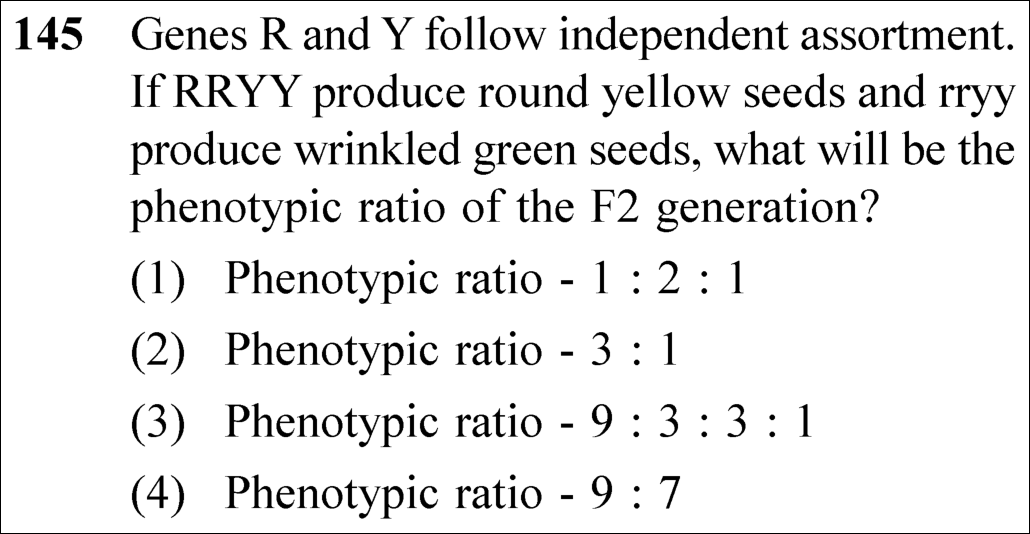
NEET 2025 Zoology Question 145: Mendelian Dihybrid Cross and F2 Phenotypic Ratio (9:3:3:1)

Question

Genes R and Y follow independent assortment. If RRYY produce round yellow seeds and rryy produce wrinkled green seeds, what will be the phenotypic ratio of the F2 generation?

  1. (1)Phenotypic ratio- 1:2: 1
  2. (2)Phenotypic ratio - 3: 1
  3. (3)Phenotypic ratio-9:3:3:1
  4. (4)Phenotypic ratio - 9:7
✓
Verified Against NTA Final Answer Key
Option (3) : Phenotypic ratio - 9 : 3 : 3 : 1
📚 Principles of Inheritance and Variation Easy
📋 Given Parameters & Problem Setup
Gene Loci R (seed shape: R round, r wrinkled) and Y (seed colour: Y yellow, y green)
Parents RRYY (Round Yellow) x rryy (Wrinkled Green)
Assortment Condition Independent assortment (unlinked genes)
Target Phenotypic ratio of the F2 generation
⚡

The 30-Second Exam Hall Shortcut: ⚡ Mendelian Dihybrid Ratio Fingerprint

⏱️ Save ~20 seconds

A standard dihybrid cross with independent assortment yields the classical 9 : 3 : 3 : 1 F2 phenotypic ratio (9 Round Yellow : 3 Round Green : 3 Wrinkled Yellow : 1 Wrinkled Green)!

1 Recall Mendel's law of independent assortment in dihybrid cross:
2 - Parents: RRYY x rryy -> F1 generation: RrYy (Round Yellow seeds).
3 - Self-pollination of F1: RrYy x RrYy.
4 - Phenotypes in F2: (3 Round : 1 Wrinkled) x (3 Yellow : 1 Green) = 9 Round Yellow : 3 Round Green : 3 Wrinkled Yellow : 1 Wrinkled Green.
5 Phenotypic ratio is 9 : 3 : 3 : 1!
6 Select Option (3)!
🛡️
Why You Can 100% Trust This Shortcut: Chromosomal Theory of Inheritance & Linkage (NCERT Biology · Principles of Inheritance and Variation: Sutton, Boveri, and Morgan).
📐

Step-by-Step Rigorous Workflow & Mathematical Proof

Step 1

Parental Cross and F1 Generation

Mendel crossed a pea plant homozygous for round yellow seeds with one having wrinkled green seeds:

  • • P generation: RRYYRRYY (Round, Yellow) ×\times rryyrryy (Wrinkled, Green).
  • • Gametes: RYRY and ryry.
  • • F1 generation: All RrYyRrYy individuals displaying the dominant phenotype (Round, Yellow seeds).
Step 2

Independent Assortment during Gametogenesis

Because genes R and Y assort independently:

  • • The F1 dihybrid (RrYyRrYy) produces 4 types of pollen grains and 4 types of eggs in equal proportions (25% each): RYRY, RyRy, rYrY, ryry.
  • • Random union of these gametes yields a 4×4=164 \times 4 = 16-box Punnett square in the F2 generation.
Step 3

Derivation of the F2 Phenotypic Ratio

Combining monohybrid independent probabilities:

  • • Round Yellow (R_Y_R\_Y\_): 34×34=916\frac{3}{4} \times \frac{3}{4} = \frac{9}{16}.
  • • Round Green (R_yyR\_yy): 34×14=316\frac{3}{4} \times \frac{1}{4} = \frac{3}{16}.
  • • Wrinkled Yellow (rrY_rrY\_): 14×34=316\frac{1}{4} \times \frac{3}{4} = \frac{3}{16}.
  • • Wrinkled Green (rryyrryy): 14×14=116\frac{1}{4} \times \frac{1}{4} = \frac{1}{16}.
Step 4

Conclusion

The F2 phenotypic ratio is 9 : 3 : 3 : 1, matching Option (3).

Phenotypic Ratio=9:3:3:1\text{Phenotypic Ratio} = 9 : 3 : 3 : 1
⭐

360° Option Elimination Engine Key Feature

Diagnose every choice: Know exactly why the right option works and why distractors fail.

4-Option Deep Scan
1 A
✗ Incorrect
Verdict & Scientific Reason:

Incorrect. 1:2:1 is the genotypic ratio of a monohybrid cross (or phenotypic ratio of incomplete dominance).

⚠️
Student Fallacy (Why candidates pick this trap): Confusing monohybrid genotypic ratio with dihybrid phenotypic ratio.
2 B
✗ Incorrect
Verdict & Scientific Reason:

Incorrect. 3:1 is the phenotypic ratio of a standard monohybrid cross.

⚠️
Student Fallacy (Why candidates pick this trap): Applying monohybrid ratio to a two-gene dihybrid cross.
3 C
✓ 100% Correct
Verdict & Scientific Reason:

100% correct. The canonical Mendelian dihybrid phenotypic ratio resulting from independent assortment.

💡
Why this is airtight: None; pristine genetic arithmetic.
4 D
✗ Incorrect
Verdict & Scientific Reason:

Incorrect. 9:7 is a modified ratio typical of complementary gene interaction, not unlinked independent assortment.

⚠️
Student Fallacy (Why candidates pick this trap): Confusing non-allelic gene interaction with independent assortment.
⚠️

NTA Trap Alert: Phenotypic vs Genotypic Dihybrid Ratios

The F2 PHENOTYPIC ratio is 9:3:3:1 (4 phenotypic classes). The F2 GENOTYPIC ratio is 1:2:1:2:4:2:1:2:1 (9 genotypic classes). Make sure you read which ratio is requested!

🛡️ How to avoid the -1 mark: Question asks for PHENOTYPIC ratio = 9 : 3 : 3 : 1.
📖

Core NEET Syllabus Standard

NEET Biology Core Syllabus · Principles of Inheritance and Variation Standard Benchmark
Core Scientific Principle Tested:

"In a dihybrid cross of independently assorting genes, the F2 generation exhibits a 9:3:3:1 phenotypic ratio."

Syllabus Focus: Inheritance of Two Genes · Law of Independent Assortment
✓ Core NEET UG Syllabus Anchor Syllabus & Academic Standards ↗
Dihybrid Phenotype = 9:3:3:1 (Mendel's Classic Double-Trait Signature)!

Ready to attempt under real exam pressure?

Test your speed and accuracy in the authentic 180-minute timed NTA simulator.

Launch NEET 2025 CBT Test →

Spotted a mistake in this solution? Report an error ([email protected])

⚖️ Legal & Fair Dealing Notice: Sourced from publicly released NEET 2025 question papers and NEET answer keys for private study, research, and non-commercial educational practice under Fair Dealing (Section 52(1)(a) of the Indian Copyright Act, 1957). Not affiliated with or endorsed by NTA or NMC.

Solve 4 NEET Questions a Day — One per Subject

Cover all 1,140 official NEET questions in 285 days at your own pace. Progress is saved on your device. No login needed.