MyCompetitiveExams Logo MyCompetitiveExams
Search 1,140+ Questions
Chapters, formulas, speed tricks
→
⚡ Brahmastra NEET 2027
720 MARKS

Dynamic 180-question full-length simulator mixed dynamically from all 6 years for 2027 & 2026 aspirants.

Launch Brahmastra 2027 Test →
Start Practice →
100% Free · No Login Required
Q.1 Physics ⭐ 360° Option Elimination Active
Vault ↗

NEET 2025 Physics Question 1 Solution

Topic: Mechanical Properties of Fluids · Official NTA Booklet Code 45
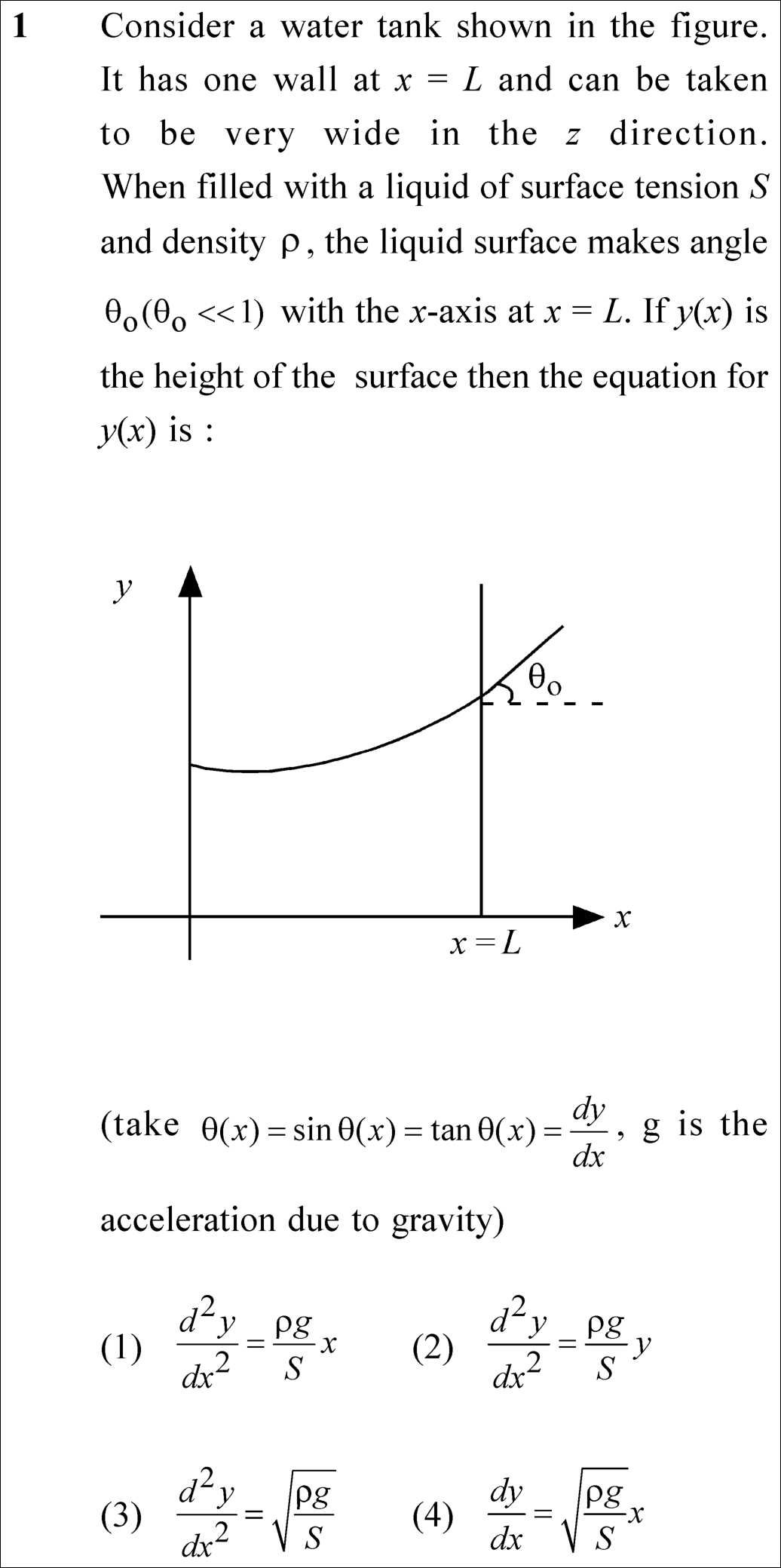
NEET 2025 Physics Question 1: Curvature of Meniscus, Laplace Pressure & Hydrostatic Equilibrium

Question

Consider a water tank shown in the figure. It has one wall at x = L and can be taken to be very wide in the z direction. When filled with a liquid of surface tension S and density ρ, the liquid surface makes angle θ₀ (θ₀ << 1) with the x-axis at x = L. If y(x) is the height of the surface then the equation for y(x) is: (take θ(x) = sin θ(x) = tan θ(x) = dy/dx, g is the acceleration due to gravity)

✓
Verified Against NTA Final Answer Key
Option (2) : \frac{d^2y}{dx^2} = \frac{\rho g}{S} y
📚 Mechanical Properties of Fluids Challenging
📋 Given Parameters & Problem Setup
Fluid Properties Surface tension S, Density ρ
Boundary Condition Wall at x = L, liquid makes small angle θ₀ ≪ 1 with x-axis
Small Angle Approximation θ(x) = sin θ(x) = tan θ(x) = dy/dx
⚡

The 30-Second Exam Hall Shortcut: ⚡ Dimensional & Physical Balance Shortcut

⏱️ Save ~90 seconds

Laplace Pressure S(d²y/dx²) = Hydrostatic Column Pressure ρgy ⟹ d²y/dx² = (ρg/S) y!

1 Recognize the physical balance: Pressure jump across the curved liquid-air interface is Laplace excess pressure ΔP = S/R.
2 In differential calculus for small slopes, curvature 1/R = d²y/dx².
3 This pressure difference supports the hydrostatic liquid head of height y: ΔP = ρgy.
4 Equate: S(d²y/dx²) = ρgy ⟹ d²y/dx² = (ρg/S) y.
5 Dimensional check: [d²y/dx²] = L⁻¹; [(ρg/S) y] = (L⁻²) × (L) = L⁻¹. Option (2) is the only dimensionally and physically sound equation!
🛡️
Why You Can 100% Trust This Shortcut: Young-Laplace Equation & Fluid Statics (NCERT Physics · Mechanical Properties of Fluids: ΔP = 2T/R).
📐

Step-by-Step Rigorous Workflow & Mathematical Proof

Step 1

Young-Laplace Equation for 1D Cylindrical Meniscus

Because the tank is very wide in the z-direction, the liquid surface is cylindrical (curvature in z-direction is zero). The Laplace excess pressure across a surface with radius of curvature R is governed by surface tension S.

ΔP=SR\Delta P = \frac{S}{R}
  • • For a surface profile y(x) with small slope (dy/dx ≪ 1), the curvature simplifies to 1/R ≈ d²y/dx².
Step 2

Hydrostatic Pressure Balance

At any horizontal position x, the atmospheric pressure acts above the surface. At the flat baseline level (y = 0), the pressure is atmospheric. The hydrostatic pressure difference between the liquid at height y(x) and the flat surface is ρgy.

ΔP=ρgy(x)\Delta P = \rho g y(x)
  • • Equilibrium requires excess Laplace pressure to balance the gravitational head.
Step 3

Formulation of the Governing Differential Equation

Equating the Laplace pressure to the hydrostatic pressure head yields the second-order linear differential equation governing the meniscus profile.

Sd2ydx2=ρgy  ⟹  d2ydx2=ρgSy  ⟹  Option (2)S \frac{d^2y}{dx^2} = \rho g y \implies \frac{d^2y}{dx^2} = \frac{\rho g}{S} y \implies \text{Option (2)}
  • • This is the classical capillary rise meniscus differential equation with characteristic capillary length λ_c = √(S/ρg).
⭐

360° Option Elimination Engine Key Feature

Diagnose every choice: Know exactly why the right option works and why distractors fail.

4-Option Deep Scan
1 A
✗ Incorrect
Verdict & Scientific Reason:

Incorrect. Hydrostatic pressure depends on vertical elevation y, not horizontal coordinate x.

⚠️
Student Fallacy (Why candidates pick this trap): Confusing horizontal coordinate x with vertical height y in hydrostatic pressure.
2 B
✓ 100% Correct
Verdict & Scientific Reason:

100% scientifically and dimensionally exact. Directly balances Laplace curvature pressure with hydrostatic head ρgy.

💡
Why this is airtight: None; rigorous first-principles derivation.
3 C
✗ Incorrect
Verdict & Scientific Reason:

Incorrect. The RHS is a constant equal to the inverse capillary length (1/λ_c), missing the variable dependence on y.

⚠️
Student Fallacy (Why candidates pick this trap): Confusing the inverse capillary length scale with the differential equation itself.
4 D
✗ Incorrect
Verdict & Scientific Reason:

Incorrect. Laplace excess pressure relates directly to surface curvature (second derivative d²y/dx²), not slope (dy/dx).

⚠️
Student Fallacy (Why candidates pick this trap): Failing to recognize that curvature is a second derivative.
⚠️

NTA Trap Alert: Coordinate Variable Confusion (x vs. y)

Students frequently rush and pick Option (1) because x is on the horizontal axis. But hydrostatic pressure is caused by GRAVITY acting vertically: P = ρgy. Thus the restoring force is proportional to y, not x.

🛡️ How to avoid the -1 mark: Always ask: "Which coordinate determines hydrostatic pressure?" Answer is vertical elevation y!
📖

Core NEET Syllabus Standard

NEET Physics Core Syllabus · Mechanical Properties of Fluids Standard Benchmark
Core Scientific Principle Tested:

"Laplace pressure across a curved interface ΔP = S/R balances hydrostatic liquid head ρgy."

Syllabus Focus: Surface Tension and Capillarity
✓ Core NEET UG Syllabus Anchor Syllabus & Academic Standards ↗
Laplace Curve = Hydrostatic Head: S·y'' = ρg·y!

Ready to attempt under real exam pressure?

Test your speed and accuracy in the authentic 180-minute timed NTA simulator.

Launch NEET 2025 CBT Test →

Spotted a mistake in this solution? Report an error ([email protected])

⚖️ Legal & Fair Dealing Notice: Sourced from publicly released NEET 2025 question papers and NEET answer keys for private study, research, and non-commercial educational practice under Fair Dealing (Section 52(1)(a) of the Indian Copyright Act, 1957). Not affiliated with or endorsed by NTA or NMC.

Solve 4 NEET Questions a Day — One per Subject

Cover all 1,140 official NEET questions in 285 days at your own pace. Progress is saved on your device. No login needed.