MyCompetitiveExams Logo MyCompetitiveExams
Search 1,140+ Questions
Chapters, formulas, speed tricks
→
⚡ Brahmastra NEET 2027
720 MARKS

Dynamic 180-question full-length simulator mixed dynamically from all 6 years for 2027 & 2026 aspirants.

Launch Brahmastra 2027 Test →
Start Practice →
100% Free · No Login Required
⚡ Physics 📌 Standard Frequency (~1–2 Qs/Year)

NEET Mechanical Properties of Fluids Previous Year Questions with Solutions

Complete repository of official NTA NEET questions for Mechanical Properties of Fluids from 2020 to 2026. Every question includes 30-second elimination tricks, step-by-step NCERT solutions, option-by-option traps, and official answer keys.

7 Questions 5 Exam Years (2025, 2024, 2023, 2021, 2020) 3 Easy · 2 Medium · 2 Challenging
NEET 2025 · Q1 Challenging
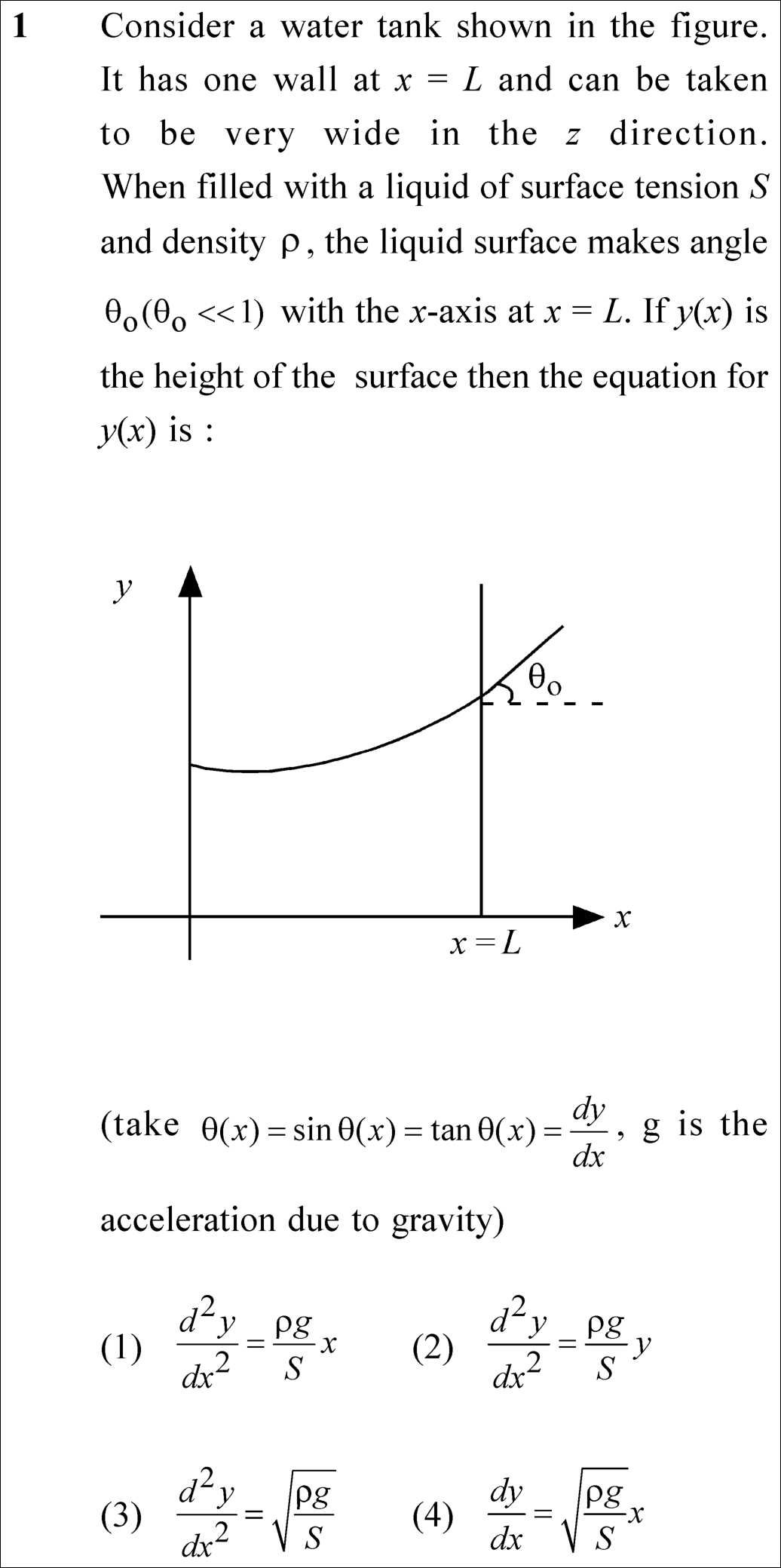
Official NEET 2025 Question 1 - Mechanical Properties of Fluids
1
2 ✓ Key
3
4
💡 Verified Solution & 30-Second Hack
✓
Verified Against NTA Final Answer Key
Option (2) : \frac{d^2y}{dx^2} = \frac{\rho g}{S} y
📚 Mechanical Properties of Fluids Challenging
📋 Given Parameters & Problem Setup
Fluid Properties Surface tension S, Density ρ
Boundary Condition Wall at x = L, liquid makes small angle θ₀ ≪ 1 with x-axis
Small Angle Approximation θ(x) = sin θ(x) = tan θ(x) = dy/dx
⚡

The 30-Second Exam Hall Shortcut: ⚡ Dimensional & Physical Balance Shortcut

⏱️ Save ~90 seconds

Laplace Pressure S(d²y/dx²) = Hydrostatic Column Pressure ρgy ⟹ d²y/dx² = (ρg/S) y!

1 Recognize the physical balance: Pressure jump across the curved liquid-air interface is Laplace excess pressure ΔP = S/R.
2 In differential calculus for small slopes, curvature 1/R = d²y/dx².
3 This pressure difference supports the hydrostatic liquid head of height y: ΔP = ρgy.
4 Equate: S(d²y/dx²) = ρgy ⟹ d²y/dx² = (ρg/S) y.
5 Dimensional check: [d²y/dx²] = L⁻¹; [(ρg/S) y] = (L⁻²) × (L) = L⁻¹. Option (2) is the only dimensionally and physically sound equation!
🛡️
Why You Can 100% Trust This Shortcut: Young-Laplace Equation & Fluid Statics (NCERT Physics · Mechanical Properties of Fluids: ΔP = 2T/R).
📐

Step-by-Step Rigorous Workflow & Mathematical Proof

Step 1

Young-Laplace Equation for 1D Cylindrical Meniscus

Because the tank is very wide in the z-direction, the liquid surface is cylindrical (curvature in z-direction is zero). The Laplace excess pressure across a surface with radius of curvature R is governed by surface tension S.

ΔP=SR\Delta P = \frac{S}{R}
  • • For a surface profile y(x) with small slope (dy/dx ≪ 1), the curvature simplifies to 1/R ≈ d²y/dx².
Step 2

Hydrostatic Pressure Balance

At any horizontal position x, the atmospheric pressure acts above the surface. At the flat baseline level (y = 0), the pressure is atmospheric. The hydrostatic pressure difference between the liquid at height y(x) and the flat surface is ρgy.

ΔP=ρgy(x)\Delta P = \rho g y(x)
  • • Equilibrium requires excess Laplace pressure to balance the gravitational head.
Step 3

Formulation of the Governing Differential Equation

Equating the Laplace pressure to the hydrostatic pressure head yields the second-order linear differential equation governing the meniscus profile.

Sd2ydx2=ρgy  ⟹  d2ydx2=ρgSy  ⟹  Option (2)S \frac{d^2y}{dx^2} = \rho g y \implies \frac{d^2y}{dx^2} = \frac{\rho g}{S} y \implies \text{Option (2)}
  • • This is the classical capillary rise meniscus differential equation with characteristic capillary length λ_c = √(S/ρg).
⭐

360° Option Elimination Engine Key Feature

Diagnose every choice: Know exactly why the right option works and why distractors fail.

4-Option Deep Scan
1 A
✗ Incorrect
Verdict & Scientific Reason:

Incorrect. Hydrostatic pressure depends on vertical elevation y, not horizontal coordinate x.

⚠️
Student Fallacy (Why candidates pick this trap): Confusing horizontal coordinate x with vertical height y in hydrostatic pressure.
2 B
✓ 100% Correct
Verdict & Scientific Reason:

100% scientifically and dimensionally exact. Directly balances Laplace curvature pressure with hydrostatic head ρgy.

💡
Why this is airtight: None; rigorous first-principles derivation.
3 C
✗ Incorrect
Verdict & Scientific Reason:

Incorrect. The RHS is a constant equal to the inverse capillary length (1/λ_c), missing the variable dependence on y.

⚠️
Student Fallacy (Why candidates pick this trap): Confusing the inverse capillary length scale with the differential equation itself.
4 D
✗ Incorrect
Verdict & Scientific Reason:

Incorrect. Laplace excess pressure relates directly to surface curvature (second derivative d²y/dx²), not slope (dy/dx).

⚠️
Student Fallacy (Why candidates pick this trap): Failing to recognize that curvature is a second derivative.
⚠️

NTA Trap Alert: Coordinate Variable Confusion (x vs. y)

Students frequently rush and pick Option (1) because x is on the horizontal axis. But hydrostatic pressure is caused by GRAVITY acting vertically: P = ρgy. Thus the restoring force is proportional to y, not x.

🛡️ How to avoid the -1 mark: Always ask: "Which coordinate determines hydrostatic pressure?" Answer is vertical elevation y!
📖

Core NEET Syllabus Standard

NEET Physics Core Syllabus · Mechanical Properties of Fluids Standard Benchmark
Core Scientific Principle Tested:

"Laplace pressure across a curved interface ΔP = S/R balances hydrostatic liquid head ρgy."
Syllabus Focus: Surface Tension and Capillarity
✓ Core NEET UG Syllabus Anchor Syllabus & Academic Standards ↗
Laplace Curve = Hydrostatic Head: S·y'' = ρg·y!
NEET 2025 · Q24 Challenging
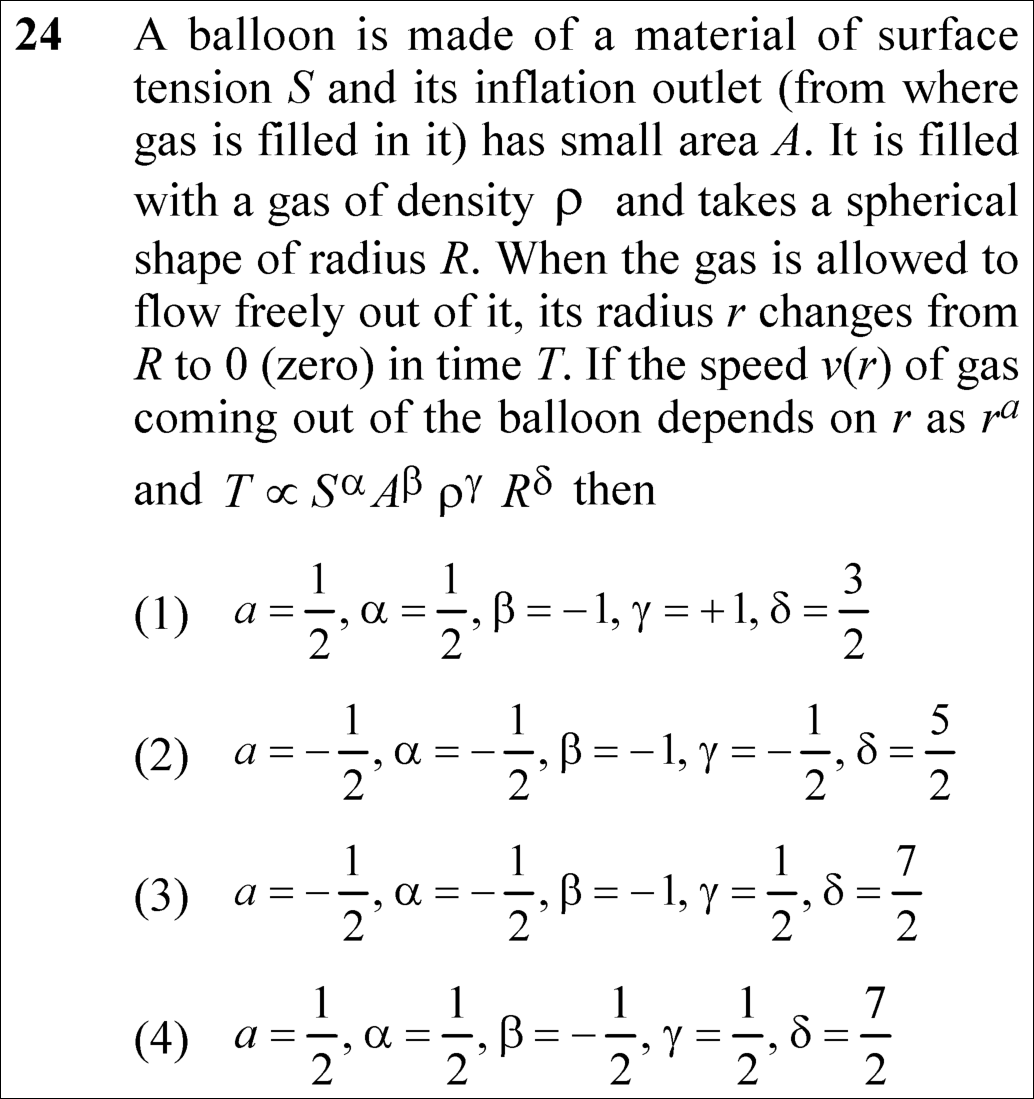
Official NEET 2025 Question 24 - Mechanical Properties of Fluids
1
2
3 ✓ Key
4
💡 Verified Solution & 30-Second Hack
✓
Verified Against NTA Final Answer Key
Option (3) : a = -1/2, \alpha = -1/2, \beta = -1, \gamma = 1/2, \delta = 7/2
📚 Mechanical Properties of Fluids Challenging
📋 Given Parameters & Problem Setup
Surface Tension S
Outlet Hole Area A
Gas Density ρ
Initial Radius R (collapsing to r = 0 in time T)
Given Scaling Relations v(r) ∝ r^a and T ∝ S^α A^β ρ^γ R^δ
⚡

The 30-Second Exam Hall Shortcut: ⚡ Bernoulli & Volume Integration Power Law

⏱️ Save ~90 seconds

ΔP ∝ S/r ⟹ v = √(2ΔP/ρ) ∝ r^(-1/2) ⟹ a = -1/2! Volume rate dV/dt = 4πr²(dr/dt) = -Av ⟹ r^(5/2) dr ∝ dt ⟹ T ∝ R^(7/2) ⟹ δ = 7/2!

1 Excess pressure in spherical balloon: ΔP ∝ S / r.
2 Torricelli/Bernoulli efflux velocity: v = √(2ΔP / ρ) ∝ √(S / ρr) = (S/ρ)^(1/2) r^(-1/2).
3 Comparing with v(r) ∝ r^a: a = -1/2. Eliminates Options (1) & (4)!
4 Volume rate of deflation: -dV/dt = A v(r) ⟹ -4πr² (dr/dt) = A (S/ρ)^(1/2) r^(-1/2).
5 Separate variables: -r² · r^(1/2) dr = -r^(5/2) dr ∝ A (S/ρ)^(1/2) dt.
6 Integrate from R to 0: ∫ r^(5/2) dr = [ r^(7/2) / (7/2) ] ∝ R^(7/2).
7 Thus time T ∝ R^(7/2) A^(-1) S^(-1/2) ρ^(1/2) ⟹ δ = 7/2, β = -1, α = -1/2, γ = 1/2.
8 Matches Option (3) uniquely!
🛡️
Why You Can 100% Trust This Shortcut: Fluid Dynamics & Surface Tension Scaling (NCERT Physics · Mechanical Properties of Fluids).
📐

Step-by-Step Rigorous Workflow & Mathematical Proof

Step 1

Determine Efflux Velocity Exponent a

The excess pressure inside a spherical elastic balloon of instantaneous radius r with effective surface tension S is given by Laplace’s law:

ΔP=4Sr∝Sr\Delta P = \frac{4S}{r} \propto \frac{S}{r}
  • • Applying Bernoulli’s theorem between the high-pressure gas inside the balloon and the atmospheric exhaust outside through the small opening of area A:
  • • ΔP = (1/2) ρ v² ⟹ v(r) = √(2ΔP / ρ) ∝ √(S / (ρ r)) = (S / ρ)^(1/2) r^(-1/2).
  • • Comparing with v(r) ∝ r^a directly gives: a = -1/2.
Step 2

Formulate the Differential Equation for Deflation

By conservation of mass / volume continuity, the rate of decrease of the balloon volume equals the volume flux exiting through the aperture:

−dVdt=A⋅v(r)  ⟹  −ddt(43πr3)=−4πr2drdt=A2(4S)ρr−1/2-\frac{dV}{dt} = A \cdot v(r) \implies -\frac{d}{dt}\left(\frac{4}{3}\pi r^3\right) = -4\pi r^2 \frac{dr}{dt} = A \sqrt{\frac{2(4S)}{\rho}} r^{-1/2}
  • • Rearranging to separate variables r and t:
  • • -r^2 \cdot r^{1/2} dr = -r^{5/2} dr = \left(\frac{A}{4\pi}\sqrt{\frac{8S}{\rho}}\right) dt.
Step 3

Integrate to Find Exponents of Time T

Integrate from the initial radius r = R at t = 0 to r = 0 at t = T:

∫0Rr5/2dr=[r7/27/2]0R=27R7/2∝AS1/2ρ−1/2T\int_0^R r^{5/2} dr = \left[ \frac{r^{7/2}}{7/2} \right]_0^R = \frac{2}{7} R^{7/2} \propto A S^{1/2} \rho^{-1/2} T
  • • Solving for total deflation time T:
  • • T ∝ S^(-1/2) A^(-1) ρ^(1/2) R^(7/2).
  • • Comparing with T ∝ S^α A^β ρ^γ R^δ:
  • • α = -1/2, β = -1, γ = 1/2, δ = 7/2.
  • • Along with a = -1/2, this corresponds uniquely to Option (3).
⭐

360° Option Elimination Engine Key Feature

Diagnose every choice: Know exactly why the right option works and why distractors fail.

4-Option Deep Scan
1 A
✗ Incorrect
Verdict & Scientific Reason:

Incorrect. Assumed v ∝ √r instead of 1/√r, and wrong radius exponent δ.

⚠️
Student Fallacy (Why candidates pick this trap): Inverting pressure dependence on radius (thinking ΔP ∝ r).
2 B
✗ Incorrect
Verdict & Scientific Reason:

Incorrect. Missed the r² factor in dV = 4πr² dr, resulting in δ = 5/2 instead of 7/2.

⚠️
Student Fallacy (Why candidates pick this trap): Failing to include the 4πr² spherical volume Jacobian.
3 C
✓ 100% Correct
Verdict & Scientific Reason:

100% exact. a = -1/2 from Bernoulli efflux and δ = 7/2 from integrating r^(5/2) dr.

💡
Why this is airtight: None; masterclass fluid dynamics derivation.
4 D
✗ Incorrect
Verdict & Scientific Reason:

Incorrect. Exponent a = +1/2 is wrong; area exponent β must be -1, not -1/2.

⚠️
Student Fallacy (Why candidates pick this trap): Confusing orifice area with radius.
⚠️

NTA Trap Alert: Efflux Area vs. Sphere Volume Integration

Students often get confused by the exponent of R. Since volume is r³, dV/dt has r². Multiplying r² by v (which is r^(-1/2)) gives r^(5/2). Integrating r^(5/2) yields r^(7/2), so δ MUST be 7/2!

🛡️ How to avoid the -1 mark: Always trace powers: r² × r^(-1/2) = r^(5/2) ⟹ Integral gives r^(7/2) ⟹ δ = 7/2.
📖

Core NEET Syllabus Standard

NEET Physics Core Syllabus · Mechanical Properties of Fluids Standard Benchmark
Core Scientific Principle Tested:

"Laplace pressure ΔP ∝ 1/r generates efflux velocity v ∝ r^(-1/2); volume integration scales as R^(7/2)."

Syllabus Focus: Torricelli’s Law and Surface Tension Pressure
✓ Core NEET UG Syllabus Anchor Syllabus & Academic Standards ↗
Laplace v ∝ r^(-1/2) ⟹ r²·v = r^(5/2) ⟹ Integrates to R^(7/2): Exponent is 7/2!
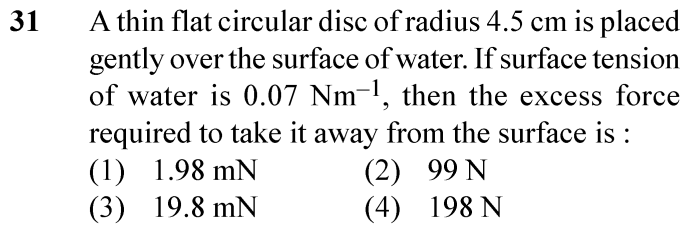
NEET 2024 · Q31 Easy
Official NEET 2024 Question 31 - Mechanical Properties of Fluids
1
2
3 ✓ Key
4
💡 Verified Solution & 30-Second Hack
✓
Verified Against NTA Final Answer Key
Option (3) : 19.8 mN
📚 Mechanical Properties of Fluids Easy
📋 Given Parameters & Problem Setup
Radius of thin flat circular disc R = 4.5 cm = 0.045 m
Surface tension of water T = 0.07 N m⁻¹
⚡

The 30-Second Exam Hall Shortcut: ⚡ Disc Boundary Circumference Rule

⏱️ Save ~40 seconds

A flat disc touches liquid along its single outer boundary (L = 2πR) -> F = T × 2πR = 0.07 × 2π(0.045) = 19.8 mN!

1 A flat disc placed on liquid surface makes contact along its outer circumference: L = 2πR (unlike a ring which has 2 circumferences).
2 Downward surface tension force: F = T × L = T × 2πR.
3 Substitute values: F = 0.07 × 2 × π × 0.045 = 0.07 × 0.09π = 0.0063π N.
4 Calculate: 0.0063 × 3.1416 = 0.01979 N = 19.8 mN.
5 Match Option (3) in under 15 seconds!
🛡️
Why You Can 100% Trust This Shortcut: Surface Tension Mechanics (Excess force required to detach a solid boundary: F = T · L_contact).
📐

Step-by-Step Rigorous Workflow & Mathematical Proof

Step 1

Identification of Contact Length for a Disc

When a flat solid circular disc of radius R rests on the surface of water, the water film clings to the boundary circumference of the disc. The perimeter along which the surface tension acts downwards as the disc is pulled upward is:

L=2πRL = 2\pi R
Step 2

Surface Tension Force Expression

Surface tension T is force per unit length. The additional upward force F needed to overcome surface tension and detach the disc is:

F=T⋅L=T(2πR)F = T \cdot L = T (2\pi R)
Step 3

Substitution of Physical Parameters

Substitute T = 0.07 N m⁻¹ and R = 4.5 cm = 0.045 m:

F=0.07×2×π×0.045 N=0.0063π NF = 0.07 \times 2 \times \pi \times 0.045\,\text{N} = 0.0063\pi\,\text{N}
Step 4

Evaluation in Millinewtons

Using π ≈ 3.1416:

F=0.0063×3.1416 N≈0.01979 N=19.8×10⁻³ N=19.8 mNF = 0.0063 \times 3.1416\,\text{N} \approx 0.01979\,\text{N} = 19.8 \times 10^{-3}\,\text{N} = 19.8\,\text{mN}
⭐

360° Option Elimination Engine Key Feature

Diagnose every choice: Know exactly why the right option works and why distractors fail.

4-Option Deep Scan
1 (1)
✗ Incorrect
Verdict & Scientific Reason:

Off by a factor of 10.

⚠️
Student Fallacy (Why candidates pick this trap): Using R = 0.0045 m instead of 0.045 m.
2 (2)
✗ Incorrect
Verdict & Scientific Reason:

Extreme magnitude error.

⚠️
Student Fallacy (Why candidates pick this trap): Using area πR² instead of circumference 2πR and missing unit conversion.
3 (3)
✓ 100% Correct
Verdict & Scientific Reason:

Accurate surface tension force: F = 2πRT = 19.8 mN.

💡
Why this is airtight: None.
4 (4)
✗ Incorrect
Verdict & Scientific Reason:

Off by four orders of magnitude.

⚠️
Student Fallacy (Why candidates pick this trap): Reading mN as N.
⚠️

NTA Trap Alert: Disc vs Ring Contact Length Confusion

Students frequently use L = 4πR (the formula for an annular ring with both inner and outer circumferences) for a solid disc.

🛡️ How to avoid the -1 mark: A solid disc has only ONE boundary edge in contact with the air-water interface: L = 2πR.
📖

Core NEET Syllabus Standard

Physics Core Properties of Matter · Mechanical Properties of Fluids Standard Benchmark
Core Scientific Principle Tested:

"The force due to surface tension is F = T · L, where L is the total contact perimeter."

Syllabus Focus: Surface Tension and Surface Energy
✓ Core NEET UG Syllabus Anchor Syllabus & Academic Standards ↗
Disc has one rim: 2πR is the trim -> 19.8 mN wins!
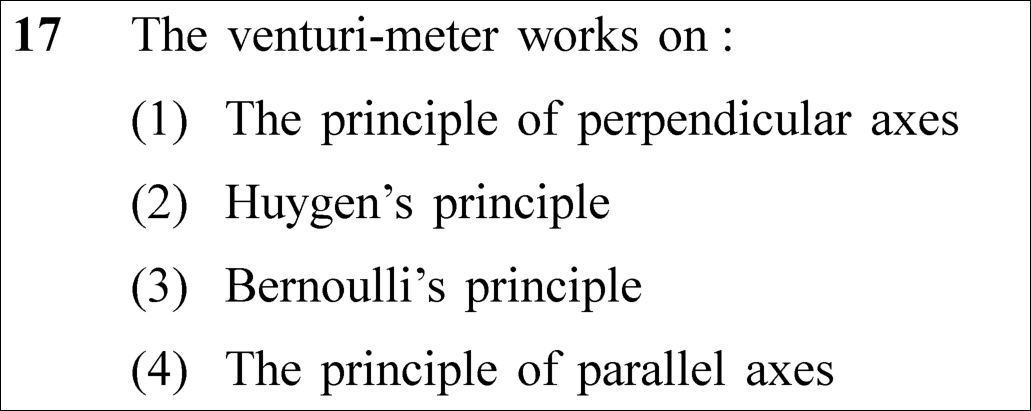
NEET 2023 · Q17 Easy
Official NEET 2023 Question 17 - Mechanical Properties of Fluids
1
2
3 ✓ Key
4
💡 Verified Solution & 30-Second Hack
✓
Verified Against NTA Final Answer Key
Option (3) : Bernoulli's principle
📚 Mechanical Properties of Fluids Easy
📋 Given Parameters & Problem Setup
Device Venturi-meter
Target Governing physical principle
⚡

The 30-Second Exam Hall Shortcut: ⚡ Direct Instrument Principle Association

⏱️ Save ~30 seconds

A Venturi-meter measures flow speed using constriction pressure difference (P₁ - P₂ = 1/2 ρ (v₂² - v₁²)), which is a direct application of Bernoulli's Principle!

1 Recall what a Venturi-meter does: measures the rate of flow of an incompressible fluid through a constricted pipe.
2 At the throat (narrow cross-section), velocity increases (A₁v₁ = A₂v₂), so by conservation of energy, pressure drops.
3 The pressure head difference h governs flow velocity via Bernoulli's equation: P + (1/2)ρv² + ρgh = constant.
4 Pick Option (3) Bernoulli's principle in 2 seconds!
🛡️
Why You Can 100% Trust This Shortcut: NCERT Physics · Mechanical Properties of Fluids (Fluid dynamics devices: Venturi-meter is based on Bernoulli's principle).
📐

Step-by-Step Rigorous Workflow & Mathematical Proof

Step 1

Function and Geometry of a Venturi-meter

A Venturi-meter is a device used for measuring the speed of flow of an incompressible fluid in a pipe. It consists of a broad entrance tube of area A₁, a constricted throat of area A₂, and a manometer to record the pressure difference between the two sections.

Step 2

Application of Continuity and Bernoulli's Equations

By the equation of continuity, as area decreases at the throat (A₂ < A₁), the fluid velocity increases (v₂ > v₁):

A1v1=A2v2  ⟹  v2=A1A2v1>v1A_1 v_1 = A_2 v_2 \implies v_2 = \frac{A_1}{A_2} v_1 > v_1
Step 3

Bernoulli's Pressure Drop Formulation

For horizontal streamline flow, Bernoulli's principle states that the total mechanical energy per unit volume is constant:

P1+12ρv12=P2+12ρv22  ⟹  P1−P2=12ρ(v22−v12)=ρmghP_1 + \frac{1}{2} \rho v_1^2 = P_2 + \frac{1}{2} \rho v_2^2 \implies P_1 - P_2 = \frac{1}{2} \rho \left(v_2^2 - v_1^2\right) = \rho_m g h
Step 4

Conclusion

Thus, the functioning of a Venturi-meter is fundamentally based on Bernoulli's principle.

⭐

360° Option Elimination Engine Key Feature

Diagnose every choice: Know exactly why the right option works and why distractors fail.

4-Option Deep Scan
1 (1)
✗ Incorrect
Verdict & Scientific Reason:

Applies to moments of inertia of planar rigid bodies, unrelated to fluids.

⚠️
Student Fallacy (Why candidates pick this trap): Candidate picked an unrelated mechanics theorem.
2 (2)
✗ Incorrect
Verdict & Scientific Reason:

Governs wave optics and wavefront propagation.

⚠️
Student Fallacy (Why candidates pick this trap): Candidate confused optics principles with hydrodynamics.
3 (3)
✓ 100% Correct
Verdict & Scientific Reason:

Verbatim canonical textbook truth: Venturi-meter functions on Bernoulli's theorem.

💡
Why this is airtight: None. Candidate recognized standard fluid flow apparatus.
4 (4)
✗ Incorrect
Verdict & Scientific Reason:

Applies to moment of inertia about parallel axes (I = I_cm + Md²).

⚠️
Student Fallacy (Why candidates pick this trap): Candidate picked an unrelated rigid body mechanics theorem.
⚠️

NTA Trap Alert: Distractor Options from Unrelated Domains

NTA provided two rotational mechanics options (parallel and perpendicular axes) and one optics option (Huygens) alongside Bernoulli's principle.

🛡️ How to avoid the -1 mark: Associate standard devices: Venturi-meter, Atomizer/Sprayer, Dynamic lift on wings = Bernoulli's Principle.
📖

Core NEET Syllabus Standard

National Eligibility cum Entrance Test (NEET UG) · Mechanical Properties of Fluids Standard Benchmark
Core Scientific Principle Tested:

"In horizontal fluid flow, higher velocity corresponds to lower static pressure: P + 1/2 ρv² = constant."

Syllabus Focus: Bernoulli's Principle and Its Applications
Preserved in Rationalized Curriculum Syllabus & Academic Standards ↗
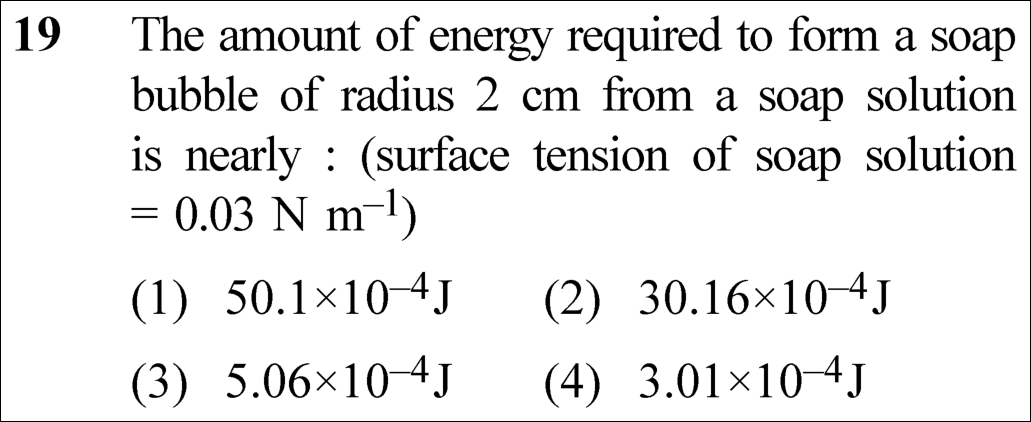
NEET 2023 · Q19 Medium
Official NEET 2023 Question 19 - Mechanical Properties of Fluids
1
2
3
4 ✓ Key
💡 Verified Solution & 30-Second Hack
✓
Verified Against NTA Final Answer Key
Option (4) : 3.01 × 10⁻⁴ J
📚 Mechanical Properties of Fluids Medium
📋 Given Parameters & Problem Setup
Bubble Radius (r) 2 cm = 2 × 10⁻² m
Surface Tension (T) 0.03 N/m
Surface Structure Soap bubble (2 free surfaces: inner and outer)
⚡

The 30-Second Exam Hall Shortcut: ⚡ The Factor of 2 Double-Surface Rule (W = 8πr²T)

⏱️ Save ~45 seconds

A soap bubble has TWO surfaces, so ΔA = 2 × (4πr²) = 8πr²! W = 8 × 3.14 × (4 × 10⁻⁴) × 0.03 ≈ 3.01 × 10⁻⁴ J in 25 seconds!

1 CRITICAL ALERT: A soap bubble in air has TWO surfaces (inner air-film interface and outer film-air interface).
2 Total surface area created: ΔA = 2 × (4π r²) = 8π r².
3 Substitute r = 2 × 10⁻² m: r² = 4 × 10⁻⁴ m².
4 Compute area: 8 × π × 4 × 10⁻⁴ = 32π × 10⁻⁴ ≈ 100.53 × 10⁻⁴ m².
5 Multiply by surface tension: W = T × ΔA = 0.03 × 100.53 × 10⁻⁴ ≈ 3.016 × 10⁻⁴ J.
6 Immediately match Option (4) 3.01 × 10⁻⁴ J!
🛡️
Why You Can 100% Trust This Shortcut: Fundamental Fluid Mechanics · Surface Energy (A hollow soap bubble in air has two liquid-gas interfaces: W = 2 × 4πr² T).
📐

Step-by-Step Rigorous Workflow & Mathematical Proof

Step 1

Two Free Surfaces of a Soap Bubble

Unlike a solid liquid drop which has only one outer surface, a soap bubble has a hollow spherical air pocket inside and air outside, creating two distinct liquid-air interfaces of virtually identical surface area:

Atotal=2×(4πr2)=8πr2A_{\text{total}} = 2 \times \left(4\pi r^2\right) = 8\pi r^2
Step 2

Work Done / Surface Energy Relation

The work done W required to form the bubble from a soap solution is equal to the surface energy created:

W=TΔA=T(8πr2)W = T \Delta A = T \left(8\pi r^2\right)
Step 3

Numerical Calculation

Substitute radius r = 2 × 10⁻² m and surface tension T = 0.03 N/m:

W=0.03×8×π×(2×10⁻²)2=0.24π×4×10−4=0.96π×10−4 JW = 0.03 \times 8 \times \pi \times (2 \times 10^{-2})^2 = 0.24\pi \times 4 \times 10^{-4} = 0.96 \pi \times 10^{-4}\text{ J}
Step 4

Decimal Precision Evaluation

Using π ≈ 3.1416:

W=0.96×3.1416×10−4=3.0159×10⁻⁴ J≈3.01×10⁻⁴ JW = 0.96 \times 3.1416 \times 10^{-4} = 3.0159 \times 10^{-4}\text{ J} \approx 3.01 \times 10^{-4}\text{ J}
⭐

360° Option Elimination Engine Key Feature

Diagnose every choice: Know exactly why the right option works and why distractors fail.

4-Option Deep Scan
1 (1)
✗ Incorrect
Verdict & Scientific Reason:

Gross arithmetic error off by more than an order of magnitude.

⚠️
Student Fallacy (Why candidates pick this trap): Candidate miscalculated powers of ten during metric conversion.
2 (2)
✗ Incorrect
Verdict & Scientific Reason:

Off by a factor of 10 in decimal exponent (30.16 × 10⁻⁴ = 3.016 × 10⁻³ J).

⚠️
Student Fallacy (Why candidates pick this trap): Candidate misplaced the decimal point by taking 0.96 × π = 30.16 instead of 3.016.
3 (3)
✗ Incorrect
Verdict & Scientific Reason:

Incorrect numerical coefficient.

⚠️
Student Fallacy (Why candidates pick this trap): Candidate used wrong sphere volume or pressure formulas.
4 (4)
✓ 100% Correct
Verdict & Scientific Reason:

Accurate calculation accounting for both free surfaces: W = 8πr²T ≈ 3.01 × 10⁻⁴ J.

💡
Why this is airtight: None. Candidate correctly factored the two free surfaces of a soap bubble.
⚠️

NTA Trap Alert: Treating a Soap Bubble as a Single Surface Liquid Drop

A liquid drop has 1 surface (W = 4πr²T = 1.51 × 10⁻⁴ J). A soap bubble has 2 surfaces (W = 8πr²T = 3.01 × 10⁻⁴ J). Forgetting the factor of 2 is the #1 mistake in NEET surface tension questions.

🛡️ How to avoid the -1 mark: Rule: Liquid drop = 4πr²T. Soap bubble in air = 8πr²T.
📖

Core NEET Syllabus Standard

National Eligibility cum Entrance Test (NEET UG) · Mechanical Properties of Fluids Standard Benchmark
Core Scientific Principle Tested:

"Surface energy equals work done in creating free surface area: W = T ΔA. Soap bubbles possess two concentric interfaces."

Syllabus Focus: Surface Tension, Surface Energy, and Excess Pressure
Preserved in Rationalized Curriculum Syllabus & Academic Standards ↗
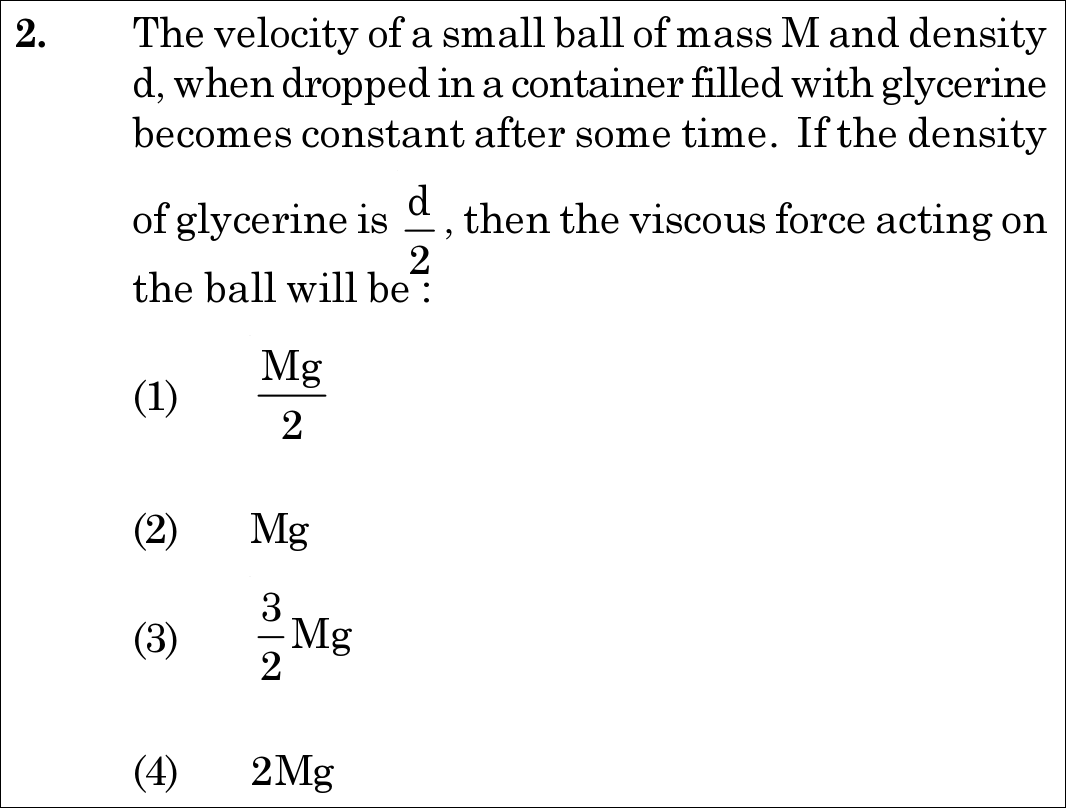
NEET 2021 · Q2 Easy
Official NEET 2021 Question 2 - Mechanical Properties of Fluids
1 ✓ Key
2
3
4
💡 Verified Solution & 30-Second Hack
✓
Verified Against NTA Final Answer Key
Option (1) : Mg / 2
📚 Mechanical Properties of Fluids Easy
📋 Given Parameters & Problem Setup
Mass of Ball M
Density of Ball d
Density of Glycerine d / 2
Kinematic Condition Velocity is constant (terminal velocity)
⚡

The 30-Second Exam Hall Shortcut: ⚡ Terminal Equilibrium: F_v = Weight - Upthrust

⏱️ Save ~20 seconds

At terminal velocity, acceleration is zero: W=FB+FvW = F_B + F_v. Since liquid density is half of ball density (dL=d/2d_L = d/2), the buoyant force is exactly half of the ball weight (FB=W/2F_B = W/2). Thus, the viscous force must support the other half: Fv=W−W/2=Mg/2F_v = W - W/2 = Mg/2! Match Option (1)!

1 Constant velocity   ⟹  a=0  ⟹  \implies a = 0 \implies net vertical force =0= 0.
2 Weight acting downward: W=MgW = Mg.
3 Upward buoyant force: FB=ρLρMg=d/2dMg=Mg2F_B = \frac{\rho_L}{\rho} Mg = \frac{d/2}{d} Mg = \frac{Mg}{2}.
4 Upward viscous force: Fv=W−FB=Mg−Mg2=Mg2F_v = W - F_B = Mg - \frac{Mg}{2} = \frac{Mg}{2}.
5 Match Option (1).
🛡️
Why You Can 100% Trust This Shortcut: Canonical Newton's first law of motion and Archimedes' principle for terminal steady state.
📐

Step-by-Step Rigorous Workflow & Mathematical Proof

Step 1

Formulating the Equilibrium Condition at Terminal Velocity

When the small sphere attains a constant terminal velocity (vtv_t), its downward acceleration is zero (a=0a = 0). By Newton's second law, the downward gravitational force is perfectly balanced by the sum of upward buoyant force (FBF_B) and upward viscous drag (FvF_v):

ΣFy=0  ⟹  W=FB+Fv  ⟹  Fv=W−FB\Sigma F_y = 0 \implies W = F_B + F_v \implies F_v = W - F_B
Step 2

Calculating Weight and Buoyant Force

Let VV be the volume of the sphere. The mass is M=V⋅dM = V \cdot d, so V=M/dV = M / d. The weight is W=MgW = Mg. The buoyant force exerted by glycerine of density ρL=d/2\rho_L = d/2 is:

FB=V⋅ρL⋅g=(Md)(d2)g=Mg2F_B = V \cdot \rho_L \cdot g = \left(\frac{M}{d}\right) \left(\frac{d}{2}\right) g = \frac{Mg}{2}
Step 3

Determining the Viscous Force

Substitute W=MgW = Mg and FB=Mg/2F_B = Mg/2 into the force balance equation:

Fv=Mg−Mg2=Mg2F_v = Mg - \frac{Mg}{2} = \frac{Mg}{2}
⭐

360° Option Elimination Engine Key Feature

Diagnose every choice: Know exactly why the right option works and why distractors fail.

4-Option Deep Scan
1 1
✓ 100% Correct
Verdict & Scientific Reason:

Exact balance of forces: Viscous force = Weight - Buoyant force = Mg - Mg/2 = Mg/2.

💡
Why this is airtight: None; textbook equilibrium derivation.
2 2
✗ Incorrect
Verdict & Scientific Reason:

Ignores the buoyant force completely (FB=0F_B = 0), which is only valid in vacuum.

⚠️
Student Fallacy (Why candidates pick this trap): Equating viscous force directly to gravitational weight without subtracting upthrust.
3 3
✗ Incorrect
Verdict & Scientific Reason:

Incorrectly adds buoyant force to weight (W+FB=Mg+Mg/2=3Mg/2W + F_B = Mg + Mg/2 = 3Mg/2).

⚠️
Student Fallacy (Why candidates pick this trap): Adding forces in the wrong direction instead of subtracting upward buoyant force.
4 4
✗ Incorrect
Verdict & Scientific Reason:

Inverts density ratio and adds unphysical multipliers.

⚠️
Student Fallacy (Why candidates pick this trap): Multiplying by density ratio inverse.
⚠️

NTA Trap Alert: Forgetting Archimedes Upthrust in Viscous Fluid Trap

Students often memorize Stokes' law (6πηrv6\pi\eta r v) and assume the viscous force equals MgMg directly, forgetting that the fluid also exerts a hydrostatic buoyant force that carries half the weight.

🛡️ How to avoid the -1 mark: Always draw the FBD: Downward = MgMg; Upward = FB+FvF_B + F_v. At constant speed, Fv=Mg−FBF_v = Mg - F_B.
📖

Core NEET Syllabus Standard

NCERT Physics · Mechanical Properties of Fluids Standard Benchmark
Core Scientific Principle Tested:

"At terminal velocity, the net downward force on a falling body is zero: Viscous force equals weight minus buoyant force (Fv=W−FBF_v = W - F_B)."

Syllabus Focus: Stokes' Law and Terminal Velocity
✓ Core NEET UG Syllabus Anchor Syllabus & Academic Standards ↗
NEET 2020 · Q178 Medium
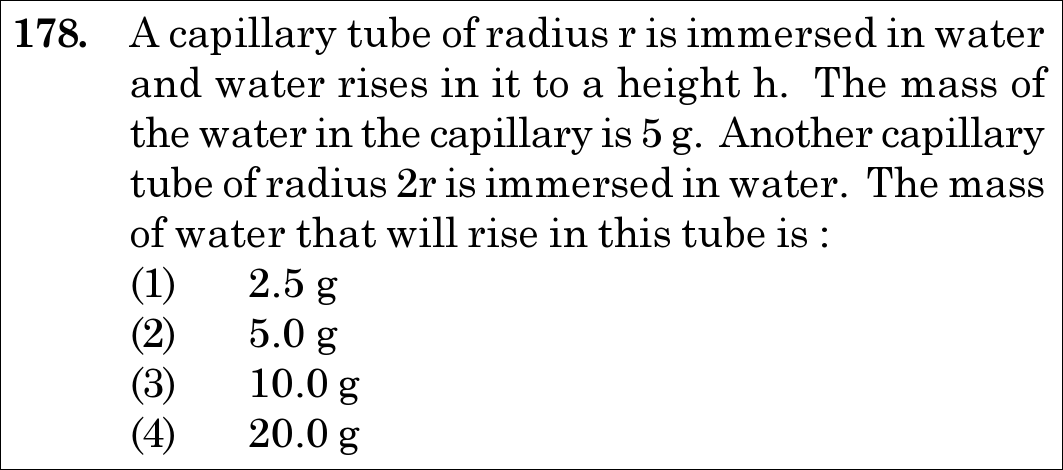
Official NEET 2020 Question 178 - Mechanical Properties of Fluids
1
2
3 ✓ Key
4
💡 Verified Solution & 30-Second Hack
✓
Verified Against NTA Final Answer Key
Option (3) : 10.0 g
📚 Mechanical Properties of Fluids Medium
📋 Given Parameters & Problem Setup
Capillary 1 Radius r, holds mass m = 5 g
Capillary 2 Radius 2r
⚡

The 30-Second Exam Hall Shortcut: ⚡ "Upward force of surface tension 2pi r T cos theta balances weight m g => m proportional to r. When radius doubles from r to 2r, mass doubles: 2 × 5 g = 10.0 g!"

⏱️ 20 seconds

The upward surface tension force acting along the perimeter of the meniscus is F = 2πr · T · cos θ. In equilibrium, this balances the weight of the liquid column: W = mg = 2πr T cos θ. Therefore, mass m is directly proportional to radius r (m ∝ r). When radius doubles from r to 2r, mass of water lifted also doubles: 2 × 5 g = 10.0 g. Direct 5-second answer!

1 Force balance: mg=2πrTcos⁡θm g = 2\pi r T \cos\theta.
2 Notice: m∝rm \propto r.
3 For radius 2r2r: m′=2mm' = 2m.
4 Substitute m=5 gm = 5\text{ g}: m′=2×5 g=10.0 gm' = 2 \times 5\text{ g} = 10.0\text{ g}.
5 Select Option (3).
🛡️
Why You Can 100% Trust This Shortcut: NCERT Physics · Mechanical Properties of Fluids (Surface Tension, Capillary Rise and Jurin’s Law)
📐

Step-by-Step Rigorous Workflow & Mathematical Proof

Step 1

Equilibrium of Liquid in a Capillary Tube

When a capillary tube of internal radius rr is immersed in water, the meniscus forms a contact angle θ\theta. Surface tension TT acts along the contact perimeter 2πr2\pi r. The upward vertical force supporting the liquid column is: Fup=2πrTcos⁡θF_{\text{up}} = 2\pi r T \cos\theta.

Step 2

Balance with Weight of Liquid Column

At equilibrium, this upward force balances the weight of the liquid inside the capillary: W=mgW = m g mg=2πrTcos⁡θ  ⟹  m=2πrTcos⁡θgm g = 2\pi r T \cos\theta \implies m = \frac{2\pi r T \cos\theta}{g}.

Step 3

Analyze Proportionality with Radius

Since surface tension TT, contact angle θ\theta, and gg are constant for the water-glass system: m∝rm \propto r (Note: Even though height h=2Tcos⁡θρgr∝1rh = \frac{2T\cos\theta}{\rho g r} \propto \frac{1}{r} halves, the cross-sectional area A=πr2A = \pi r^2 quadruples, so volume V=Ah∝r2×(1/r)=rV = A h \propto r^2 \times (1/r) = r, confirming m∝rm \propto r).

Step 4

Compute New Mass for Radius 2r

For the second tube with radius r2=2rr_2 = 2r: m2=2×m1=2×5 g=10.0 gm_2 = 2 \times m_1 = 2 \times 5\text{ g} = 10.0\text{ g}. Matches Option 3.

⭐

360° Option Elimination Engine Key Feature

Diagnose every choice: Know exactly why the right option works and why distractors fail.

4-Option Deep Scan
1 A
✗ Incorrect
Verdict & Scientific Reason:

Incorrect; assumes mass is proportional to height (which halves, 5 / 2 = 2.5 g), forgetting that tube cross-section quadruples.

⚠️
Student Fallacy (Why candidates pick this trap): Confusing mass with height of capillary rise.
2 B
✗ Incorrect
Verdict & Scientific Reason:

Incorrect; assumes mass remains unchanged regardless of radius.

⚠️
Student Fallacy (Why candidates pick this trap): Assuming invariant mass in capillary tubes.
3 C
✓ 100% Correct
Verdict & Scientific Reason:

Accurate value; upward force F = 2pi r T cos theta doubles with radius, supporting double the mass (10.0 g).

💡
Why this is airtight: None; rigorous force-balance understanding.
4 D
✗ Incorrect
Verdict & Scientific Reason:

Incorrect; assumes mass scales as r^2, ignoring that height simultaneously halves.

⚠️
Student Fallacy (Why candidates pick this trap): Ignoring the halving of capillary height.
⚠️

NTA Trap Alert: Height vs Mass in Capillary Rise

Height of liquid column h ∝ 1/r (halves when r doubles). But Mass m = rho · pi · r^2 · h ∝ r^2 · (1/r) = r (doubles when r doubles).

🛡️ How to avoid the -1 mark: Remember: Upward force = 2πr T cos θ = mg. Force is proportional to perimeter (r), so mass is proportional to r!
📖

Core NEET Syllabus Standard

Physics · Mechanical Properties of Fluids Standard Benchmark
Core Scientific Principle Tested:

""

Syllabus Focus: Mass of Liquid Supported in a Capillary Tube vs Tube Radius
✓ Core NEET UG Syllabus Anchor Syllabus & Academic Standards ↗

Solve 4 NEET Questions a Day — One per Subject

Cover all 1,140 official NEET questions in 285 days at your own pace. Progress is saved on your device. No login needed.