MyCompetitiveExams Logo MyCompetitiveExams
Search 1,140+ Questions
Chapters, formulas, speed tricks
→
⚡ Brahmastra NEET 2027
720 MARKS

Dynamic 180-question full-length simulator mixed dynamically from all 6 years for 2027 & 2026 aspirants.

Launch Brahmastra 2027 Test →
Start Practice →
100% Free · No Login Required
Q.4 Physics ⭐ 360° Option Elimination Active
Vault ↗

NEET 2025 Physics Question 4 Solution

Topic: Laws of Motion · Official NTA Booklet Code 45
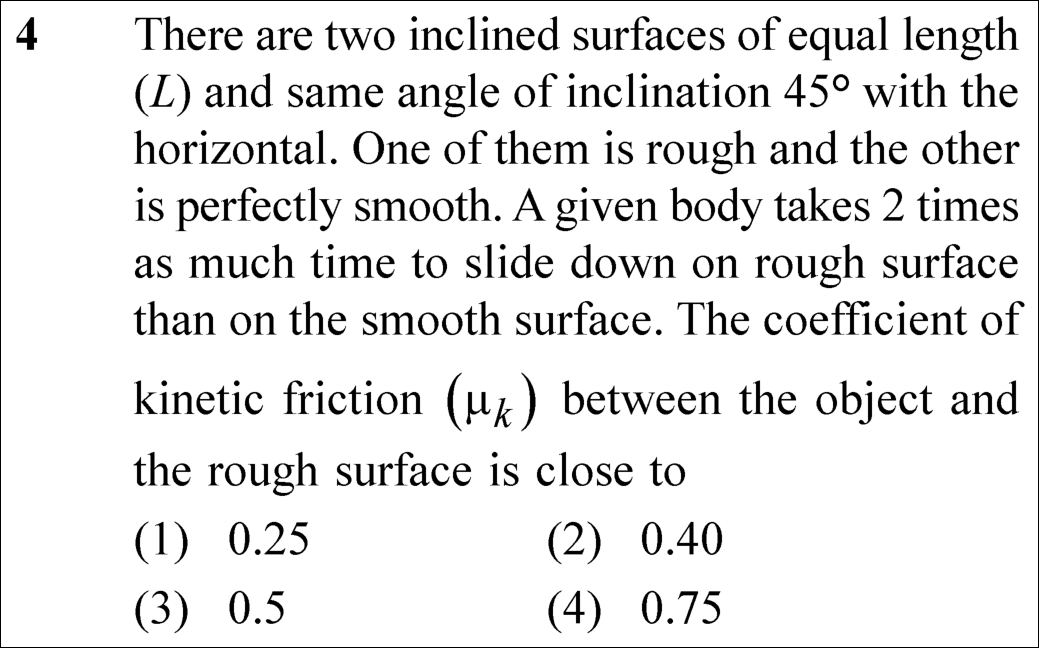
NEET 2025 Physics Question 4: Coefficient of Kinetic Friction from Time of Descent Ratio

Question

There are two inclined surfaces of equal length (L) and same angle of inclination 45° with the horizontal. One of them is rough and the other is perfectly smooth. A given body takes 2 times as much time to slide down on rough surface than on the smooth surface. The coefficient of kinetic friction (μₖ) between the object and the rough surface is close to

✓
Verified Against NTA Final Answer Key
Option (4) : 0.75
📚 Laws of Motion Easy
📋 Given Parameters & Problem Setup
Inclination Angle (θ) 45° (tan 45° = 1)
Incline Length (L) Equal length L for both smooth and rough
Time Ratio t_rough = 2 × t_smooth (n = 2)
⚡

The 30-Second Exam Hall Shortcut: ⚡ Incline Friction Master Formula

⏱️ Save ~50 seconds

μ_k = tan θ [1 - (1 / n²)] = tan 45° [1 - (1 / 2²)] = 1 × (1 - 0.25) = 0.75!

1 Recall canonical time-ratio formula for rough vs smooth incline of equal length: μ = tan θ (1 - 1/n²).
2 Identify: θ = 45° ⟹ tan 45° = 1.
3 Identify time multiplier: n = 2 ⟹ n² = 4.
4 Compute: μ_k = 1 × (1 - 1/4) = 3/4 = 0.75.
5 Select Option (4) in under 10 seconds!
🛡️
Why You Can 100% Trust This Shortcut: Fundamental Mechanics · Laws of Motion (Newton's Third Law & Normal Contact Force: N = mg + ma).
📐

Step-by-Step Rigorous Workflow & Mathematical Proof

Step 1

Accelerations on Smooth and Rough Inclines

On a frictionless incline of angle θ, the acceleration is simply the component of gravity along the incline. On a rough incline with coefficient of kinetic friction μ_k, kinetic friction opposes motion.

asmooth=gsin⁡θ,arough=g(sin⁡θ−μkcos⁡θ)a_{smooth} = g \sin\theta, \quad a_{rough} = g(\sin\theta - \mu_k \cos\theta)
  • • Normal reaction N = mg cos θ; limiting kinetic friction f_k = μ_k mg cos θ.
Step 2

Relate Acceleration to Time of Descent

Starting from rest over length L, the distance formula gives L = (1/2) a t², meaning t ∝ 1/√a. Taking the ratio of times:

troughtsmooth=asmootharough=n  ⟹  asmootharough=n2\frac{t_{rough}}{t_{smooth}} = \sqrt{\frac{a_{smooth}}{a_{rough}}} = n \implies \frac{a_{smooth}}{a_{rough}} = n^2
  • • Given n = 2, so n² = 4.
Step 3

Derive and Calculate μ_k

Substitute the acceleration expressions into the ratio and solve for μ_k:

gsin⁡θg(sin⁡θ−μkcos⁡θ)=n2  ⟹  μk=tan⁡θ(1−1n2)=tan⁡45∘(1−14)=0.75\frac{g\sin\theta}{g(\sin\theta - \mu_k\cos\theta)} = n^2 \implies \mu_k = \tan\theta\left(1 - \frac{1}{n^2}\right) = \tan 45^\circ\left(1 - \frac{1}{4}\right) = 0.75
  • • Matches Option (4) exactly.
⭐

360° Option Elimination Engine Key Feature

Diagnose every choice: Know exactly why the right option works and why distractors fail.

4-Option Deep Scan
1 A
✗ Incorrect
Verdict & Scientific Reason:

Incorrect. 0.25 is 1/n² = 1/4, forgetting to subtract it from 1.

⚠️
Student Fallacy (Why candidates pick this trap): Taking 1/n² directly instead of (1 - 1/n²).
2 B
✗ Incorrect
Verdict & Scientific Reason:

Incorrect. Arbitrary guessing.

⚠️
Student Fallacy (Why candidates pick this trap): Guessing a typical friction value.
3 C
✗ Incorrect
Verdict & Scientific Reason:

Incorrect. Mistakenly using 1 - 1/n = 1 - 1/2 = 0.5 without squaring n.

⚠️
Student Fallacy (Why candidates pick this trap): Forgetting that time is squared in kinematic distance relations.
4 D
✓ 100% Correct
Verdict & Scientific Reason:

100% exact. μ_k = tan 45° (1 - 1/4) = 3/4 = 0.75.

💡
Why this is airtight: None; textbook physics.
⚠️

NTA Trap Alert: Linear vs. Quadratic Time Scaling

A common student slip is writing a_smooth / a_rough = n instead of n². Distance is quadratic in time (s = 1/2 at²), so acceleration ratio equals n².

🛡️ How to avoid the -1 mark: Always remember: t ∝ 1/√a ⟹ a ratio = n²!
📖

Core NEET Syllabus Standard

NEET Physics Core Syllabus · Laws of Motion Standard Benchmark
Core Scientific Principle Tested:

"Time of descent on rough incline of angle θ relates to smooth incline by μ = tan θ (1 - 1/n²)."

Syllabus Focus: Friction · Motion on an Inclined Plane
✓ Core NEET UG Syllabus Anchor Syllabus & Academic Standards ↗
n-Times Slower = 1 minus 1/n²: 1 - 1/4 = 0.75!

Ready to attempt under real exam pressure?

Test your speed and accuracy in the authentic 180-minute timed NTA simulator.

Launch NEET 2025 CBT Test →

Spotted a mistake in this solution? Report an error ([email protected])

⚖️ Legal & Fair Dealing Notice: Sourced from publicly released NEET 2025 question papers and NEET answer keys for private study, research, and non-commercial educational practice under Fair Dealing (Section 52(1)(a) of the Indian Copyright Act, 1957). Not affiliated with or endorsed by NTA or NMC.

Solve 4 NEET Questions a Day — One per Subject

Cover all 1,140 official NEET questions in 285 days at your own pace. Progress is saved on your device. No login needed.