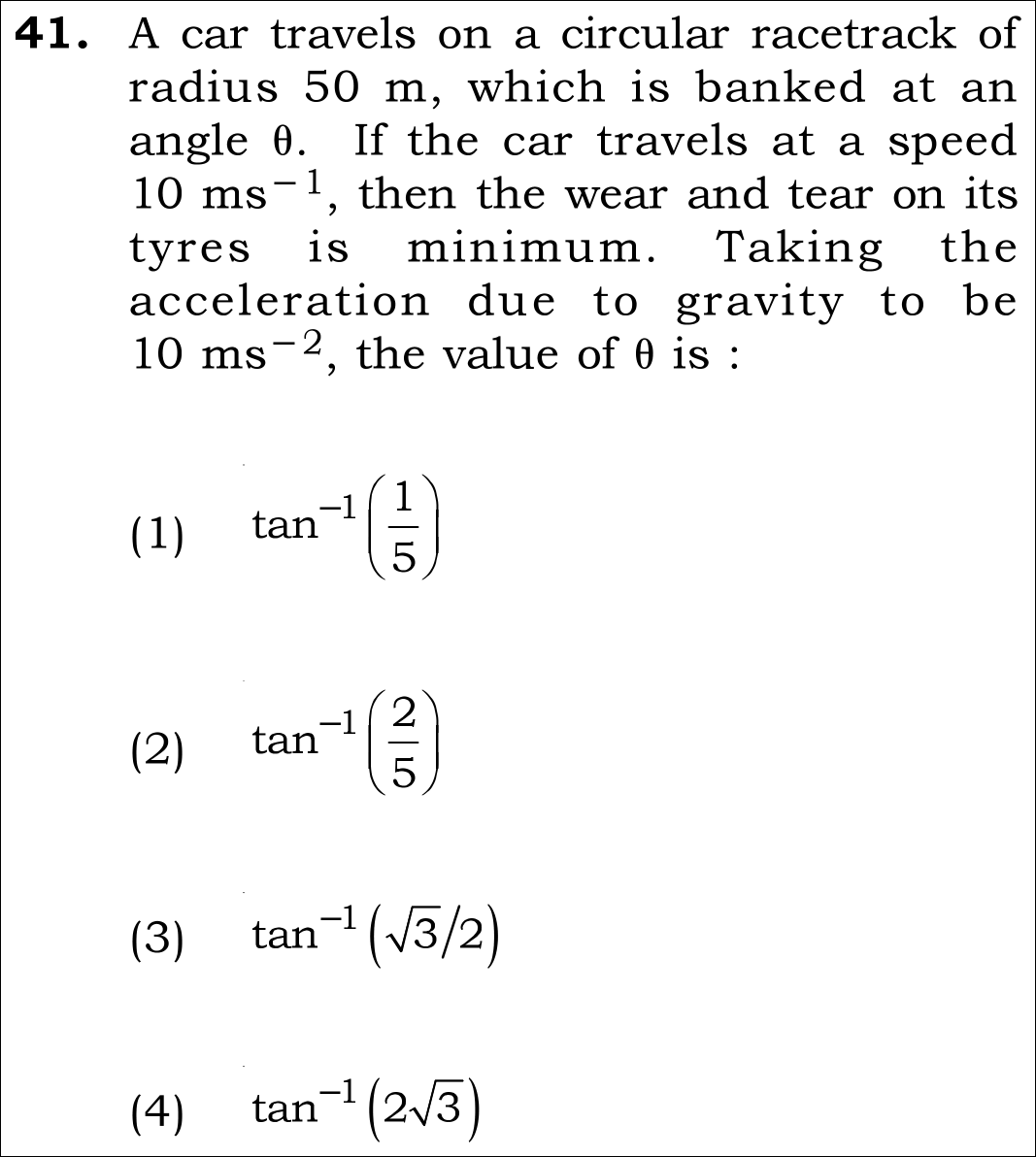
The 30-Second Exam Hall Shortcut: ⚡ Optimum Banking Formula Shortcut
Zero wear and tear means zero sideways friction: tan(theta) = v^2 / (r * g)!
Step-by-Step Rigorous Workflow & Mathematical Proof
Understand the Physical Meaning of "Minimum Wear and Tear"
Tyre wear and tear occurs due to sideways frictional forces between the tyres and the road surface:
- • When a vehicle travels at the design speed on a banked road, no lateral friction is demanded.
- • Centripetal acceleration is supplied entirely by the normal force from the inclined road surface.
Set Up Dynamic Equilibrium Equations
Resolve the normal force N into horizontal and vertical components:
- • N*sin(theta) acts toward the center of the circular track.
- • N*cos(theta) balances the vehicle weight.
Divide Equations and Solve for theta
Divide the horizontal balance by the vertical balance:
- • Matches Option (1) exactly.
360° Option Elimination Engine Key Feature
Diagnose every choice: Know exactly why the right option works and why distractors fail.
100% mathematically exact; confirmed by Official NTA Final Answer Key.
Arithmetic factor of 2 error.
Confuses with 30 or 60 degree standard angles.
Inverted and multiplied.
NTA Trap Alert: Confusing Optimum Speed with Maximum Friction Speed
Students who look for friction coefficient mu panic because mu is not given in the question.
Core NEET Syllabus Standard
"Optimum banking angle of a circular road: tan(theta) = v^2 / (r*g). At this speed, a vehicle can navigate the turn safely even on frictionless ice."