MyCompetitiveExams Logo MyCompetitiveExams
Search 1,140+ Questions
Chapters, formulas, speed tricks
→
⚡ Brahmastra NEET 2027
720 MARKS

Dynamic 180-question full-length simulator mixed dynamically from all 6 years for 2027 & 2026 aspirants.

Launch Brahmastra 2027 Test →
Start Practice →
100% Free · No Login Required
Q.45 Physics ⭐ 360° Option Elimination Active
Vault ↗

NEET 2023 Physics Question 45 Solution

Topic: Laws of Motion · Official NTA Booklet Code G5
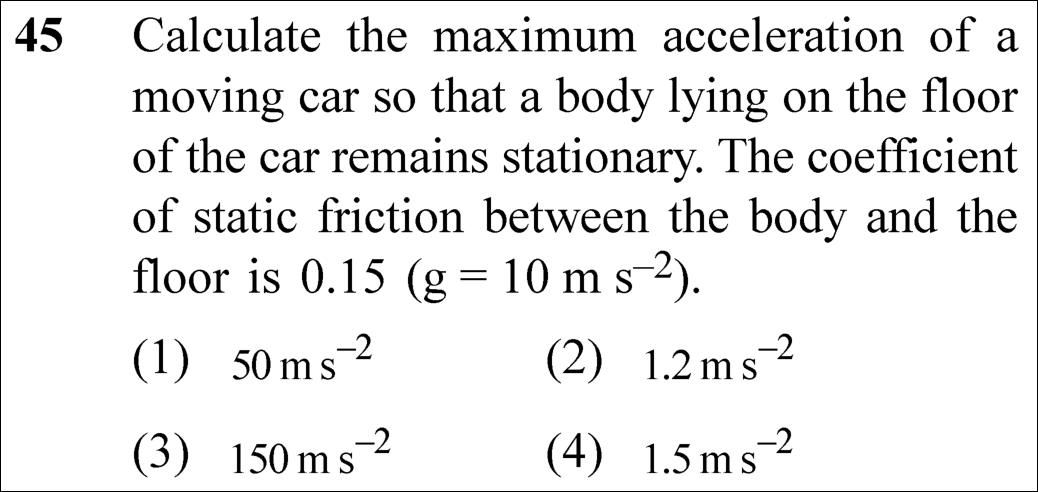
NEET 2023 Physics Question 45: Maximum Acceleration Without Slipping on a Horizontal Floor

Question

Calculate the maximum acceleration of a moving car so that a body lying on the floor of the car remains stationary. The coefficient of static friction between the body and the floor is 0.15 (g = 10 m s⁻²).

✓
Verified Against NTA Final Answer Key
Option (4) : 1.5 m s⁻²
📚 Laws of Motion Easy
📋 Given Parameters & Problem Setup
Coefficient of static friction (μ_s) 0.15
Acceleration due to gravity (g) 10 m s⁻²
Limiting static friction force (f_s,max) μ_s N = μ_s m g
⚡

The 30-Second Exam Hall Shortcut: ⚡ Limiting Acceleration Formula: a_max = μ_s g

⏱️ Save ~30 seconds

Static friction provides the acceleration: m a_max = μ_s m g ⟹ a_max = μ_s g = 0.15 × 10 = 1.5 m s⁻² in 5 seconds!

1 In the ground frame, static friction is the sole horizontal force accelerating the body: f_s = m a.
2 The maximum static friction available is f_s,max = μ_s N = μ_s m g.
3 For the body to remain stationary relative to the car, required acceleration cannot exceed available friction:
4 m a_max = μ_s m g ⟹ a_max = μ_s g.
5 Substitute given numbers: a_max = 0.15 × 10 m/s² = 1.5 m s⁻².
6 Lock Option (4) 1.5 m s⁻² immediately!
🛡️
Why You Can 100% Trust This Shortcut: Newtonian Mechanics · Static Friction Laws (The maximum acceleration a body can experience due to horizontal friction alone is a_max = μ_s g).
📐

Step-by-Step Rigorous Workflow & Mathematical Proof

Step 1

Free-Body Diagram in the Non-Inertial Reference Frame of the Car

Consider the reference frame of the accelerating car (acceleration a). In this accelerated frame, a pseudo-force F_pseudo = m a acts on the body in the direction opposite to the car’s acceleration. To prevent the body from slipping backward, static friction f_s acts forward:

Fpseudo=ma,fs≥FpseudoF_{\text{pseudo}} = m a, \qquad f_s \ge F_{\text{pseudo}}
Step 2

Vertical Equilibrium and Normal Reaction

In the vertical direction, the body is in static equilibrium under gravity and the normal reaction from the car floor:

∑Fy=0  ⟹  N=mg\sum F_y = 0 \implies N = m g
Step 3

Limiting Static Friction and Maximum Acceleration Condition

The maximum static friction that the floor can exert on the body is given by Amontons-Coulomb’s law of friction:

fs,max⁡=μsN=μsmgf_{s,\max} = \mu_s N = \mu_s m g
Step 4

Evaluation of Maximum Permissible Acceleration

Equating the pseudo force to the limiting static friction to determine a_max:

mamax⁡=μsmg  ⟹  amax⁡=μsg=0.15×10=1.5 m s−2m a_{\max} = \mu_s m g \implies a_{\max} = \mu_s g = 0.15 \times 10 = 1.5\text{ m s}^{-2}
⭐

360° Option Elimination Engine Key Feature

Diagnose every choice: Know exactly why the right option works and why distractors fail.

4-Option Deep Scan
1 (1)
✗ Incorrect
Verdict & Scientific Reason:

Physically impossible value (candidate divided by friction coefficient or manipulated numbers).

⚠️
Student Fallacy (Why candidates pick this trap): Candidate calculated g / (0.15 × 2) = 33 or 50.
2 (2)
✗ Incorrect
Verdict & Scientific Reason:

Incorrect multiplier.

⚠️
Student Fallacy (Why candidates pick this trap): Candidate multiplied by 8 or made an arithmetic error.
3 (3)
✗ Incorrect
Verdict & Scientific Reason:

Off by two orders of magnitude (factor of 100).

⚠️
Student Fallacy (Why candidates pick this trap): Decimal point misplaced: 0.15 × 1000 = 150.
4 (4)
✓ 100% Correct
Verdict & Scientific Reason:

Accurate maximum acceleration: a_max = μ_s g = 0.15 × 10 = 1.5 m s⁻².

💡
Why this is airtight: None. Candidate executed the standard friction relation correctly.
⚠️

NTA Trap Alert: Confusing Mass Dependence

Some candidates worry about the missing mass m of the body. Notice mass CANCELS identically: m a = μ_s m g ⟹ a = μ_s g. The maximum acceleration is completely mass-independent!

🛡️ How to avoid the -1 mark: Whenever horizontal friction accelerates a body, mass always cancels: a_max = μ_s g.
📖

Core NEET Syllabus Standard

National Eligibility cum Entrance Test (NEET UG) · Laws of Motion Standard Benchmark
Core Scientific Principle Tested:

"Limiting acceleration without slipping on a horizontal surface is a_max = μ_s g."

Syllabus Focus: Static and Limiting Friction
Preserved in Rationalized Curriculum Syllabus & Academic Standards ↗

Ready to attempt under real exam pressure?

Test your speed and accuracy in the authentic 200-minute timed NTA simulator.

Launch NEET 2023 CBT Test →

Spotted a mistake in this solution? Report an error ([email protected])

⚖️ Legal & Fair Dealing Notice: Sourced from publicly released NEET 2023 question papers and NEET answer keys for private study, research, and non-commercial educational practice under Fair Dealing (Section 52(1)(a) of the Indian Copyright Act, 1957). Not affiliated with or endorsed by NTA or NMC.

Solve 4 NEET Questions a Day — One per Subject

Cover all 1,140 official NEET questions in 285 days at your own pace. Progress is saved on your device. No login needed.