NEET 2023 Physics Question 46 Solution
Question
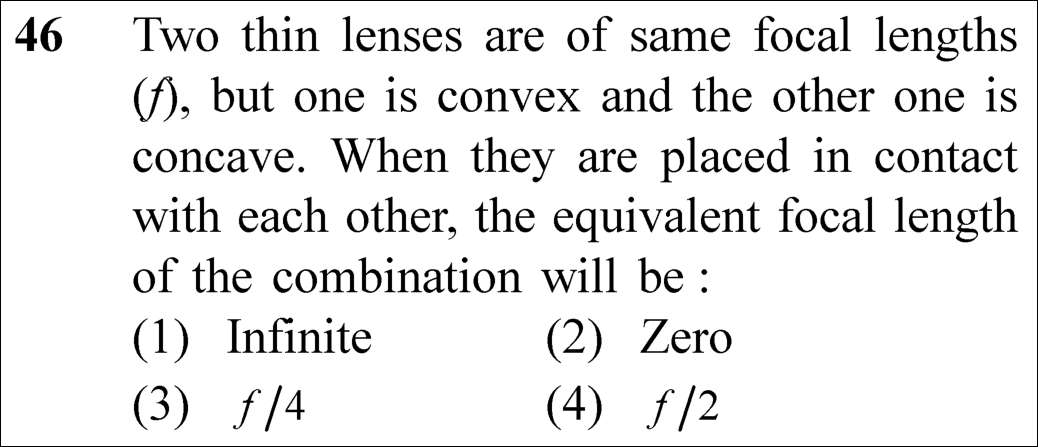
Two thin lenses are of same focal lengths (f), but one is convex and the other one is concave. When they are placed in contact with each other, the equivalent focal length of the combination will be:
Dynamic 180-question full-length simulator mixed dynamically from all 6 years for 2027 & 2026 aspirants.
Two thin lenses are of same focal lengths (f), but one is convex and the other one is concave. When they are placed in contact with each other, the equivalent focal length of the combination will be:
A convex lens (+f) and concave lens (-f) have equal and opposite powers: P_eq = +P - P = 0 ⟹ F = 1/0 = ∞ (Infinite / Glass Slab Behavior) in 5 seconds!
When two thin lenses of focal lengths f₁ and f₂ are placed coaxially in direct physical contact, their powers add algebraically:
By optical sign convention, a convex (converging) lens has a positive focal length, while a concave (diverging) lens of identical magnitude has a negative focal length:
Substitute the focal lengths into the power equation:
Taking the reciprocal of zero power yields:
Diagnose every choice: Know exactly why the right option works and why distractors fail.
Accurate: Zero net optical power corresponds to infinite focal length (acts like a plane glass plate).
Zero is the net POWER, not the net focal length.
Arbitrary fractional option.
Represents two CONVEX lenses of focal length f in contact (+f/2).
The net optical power is P = 0 D (the combination neither converges nor diverges parallel rays). But focal length is the reciprocal of power: F = 1/P = 1/0 = ∞. Choosing Zero (Option 2) is a frequent confusion between Power and Focal Length.
"Net focal length satisfies 1/F = 1/f₁ + 1/f₂. Equal opposite powers give 1/F = 0 ⟹ F = ∞."
Test your speed and accuracy in the authentic 200-minute timed NTA simulator.
Spotted a mistake in this solution? Report an error ([email protected])
Cover all 1,140 official NEET questions in 285 days at your own pace. Progress is saved on your device. No login needed.