MyCompetitiveExams Logo MyCompetitiveExams
Search 1,140+ Questions
Chapters, formulas, speed tricks
→
⚡ Brahmastra NEET 2027
720 MARKS

Dynamic 180-question full-length simulator mixed dynamically from all 6 years for 2027 & 2026 aspirants.

Launch Brahmastra 2027 Test →
Start Practice →
100% Free · No Login Required
Q.54 Chemistry ⭐ 360° Option Elimination Active
Vault ↗

NEET 2025 Chemistry Question 54 Solution

Topic: Some Basic Concepts of Chemistry · Official NTA Booklet Code 45
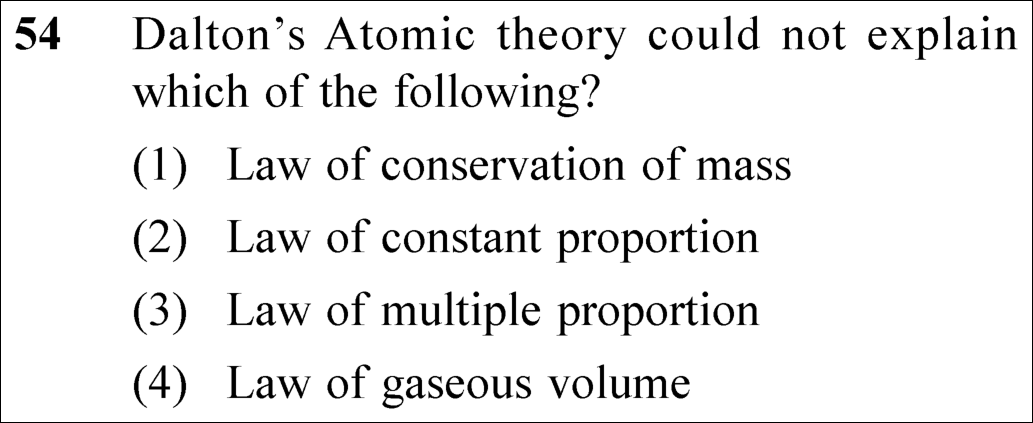
NEET 2025 Chemistry Question 54: Limitations of Dalton’s Atomic Theory: Inability to Explain Gay-Lussac’s Law of Gaseous Volumes

Question

Dalton's Atomic theory could not explain which of the following?

  1. (1)Law of conservation of mass
  2. (2)Law of constant proportion
  3. (3)Law of multiple proportion
  4. (4)Law of gaseous volume
✓
Verified Against NTA Final Answer Key
Option (4) : Law of gaseous volume
📚 Some Basic Concepts of Chemistry Easy
📋 Given Parameters & Problem Setup
Theoretical Framework Dalton’s Atomic Theory (1808)
Candidate Laws Conservation of mass, Constant proportion, Multiple proportion, Gaseous volume
⚡

The 30-Second Exam Hall Shortcut: ⚡ Dalton vs Gay-Lussac Historical Rule

⏱️ Save ~25 seconds

Dalton considered atoms indivisible and could not distinguish atoms from molecules. Therefore, Dalton’s theory could NOT explain Gay-Lussac’s Law of Gaseous Volume (which required Avogadro’s molecular hypothesis)!

1 Dalton’s atomic theory successfully explained all mass-based laws: Law of conservation of mass, Law of constant proportion, and Law of multiple proportion.
2 However, Dalton could not explain why gases combine in simple integer ratios of volumes (Gay-Lussac’s Law of Gaseous Volumes).
3 NCERT text verbatim: "Dalton’s atomic theory could explain the laws of chemical combination. However, it could not explain the laws of gaseous volumes."
4 Select Option (4) in under 5 seconds!
🛡️
Why You Can 100% Trust This Shortcut: Dalton’s Atomic Theory & Laws of Chemical Combination (NCERT Chemistry · Some Basic Concepts of Chemistry).
📐

Step-by-Step Rigorous Workflow & Mathematical Proof

Step 1

Review Dalton’s Postulates and Mass Laws

John Dalton proposed his atomic theory in 1808 based on the premise that matter consists of indivisible atoms:

Atoms are indestructible  ⟹  Explains Law of Conservation of Mass\text{Atoms are indestructible} \implies \text{Explains Law of Conservation of Mass}
  • • Compounds are formed by atoms combining in fixed whole-number ratios, explaining the Law of Definite (Constant) Proportion.
  • • When elements form multiple compounds, atoms combine in simple integer ratios, explaining the Law of Multiple Proportion.
Step 2

Identify the Inability to Explain Gaseous Volumes

Gay-Lussac showed that when gases react, they do so in volumes which bear a simple whole-number ratio to one another and to the volumes of gaseous products:

2H2(g)+O2(g)⟶2H2O(g)(2 vol:1 vol:2 vol)2\text{H}_2(g) + \text{O}_2(g) \longrightarrow 2\text{H}_2\text{O}(g) \quad (2\text{ vol} : 1\text{ vol} : 2\text{ vol})
  • • Because Dalton failed to distinguish between atoms and diatomic molecules, his theory could not account for fractional atomic volumes.
  • • It was only in 1811 that Avogadro resolved this discrepancy with Avogadro’s hypothesis (introducing molecules).
Step 3

Select Matching Option

Dalton’s theory could not explain the Law of gaseous volume, matching Option (4).

Unexplained Law=Law of Gaseous Volume (Option 4)\text{Unexplained Law} = \text{Law of Gaseous Volume (Option 4)}
  • • Matches Option (4) with 100% historical and conceptual precision.
⭐

360° Option Elimination Engine Key Feature

Diagnose every choice: Know exactly why the right option works and why distractors fail.

4-Option Deep Scan
1 A
✗ Incorrect
Verdict & Scientific Reason:

Incorrect. Dalton successfully explained this by postulating that atoms are indestructible.

⚠️
Student Fallacy (Why candidates pick this trap): Thinking Dalton failed on mass conservation.
2 B
✗ Incorrect
Verdict & Scientific Reason:

Incorrect. Dalton explained this by postulating that atoms combine in fixed integer ratios.

⚠️
Student Fallacy (Why candidates pick this trap): Confusing Proust’s law with Gay-Lussac’s law.
3 C
✗ Incorrect
Verdict & Scientific Reason:

Incorrect. Dalton himself proposed and explained the Law of Multiple Proportions.

⚠️
Student Fallacy (Why candidates pick this trap): Forgetting that Dalton formulated this law.
4 D
✓ 100% Correct
Verdict & Scientific Reason:

100% correct. Explicitly stated in NCERT Chapter 1: Dalton could not explain the law of gaseous volumes.

💡
Why this is airtight: None; textbook historical chemistry.
⚠️

NTA Trap Alert: Confusing Mass Laws with Volume Laws

All laws involving MASS were fully explained by Dalton. The only law of chemical combination that Dalton failed to explain was the law of GASEOUS VOLUMES (Gay-Lussac’s law).

🛡️ How to avoid the -1 mark: Remember: Dalton = MASS laws explained; GASEOUS VOLUMES unexplained!
📖

Core NEET Syllabus Standard

NEET Chemistry Core Syllabus · Some Basic Concepts of Chemistry Standard Benchmark
Core Scientific Principle Tested:

"Dalton’s theory could not explain Gay-Lussac’s Law of Gaseous Volumes."

Syllabus Focus: Dalton’s Atomic Theory & Laws of Chemical Combination
✓ Core NEET UG Syllabus Anchor Syllabus & Academic Standards ↗
Dalton solved Mass, but Gaseous Volume required Avogadro!

Ready to attempt under real exam pressure?

Test your speed and accuracy in the authentic 180-minute timed NTA simulator.

Launch NEET 2025 CBT Test →

Spotted a mistake in this solution? Report an error ([email protected])

⚖️ Legal & Fair Dealing Notice: Sourced from publicly released NEET 2025 question papers and NEET answer keys for private study, research, and non-commercial educational practice under Fair Dealing (Section 52(1)(a) of the Indian Copyright Act, 1957). Not affiliated with or endorsed by NTA or NMC.

Solve 4 NEET Questions a Day — One per Subject

Cover all 1,140 official NEET questions in 285 days at your own pace. Progress is saved on your device. No login needed.