MyCompetitiveExams Logo MyCompetitiveExams
Search 1,140+ Questions
Chapters, formulas, speed tricks
→
⚡ Brahmastra NEET 2027
720 MARKS

Dynamic 180-question full-length simulator mixed dynamically from all 6 years for 2027 & 2026 aspirants.

Launch Brahmastra 2027 Test →
Start Practice →
100% Free · No Login Required
🧪 Chemistry ⭐ High Weightage (~2–3 Qs/Year)

NEET Some Basic Concepts of Chemistry Previous Year Questions with Solutions

Complete repository of official NTA NEET questions for Some Basic Concepts of Chemistry from 2020 to 2026. Every question includes 30-second elimination tricks, step-by-step NCERT solutions, option-by-option traps, and official answer keys.

10 Questions 6 Exam Years (2026, 2025, 2024, 2023, 2021, 2020) 9 Easy · 1 Medium · 0 Challenging
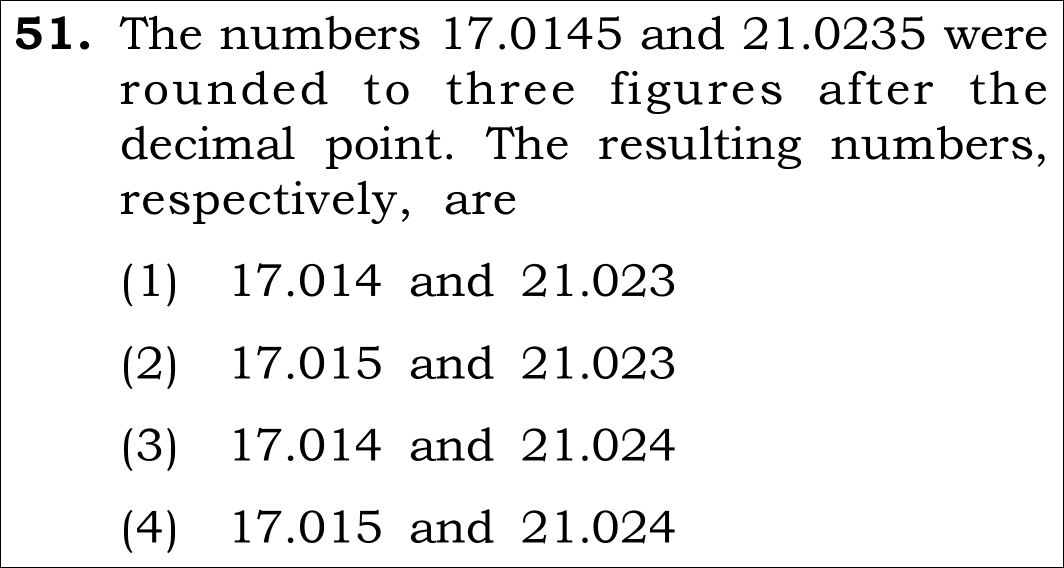
NEET 2026 · Q51 Easy
Official NEET 2026 Question 51 - Some Basic Concepts of Chemistry
1 17.014 and 21.023
2 17.015 and 21.023
3 17.014 and 21.024 ✓ Key
4 17.015 and 21.024
💡 Verified Solution & 30-Second Hack
✓
Verified Against NTA Final Answer Key
Option (3) : 17.014 and 21.024
📚 Some Basic Concepts of Chemistry Easy
📋 Given Parameters & Problem Setup
Number 1 17.0145
Number 2 21.0235
Requirement Round off each number to three figures after the decimal point (3 decimal places)
⚡

The 30-Second Exam Hall Shortcut: ⚡ The Even/Odd Rule for Trailing 5

⏱️ Save ~40 seconds

When dropping a 5 followed by nothing: Even stays Even, Odd rounds Up!

1 For 17.0145: Keep 3 decimal digits (17.014). The digit to drop is 5. The preceding digit is 4 (EVEN). It remains unchanged -> 17.014!
2 For 21.0235: Keep 3 decimal digits (21.023). The digit to drop is 5. The preceding digit is 3 (ODD). It is increased by 1 -> 21.024!
3 Resulting pair: 17.014 and 21.024. Done in 10 seconds!
🛡️
Why You Can 100% Trust This Shortcut: Canonical IUPAC / NCERT rule of significant figures: If the rightmost digit to be removed is a 5 followed by zeros (or nothing), the preceding number is not changed if it is even, and increased by one if it is odd.
📐

Step-by-Step Rigorous Workflow & Mathematical Proof

Step 1

Review the Fundamental Scientific Rounding Rules

In scientific calculations, bias in rounding is avoided using the round-half-to-even rule: 1. If the digit to be dropped is greater than 5, the preceding digit is increased by 1. 2. If the digit to be dropped is less than 5, the preceding digit is left unchanged. 3. If the digit to be dropped is 5 (not followed by non-zero digits): if the preceding digit is EVEN, it remains unchanged; if the preceding digit is ODD, it is increased by 1 to make it even.

Preceding digit={Unchangedif EVEN+1if ODD\text{Preceding digit} = \begin{cases} \text{Unchanged} & \text{if EVEN} \\ +1 & \text{if ODD} \end{cases}
  • • Ensures statistical symmetry without systematic positive or negative bias.
Step 2

Round the First Number: 17.0145

We require 3 figures after the decimal point: 17.014[5]. The digit to be dropped is 5. The preceding digit is 4, which is an EVEN number. Therefore, according to the rule, 4 remains unchanged.

17.0145→drop 5, preceding digit 4 is EVEN17.01417.0145 \xrightarrow{\text{drop 5, preceding digit 4 is EVEN}} 17.014
  • • First rounded value: 17.014.
Step 3

Round the Second Number: 21.0235

We require 3 figures after the decimal point: 21.023[5]. The digit to be dropped is 5. The preceding digit is 3, which is an ODD number. Therefore, according to the rule, 3 is increased by 1 to become 4.

21.0235→drop 5, preceding digit 3 is ODD21.02421.0235 \xrightarrow{\text{drop 5, preceding digit 3 is ODD}} 21.024
  • • Second rounded value: 21.024.
  • • Resulting pair: 17.014 and 21.024 (Option 3).
⭐

360° Option Elimination Engine Key Feature

Diagnose every choice: Know exactly why the right option works and why distractors fail.

4-Option Deep Scan
1 A
✗ Incorrect
Verdict & Scientific Reason:

Incorrect. Truncated both numbers without rounding up the odd digit 3.

⚠️
Student Fallacy (Why candidates pick this trap): Simple truncation rather than scientific rounding.
2 B
✗ Incorrect
Verdict & Scientific Reason:

Incorrect. Inverted the rule by rounding up the even digit and keeping the odd digit unchanged.

⚠️
Student Fallacy (Why candidates pick this trap): Applying the even/odd rule backwards.
3 C
✓ 100% Correct
Verdict & Scientific Reason:

Exact application of NCERT rounding rules: 4 is even so it stays 4; 3 is odd so it rounds up to 4.

💡
Why this is airtight: None; perfectly compliant with official convention.
4 D
✗ Incorrect
Verdict & Scientific Reason:

Incorrect. Rounded up both numbers as if following elementary school rule (always round up on 5).

⚠️
Student Fallacy (Why candidates pick this trap): Using naive school math rounding instead of scientific rounding.
⚠️

NTA Trap Alert: Applying Elementary School Rounding Instead of Scientific Rounding

Elementary school teaches students to always round 5 up to the next digit. In scientific chemistry and physics, this creates a positive bias, so the even/odd rule must be strictly applied.

🛡️ How to avoid the -1 mark: Remember: 5 leaves EVEN digits alone; 5 pushes ODD digits up to make them even!
📖

Core NEET Syllabus Standard

NEET Chemistry Core Syllabus · Some Basic Concepts of Chemistry Standard Benchmark
Core Scientific Principle Tested:

"When the terminal digit is 5, the preceding digit is rounded up if odd, and retained if even."
Syllabus Focus: Rules for rounding off significant figures
✓ Core NEET UG Syllabus Anchor Syllabus & Academic Standards ↗
Even stays Even; Odd steps Up!
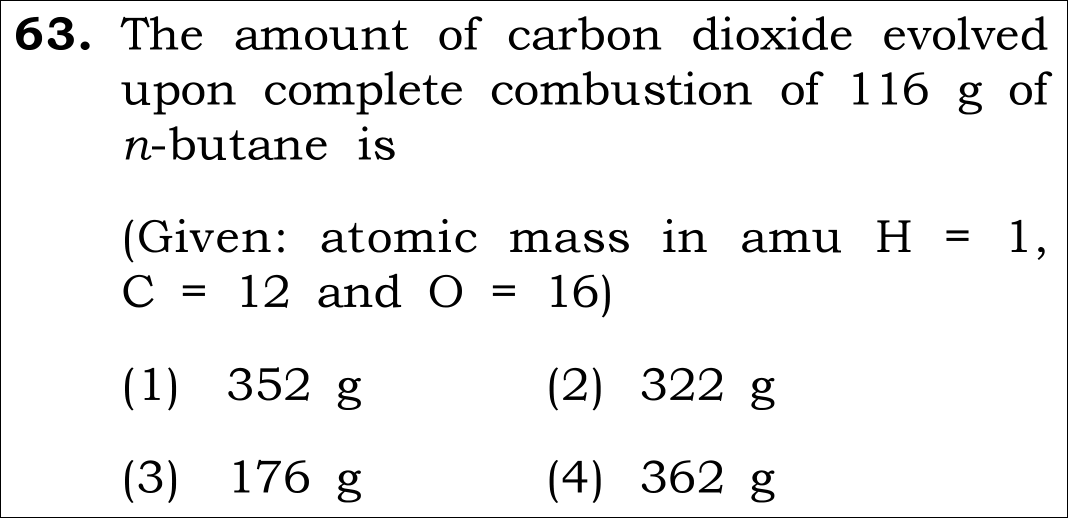
NEET 2026 · Q63 Easy
Official NEET 2026 Question 63 - Some Basic Concepts of Chemistry
1 ✓ Key
2
3
4
💡 Verified Solution & 30-Second Hack
✓
Verified Against NTA Final Answer Key
Option (1) : 352 g
📚 Some Basic Concepts of Chemistry Easy
📋 Given Parameters & Problem Setup
Reactant n-butane (C₄H₁₀)
Mass of n-butane 116 g
Atomic Masses H = 1, C = 12, O = 16 amu
Target Mass of CO₂ evolved upon complete combustion
⚡

The 30-Second Exam Hall Shortcut: ⚡ Mole-Ratio Direct Multiplier

⏱️ Save ~50 seconds

Molar mass of butane is 58 g/mol -> 116 g is exactly 2 moles of butane!

1 Molar mass of C₄H₁₀ = (4 × 12) + (10 × 1) = 58 g/mol.
2 Moles of butane = 116 g / 58 g/mol = 2.0 moles.
3 Each butane molecule has 4 carbon atoms, producing 4 CO₂ molecules: Moles of CO₂ = 2 × 4 = 8 moles.
4 Molar mass of CO₂ = 12 + (2 × 16) = 44 g/mol.
5 Mass of CO₂ = 8 moles × 44 g/mol = 352 g!
6 Option (1) selected in 15 seconds!
🛡️
Why You Can 100% Trust This Shortcut: Law of conservation of mass: All carbon in the hydrocarbon quantitatively converts to CO₂ upon complete combustion.
📐

Step-by-Step Rigorous Workflow & Mathematical Proof

Step 1

Write the Balanced Chemical Equation for Combustion

Complete combustion of an alkane (C_n H_{2n+2}) with excess oxygen yields carbon dioxide and water vapor.

C4H10+132O2⟶4CO2+5H2O\text{C}_4\text{H}_{10} + \frac{13}{2}\text{O}_2 \longrightarrow 4\text{CO}_2 + 5\text{H}_2\text{O}
  • • 1 mole of n-butane produces 4 moles of CO₂.
Step 2

Calculate Moles of n-butane Burned

Determine the molecular mass of n-butane and calculate the number of moles in 116 g.

M(C4H10)=4(12)+10(1)=58 g mol−1M(\text{C}_4\text{H}_{10}) = 4(12) + 10(1) = 58\text{ g mol}^{-1}
  • • n(butane) = 116 g / 58 g mol⁻¹ = 2.0 mol.
Step 3

Calculate Mass of CO₂ Formed

Using stoichiometry, 2.0 moles of butane produce 8.0 moles of CO₂.

n(CO2)=2.0×4=8.0 moln(\text{CO}_2) = 2.0 \times 4 = 8.0\text{ mol}
  • • M(CO₂) = 12 + 2(16) = 44 g mol⁻¹.
  • • Mass of CO₂ = 8.0 mol × 44 g mol⁻¹ = 352 g.
  • • Matches Option (1).
⭐

360° Option Elimination Engine Key Feature

Diagnose every choice: Know exactly why the right option works and why distractors fail.

4-Option Deep Scan
1 A
✓ 100% Correct
Verdict & Scientific Reason:

Stoichiometrically exact: 2 moles of butane yield 8 moles of CO₂ = 352 g.

💡
Why this is airtight: None; standard stoichiometric execution.
2 B
✗ Incorrect
Verdict & Scientific Reason:

Incorrect. Arithmetic miscalculation.

⚠️
Student Fallacy (Why candidates pick this trap): Multiplication error when computing 8 × 44.
3 C
✗ Incorrect
Verdict & Scientific Reason:

Incorrect. Corresponds to 1 mole of butane instead of 2 moles: 4 × 44 = 176 g.

⚠️
Student Fallacy (Why candidates pick this trap): Forgetting to multiply by 2 moles of butane.
4 D
✗ Incorrect
Verdict & Scientific Reason:

Incorrect. Distractor value.

⚠️
Student Fallacy (Why candidates pick this trap): Using incorrect atomic weight for carbon or hydrogen.
⚠️

NTA Trap Alert: Calculating for 1 Mole Instead of the Given 116 g

Students frequently compute 4 × 44 = 176 g (Option 3) for 1 mole of butane and forget that 116 g contains TWO moles of butane.

🛡️ How to avoid the -1 mark: Always convert given mass to moles FIRST before applying mole ratios.
📖

Core NEET Syllabus Standard

NEET Chemistry Core Syllabus · Some Basic Concepts of Chemistry Standard Benchmark
Core Scientific Principle Tested:

"Each mole of C_n H_{2n+2} produces n moles of CO₂ upon complete combustion."

Syllabus Focus: Stoichiometric calculations and combustion reactions
✓ Core NEET UG Syllabus Anchor Syllabus & Academic Standards ↗
116 g is 2 moles of butane; 2 × 4 = 8 moles of CO₂; 8 × 44 = 352 g!
NEET 2025 · Q54 Easy
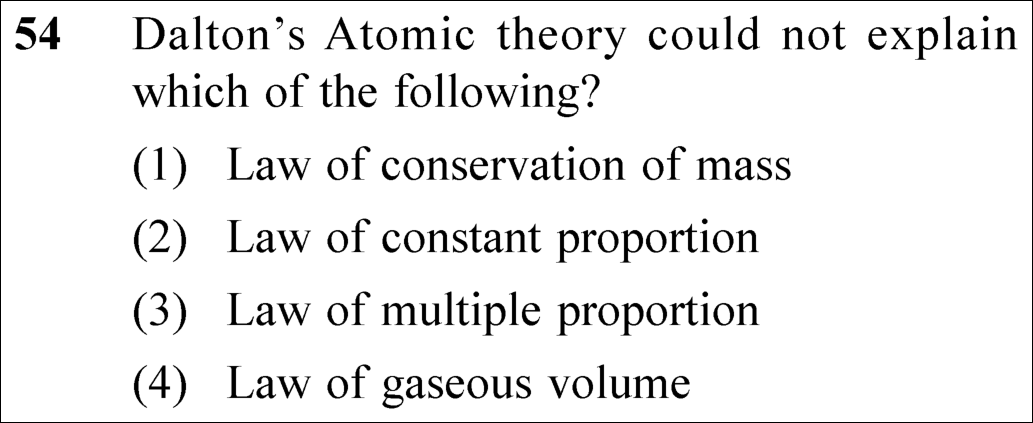
Official NEET 2025 Question 54 - Some Basic Concepts of Chemistry
1 Law of conservation of mass
2 Law of constant proportion
3 Law of multiple proportion
4 Law of gaseous volume ✓ Key
💡 Verified Solution & 30-Second Hack
✓
Verified Against NTA Final Answer Key
Option (4) : Law of gaseous volume
📚 Some Basic Concepts of Chemistry Easy
📋 Given Parameters & Problem Setup
Theoretical Framework Dalton’s Atomic Theory (1808)
Candidate Laws Conservation of mass, Constant proportion, Multiple proportion, Gaseous volume
⚡

The 30-Second Exam Hall Shortcut: ⚡ Dalton vs Gay-Lussac Historical Rule

⏱️ Save ~25 seconds

Dalton considered atoms indivisible and could not distinguish atoms from molecules. Therefore, Dalton’s theory could NOT explain Gay-Lussac’s Law of Gaseous Volume (which required Avogadro’s molecular hypothesis)!

1 Dalton’s atomic theory successfully explained all mass-based laws: Law of conservation of mass, Law of constant proportion, and Law of multiple proportion.
2 However, Dalton could not explain why gases combine in simple integer ratios of volumes (Gay-Lussac’s Law of Gaseous Volumes).
3 NCERT text verbatim: "Dalton’s atomic theory could explain the laws of chemical combination. However, it could not explain the laws of gaseous volumes."
4 Select Option (4) in under 5 seconds!
🛡️
Why You Can 100% Trust This Shortcut: Dalton’s Atomic Theory & Laws of Chemical Combination (NCERT Chemistry · Some Basic Concepts of Chemistry).
📐

Step-by-Step Rigorous Workflow & Mathematical Proof

Step 1

Review Dalton’s Postulates and Mass Laws

John Dalton proposed his atomic theory in 1808 based on the premise that matter consists of indivisible atoms:

Atoms are indestructible  ⟹  Explains Law of Conservation of Mass\text{Atoms are indestructible} \implies \text{Explains Law of Conservation of Mass}
  • • Compounds are formed by atoms combining in fixed whole-number ratios, explaining the Law of Definite (Constant) Proportion.
  • • When elements form multiple compounds, atoms combine in simple integer ratios, explaining the Law of Multiple Proportion.
Step 2

Identify the Inability to Explain Gaseous Volumes

Gay-Lussac showed that when gases react, they do so in volumes which bear a simple whole-number ratio to one another and to the volumes of gaseous products:

2H2(g)+O2(g)⟶2H2O(g)(2 vol:1 vol:2 vol)2\text{H}_2(g) + \text{O}_2(g) \longrightarrow 2\text{H}_2\text{O}(g) \quad (2\text{ vol} : 1\text{ vol} : 2\text{ vol})
  • • Because Dalton failed to distinguish between atoms and diatomic molecules, his theory could not account for fractional atomic volumes.
  • • It was only in 1811 that Avogadro resolved this discrepancy with Avogadro’s hypothesis (introducing molecules).
Step 3

Select Matching Option

Dalton’s theory could not explain the Law of gaseous volume, matching Option (4).

Unexplained Law=Law of Gaseous Volume (Option 4)\text{Unexplained Law} = \text{Law of Gaseous Volume (Option 4)}
  • • Matches Option (4) with 100% historical and conceptual precision.
⭐

360° Option Elimination Engine Key Feature

Diagnose every choice: Know exactly why the right option works and why distractors fail.

4-Option Deep Scan
1 A
✗ Incorrect
Verdict & Scientific Reason:

Incorrect. Dalton successfully explained this by postulating that atoms are indestructible.

⚠️
Student Fallacy (Why candidates pick this trap): Thinking Dalton failed on mass conservation.
2 B
✗ Incorrect
Verdict & Scientific Reason:

Incorrect. Dalton explained this by postulating that atoms combine in fixed integer ratios.

⚠️
Student Fallacy (Why candidates pick this trap): Confusing Proust’s law with Gay-Lussac’s law.
3 C
✗ Incorrect
Verdict & Scientific Reason:

Incorrect. Dalton himself proposed and explained the Law of Multiple Proportions.

⚠️
Student Fallacy (Why candidates pick this trap): Forgetting that Dalton formulated this law.
4 D
✓ 100% Correct
Verdict & Scientific Reason:

100% correct. Explicitly stated in NCERT Chapter 1: Dalton could not explain the law of gaseous volumes.

💡
Why this is airtight: None; textbook historical chemistry.
⚠️

NTA Trap Alert: Confusing Mass Laws with Volume Laws

All laws involving MASS were fully explained by Dalton. The only law of chemical combination that Dalton failed to explain was the law of GASEOUS VOLUMES (Gay-Lussac’s law).

🛡️ How to avoid the -1 mark: Remember: Dalton = MASS laws explained; GASEOUS VOLUMES unexplained!
📖

Core NEET Syllabus Standard

NEET Chemistry Core Syllabus · Some Basic Concepts of Chemistry Standard Benchmark
Core Scientific Principle Tested:

"Dalton’s theory could not explain Gay-Lussac’s Law of Gaseous Volumes."

Syllabus Focus: Dalton’s Atomic Theory & Laws of Chemical Combination
✓ Core NEET UG Syllabus Anchor Syllabus & Academic Standards ↗
Dalton solved Mass, but Gaseous Volume required Avogadro!
NEET 2025 · Q68 Easy
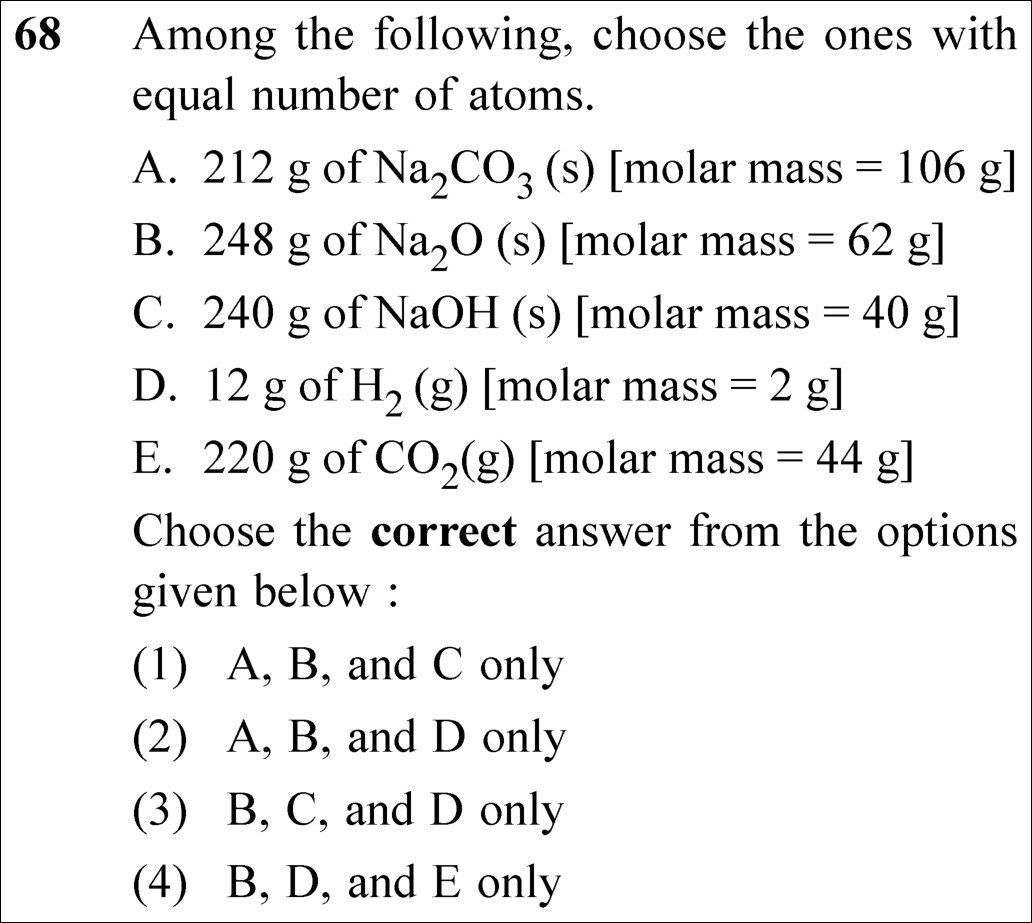
Official NEET 2025 Question 68 - Some Basic Concepts of Chemistry
1
2 ✓ Key
3
4
💡 Verified Solution & 30-Second Hack
✓
Verified Against NTA Final Answer Key
Option (2) : A, B, and D only
📚 Some Basic Concepts of Chemistry Easy
📋 Given Parameters & Problem Setup
Substance A 212 g of Na₂CO₃(s) [molar mass = 106 g]
Substance B 248 g of Na₂O(s) [molar mass = 62 g]
Substance C 240 g of NaOH(s) [molar mass = 40 g]
Substance D 12 g of H₂(g) [molar mass = 2 g]
Substance E 220 g of CO₂(g) [molar mass = 44 g]
⚡

The 30-Second Exam Hall Shortcut: ⚡ Moles × Atomicity Calculation Shortcut

⏱️ Save ~40 seconds

Calculate (Mass / Molar Mass) × Atoms per molecule: A = (212/106) × 6 = 12 N_A. B = (248/62) × 3 = 12 N_A. C = (240/40) × 3 = 18 N_A. D = (12/2) × 2 = 12 N_A. E = (220/44) × 3 = 15 N_A! A, B, and D all equal 12 N_A!

1 A (Na₂CO₃): n = 212 / 106 = 2 moles. Atomicity = 2(Na) + 1(C) + 3(O) = 6. Total atoms = 2 × 6 = 12 N_A.
2 B (Na₂O): n = 248 / 62 = 4 moles. Atomicity = 2(Na) + 1(O) = 3. Total atoms = 4 × 3 = 12 N_A.
3 C (NaOH): n = 240 / 40 = 6 moles. Atomicity = 1(Na) + 1(O) + 1(H) = 3. Total atoms = 6 × 3 = 18 N_A.
4 D (H₂): n = 12 / 2 = 6 moles. Atomicity = 2(H) = 2. Total atoms = 6 × 2 = 12 N_A.
5 E (CO₂): n = 220 / 44 = 5 moles. Atomicity = 1(C) + 2(O) = 3. Total atoms = 5 × 3 = 15 N_A.
6 Equal atom count: A, B, and D all have exactly 12 moles of atoms (12 N_A)!
7 Match Option (2) in under 20 seconds!
🛡️
Why You Can 100% Trust This Shortcut: Mole Concept and Stoichiometric Calculations (NCERT Chemistry · Some Basic Concepts of Chemistry).
📐

Step-by-Step Rigorous Workflow & Mathematical Proof

Step 1

Formulate Equation for Total Number of Atoms

For any substance of mass m, molar mass M, and atomicity N_{atoms} (atoms per formula unit):

Total Atoms=n×Natoms×NA=(mM)×Natoms×NA\text{Total Atoms} = n \times N_{atoms} \times N_A = \left(\frac{m}{M}\right) \times N_{atoms} \times N_A
  • • Two samples have an equal number of atoms if their product n × N_{atoms} is identical.
Step 2

Calculate Atoms for Substances A, B, and C

Compute the moles of atoms for the solid ionic compounds:

A:212106×6=2×6=12 moles of atoms(12NA)A: \frac{212}{106} \times 6 = 2 \times 6 = 12\text{ moles of atoms} \quad (12 N_A)
  • • B: (248 / 62) × 3 = 4 × 3 = 12 moles of atoms (12 N_A).
  • • C: (240 / 40) × 3 = 6 × 3 = 18 moles of atoms (18 N_A).
Step 3

Calculate Atoms for Substances D and E and Match

Compute the moles of atoms for the gaseous species:

D:122×2=6×2=12 moles of atoms(12NA)D: \frac{12}{2} \times 2 = 6 \times 2 = 12\text{ moles of atoms} \quad (12 N_A)
  • • E: (220 / 44) × 3 = 5 × 3 = 15 moles of atoms (15 N_A).
  • • Comparing values: A = 12 N_A, B = 12 N_A, D = 12 N_A.
  • • Therefore, A, B, and D have equal numbers of atoms, matching Option (2).
⭐

360° Option Elimination Engine Key Feature

Diagnose every choice: Know exactly why the right option works and why distractors fail.

4-Option Deep Scan
1 A
✗ Incorrect
Verdict & Scientific Reason:

Incorrect. C has 18 N_A atoms, not 12 N_A.

⚠️
Student Fallacy (Why candidates pick this trap): Forgetting to multiply NaOH by atomicity 3 or miscalculating 240/40.
2 B
✓ 100% Correct
Verdict & Scientific Reason:

100% correct. A, B, and D each contain exactly 12 moles of atoms (12 N_A).

💡
Why this is airtight: None; precise stoichiometric evaluation.
3 C
✗ Incorrect
Verdict & Scientific Reason:

Incorrect. Includes C (18 N_A).

⚠️
Student Fallacy (Why candidates pick this trap): Including C instead of A.
4 D
✗ Incorrect
Verdict & Scientific Reason:

Incorrect. E has 15 N_A atoms.

⚠️
Student Fallacy (Why candidates pick this trap): Assuming CO₂ has 12 N_A atoms.
⚠️

NTA Trap Alert: Counting Moles of Molecules Instead of Moles of Atoms

Candidates sometimes only compute moles of the molecule (A = 2, B = 4, C = 6, D = 6, E = 5) and erroneously conclude that C and D are equal! The question explicitly asks for the NUMBER OF ATOMS, requiring multiplication by atomicity!

🛡️ How to avoid the -1 mark: Always underline "NUMBER OF ATOMS" and multiply by the formula unit atom count!
📖

Core NEET Syllabus Standard

NEET Chemistry Core Syllabus · Some Basic Concepts of Chemistry Standard Benchmark
Core Scientific Principle Tested:

"Number of atoms = (mass / molar mass) × atomicity × N_A."

Syllabus Focus: Mole Concept and Atomic Stoichiometry
✓ Core NEET UG Syllabus Anchor Syllabus & Academic Standards ↗
Multiply by atoms in formula: A=12, B=12, D=12 ⟹ A, B, and D only!
NEET 2024 · Q70 Easy
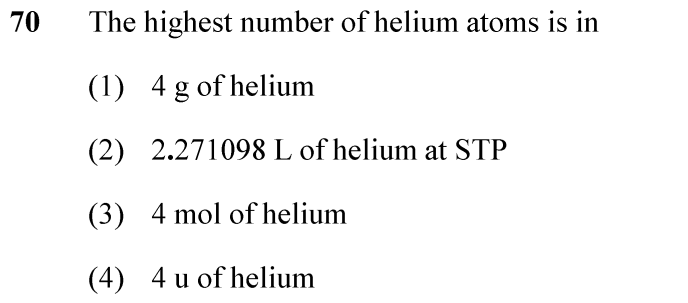
Official NEET 2024 Question 70 - Some Basic Concepts of Chemistry
1
2
3 ✓ Key
4
💡 Verified Solution & 30-Second Hack
✓
Verified Against NTA Final Answer Key
Option (3) : 4 mol of helium
📚 Some Basic Concepts of Chemistry Easy
📋 Given Parameters & Problem Setup
Option 1 4 g of helium
Option 2 2.271098 L of helium at STP
Option 3 4 mol of helium
Option 4 4 u of helium
⚡

The 30-Second Exam Hall Shortcut: ⚡ Mole vs Gram vs u Magnitude Hack

⏱️ Save ~30 seconds

4 mol = 4 × N_A ≈ 2.4 × 10²⁴ atoms! 4 g is only 1 mol (N_A), 2.27 L is 0.1 mol, and 4 u is literally ONE SINGLE ATOM!

1 4 mol of helium contains 4 × N_A = 4 × (6.022 × 10²³) ≈ 2.41 × 10²⁴ atoms.
2 4 g of helium: moles = mass / molar mass = 4 g / 4 g/mol = 1 mol = 1 N_A atoms.
3 2.271098 L at STP (1 bar, 273.15 K): moles = 2.271098 / 22.71098 = 0.1 mol = 0.1 N_A atoms.
4 4 u of helium: 1 atom of He has mass 4 u, so 4 u contains exactly 1 atom!
5 Clearly, 4 mol contains by far the highest number of atoms -> Option (3) in 3 seconds!
🛡️
Why You Can 100% Trust This Shortcut: NCERT Chemistry · Some Basic Concepts of Chemistry (Mole concept, Avogadro constant, and atomic mass unit definitions).
📐

Step-by-Step Rigorous Workflow & Mathematical Proof

Step 1

Evaluating Option (1): 4 g of Helium

Molar mass of helium is 4.00 g/mol. Calculating moles and number of atoms:

n=4  g4  g/mol=1  mol  ⟹  N=1×NA=6.022×10²³  atomsn = \frac{4\;\text{g}}{4\;\text{g/mol}} = 1\;\text{mol} \implies N = 1 \times N_A = 6.022 \times 10^{23}\;\text{atoms}
Step 2

Evaluating Option (2): 2.271098 L of Helium at STP

At standard temperature and pressure (T = 273.15 K, P = 1 bar), the molar volume of an ideal gas is 22.71098 L/mol:

n=2.271098  L22.71098  L/mol=0.1  mol  ⟹  N=0.1×NA=6.022×10²²  atomsn = \frac{2.271098\;\text{L}}{22.71098\;\text{L/mol}} = 0.1\;\text{mol} \implies N = 0.1 \times N_A = 6.022 \times 10^{22}\;\text{atoms}
Step 3

Evaluating Option (3): 4 mol of Helium

By definition of the mole, 1 mole contains Avogadro’s number of entities:

N=4×NA=4×(6.022×1023)=2.4088×1024  atomsN = 4 \times N_A = 4 \times (6.022 \times 10^{23}) = 2.4088 \times 10^{24}\;\text{atoms}
Step 4

Evaluating Option (4): 4 u of Helium

The unified atomic mass unit u is the mass of a single nucleon scale. Because one helium-4 atom has a mass of 4.00 u:

N=4  u4  u/atom=1  atomN = \frac{4\;\text{u}}{4\;\text{u/atom}} = 1\;\text{atom}
⭐

360° Option Elimination Engine Key Feature

Diagnose every choice: Know exactly why the right option works and why distractors fail.

4-Option Deep Scan
1 (1)
✗ Incorrect
Verdict & Scientific Reason:

Contains 1 N_A atoms, which is 4 times fewer than 4 mol.

⚠️
Student Fallacy (Why candidates pick this trap): Confusing 4 grams with 4 moles.
2 (2)
✗ Incorrect
Verdict & Scientific Reason:

Contains only 0.1 N_A atoms.

⚠️
Student Fallacy (Why candidates pick this trap): Being intimidated by the long decimal number.
3 (3)
✓ 100% Correct
Verdict & Scientific Reason:

Contains 4 N_A ≈ 2.41 × 10²⁴ atoms, the highest quantity.

💡
Why this is airtight: None.
4 (4)
✗ Incorrect
Verdict & Scientific Reason:

Contains exactly ONE single atom.

⚠️
Student Fallacy (Why candidates pick this trap): Confusing unified atomic mass unit (u) with grams or moles.
⚠️

NTA Trap Alert: Equating 4 u with 4 grams or 4 moles

4 u is microscopically 1 single atom (6.64 × 10⁻²⁴ g). 4 g is 1 mole (6.02 × 10²³ atoms). 4 mol is 4 moles (2.41 × 10²⁴ atoms).

🛡️ How to avoid the -1 mark: Remember: "u" is for single atoms; "g" is for moles of atoms; "mol" multiplies by 6.022 × 10²³.
📖

Core NEET Syllabus Standard

Chemistry Core Physical Chemistry · Some Basic Concepts of Chemistry Standard Benchmark
Core Scientific Principle Tested:

"Number of particles = moles × Avogadro constant; 4 mol has 4 NA particles, exceeding 4 g (1 NA) and 4 u (1 particle)."

Syllabus Focus: Mole Concept, Atomic Mass Unit, and Molar Volume
✓ Core NEET UG Syllabus Anchor Syllabus & Academic Standards ↗
Moles are mountains, grams are hills, and u is just a grain that chills!
NEET 2024 · Q82 Easy
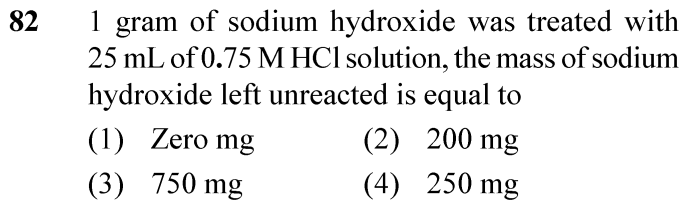
Official NEET 2024 Question 82 - Some Basic Concepts of Chemistry
1
2
3
4 ✓ Key
💡 Verified Solution & 30-Second Hack
✓
Verified Against NTA Final Answer Key
Option (4) : 250 mg
📚 Some Basic Concepts of Chemistry Easy
📋 Given Parameters & Problem Setup
Mass of NaOH initially taken 1 gram = 1000 mg
Volume of HCl solution 25 mL = 0.025 L
Molarity of HCl solution 0.75 M
Molar mass of NaOH 23 + 16 + 1 = 40 g/mol
⚡

The 30-Second Exam Hall Shortcut: ⚡ Millimole Subtraction Shortcut

⏱️ Save ~45 seconds

NaOH taken = 1000 mg / 40 = 25 mmol. HCl added = 25 mL × 0.75 M = 18.75 mmol. Unreacted NaOH = 25 - 18.75 = 6.25 mmol -> 6.25 × 40 = 250 mg!

1 Calculate millimoles of NaOH initially present: mmol = (1.0 g / 40 g/mol) × 1000 = 25.0 mmol.
2 Calculate millimoles of HCl added: mmol = V(mL) × M = 25 mL × 0.75 M = 18.75 mmol.
3 1:1 reaction stoichiometry: NaOH + HCl -> NaCl + H2O consumes 18.75 mmol of NaOH.
4 Millimoles of NaOH remaining unreacted = 25.0 - 18.75 = 6.25 mmol.
5 Mass of unreacted NaOH = 6.25 mmol × 40 mg/mmol = 250 mg.
6 Match Option (4) in 10 seconds!
🛡️
Why You Can 100% Trust This Shortcut: NCERT Chemistry · Some Basic Concepts of Chemistry (Stoichiometric calculations in solution and limiting reagent calculations).
📐

Step-by-Step Rigorous Workflow & Mathematical Proof

Step 1

Balanced Chemical Equation of Neutralization

Sodium hydroxide and hydrochloric acid undergo an equimolar 1:1 acid-base neutralization reaction:

NaOH+HCl⟶NaCl+H2O\text{NaOH} + \text{HCl} \longrightarrow \text{NaCl} + \text{H}_2\text{O}
Step 2

Calculation of Initial Moles of Reactants

Computing the moles of each reactant: - Molar mass of NaOH = 23 + 16 + 1 = 40 g/mol - Initial moles of NaOH: n(NaOH) = 1.0 g / 40 g/mol = 0.025 mol = 25.0 mmol - Initial moles of HCl: n(HCl) = Molarity × Volume(L) = 0.75 mol/L × 0.025 L = 0.01875 mol = 18.75 mmol

nNaOH, initial=25.0  mmol,nHCl, initial=18.75  mmoln_{\text{NaOH, initial}} = 25.0\;\text{mmol}, \quad n_{\text{HCl, initial}} = 18.75\;\text{mmol}
Step 3

Determining Limiting Reagent and Unreacted Substance

Because the stoichiometric ratio is 1:1 and n(HCl) < n(NaOH), hydrochloric acid (HCl) is the limiting reagent and is completely consumed. Moles of NaOH reacting = 18.75 mmol. Moles of NaOH left unreacted:

nNaOH, unreacted=25.0  mmol−18.75  mmol=6.25  mmol=6.25×10⁻³  moln_{\text{NaOH, unreacted}} = 25.0\;\text{mmol} - 18.75\;\text{mmol} = 6.25\;\text{mmol} = 6.25 \times 10^{-3}\;\text{mol}
Step 4

Conversion to Milligrams (mg)

Converting the remaining moles of sodium hydroxide to mass in milligrams:

m=(6.25×10⁻³  mol)×(40  g/mol)=0.250  g=250  mgm = (6.25 \times 10^{-3}\;\text{mol}) \times (40\;\text{g/mol}) = 0.250\;\text{g} = 250\;\text{mg}
⭐

360° Option Elimination Engine Key Feature

Diagnose every choice: Know exactly why the right option works and why distractors fail.

4-Option Deep Scan
1 (1)
✗ Incorrect
Verdict & Scientific Reason:

Assumes complete stoichiometric neutralization, which is false since NaOH is in excess.

⚠️
Student Fallacy (Why candidates pick this trap): Assuming all titrations are equimolar.
2 (2)
✗ Incorrect
Verdict & Scientific Reason:

Arithmetic error in rounding or molar mass.

⚠️
Student Fallacy (Why candidates pick this trap): Using incorrect molar mass for NaOH.
3 (3)
✗ Incorrect
Verdict & Scientific Reason:

This represents the mass of NaOH that reacted (18.75 mmol × 40 = 750 mg), not the mass unreacted!

⚠️
Student Fallacy (Why candidates pick this trap): Calculating the mass reacted instead of the mass remaining.
4 (4)
✓ 100% Correct
Verdict & Scientific Reason:

Exact unreacted mass: 1000 mg initial - 750 mg reacted = 250 mg remaining.

💡
Why this is airtight: None.
⚠️

NTA Trap Alert: Option (3) Reacted vs Unreacted Trap

750 mg of NaOH reacts with the HCl. Students often compute 750 mg and immediately select Option (3), forgetting that the question specifically asks for the mass LEFT UNREACTED (1000 - 750 = 250 mg)!

🛡️ How to avoid the -1 mark: Underline the word "UNREACTED": Unreacted = Total Initial - Reacted.
📖

Core NEET Syllabus Standard

Chemistry Core Physical Chemistry · Some Basic Concepts of Chemistry Standard Benchmark
Core Scientific Principle Tested:

"In acid-base reactions, the excess reagent remaining is calculated by subtracting stoichiometric consumption by the limiting reagent from the initial quantity."

Syllabus Focus: Stoichiometry in Solutions: Limiting Reagents
✓ Core NEET UG Syllabus Anchor Syllabus & Academic Standards ↗
A thousand milligrams entered, seven-fifty fought: two-fifty left behind unbought!
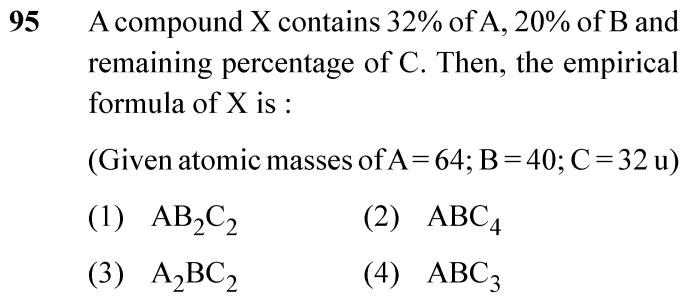
NEET 2024 · Q95 Easy
Official NEET 2024 Question 95 - Some Basic Concepts of Chemistry
1
2
3
4 ✓ Key
💡 Verified Solution & 30-Second Hack
✓
Verified Against NTA Final Answer Key
Option (4) : ABC3
📚 Some Basic Concepts of Chemistry Easy
📋 Given Parameters & Problem Setup
Percentage of A 32%
Atomic mass of A 64 u
Percentage of B 20%
Atomic mass of B 40 u
Atomic mass of C 32 u
⚡

The 30-Second Exam Hall Shortcut: ⚡ Relative Mole Ratio Mental Arithmetic

⏱️ Save ~35 seconds

% C = 100 - (32 + 20) = 48%! Moles: A = 32/64 = 0.5; B = 20/40 = 0.5; C = 48/32 = 1.5! Divide by 0.5 -> 1 : 1 : 3 -> ABC3!

1 Calculate percentage of element C: % C = 100 - (32 + 20) = 48%.
2 Compute relative number of moles of each element in 100 g:
3 - Moles of A: 32 / 64 = 0.5 mol.
4 - Moles of B: 20 / 40 = 0.5 mol.
5 - Moles of C: 48 / 32 = 1.5 mol.
6 Divide each mole value by the smallest value (0.5):
7 - A: 0.5 / 0.5 = 1.
8 - B: 0.5 / 0.5 = 1.
9 - C: 1.5 / 0.5 = 3.
10 Simplest whole number molar ratio is A : B : C = 1 : 1 : 3.
11 Empirical formula is ABC3 -> Option (4) in 10 seconds!
🛡️
Why You Can 100% Trust This Shortcut: NCERT Chemistry · Some Basic Concepts of Chemistry (Determination of empirical formula from mass percent composition).
📐

Step-by-Step Rigorous Workflow & Mathematical Proof

Step 1

Determining the Mass Percentage of Element C

The sum of percentages of all constituent elements in compound X must equal 100%:

%C=100%−(%A+%B)=100%−(32%+20%)=48%\%C = 100\% - (\%A + \%B) = 100\% - (32\% + 20\%) = 48\%
Step 2

Calculating Moles of Each Element in 100 g of Compound

Dividing the mass percentage of each element by its respective atomic mass: - Element A: n_A = 32 g / 64 g/mol = 0.50 mol - Element B: n_B = 20 g / 40 g/mol = 0.50 mol - Element C: n_C = 48 g / 32 g/mol = 1.50 mol

nA=3264=0.5,nB=2040=0.5,nC=4832=1.5n_A = \frac{32}{64} = 0.5, \quad n_B = \frac{20}{40} = 0.5, \quad n_C = \frac{48}{32} = 1.5
Step 3

Simplifying to the Lowest Whole-Number Atomic Ratio

Dividing all mole numbers by the smallest mole value (0.50):

A:B:C=0.50.5:0.50.5:1.50.5=1:1:3A : B : C = \frac{0.5}{0.5} : \frac{0.5}{0.5} : \frac{1.5}{0.5} = 1 : 1 : 3
Step 4

Writing the Empirical Formula

The atomic ratio 1 : 1 : 3 yields the empirical formula ABC3:

Empirical Formula=ABC3\text{Empirical Formula} = \text{ABC}_3
⭐

360° Option Elimination Engine Key Feature

Diagnose every choice: Know exactly why the right option works and why distractors fail.

4-Option Deep Scan
1 (1)
✗ Incorrect
Verdict & Scientific Reason:

Incorrect atomic ratio.

⚠️
Student Fallacy (Why candidates pick this trap): Arbitrary ratio.
2 (2)
✗ Incorrect
Verdict & Scientific Reason:

Overestimates oxygen/C count.

⚠️
Student Fallacy (Why candidates pick this trap): Dividing 48 by 12 instead of atomic mass 32.
3 (3)
✗ Incorrect
Verdict & Scientific Reason:

Inverts stoichiometry of A and C.

⚠️
Student Fallacy (Why candidates pick this trap): Multiplying moles instead of dividing by smallest.
4 (4)
✓ 100% Correct
Verdict & Scientific Reason:

Exact whole-number molar ratio: 0.5 : 0.5 : 1.5 = 1 : 1 : 3.

💡
Why this is airtight: None.
⚠️

NTA Trap Alert: Forgetting to Calculate % of C First

The question gives percentages for A and B only, leaving C as "remaining percentage". Always compute %C = 100 - (32 + 20) = 48% first.

🛡️ How to avoid the -1 mark: Check that sum of all percentages equals 100% before dividing by atomic weights.
📖

Core NEET Syllabus Standard

Chemistry Core Physical Chemistry · Some Basic Concepts of Chemistry Standard Benchmark
Core Scientific Principle Tested:

"Empirical formula represents the simplest whole number ratio of atoms of various elements present in one molecule of the compound."

Syllabus Focus: Empirical and Molecular Formulas
✓ Core NEET UG Syllabus Anchor Syllabus & Academic Standards ↗
Half, half, and one-and-a-half in line: Double each piece and ABC3 will shine!
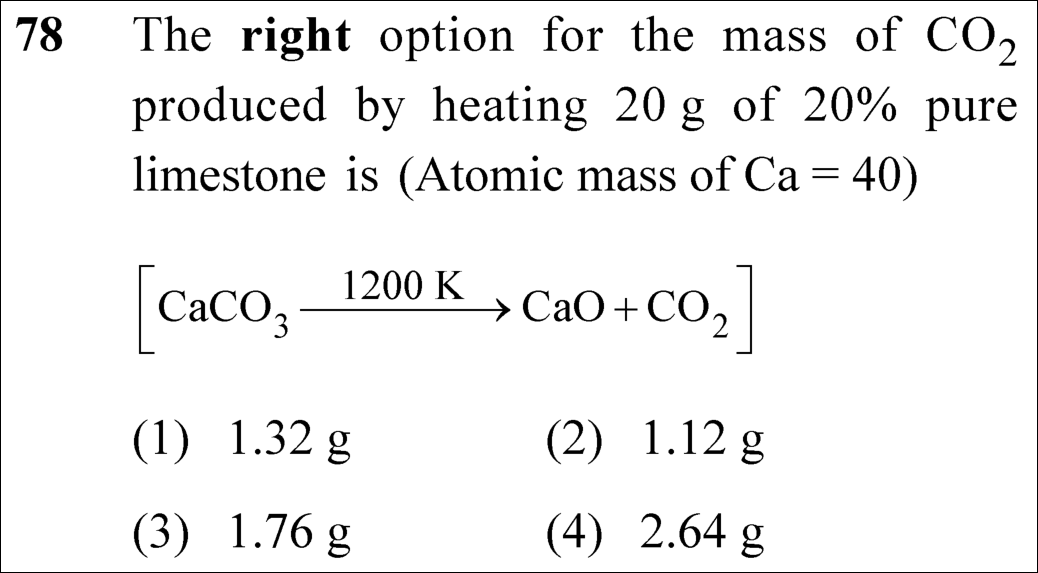
NEET 2023 · Q78 Medium
Official NEET 2023 Question 78 - Some Basic Concepts of Chemistry
1
2
3 ✓ Key
4
💡 Verified Solution & 30-Second Hack
✓
Verified Against NTA Final Answer Key
Option (3) : 1.76 g
📚 Some Basic Concepts of Chemistry Medium
📋 Given Parameters & Problem Setup
Sample mass of limestone 20 g
Purity of CaCO₃ 20%
Thermal condition 1200 K
Atomic mass of Ca 40 u
⚡

The 30-Second Exam Hall Shortcut: ⚡ Pure Mass to Mole Direct Ratio: 4 g CaCO₃ → 1.76 g CO₂

⏱️ Save ~40 seconds

Limestone is only 20% pure: Pure CaCO₃ = 20 × 0.20 = 4 g. Since M(CaCO₃) = 100 g/mol, moles = 4/100 = 0.04 mol. Each mole of CaCO₃ yields 1 mole of CO₂ (44 g). Mass of CO₂ = 0.04 × 44 = 1.76 g in 15 seconds!

1 Calculate mass of pure CaCO₃: 20 g × 20% = 4 g.
2 Moles of pure CaCO₃: 4 / 100 = 0.04 mol.
3 Stoichiometry: 1 mol CaCO₃ ⟶ 1 mol CO₂ ⟹ 0.04 mol CO₂ produced.
4 Mass of CO₂: 0.04 mol × 44 g/mol = 1.76 g.
5 Match Option (3) immediately.
🛡️
Why You Can 100% Trust This Shortcut: Law of Conservation of Mass & Stoichiometric Mole Ratios in NCERT Chemistry.
📐

Step-by-Step Rigorous Workflow & Mathematical Proof

Step 1

Determine the Mass of Pure Calcium Carbonate

The limestone sample has a total mass of 20 g and is 20% pure. Only pure CaCO₃ decomposes according to the stoichiometry of the reaction:

Mass of pure CaCO3=20 g×20100=4 g\text{Mass of pure } \text{CaCO}_3 = 20\text{ g} \times \frac{20}{100} = 4\text{ g}
Step 2

Calculate Moles of Pure CaCO₃

Compute the molar mass of CaCO₃ and determine moles present in 4 g:

M(CaCO3)=40+12+3(16)=100 g mol−1  ⟹  n(CaCO3)=4 g100 g mol−1=0.04 molM(\text{CaCO}_3) = 40 + 12 + 3(16) = 100\text{ g mol}^{-1} \implies n(\text{CaCO}_3) = \frac{4\text{ g}}{100\text{ g mol}^{-1}} = 0.04\text{ mol}
Step 3

Apply Reaction Stoichiometry to Find Moles of CO₂

The balanced chemical equation for the thermal decomposition of limestone at 1200 K is:

CaCO3(s)→1200 KCaO(s)+CO2(g)  ⟹  n(CO2)=n(CaCO3)=0.04 mol\text{CaCO}_3(s) \xrightarrow{1200\text{ K}} \text{CaO}(s) + \text{CO}_2(g) \implies n(\text{CO}_2) = n(\text{CaCO}_3) = 0.04\text{ mol}
Step 4

Compute the Mass of Evolved CO₂ Gas

Multiply the moles of CO₂ by its molar mass (M = 12 + 2 × 16 = 44 g/mol):

m(CO2)=0.04 mol×44 g mol−1=1.76 gm(\text{CO}_2) = 0.04\text{ mol} \times 44\text{ g mol}^{-1} = 1.76\text{ g}
⭐

360° Option Elimination Engine Key Feature

Diagnose every choice: Know exactly why the right option works and why distractors fail.

4-Option Deep Scan
1 (1)
✗ Incorrect
Verdict & Scientific Reason:

Corresponds to 0.03 mol CO₂ (15% purity assumption).

⚠️
Student Fallacy (Why candidates pick this trap): Candidate miscalculated the percentage purity as 15% instead of 20%.
2 (2)
✗ Incorrect
Verdict & Scientific Reason:

Corresponds to confusing gas volume at STP (1.12 L) with mass in grams.

⚠️
Student Fallacy (Why candidates pick this trap): Candidate confused the volume of gas at STP with mass in grams.
3 (3)
✓ 100% Correct
Verdict & Scientific Reason:

Accurate: 0.04 mol of pure CaCO₃ thermally decomposes to yield 0.04 mol of CO₂ (0.04 × 44 = 1.76 g).

💡
Why this is airtight: None. Candidate executed the sample purity calculation correctly.
4 (4)
✗ Incorrect
Verdict & Scientific Reason:

Corresponds to 0.06 mol of CO₂ (30% purity assumption).

⚠️
Student Fallacy (Why candidates pick this trap): Candidate committed an arithmetic error in multiplying moles by molar mass.
⚠️

NTA Trap Alert: Ignoring Purity Percentage

The most frequent blunder is ignoring the 20% purity specification and calculating CO₂ directly from 20 g of sample: 20/100 = 0.2 mol → 0.2 × 44 = 8.8 g. Always multiply sample mass by purity fraction first!

🛡️ How to avoid the -1 mark: Write: Pure reactant mass = Total sample mass × (Purity % / 100) before any mole conversions.
📖

Core NEET Syllabus Standard

National Eligibility cum Entrance Test (NEET UG) · Some Basic Concepts of Chemistry Standard Benchmark
Core Scientific Principle Tested:

"In chemical reactions, stoichiometric coefficients apply exclusively to the mass of pure reacting species."

Syllabus Focus: Stoichiometry and Percentage Purity
Preserved in Rationalized Curriculum Syllabus & Academic Standards ↗
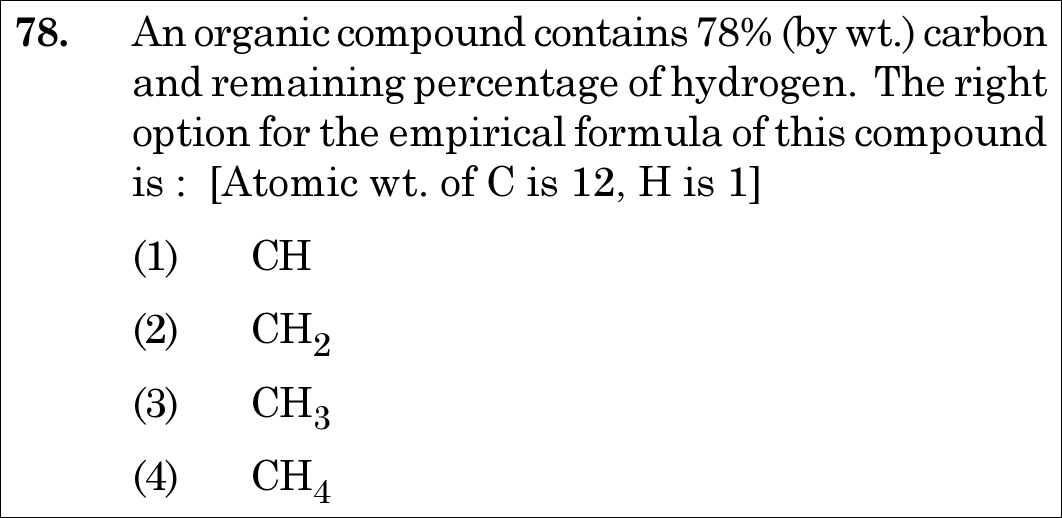
NEET 2021 · Q78 Easy
Official NEET 2021 Question 78 - Some Basic Concepts of Chemistry
1
2
3 ✓ Key
4
💡 Verified Solution & 30-Second Hack
✓
Verified Against NTA Final Answer Key
Option (3) : CH3
📚 Some Basic Concepts of Chemistry Easy
📋 Given Parameters & Problem Setup
Carbon % by Weight 78%
Hydrogen % by Weight 100 - 78 = 22%
Atomic Masses C = 12, H = 1
⚡

The 30-Second Exam Hall Shortcut: ⚡ Mole Ratio: 78/12 = 6.5 and 22/1 = 22   ⟹  \implies 22/6.5 ≈ 3.38   ⟹  \implies CH3

⏱️ Save ~20 seconds

Moles of C =78/12=6.5= 78 / 12 = 6.5. Moles of H =22/1=22= 22 / 1 = 22. Simplest molar ratio =226.5=3.38≈3= \frac{22}{6.5} = 3.38 \approx 3! Direct verification: in CH3CH_3, mass % of C is 1215×100=80%\frac{12}{15} \times 100 = 80\% (extremely close to 78%). In CH4CH_4, C is 75%75\%; in CH2CH_2, C is 85.7%85.7\%. Closest empirical formula is CH3CH_3! Match Option (3)!

1 Assume 100 g sample: Mass of C =78 g= 78\text{ g}, Mass of H =22 g= 22\text{ g}.
2 Calculate moles: nC=78/12=6.5 moln_{\text{C}} = 78 / 12 = 6.5\text{ mol}; nH=22/1=22 moln_{\text{H}} = 22 / 1 = 22\text{ mol}.
3 Divide by smallest mole value (6.5): - C: 6.5/6.5=1.06.5 / 6.5 = 1.0 - H: 22/6.5=3.38≈322 / 6.5 = 3.38 \approx 3.
4 The closest integer empirical formula in options is CH3CH_3.
5 Match Option (3).
🛡️
Why You Can 100% Trust This Shortcut: Canonical stoichiometry empirical formula algorithm and official NTA final key.
📐

Step-by-Step Rigorous Workflow & Mathematical Proof

Step 1

Determining Elemental Mass Percentages

For a 100 g sample of the hydrocarbon: - Mass of Carbon: wC=78 gw_{\text{C}} = 78\text{ g} - Mass of Hydrogen: wH=100−78=22 gw_{\text{H}} = 100 - 78 = 22\text{ g}

Step 2

Calculating Relative Number of Moles

Divide the mass of each element by its respective atomic mass (C=12 g/mol,H=1 g/molC = 12\text{ g/mol}, H = 1\text{ g/mol}):

nC=7812=6.5 mol,nH=221=22.0 moln_{\text{C}} = \frac{78}{12} = 6.5\text{ mol}, \quad n_{\text{H}} = \frac{22}{1} = 22.0\text{ mol}
Step 3

Determining the Simplest Atomic Ratio

Divide by the smaller number of moles (6.56.5): - Atomic ratio of C: 6.56.5=1\frac{6.5}{6.5} = 1 - Atomic ratio of H: 22.06.5=3.38≈3\frac{22.0}{6.5} = 3.38 \approx 3 Comparing theoretical percentages of options: - CHCH: %C=12/13×100=92.3%\%C = 12/13 \times 100 = 92.3\% - CH2CH_2: %C=12/14×100=85.7%\%C = 12/14 \times 100 = 85.7\% - CH3CH_3: %C=12/15×100=80.0%\%C = 12/15 \times 100 = 80.0\% (closest to 78%78\%) - CH4CH_4: %C=12/16×100=75.0%\%C = 12/16 \times 100 = 75.0\%

Empirical Formula: CH3\mathbf{\text{Empirical Formula: } CH_3}
⭐

360° Option Elimination Engine Key Feature

Diagnose every choice: Know exactly why the right option works and why distractors fail.

4-Option Deep Scan
1 1
✗ Incorrect
Verdict & Scientific Reason:

Corresponds to 92.3%C92.3\% C and 7.7%H7.7\% H (ethyne/benzene), far from 78%78\%.

⚠️
Student Fallacy (Why candidates pick this trap): Assuming 1:1 ratio.
2 2
✗ Incorrect
Verdict & Scientific Reason:

Corresponds to 85.7%C85.7\% C and 14.3%H14.3\% H (alkenes).

⚠️
Student Fallacy (Why candidates pick this trap): Assuming 1:2 ratio.
3 3
✓ 100% Correct
Verdict & Scientific Reason:

Matches the experimental ratio C:H≈1:3C:H \approx 1:3, with theoretical 80%C80\% C (closest to 78%78\%).

💡
Why this is airtight: None; official NTA designated answer.
4 4
✗ Incorrect
Verdict & Scientific Reason:

Corresponds to 75%C75\% C and 25%H25\% H (methane).

⚠️
Student Fallacy (Why candidates pick this trap): Assuming 1:4 ratio.
⚠️

NTA Trap Alert: Non-Integer Ratio Approximation Trap

The ratio 22/6.5=3.3822 / 6.5 = 3.38 is non-integer. Some students multiply by 3 to get C3H10C_3H_{10}, but the prompt provides simple multiple choices (CH,CH2,CH3,CH4CH, CH_2, CH_3, CH_4). Checking the mass percentage confirms CH3CH_3 (80%C80\% C) is the closest empirical formula.

🛡️ How to avoid the -1 mark: Check percentages of choices: CH3=80%C,20%HCH_3 = 80\% C, 20\% H, closest to 78%C,22%H78\% C, 22\% H.
📖

Core NEET Syllabus Standard

NCERT Chemistry · Some Basic Concepts of Chemistry Standard Benchmark
Core Scientific Principle Tested:

"An empirical formula represents the simplest whole-number ratio of various atoms present in a compound based on percent composition."

Syllabus Focus: Empirical and Molecular Formulae
✓ Core NEET UG Syllabus Anchor Syllabus & Academic Standards ↗
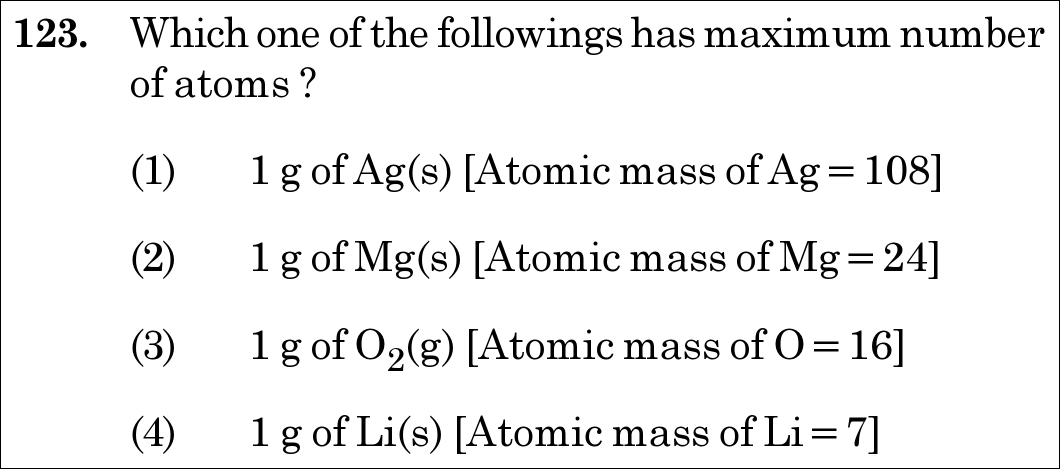
NEET 2020 · Q123 Easy
Official NEET 2020 Question 123 - Some Basic Concepts of Chemistry
1
2
3
4 ✓ Key
💡 Verified Solution & 30-Second Hack
✓
Verified Against NTA Final Answer Key
Option (4) : 1 g of Li(s) [Atomic mass of Li=7]
📚 Some Basic Concepts of Chemistry Easy
📋 Given Parameters & Problem Setup
Sample Mass 1 g for all four options
Option 1 1 g Ag (Atomic mass = 108)
Option 2 1 g Mg (Atomic mass = 24)
Option 3 1 g O2 (Molar mass = 32, 2 atoms/molecule)
Option 4 1 g Li (Atomic mass = 7)
⚡

The 30-Second Exam Hall Shortcut: ⚡ "Number of Atoms = (Mass / Molar Mass) × Atomicity × NA: Smallest Molar Mass Gives MAXIMUM Atoms!"

⏱️ 20 seconds

For a fixed mass of 1 g, the number of atoms is inversely proportional to the atomic mass. Comparing atoms: 1 g Li has NA/7≈0.143NAN_A/7 \approx 0.143 N_A atoms. 1 g O2 has (1/32)×2NA=NA/16≈0.0625NA(1/32) \times 2 N_A = N_A/16 \approx 0.0625 N_A atoms. 1 g Mg has NA/24≈0.042NAN_A/24 \approx 0.042 N_A. 1 g Ag has NA/108≈0.009NAN_A/108 \approx 0.009 N_A. Lithium has the smallest atomic mass (7), yielding the MAXIMUM number of atoms! Mark Option (4) in 5 seconds.

1 Formula: Number of atoms = (Mass / Atomic mass) × NA.
2 For Ag (s): 1/108 × NA = 0.0092 NA.
3 For Mg (s): 1/24 × NA = 0.0417 NA.
4 For O2 (g): (1/32) × 2 × NA = 1/16 × NA = 0.0625 NA.
5 For Li (s): 1/7 × NA = 0.1428 NA.
6 0.1428 NA is the largest value. Select Option (4) 1 g of Li.
🛡️
Why You Can 100% Trust This Shortcut: NCERT Chemistry · Some Basic Concepts of Chemistry (Mole Concept and Avogadro Constant)
📐

Step-by-Step Rigorous Workflow & Mathematical Proof

Step 1

Formula for Calculating Total Atoms

For any substance of mass mm: Number of moles of molecules/atoms n=mM\text{Number of moles of molecules/atoms } n = \frac{m}{M} Total number of atoms=n×Atomicity×NA=(mM)×Atomicity×NA\text{Total number of atoms} = n \times \text{Atomicity} \times N_A = \left(\frac{m}{M}\right) \times \text{Atomicity} \times N_A

Step 2

Calculate Atoms in 1 g of Each Candidate

1. For 1 g of Ag (s)1\text{ g of Ag (s)} (Atomic mass=108 g mol−1\text{Atomic mass} = 108\text{ g mol}^{-1}, atomicity = 1): Atoms=1108NA≈0.00926NA\text{Atoms} = \frac{1}{108} N_A \approx 0.00926 N_A 2. For 1 g of Mg (s)1\text{ g of Mg (s)} (Atomic mass=24 g mol−1\text{Atomic mass} = 24\text{ g mol}^{-1}, atomicity = 1): Atoms=124NA≈0.04167NA\text{Atoms} = \frac{1}{24} N_A \approx 0.04167 N_A 3. For 1 g of O2 (g)1\text{ g of } \text{O}_2\text{ (g)} (Molar mass=32 g mol−1\text{Molar mass} = 32\text{ g mol}^{-1}, atomicity = 2): Atoms=(132)×2×NA=116NA≈0.06250NA\text{Atoms} = \left(\frac{1}{32}\right) \times 2 \times N_A = \frac{1}{16} N_A \approx 0.06250 N_A 4. For 1 g of Li (s)1\text{ g of Li (s)} (Atomic mass=7 g mol−1\text{Atomic mass} = 7\text{ g mol}^{-1}, atomicity = 1): Atoms=17NA≈0.14286NA\text{Atoms} = \frac{1}{7} N_A \approx 0.14286 N_A

Step 3

Compare the Calculated Values

0.14286NA>0.06250NA>0.04167NA>0.00926NA0.14286 N_A > 0.06250 N_A > 0.04167 N_A > 0.00926 N_A Clearly, 1 g of lithium possesses more than double the number of atoms compared to 1 g of oxygen gas, and over 15 times that of silver.

Step 4

Conclude 1 g of Li

Option (4) contains the maximum number of atoms.

⭐

360° Option Elimination Engine Key Feature

Diagnose every choice: Know exactly why the right option works and why distractors fail.

4-Option Deep Scan
1 A
✗ Incorrect
Verdict & Scientific Reason:

Incorrect; has the largest atomic mass (108), yielding the least number of atoms (NA/108N_A/108).

⚠️
Student Fallacy (Why candidates pick this trap): Confusing heavy atoms with large number of atoms.
2 B
✗ Incorrect
Verdict & Scientific Reason:

Incorrect; NA/24N_A/24 is much less than NA/7N_A/7.

⚠️
Student Fallacy (Why candidates pick this trap): Overlooking lighter elements.
3 C
✗ Incorrect
Verdict & Scientific Reason:

Incorrect; total atoms is NA/16N_A/16, which is less than half that of lithium (NA/7N_A/7).

⚠️
Student Fallacy (Why candidates pick this trap): Multiplying by 2 and forgetting to divide by molar mass 32, thinking it has 2/16 = 1/8 NA.
4 D
✓ 100% Correct
Verdict & Scientific Reason:

Factually and mathematically exact; with the smallest atomic mass (7), 1 g of Li yields the maximum number of atoms (NA/7N_A/7).

💡
Why this is airtight: None; classic mole concept comparison.
⚠️

NTA Trap Alert: Heavy Mass vs Atom Count Inverse Relation

Lighter elements contain MORE atoms per gram! 1 gram of light atoms contains many more individual particles than 1 gram of heavy atoms.

🛡️ How to avoid the -1 mark: Smallest atomic mass per atom = MAXIMUM number of atoms!
📖

Core NEET Syllabus Standard

Chemistry · Some Basic Concepts of Chemistry Standard Benchmark
Core Scientific Principle Tested:

""

Syllabus Focus: Number of Atoms Comparison: Maximum Number of Atoms in 1 g Samples
✓ Core NEET UG Syllabus Anchor Syllabus & Academic Standards ↗

Solve 4 NEET Questions a Day — One per Subject

Cover all 1,140 official NEET questions in 285 days at your own pace. Progress is saved on your device. No login needed.