MyCompetitiveExams Logo MyCompetitiveExams
Search 1,140+ Questions
Chapters, formulas, speed tricks
→
⚡ Brahmastra NEET 2027
720 MARKS

Dynamic 180-question full-length simulator mixed dynamically from all 6 years for 2027 & 2026 aspirants.

Launch Brahmastra 2027 Test →
Start Practice →
100% Free · No Login Required
Q.78 Chemistry ⭐ 360° Option Elimination Active
Vault ↗

NEET 2023 Chemistry Question 78 Solution

Topic: Some Basic Concepts of Chemistry · Official NTA Booklet Code G5
NEET 2023 Chemistry Question 78: Stoichiometry of Limestone Decomposition and Percentage Purity

Question

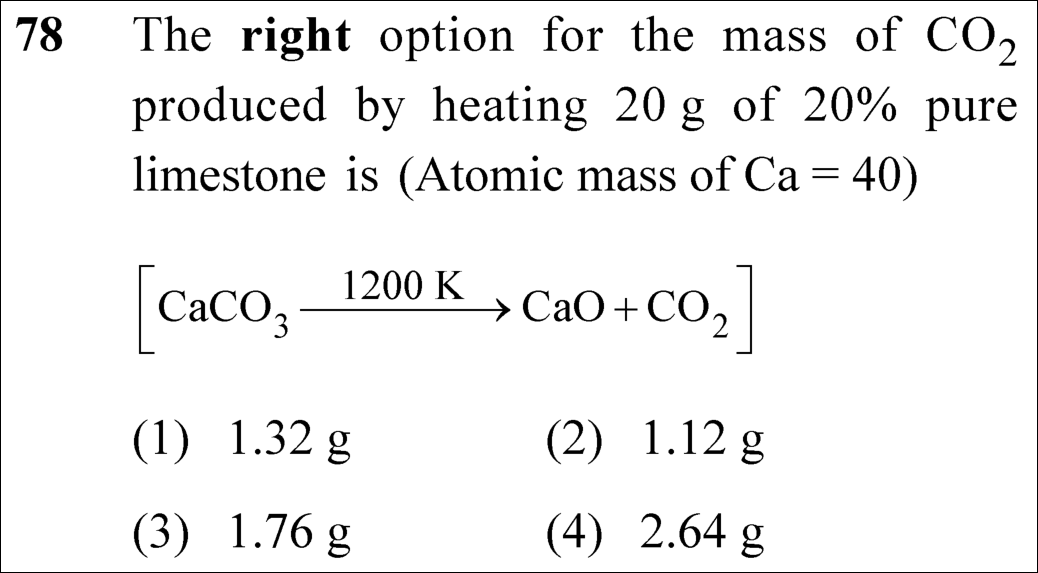
The right option for the mass of CO₂ produced by heating 20 g of 20% pure limestone is (Atomic mass of Ca = 40) [CaCO₃ → (1200 K) CaO + CO₂]

✓
Verified Against NTA Final Answer Key
Option (3) : 1.76 g
📚 Some Basic Concepts of Chemistry Medium
📋 Given Parameters & Problem Setup
Sample mass of limestone 20 g
Purity of CaCO₃ 20%
Thermal condition 1200 K
Atomic mass of Ca 40 u
⚡

The 30-Second Exam Hall Shortcut: ⚡ Pure Mass to Mole Direct Ratio: 4 g CaCO₃ → 1.76 g CO₂

⏱️ Save ~40 seconds

Limestone is only 20% pure: Pure CaCO₃ = 20 × 0.20 = 4 g. Since M(CaCO₃) = 100 g/mol, moles = 4/100 = 0.04 mol. Each mole of CaCO₃ yields 1 mole of CO₂ (44 g). Mass of CO₂ = 0.04 × 44 = 1.76 g in 15 seconds!

1 Calculate mass of pure CaCO₃: 20 g × 20% = 4 g.
2 Moles of pure CaCO₃: 4 / 100 = 0.04 mol.
3 Stoichiometry: 1 mol CaCO₃ ⟶ 1 mol CO₂ ⟹ 0.04 mol CO₂ produced.
4 Mass of CO₂: 0.04 mol × 44 g/mol = 1.76 g.
5 Match Option (3) immediately.
🛡️
Why You Can 100% Trust This Shortcut: Law of Conservation of Mass & Stoichiometric Mole Ratios in NCERT Chemistry.
📐

Step-by-Step Rigorous Workflow & Mathematical Proof

Step 1

Determine the Mass of Pure Calcium Carbonate

The limestone sample has a total mass of 20 g and is 20% pure. Only pure CaCO₃ decomposes according to the stoichiometry of the reaction:

Mass of pure CaCO3=20 g×20100=4 g\text{Mass of pure } \text{CaCO}_3 = 20\text{ g} \times \frac{20}{100} = 4\text{ g}
Step 2

Calculate Moles of Pure CaCO₃

Compute the molar mass of CaCO₃ and determine moles present in 4 g:

M(CaCO3)=40+12+3(16)=100 g mol−1  ⟹  n(CaCO3)=4 g100 g mol−1=0.04 molM(\text{CaCO}_3) = 40 + 12 + 3(16) = 100\text{ g mol}^{-1} \implies n(\text{CaCO}_3) = \frac{4\text{ g}}{100\text{ g mol}^{-1}} = 0.04\text{ mol}
Step 3

Apply Reaction Stoichiometry to Find Moles of CO₂

The balanced chemical equation for the thermal decomposition of limestone at 1200 K is:

CaCO3(s)→1200 KCaO(s)+CO2(g)  ⟹  n(CO2)=n(CaCO3)=0.04 mol\text{CaCO}_3(s) \xrightarrow{1200\text{ K}} \text{CaO}(s) + \text{CO}_2(g) \implies n(\text{CO}_2) = n(\text{CaCO}_3) = 0.04\text{ mol}
Step 4

Compute the Mass of Evolved CO₂ Gas

Multiply the moles of CO₂ by its molar mass (M = 12 + 2 × 16 = 44 g/mol):

m(CO2)=0.04 mol×44 g mol−1=1.76 gm(\text{CO}_2) = 0.04\text{ mol} \times 44\text{ g mol}^{-1} = 1.76\text{ g}
⭐

360° Option Elimination Engine Key Feature

Diagnose every choice: Know exactly why the right option works and why distractors fail.

4-Option Deep Scan
1 (1)
✗ Incorrect
Verdict & Scientific Reason:

Corresponds to 0.03 mol CO₂ (15% purity assumption).

⚠️
Student Fallacy (Why candidates pick this trap): Candidate miscalculated the percentage purity as 15% instead of 20%.
2 (2)
✗ Incorrect
Verdict & Scientific Reason:

Corresponds to confusing gas volume at STP (1.12 L) with mass in grams.

⚠️
Student Fallacy (Why candidates pick this trap): Candidate confused the volume of gas at STP with mass in grams.
3 (3)
✓ 100% Correct
Verdict & Scientific Reason:

Accurate: 0.04 mol of pure CaCO₃ thermally decomposes to yield 0.04 mol of CO₂ (0.04 × 44 = 1.76 g).

💡
Why this is airtight: None. Candidate executed the sample purity calculation correctly.
4 (4)
✗ Incorrect
Verdict & Scientific Reason:

Corresponds to 0.06 mol of CO₂ (30% purity assumption).

⚠️
Student Fallacy (Why candidates pick this trap): Candidate committed an arithmetic error in multiplying moles by molar mass.
⚠️

NTA Trap Alert: Ignoring Purity Percentage

The most frequent blunder is ignoring the 20% purity specification and calculating CO₂ directly from 20 g of sample: 20/100 = 0.2 mol → 0.2 × 44 = 8.8 g. Always multiply sample mass by purity fraction first!

🛡️ How to avoid the -1 mark: Write: Pure reactant mass = Total sample mass × (Purity % / 100) before any mole conversions.
📖

Core NEET Syllabus Standard

National Eligibility cum Entrance Test (NEET UG) · Some Basic Concepts of Chemistry Standard Benchmark
Core Scientific Principle Tested:

"In chemical reactions, stoichiometric coefficients apply exclusively to the mass of pure reacting species."

Syllabus Focus: Stoichiometry and Percentage Purity
Preserved in Rationalized Curriculum Syllabus & Academic Standards ↗

Ready to attempt under real exam pressure?

Test your speed and accuracy in the authentic 200-minute timed NTA simulator.

Launch NEET 2023 CBT Test →

Spotted a mistake in this solution? Report an error ([email protected])

⚖️ Legal & Fair Dealing Notice: Sourced from publicly released NEET 2023 question papers and NEET answer keys for private study, research, and non-commercial educational practice under Fair Dealing (Section 52(1)(a) of the Indian Copyright Act, 1957). Not affiliated with or endorsed by NTA or NMC.

Solve 4 NEET Questions a Day — One per Subject

Cover all 1,140 official NEET questions in 285 days at your own pace. Progress is saved on your device. No login needed.