MyCompetitiveExams Logo MyCompetitiveExams
Search 1,140+ Questions
Chapters, formulas, speed tricks
→
⚡ Brahmastra NEET 2027
720 MARKS

Dynamic 180-question full-length simulator mixed dynamically from all 6 years for 2027 & 2026 aspirants.

Launch Brahmastra 2027 Test →
Start Practice →
100% Free · No Login Required
Q.77 Chemistry ⭐ 360° Option Elimination Active
Vault ↗

NEET 2023 Chemistry Question 77 Solution

Topic: Equilibrium · Official NTA Booklet Code G5
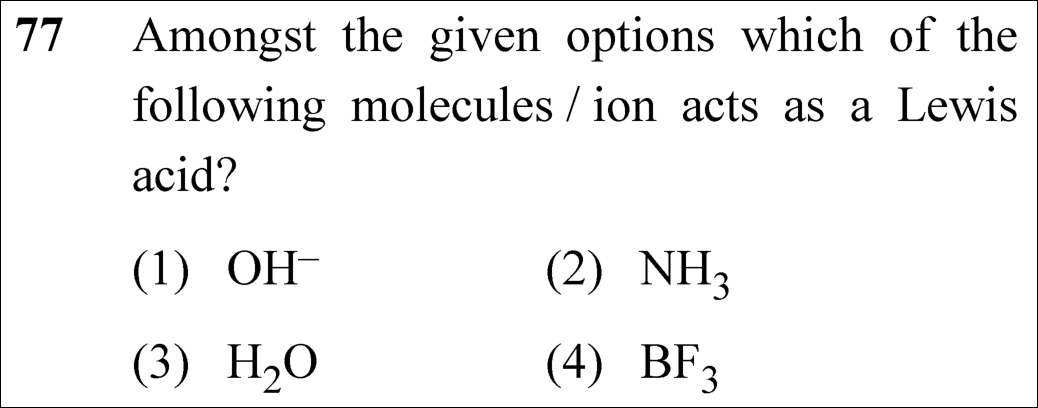
NEET 2023 Chemistry Question 77: Lewis Acid-Base Theory and Incomplete Octet Electron Acceptors (BF₃)

Question

Amongst the given options which of the following molecules /ion acts as a Lewis acid?

✓
Verified Against NTA Final Answer Key
Option (4) : BF₃
📚 Equilibrium Easy
📋 Given Parameters & Problem Setup
Species evaluated OH⁻, NH₃, H₂O, BF₃
Criterion Acts as a Lewis acid (electron pair acceptor)
⚡

The 30-Second Exam Hall Shortcut: ⚡ Electron Pair Acceptor Scan: Incomplete Octet Boron

⏱️ Save ~25 seconds

OH⁻, NH₃, and H₂O all possess unshared lone pairs and act as Lewis bases! In BF₃, boron has only 6 valence electrons (vacant 2p orbital) and greedily accepts an electron pair ⟹ BF₃ is a Lewis acid in 5 seconds!

1 Recall Lewis definitions:
2 - Lewis Acid: Electron-pair ACCEPTOR (must have vacant orbital or incomplete octet).
3 - Lewis Base: Electron-pair DONOR (must have available unshared lone pair).
4 Evaluate the choices:
5 - OH⁻: Has negative charge and 3 lone pairs on oxygen ⟶ Lewis base / nucleophile.
6 - NH₃: Nitrogen has an unshared lone pair (:NH₃) ⟶ Lewis base.
7 - H₂O: Oxygen has two unshared lone pairs (H₂Ö:) ⟶ Lewis base.
8 - BF₃: Boron has 3 valence electrons, forming 3 B–F single bonds (total 6 electrons). It has an incomplete octet and an empty 2p orbital capable of accepting an electron pair ⟶ LEWIS ACID.
9 Lock Option (4) BF₃ immediately!
🛡️
Why You Can 100% Trust This Shortcut: Chemical Equilibrium · Lewis Acid-Base Concepts (Electron deficient molecules in which the central atom has an incomplete octet, such as BF₃ and AlCl₃, act as Lewis acids).
📐

Step-by-Step Rigorous Workflow & Mathematical Proof

Step 1

The Lewis Concept of Acids and Bases

According to G.N. Lewis (1923), an acid is defined as an electron-pair acceptor, and a base is defined as an electron-pair donor. A coordinate covalent (dative) bond is formed when a Lewis base donates its electron pair into a vacant orbital of a Lewis acid:

A (Lewis Acid: vacant orbital)+:B (Lewis Base: lone pair)⟶A←B (Adduct)\text{A (Lewis Acid: vacant orbital)} + :\text{B (Lewis Base: lone pair)} \longrightarrow \text{A}\leftarrow\text{B (Adduct)}
Step 2

Electronic Structure of Boron Trifluoride (BF₃)

Boron (Z = 5) has ground-state configuration 1s² 2s² 2p¹. In BF₃, boron undergoes sp² hybridization, forming three B–F σ-bonds. The central boron atom is surrounded by only 6 valence electrons, leaving one unhybridized 2p_z orbital completely empty:

Valence electrons around B in BF3=3×2=6 e−(Incomplete octet, vacant 2pz orbital)\text{Valence electrons around B in BF}_3 = 3 \times 2 = 6\ e^- \quad (\text{Incomplete octet, vacant } 2p_z \text{ orbital})
Step 3

Confirmation of Lewis Acidic Behavior

Because boron possesses an empty 2p orbital, BF₃ readily accepts an electron pair from Lewis bases (such as NH₃ or F⁻) to complete its stable octet (8 e⁻):

BF3+:NH3⟶F3B←NH3\text{BF}_3 + :\text{NH}_3 \longrightarrow \text{F}_3\text{B}\leftarrow\text{NH}_3
Step 4

Analysis of Distractors (Lewis Bases)

All other three species possess available lone pairs of electrons and act as electron-pair donors (Lewis bases):

OH−:Three lone pairs on oxygen, negatively charged donor (Lewis Base):NH3:One lone pair on nitrogen (Lewis Base)H2O::Two lone pairs on oxygen (Lewis Base)\begin{aligned} \text{OH}^- &: \text{Three lone pairs on oxygen, negatively charged donor } (\text{Lewis Base}) \\[4pt] :\text{NH}_3 &: \text{One lone pair on nitrogen } (\text{Lewis Base}) \\[4pt] \text{H}_2\text{O}: &: \text{Two lone pairs on oxygen } (\text{Lewis Base}) \end{aligned}
⭐

360° Option Elimination Engine Key Feature

Diagnose every choice: Know exactly why the right option works and why distractors fail.

4-Option Deep Scan
1 (1)
✗ Incorrect
Verdict & Scientific Reason:

Hydroxide ion is a strong Lewis base (electron pair donor).

⚠️
Student Fallacy (Why candidates pick this trap): Candidate confused Bronsted-Lowry base with Lewis acid.
2 (2)
✗ Incorrect
Verdict & Scientific Reason:

Ammonia has a lone pair on nitrogen and acts as a classic Lewis base.

⚠️
Student Fallacy (Why candidates pick this trap): Candidate forgot the lone pair on nitrogen.
3 (3)
✗ Incorrect
Verdict & Scientific Reason:

Water has two lone pairs on oxygen and acts as a Lewis base.

⚠️
Student Fallacy (Why candidates pick this trap): Candidate thought neutral amphoteric water is a Lewis acid.
4 (4)
✓ 100% Correct
Verdict & Scientific Reason:

Accurate: BF₃ is electron-deficient (6 valence electrons) with a vacant 2p orbital that accepts an electron pair.

💡
Why this is airtight: None. Candidate correctly identified the incomplete octet.
⚠️

NTA Trap Alert: Confusing Arrhenius/Bronsted Acidity with Lewis Acidity

Arrhenius and Bronsted acids must contain hydrogen (protons, H⁺). Lewis acids do NOT need hydrogen! BF₃ has no hydrogen at all, but is one of the strongest and most classic Lewis acids because of its empty 2p orbital.

🛡️ How to avoid the -1 mark: Lewis Acid = Electron pair ACCEPTOR. Look for incomplete octets (BF₃, AlCl₃, BCl₃) or cations.
📖

Core NEET Syllabus Standard

National Eligibility cum Entrance Test (NEET UG) · Equilibrium Standard Benchmark
Core Scientific Principle Tested:

"Species that can accept a pair of electrons are Lewis acids (e.g., BF₃, AlCl₃, Co³⁺)."

Syllabus Focus: Acids, Bases and Salts – Lewis Concept
Preserved in Rationalized Curriculum Syllabus & Academic Standards ↗

Ready to attempt under real exam pressure?

Test your speed and accuracy in the authentic 200-minute timed NTA simulator.

Launch NEET 2023 CBT Test →

Spotted a mistake in this solution? Report an error ([email protected])

⚖️ Legal & Fair Dealing Notice: Sourced from publicly released NEET 2023 question papers and NEET answer keys for private study, research, and non-commercial educational practice under Fair Dealing (Section 52(1)(a) of the Indian Copyright Act, 1957). Not affiliated with or endorsed by NTA or NMC.

Solve 4 NEET Questions a Day — One per Subject

Cover all 1,140 official NEET questions in 285 days at your own pace. Progress is saved on your device. No login needed.