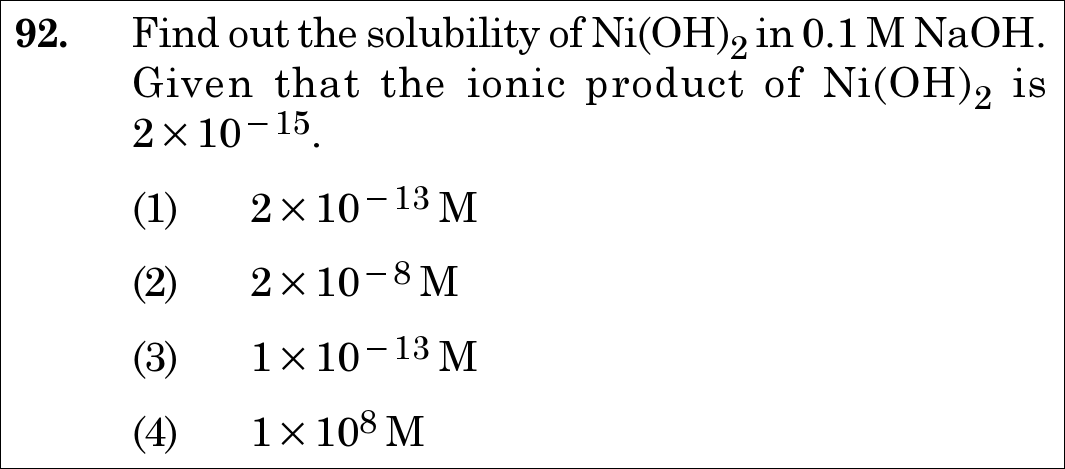
The 30-Second Exam Hall Shortcut: ⚡ Molar Solubility Cube-Root vs Square-Root Diagnostic
Do NOT compare Ksp values directly for different salt stoichiometries!
Step-by-Step Rigorous Workflow & Mathematical Proof
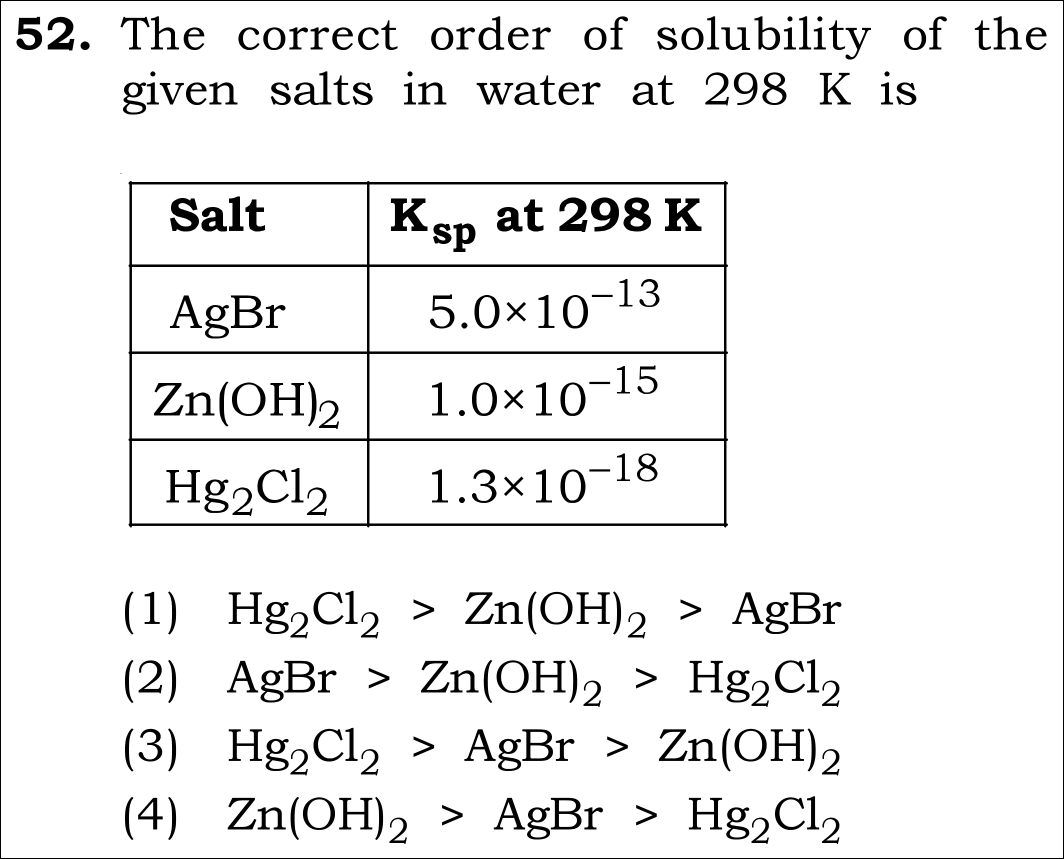
Calculate Molar Solubility of AgBr (AB-type electrolyte)
Silver bromide dissociates into one silver cation and one bromide anion.
- • S₁ = sqrt(5.0 × 10⁻¹³) = sqrt(50 × 10⁻¹⁴) ≈ 7.07 × 10⁻⁷ mol L⁻¹.
Calculate Molar Solubility of Zn(OH)₂ (AB₂-type electrolyte)
Zinc hydroxide dissociates into one Zn²⁺ cation and two OH⁻ anions.
- • S₂³ = K_sp / 4 = (1.0 × 10⁻¹⁵) / 4 = 2.5 × 10⁻¹⁶ = 250 × 10⁻¹⁸.
- • S₂ = (250)^(1/3) × 10⁻⁶ ≈ 6.30 × 10⁻⁶ mol L⁻¹.
Calculate Molar Solubility of Hg₂Cl₂ (Calomel, [Hg₂]Cl₂ electrolyte)
Mercurous chloride contains the dimeric mercurous ion Hg₂²⁺ and two chloride ions Cl⁻.
- • S₃³ = K_sp / 4 = (1.3 × 10⁻¹⁸) / 4 = 0.325 × 10⁻¹⁸.
- • S₃ = (0.325)^(1/3) × 10⁻⁶ ≈ 0.687 × 10⁻⁶ mol L⁻¹ = 6.87 × 10⁻⁷ mol L⁻¹.
Compare the Molar Solubilities
Arranging the three solubilities: S[Zn(OH)₂] = 63.0 × 10⁻⁷ M S[AgBr] = 7.07 × 10⁻⁷ M S[Hg₂Cl₂] = 6.87 × 10⁻⁷ M Therefore: Zn(OH)₂ > AgBr > Hg₂Cl₂.
- • Matches Option (4).
360° Option Elimination Engine Key Feature
Diagnose every choice: Know exactly why the right option works and why distractors fail.
Incorrect. Hg₂Cl₂ has the lowest solubility among the three.
Incorrect. Students pick this if they directly compare Ksp exponents (10⁻¹³ > 10⁻¹⁵), which is invalid for different stoichiometries.
Incorrect. Reverses the true solubility order.
Exact mathematical result derived from stoichiometric equilibrium relations.
NTA Trap Alert: Directly Comparing Ksp Values Without Stoichiometry
The number one trap in ionic equilibrium: comparing K_sp values of salts with different formulas (AB vs AB₂). A salt with a smaller K_sp can have a much LARGER solubility if it dissociates into more ions.
Core NEET Syllabus Standard
"Solubility S must be calculated via K_sp = x^x y^y S^(x+y) for salt A_x B_y."