MyCompetitiveExams Logo MyCompetitiveExams
Search 1,140+ Questions
Chapters, formulas, speed tricks
→
⚡ Brahmastra NEET 2027
720 MARKS

Dynamic 180-question full-length simulator mixed dynamically from all 6 years for 2027 & 2026 aspirants.

Launch Brahmastra 2027 Test →
Start Practice →
100% Free · No Login Required
Q.79 Chemistry · Section A ⭐ 360° Option Elimination Active
Vault ↗

NEET 2024 Chemistry Question 79 Solution

Topic: Equilibrium · Official NTA Booklet Code T1
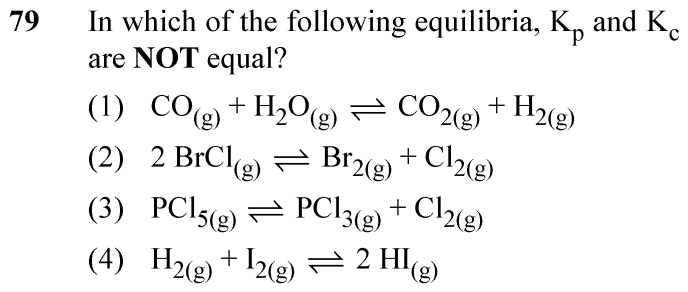
NEET 2024 Chemistry Question 79: Relationship Between Kp and Kc (Δng Condition)

Question

In which of the following equilibria, Kp and Kc are NOT equal?

✓
Verified Against NTA Final Answer Key
Option (3) : PCl5(g) ⇌ PCl3(g) + Cl2(g)
📚 Equilibrium Easy
📋 Given Parameters & Problem Setup
Core relationship K_p = K_c (RT)^Δn_g
Target condition Equilibria in which K_p and K_c are NOT equal (Δn_g ≠ 0)
⚡

The 30-Second Exam Hall Shortcut: ⚡ Δng ≠ 0 Instant Filter

⏱️ Save ~35 seconds

K_p = K_c when Δn_g = 0. In PCl5(g) ⇌ PCl3(g) + Cl2(g), Δn_g = (1 + 1) - 1 = +1 ≠ 0 -> K_p ≠ K_c!

1 Formula: K_p = K_c · (RT)^Δn_g, where Δn_g = (moles of gaseous products) - (moles of gaseous reactants).
2 K_p equals K_c ONLY when Δn_g = 0.
3 Check Option (1): CO(g) + H2O(g) ⇌ CO2(g) + H2(g) -> Δn_g = 2 - 2 = 0 (K_p = K_c).
4 Check Option (2): 2 BrCl(g) ⇌ Br2(g) + Cl2(g) -> Δn_g = 2 - 2 = 0 (K_p = K_c).
5 Check Option (3): PCl5(g) ⇌ PCl3(g) + Cl2(g) -> Δn_g = (1 + 1) - 1 = +1 ≠ 0 (K_p ≠ K_c).
6 Check Option (4): H2(g) + I2(g) ⇌ 2 HI(g) -> Δn_g = 2 - 2 = 0 (K_p = K_c).
7 Option (3) is the only equilibrium where K_p ≠ K_c in 5 seconds!
🛡️
Why You Can 100% Trust This Shortcut: NCERT Chemistry · Equilibrium (Relationship between equilibrium constant in terms of partial pressure Kp and molar concentration Kc).
📐

Step-by-Step Rigorous Workflow & Mathematical Proof

Step 1

Thermodynamic Derivation of Kp = Kc(RT)^Δng

For a general gas-phase equilibrium aA + bB ⇌ cC + dD, partial pressures relate to molar concentrations by the ideal gas law: p_i = [i]RT. Substituting this into the Kp expression yields:

Kp=Kc(RT)Δng,where Δng=(c+d)−(a+b)K_p = K_c(RT)^{\Delta n_g}, \quad \text{where } \Delta n_g = (c + d) - (a + b)
Step 2

Condition for Equality of Kp and Kc

For Kp to equal Kc identically (independent of temperature): (RT)^Δng = 1 ⟹ Δng = 0. Thus, Kp = Kc if and only if the total stoichiometric sum of gaseous product coefficients equals that of the gaseous reactants.

Kp=Kc  ⟺  Δng=0K_p = K_c \iff \Delta n_g = 0
Step 3

Evaluation of Δng for Each Given Equilibrium

Calculating Δng for all four reactions: 1. CO(g) + H2O(g) ⇌ CO2(g) + H2(g): Δng = (1 + 1) - (1 + 1) = 0 ⟹ Kp = Kc. 2. 2 BrCl(g) ⇌ Br2(g) + Cl2(g): Δng = (1 + 1) - 2 = 0 ⟹ Kp = Kc. 3. PCl5(g) ⇌ PCl3(g) + Cl2(g): Δng = (1 + 1) - 1 = +1 ⟹ Kp = Kc(RT) ≠ Kc! 4. H2(g) + I2(g) ⇌ 2 HI(g): Δng = 2 - (1 + 1) = 0 ⟹ Kp = Kc.

Δng(PCl5)=2−1=+1  ⟹  Kp=Kc(RT)≠Kc\Delta n_g(\text{PCl}_5) = 2 - 1 = +1 \implies K_p = K_c(RT) \neq K_c
⭐

360° Option Elimination Engine Key Feature

Diagnose every choice: Know exactly why the right option works and why distractors fail.

4-Option Deep Scan
1 (1)
✗ Incorrect
Verdict & Scientific Reason:

Δng = 0, so Kp = Kc.

⚠️
Student Fallacy (Why candidates pick this trap): Miscounting gaseous moles.
2 (2)
✗ Incorrect
Verdict & Scientific Reason:

Δng = 0, so Kp = Kc.

⚠️
Student Fallacy (Why candidates pick this trap): Forgetting coefficient of 2 for BrCl.
3 (3)
✓ 100% Correct
Verdict & Scientific Reason:

Δng = +1 ≠ 0, making Kp and Kc strictly unequal.

💡
Why this is airtight: None.
4 (4)
✗ Incorrect
Verdict & Scientific Reason:

Δng = 0, so Kp = Kc.

⚠️
Student Fallacy (Why candidates pick this trap): Thinking HI formation involves pressure change.
⚠️

NTA Trap Alert: Missing the Word "NOT"

The question asks where Kp and Kc are NOT equal. Three options have Kp = Kc, and only Option (3) has Kp ≠ Kc.

🛡️ How to avoid the -1 mark: Highlight the negative constraint "NOT equal" and immediately look for Δng ≠ 0.
📖

Core NEET Syllabus Standard

Chemistry Core Physical Chemistry · Equilibrium Standard Benchmark
Core Scientific Principle Tested:

"Kp equals Kc only when Δng = 0; when Δng ≠ 0 (as in PCl5 decomposition where Δng = +1), Kp ≠ Kc."

Syllabus Focus: Relationship Between Kp and Kc
✓ Core NEET UG Syllabus Anchor Syllabus & Academic Standards ↗
When gas moles on left and right agree, Kp equals Kc easily! When moles expand (1 to 2), Kp and Kc part ways anew!

Ready to attempt under real exam pressure?

Test your speed and accuracy in the authentic 200-minute timed NTA simulator.

Launch NEET 2024 CBT Test →

Spotted a mistake in this solution? Report an error ([email protected])

⚖️ Legal & Fair Dealing Notice: Sourced from publicly released NEET 2024 question papers and NEET answer keys for private study, research, and non-commercial educational practice under Fair Dealing (Section 52(1)(a) of the Indian Copyright Act, 1957). Not affiliated with or endorsed by NTA or NMC.

Solve 4 NEET Questions a Day — One per Subject

Cover all 1,140 official NEET questions in 285 days at your own pace. Progress is saved on your device. No login needed.